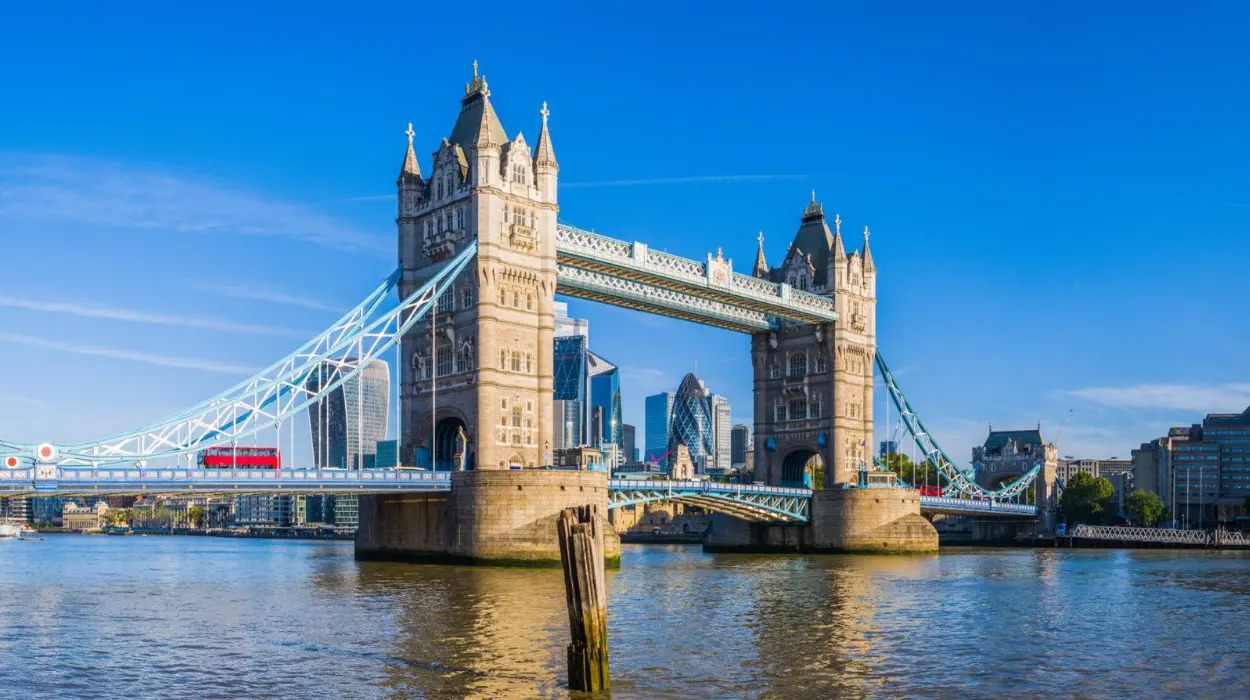
Tower Bridge was built to solve severe transport congestion in East London during the nineteenth century. The bridge created a permanent Thames crossing while preserving access for commercial ships entering the busy Pool of London, which remained central to Britain’s global trade network.
- Who designed Tower Bridge and how was the final plan approved?
- How was Tower Bridge constructed between 1886 and 1894?
- How does Tower Bridge’s bascule mechanism operate?
- Why does Tower Bridge look medieval despite being Victorian?
- What impact did Tower Bridge have on London’s development?
- How has Tower Bridge been preserved in the modern era?
- Why does Tower Bridge remain one of London’s most recognized landmarks?
During the nineteenth century, London expanded into the world’s largest commercial city. The eastern districts around the River Thames handled enormous quantities of imported goods, including tea, coal, sugar, timber, and textiles. Existing crossings failed to support the increasing movement of workers, merchants, livestock, and horse-drawn carts.
The nearest major crossing was London Bridge. By the 1870s, congestion reached critical levels. Parliamentary committees investigated solutions capable of improving movement across the Thames without disrupting river navigation.
The Thames remained one of Europe’s busiest commercial waterways. Tall-masted vessels required uninterrupted access to upstream docks. A conventional fixed bridge blocked shipping lanes, while tunnel proposals created engineering and financial complications.
In 1876, the City of London Corporation established the Special Bridge or Subway Committee. More than 50 proposals were examined. Engineers and architects submitted ideas, including ferry systems, lifting bridges, and underground crossings.
The final solution combined a bascule bridge with elevated pedestrian walkways. The chosen site stood beside the Tower of London, allowing direct road access between northern and southern commercial districts.
Tower Bridge became more than infrastructure. The bridge symbolized Victorian engineering strength, imperial trade power, and London’s transformation into a modern industrial capital. To experience this historic landmark in person today, consult our comprehensive [Insert Anchor Text for Things to Do Article Here] for itineraries and visiting parameters.
Who designed Tower Bridge and how was the final plan approved?
Tower Bridge was designed by architect Sir Horace Jones and engineer Sir John Wolfe Barry. Their plan united Gothic Revival architecture with advanced hydraulic engineering, satisfying parliamentary demands for efficient road transport, river navigation access, and architectural harmony with nearby historic landmarks.
Sir Horace Jones created the original architectural vision. He proposed twin towers linked by high-level walkways and movable bascules. Jones wanted the structure to complement the medieval appearance of the nearby Tower of London.
Sir John Wolfe Barry refined the engineering systems and structural mechanics. Barry specialized in major infrastructure projects and transformed the architectural concept into a practical bridge capable of handling heavy traffic and river operations.
The bridge adopted Gothic Revival styling because Victorian planners believed industrial infrastructure should visually respect historic surroundings. Decorative stone towers concealed a powerful steel skeleton beneath the surface.
Parliament formally approved the project through the Tower Bridge Act of 1885. The legislation authorized construction funding, engineering oversight, and navigation regulations for river traffic.
The final design balanced utility and symbolism. The bridge solved London’s transport crisis while reinforcing Britain’s civic identity during the height of the Victorian Empire.
How was Tower Bridge constructed between 1886 and 1894?
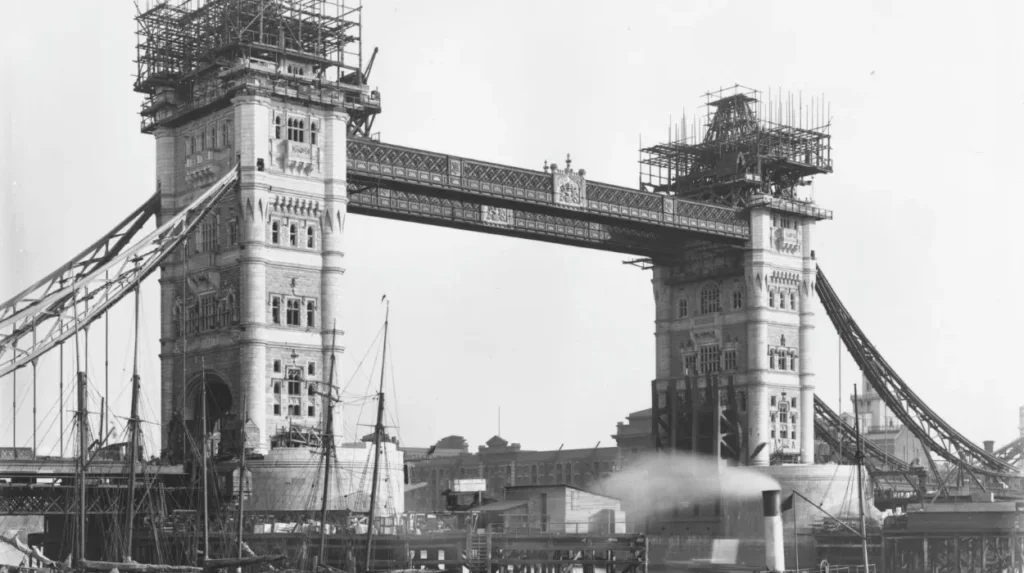
Tower Bridge was constructed using deep river foundations, steel-framed towers, hydraulic machinery, and Gothic stone cladding. More than 400 workers participated in the project, which required advanced Victorian engineering methods and continuous management of active Thames shipping traffic.
Construction began officially on 21 June 1886. The Prince of Wales, later Edward VII, attended the foundation ceremony.
Engineers first excavated massive foundations beneath the Thames using compressed-air caissons. These watertight chambers allowed workers to dig below river level safely. The foundations extended more than 25 feet into the riverbed.
The project consumed approximately 70,000 tons of concrete and over 11,000 tons of steel. Steel formed the bridge’s structural framework, while Cornish granite and Portland stone covered the exterior surfaces.
The bridge’s central bascules each weighed more than 1,000 tons. Counterweight systems reduced the mechanical force required to raise the roadway sections for passing ships.
Steam-powered hydraulic engines operated the lifting mechanisms. Coal-fired boilers generated hydraulic pressure stored inside accumulators. The system allowed rapid and reliable bridge openings.
Construction conditions remained dangerous. Workers handled underwater excavation, heavy steel assembly, and industrial machinery under limited Victorian safety standards. Several laborers died during construction accidents.
Tower Bridge officially opened on 30 June 1894. Edward VII and Alexandra of Denmark participated in the inauguration ceremony.
How does Tower Bridge’s bascule mechanism operate?
Tower Bridge operates through a bascule lifting system originally powered by steam hydraulics and later modernized with electric hydraulic systems. Balanced roadway sections rise independently, allowing ships to pass while preserving structural efficiency and rapid operational movement across the Thames.
The word “bascule” comes from the French term for “see-saw.” Each roadway section pivots upward around a central axis while enormous counterweights maintain balance below the surface.
The original system used steam engines connected to hydraulic pumps. Water pressure accumulated inside large hydraulic storage systems before powering the lifting machinery.
The bascules opened in roughly one minute. This rapid movement minimized delays for both ships and road traffic. The mechanism represented one of the most advanced hydraulic engineering systems of the Victorian era.
In 1976, engineers converted the bridge from steam hydraulics to electro-hydraulic technology. Electric motors replaced coal-fired steam systems, improving reliability and reducing maintenance demands.
Today, the bridge continues opening for authorized river traffic including naval vessels, cruise ships, ceremonial boats, and tall ships.
Visitors can view preserved machinery inside the Tower Bridge Exhibition, where Victorian engines and hydraulic systems remain on display.
Why does Tower Bridge look medieval despite being Victorian?
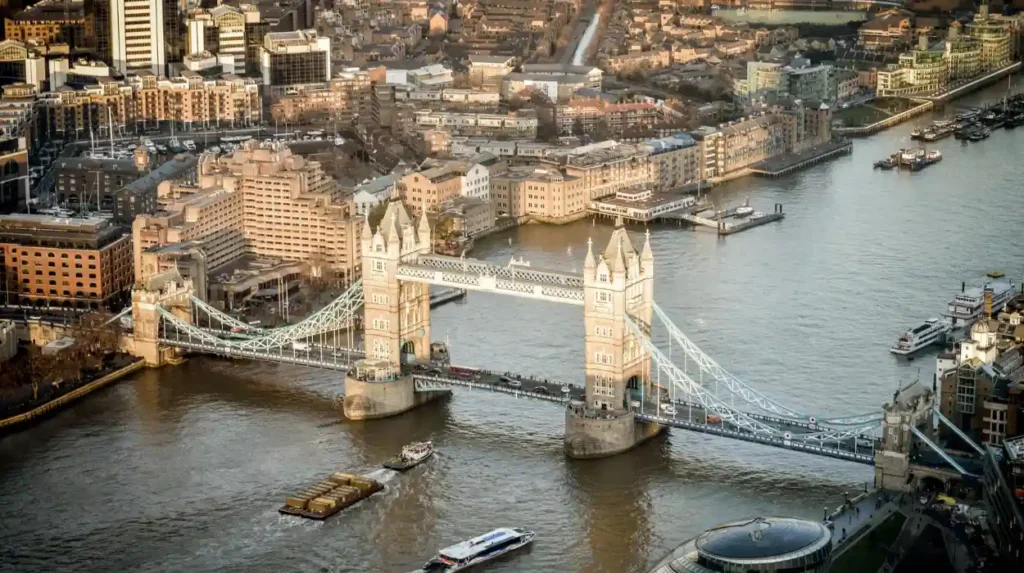
Tower Bridge appears medieval because Victorian architects intentionally used Gothic Revival architecture to match the nearby Tower of London. Decorative stone towers conceal a modern steel structure, blending medieval symbolism with nineteenth-century industrial engineering technology and civic design principles.
Victorian Britain experienced a major Gothic Revival movement. Architects used medieval forms for public buildings, churches, railway stations, and civic infrastructure.
Sir Horace Jones believed a purely industrial bridge would clash with the historic environment surrounding the Tower of London. The final design therefore included pointed arches, decorative battlements, and stone towers inspired by medieval fortifications.
Despite its historic appearance, Tower Bridge relied on advanced industrial engineering. Steel provided the structural strength, while granite and stone served decorative and protective purposes.
The bridge’s visual identity evolved over time. In 1977, the structure received red, white, and blue paint to celebrate the Silver Jubilee of Elizabeth II. Later restoration projects introduced the modern blue-and-white color scheme recognized today.
Tower Bridge remains one of the clearest examples of Victorian architectural philosophy, combining historical symbolism with technological progress.
What impact did Tower Bridge have on London’s development?
Tower Bridge transformed East London by improving transportation efficiency, supporting dockland commerce, and strengthening connections between industrial districts. The bridge also became an international symbol of London’s engineering achievement, urban modernization, and imperial-era economic expansion.
The bridge improved movement between commercial districts north and south of the Thames. Workers, traders, and industrial transport systems gained faster and more reliable access across the river.
The surrounding docklands formed part of Britain’s imperial trading economy. Warehouses and shipping firms relied heavily on uninterrupted movement of cargo and labor.
Tower Bridge also encouraged urban growth in districts including Southwark and Bermondsey. Industrial development and residential construction expanded rapidly after the bridge opened.
During the Second World War, the bridge remained strategically important for transportation and emergency movement during the Blitz bombing campaign.
As commercial shipping shifted downstream during the twentieth century, Tower Bridge evolved into a major tourism and heritage destination. Millions of visitors now travel to the bridge annually.
The structure functions simultaneously as transport infrastructure, museum space, engineering landmark, and international cultural symbol.
How has Tower Bridge been preserved in the modern era?
Tower Bridge has been preserved through heritage protection laws, engineering restoration programs, museum development, and structural modernization. Conservation projects protect its Victorian machinery, steel framework, and architectural appearance while allowing the bridge to remain operational within modern London.
Tower Bridge received Grade I listed status in 1973. This classification protects buildings of exceptional architectural and historical importance within the United Kingdom.
The City of London Corporation oversees bridge maintenance and conservation management. Engineers regularly inspect structural steel, hydraulic systems, stonework, and roadway components.
The Tower Bridge Exhibition opened in 1982, allowing public access to the elevated walkways and preserved Victorian engine rooms.
In 2014, conservation teams introduced glass floors within the upper walkways. Visitors can now observe traffic and river activity directly beneath their feet while exploring the historic structure.
Modern restoration projects address pollution damage, corrosion, traffic wear, and environmental stress. Conservation specialists balance historical authenticity with operational safety requirements.
Tower Bridge remains fully operational more than 130 years after opening. This continued practical use distinguishes the structure from many preserved historical monuments that no longer perform their original function.
Why does Tower Bridge remain one of London’s most recognized landmarks?
Tower Bridge remains globally recognized because it combines engineering innovation, historical symbolism, architectural identity, and cultural visibility. The bridge represents Victorian London’s industrial achievements while continuing to function as an active transport crossing and internationally celebrated heritage monument.
Tower Bridge stands at the center of one of London’s most historic districts. The structure connects the commercial history of the River Thames with the medieval legacy of the Tower of London.
The bridge represents several major historical themes simultaneously, including industrialization, maritime trade expansion, Gothic Revival architecture, and Victorian civic ambition.
Its instantly recognizable silhouette appears in films, documentaries, tourism campaigns, educational resources, and international media coverage focused on Britain.
Unlike many historic monuments, Tower Bridge continues serving its original transport purpose. Vehicles still cross daily, while river vessels continue requesting bridge openings.
Educational institutions use Tower Bridge to teach engineering, architecture, urban planning, and industrial history. Historians and conservation experts also study the structure as a leading example of adaptive heritage preservation.
Today, Tower Bridge remains both a working bridge and a monumental historical document. Its steel framework, hydraulic machinery, Gothic towers, and river setting preserve the story of how Victorian London became a modern global city.
What is Tower Bridge?
Tower Bridge is a Victorian bascule and suspension bridge crossing the River Thames in central London. It remains one of Britain’s most recognizable landmarks.