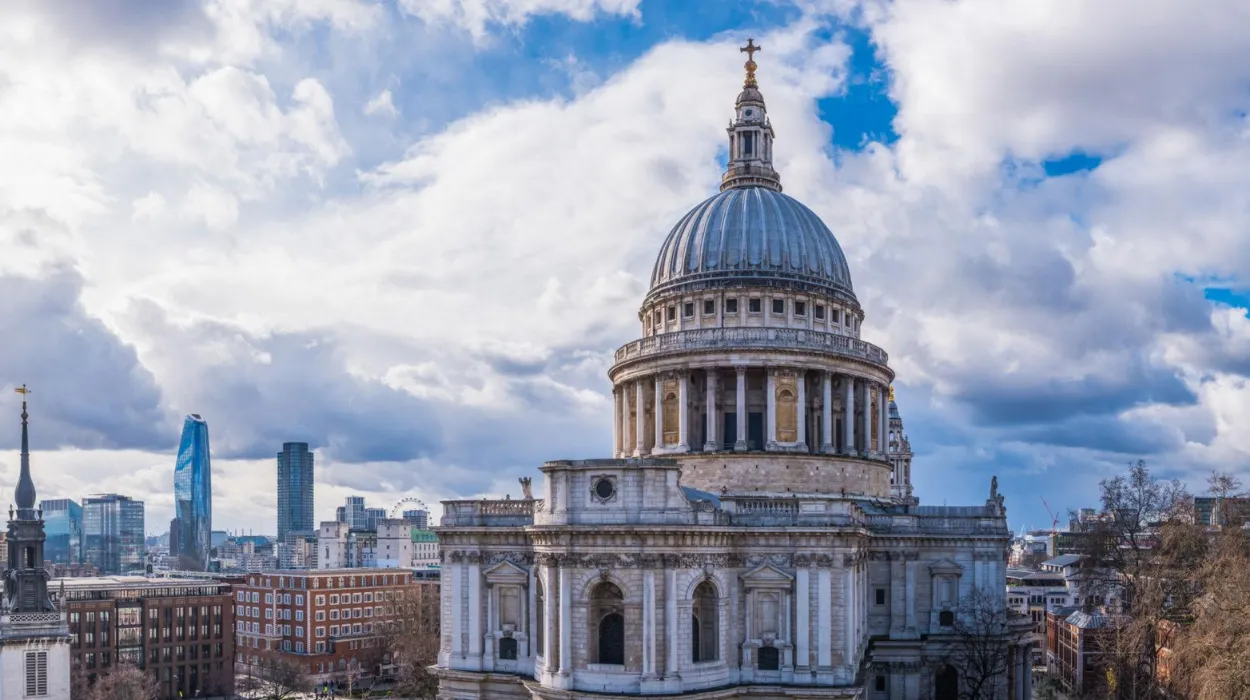
London’s skyline has been defined for more than three centuries by the magnificent presence of St Paul’s Cathedral. Rising above the City of London, the cathedral represents one of the most important religious, architectural, and historical landmarks in the United Kingdom. Visitors come to admire its iconic dome, explore its vast crypt, and understand its role in British national life.
- Why is St Paul’s Cathedral one of London’s most important historic landmarks?
- What makes the dome of St Paul’s Cathedral architecturally significant?
- What can visitors see inside the cathedral itself?
- What is the significance of the crypt beneath St Paul’s Cathedral?
- How did St Paul’s Cathedral survive war, disaster, and urban change?
- What tours are available at St Paul’s Cathedral?
- How does St Paul’s Cathedral contribute to modern London today?
- Why does St Paul’s Cathedral remain essential for understanding London’s history?
Designed by Sir Christopher Wren after the destruction of the medieval cathedral during the Great Fire of London, St Paul’s Cathedral remains both a functioning Anglican church and a major heritage attraction. Its architecture, memorials, artworks, and viewing galleries provide insight into more than 1,400 years of London’s religious and civic history.
Why is St Paul’s Cathedral one of London’s most important historic landmarks?
St Paul’s Cathedral is London’s principal Anglican cathedral, a masterpiece of Baroque architecture, and a symbol of national resilience. Its dome dominates the capital’s skyline, while its history connects major events including royal ceremonies, state funerals, wartime survival, and religious worship.
The site of St Paul’s has served as a place of Christian worship since approximately AD 604. Several churches occupied the location before the medieval cathedral was constructed. The medieval structure stood for centuries before being severely damaged and ultimately destroyed during the Great Fire of London in 1666.
The rebuilding project transformed both the site and London’s architectural identity. King Charles II commissioned Sir Christopher Wren to design a new cathedral suitable for a growing global city. Construction began in 1675 and continued until 1710.
The completed building became one of Europe’s greatest architectural achievements. Its design reflected influences from Renaissance architecture, particularly churches in Italy, while maintaining a distinct English character.
Throughout modern British history, the cathedral has hosted nationally significant occasions. Examples include the funeral of Horatio Nelson in 1806, the funeral of Arthur Wellesley, 1st Duke of Wellington in 1852, the wedding of Charles III and Diana, Princess of Wales in 1981, and services marking national milestones.
Its survival during the Second World War further strengthened its symbolic importance. Images of the cathedral standing amid smoke during the Blitz became enduring representations of British resilience.
What makes the dome of St Paul’s Cathedral architecturally significant?
The dome of St Paul’s Cathedral is one of the largest cathedral domes in the world and represents a major engineering achievement. Its innovative triple-shell structure combines visual grandeur, structural stability, and panoramic viewing platforms above London.
The cathedral’s dome reaches approximately 111 metres (365 feet) from the floor of the cathedral to the top of the cross. For centuries, it remained the tallest structure in London.
Wren developed a complex triple-shell system. This design includes an inner dome visible from the cathedral floor, a concealed brick cone that supports the lantern, and an external dome that creates the famous skyline profile.
The engineering solution allowed the structure to appear monumental while maintaining long-term stability. The dome’s design influenced architects across Britain and beyond.
Visitors can access three major viewing areas. The first is the Whispering Gallery, located approximately 30 metres above the cathedral floor. The gallery is famous for its unusual acoustic properties, allowing sounds to travel around the circular wall.
Above this level sits the Stone Gallery, which provides outdoor views across central London. The highest public viewing point is the Golden Gallery. From this position, visitors can observe numerous landmarks across the capital.
Visible locations include Tower Bridge, The Shard, Tower of London, and the Palace of Westminster.
The dome remains one of the most recognisable architectural features in Europe and continues to define London’s historic skyline.
What can visitors see inside the cathedral itself?
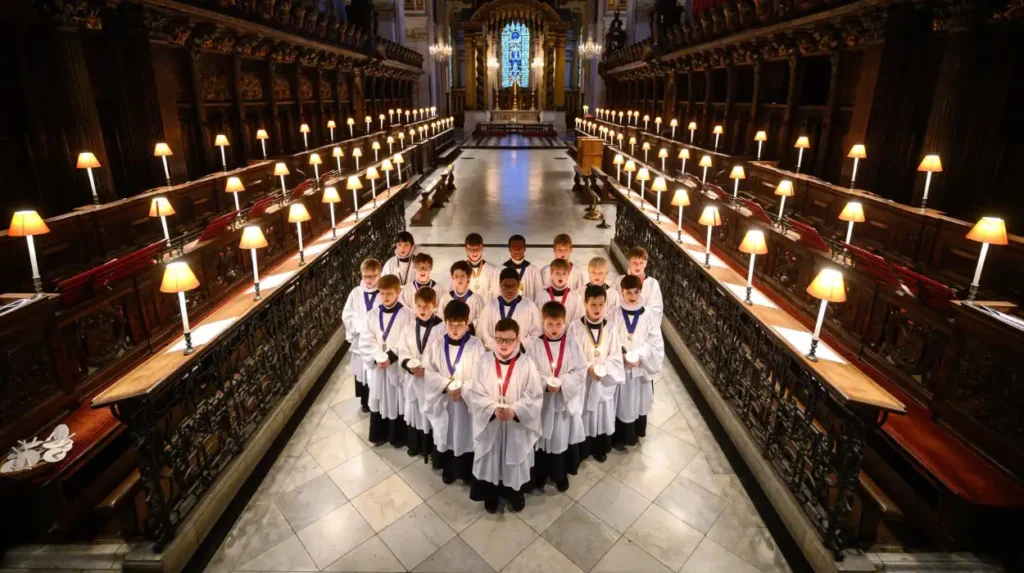
The cathedral interior contains monumental architecture, religious artworks, historic chapels, mosaics, sculptures, and ceremonial spaces. Every section reflects the religious, artistic, and political history of Britain from the late seventeenth century to the present day.
The cathedral’s interior extends approximately 158 metres in length. The immense scale creates a sense of grandeur intended by Wren to inspire worshippers and visitors alike.
One of the most significant spaces is the Nave. This central area welcomes visitors entering the building and leads toward the cathedral’s high altar.
The Quire contains intricately carved wooden stalls used by clergy and the cathedral choir. These carvings represent some of the finest examples of ecclesiastical craftsmanship in England.
The High Altar occupies a central position beneath the dome and remains an active focus of worship. The current design incorporates elements reconstructed after wartime damage.
Victorian mosaics cover portions of the interior with elaborate decorative schemes. These mosaics introduced rich colour and artistic detail during nineteenth-century restoration efforts.
The cathedral also contains numerous chapels. Examples include the American Memorial Chapel and St Dunstan’s Chapel. Each space commemorates different historical relationships and religious traditions.
Monuments and memorials throughout the building honour military leaders, scientists, artists, and national figures. These commemorations transform the cathedral into a record of British cultural history.
Visitors frequently spend considerable time examining inscriptions, sculptures, and artworks that document centuries of national achievement.
What is the significance of the crypt beneath St Paul’s Cathedral?
The crypt is one of Europe’s largest cathedral crypts and contains the tombs of nationally important figures. It preserves memorials, burial chambers, and historical exhibits that reveal Britain’s military, political, scientific, and cultural heritage.
The crypt extends beneath much of the cathedral and forms an essential component of the visitor experience.
Among its most famous burials is Admiral Horatio Nelson. Nelson commanded British naval forces during the Napoleonic Wars and achieved victory at the Battle of Trafalgar in 1805.
The crypt also contains the tomb of the Duke of Wellington. Wellington defeated Napoleon Bonaparte at the Battle of Waterloo in 1815 and later served as Prime Minister.
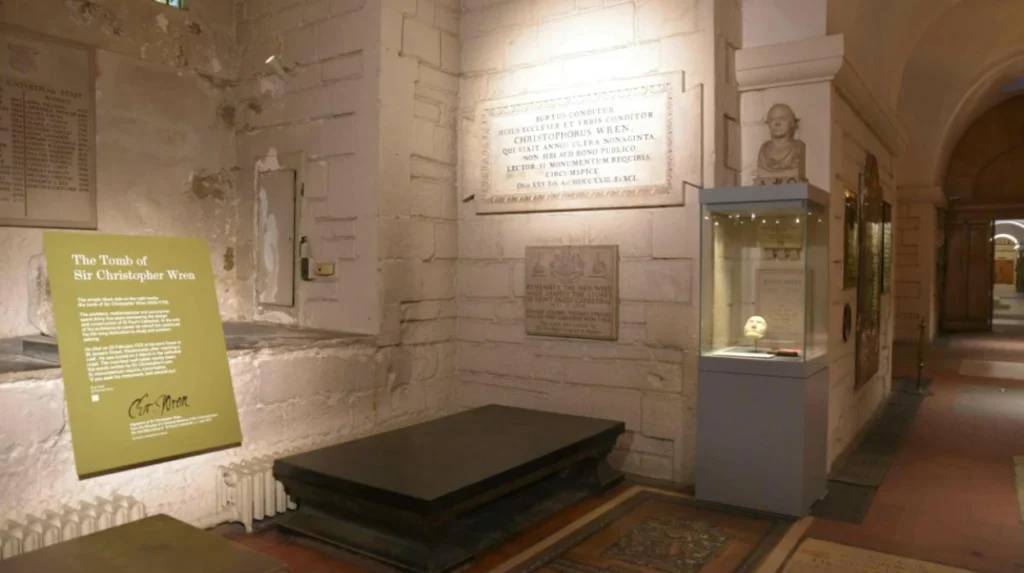
Perhaps the most significant burial is that of Sir Christopher Wren himself. His tomb bears a Latin inscription encouraging visitors to look around the cathedral if they seek his monument.
Additional memorials honour military personnel, artists, clergy, scientists, and public servants. Examples include commemorations dedicated to members of the armed forces and distinguished citizens from different eras.
Historical exhibitions within the crypt explain the cathedral’s construction, restoration projects, and role during major national events.
The crypt therefore functions not only as a burial place but also as a historical archive that connects visitors directly to influential figures in British history.
How did St Paul’s Cathedral survive war, disaster, and urban change?
St Paul’s Cathedral survived the Great Fire rebuilding era, wartime bombing, industrialisation, and modern urban development through continuous preservation efforts. Its endurance reflects both architectural strength and sustained national commitment to heritage conservation.
The cathedral’s existence is closely linked to London’s history of destruction and renewal.
After the Great Fire of London devastated the medieval cathedral in 1666, Wren’s rebuilding programme created a structure capable of enduring future challenges.
The most dramatic test came during the Second World War. German bombing campaigns targeted London extensively between 1940 and 1941.
Incendiary bombs fell around the cathedral on numerous occasions. Volunteer groups known as the St Paul’s Watch protected the building by extinguishing fires and removing unexploded devices.
The famous photograph known as “St Paul’s Survives” became a powerful wartime image. It showed the cathedral rising above smoke and destruction following a major air raid.
Post-war restoration addressed bomb damage while preserving original architectural features. Conservation specialists continue to maintain the stonework, mosaics, sculptures, and structural elements.
Modern planning regulations also protect important views of the cathedral. Strategic sightlines across London ensure that the dome remains visible from designated locations despite the growth of skyscrapers.
These preservation policies demonstrate how historic landmarks can coexist with contemporary urban development.
What tours are available at St Paul’s Cathedral?
St Paul’s Cathedral offers self-guided visits, multimedia experiences, educational programmes, and expert-led tours. These options help visitors understand the building’s architecture, religious significance, construction history, memorials, and role within London’s broader heritage landscape.
Guided tours provide detailed interpretation beyond what visitors can observe independently.
Expert guides explain the construction process that took place between 1675 and 1710. They also discuss architectural innovations introduced by Wren and his collaborators.
Educational tours serve schools, universities, and heritage groups. These programmes explore themes including architecture, religion, art history, engineering, and urban development.
Multimedia guides provide information for international visitors and support self-paced exploration.
Special tours occasionally focus on restricted areas, conservation projects, or historical themes. Examples include architectural tours and behind-the-scenes heritage experiences.
For researchers and educators, these tours offer valuable context about the cathedral’s role in shaping British religious and civic life.
To experience this historic landmark in person today, consult our comprehensive [St Paul’s Cathedral: The History of London’s Most Iconic Dome] for itineraries and visiting parameters.
The combination of educational interpretation and physical exploration helps visitors connect historical knowledge with the building itself.
How does St Paul’s Cathedral contribute to modern London today?
St Paul’s Cathedral remains an active place of worship, a leading heritage attraction, an educational resource, and a symbol of London. Its continuing role demonstrates how historic monuments can remain relevant within contemporary urban society.
The cathedral welcomes hundreds of thousands of visitors annually while continuing its religious mission.
Daily worship services maintain the building’s original purpose as a cathedral church of the Church of England.
Educational programmes support schools, universities, historians, and cultural organisations. Students examine architecture, religious history, urban development, and conservation techniques through the cathedral’s collections and spaces.
The cathedral also contributes significantly to cultural tourism. Visitors from around the world include historians, architects, educators, genealogists, and general travellers.
Researchers use archival materials to study London’s social and religious history. Genealogical researchers tracing family connections often encounter records associated with the cathedral and the wider City of London.
Conservation teams continue extensive maintenance projects. These initiatives preserve stone façades, interior artworks, mosaics, memorials, and structural elements for future generations.
The cathedral also remains a venue for major national services and commemorative events. This ongoing ceremonial role reinforces its status as one of Britain’s most important public buildings.
Why does St Paul’s Cathedral remain essential for understanding London’s history?
St Paul’s Cathedral encapsulates more than fourteen centuries of London’s religious, architectural, political, and cultural development. Its dome, crypt, memorials, and ceremonial functions provide a comprehensive record of the city’s transformation from an early Christian settlement into a global capital.
Few buildings illustrate London’s historical evolution as completely as St Paul’s Cathedral.
The site connects early medieval Christianity, the Great Fire of London, the architectural achievements of Sir Christopher Wren, the expansion of the British Empire, the resilience of the Second World War, and contemporary heritage preservation.
Its dome represents one of the greatest achievements in European architecture. Its interior preserves artistic and religious traditions spanning centuries. Its crypt records the lives of influential national figures whose actions shaped British history.
For visitors, the cathedral offers more than spectacular views across London. It provides direct access to the people, events, and ideas that shaped the city and the nation.
As a place of worship, a monument of architecture, a repository of historical memory, and a living cultural institution, St Paul’s Cathedral continues to occupy a central position in London’s identity. Its preservation ensures that future generations can understand the historical forces that transformed London into one of the world’s most influential cities.
When was St Paul’s Cathedral built?
The current St Paul’s Cathedral was constructed between 1675 and 1710 after the medieval cathedral was destroyed during the Great Fire of London in 1666. The project was designed by architect Sir Christopher Wren.