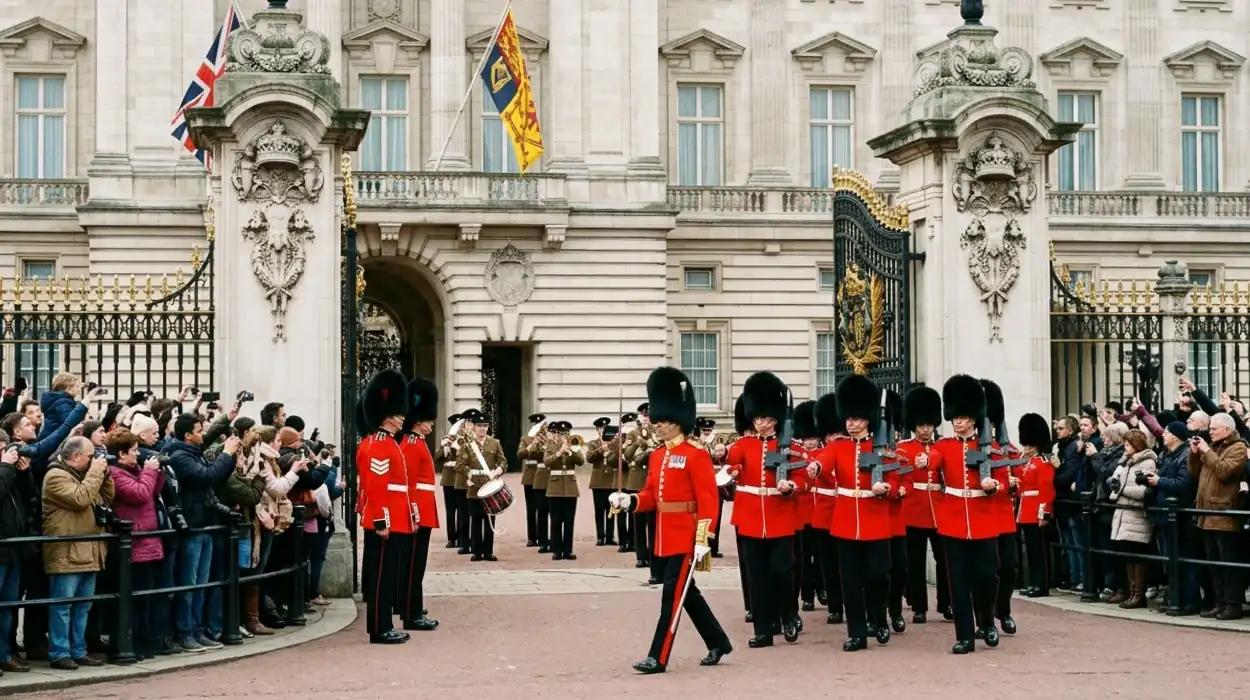
Extra London News delivers comprehensive guides to London’s iconic events. The Buckingham Palace Changing of the Guard ceremony features the handover of duties from the Old Guard to the New Guard, performed by units from the Household Division of the British Army.
- What is the Changing of the Guard at Buckingham Palace?
- When is the Changing of the Guard schedule at Buckingham Palace?
- Where are the best viewing spots for Changing of the Guard at Buckingham Palace?
- How early should you arrive for the best Changing of the Guard views?
- What happens during the Changing of the Guard ceremony step by step?
- Which regiments participate in the Buckingham Palace Changing of the Guard?
- Is the Changing of the Guard at Buckingham Palace free to watch?
- What is the history behind the Buckingham Palace Changing of the Guard?
- Are there accessibility considerations for Changing of the Guard viewers?
- How does weather impact the Changing of the Guard schedule?
What is the Changing of the Guard at Buckingham Palace?
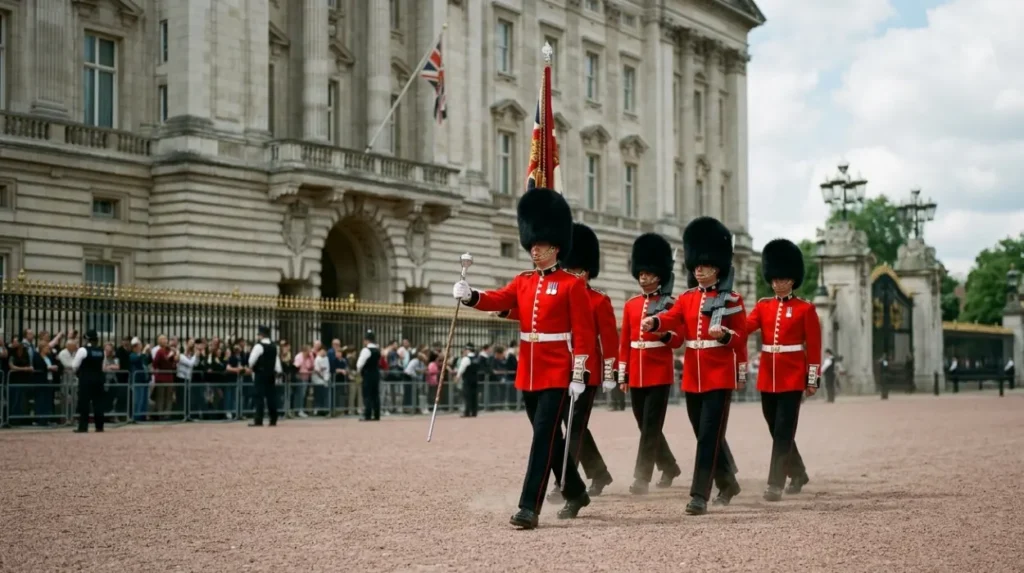
The Changing of the Guard at Buckingham Palace is a formal military ceremony where the New Guard replaces the Old Guard in protecting the monarch’s residence. It occurs daily during summer and select days otherwise, lasting 45 minutes, with guards marching from Wellington Barracks to the palace forecourt for inspection and handover.
Buckingham Palace serves as the official London residence of the British monarch. The ceremony dates to 1660, when King Charles II instituted daily guards following the Restoration. The Household Division, comprising five regiments—Grenadier Guards, Coldstream Guards, Scots Guards, Irish Guards, and Welsh Guards—executes the event.
The process begins at 10:57 AM when the New Guard departs Wellington Barracks in Birdcage Walk. They march via Spur Road, Constitution Hill, and The Mall to the palace forecourt. There, the Old Guard stands ready. The Captain of the Guard inspects both units. Sentries receive new orders, and responsibility transfers formally at 11:00 AM.
Key components include precision drill movements, regimental bands playing traditional tunes, and bearskin caps worn by guards. The full sequence covers 1.5 miles of marching. Weather cancels only extreme cases, like heavy snow. Annually, over 500 ceremonies occur, drawing 1 million visitors.
This tradition symbolizes royal protection continuity. It reinforces military discipline publicly. Tourists witness live the standards of the British Army.
When is the Changing of the Guard schedule at Buckingham Palace?
The Changing of the Guard at Buckingham Palace follows a schedule of Monday, Wednesday, Friday at 10:45 AM to 12:00 PM, plus Tuesday, Thursday, Saturday inspections at 3:00 PM, and Sunday parades at 9:55 AM. Confirm dates via Household Division announcements as they vary seasonally.
The ceremony aligns with guard shift rotations. Summer (May to July) features daily 11:00 AM events. Off-peak limits to three days weekly. February 2026 confirms select dates from British Army records.
St James’s Palace, Wellington Barracks, and Horse Guards Parade host related movements. The core palace handover starts at 11:00 AM, ending by 11:45 AM. Captain’s inspections occur afternoons on alternate days in the forecourt.
Variations stem from royal events or military duties. The Sunday Parade assembles at 9:55 AM on The Mall. Apps and websites like the Royal Collection Trust provide real-time confirmations. In 2025, 80% of scheduled events proceeded.
Planning requires checking 48 hours prior. This ensures alignment with travel.
Where are the best viewing spots for Changing of the Guard at Buckingham Palace?
Prime viewing spots include the Buckingham Palace gates, Victoria Memorial steps opposite, The Mall between Marlborough Road and the palace, and opposite St James’s Palace near Queen Alexandra’s statue. Arrive by 10:00 AM for front positions; St James’s offers uncrowded close-ups at 11:35 AM.
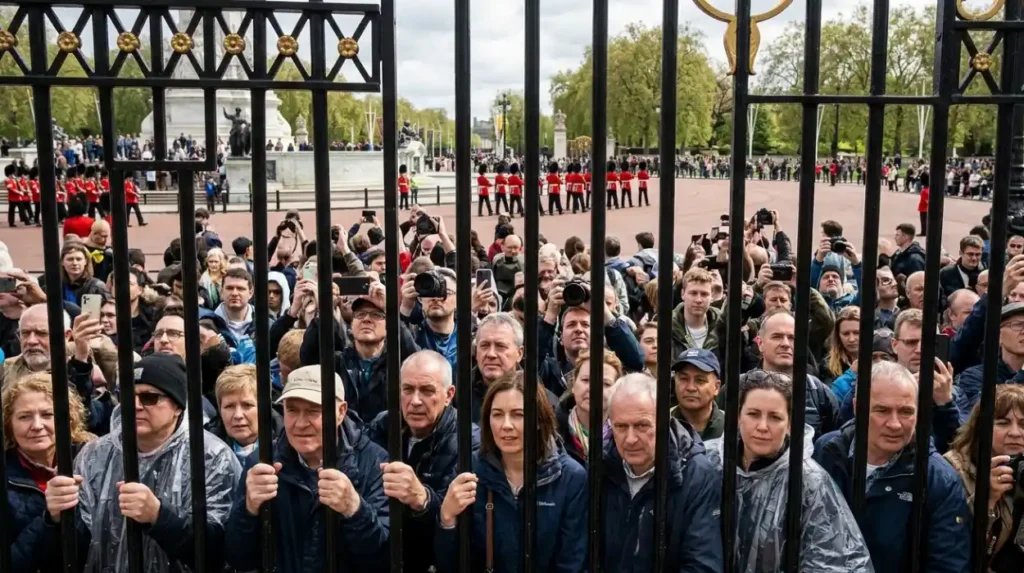
Buckingham Palace forecourt provides the main handover view. Railings limit proximity, with crowds 10 deep by 10:30 AM. The Victoria Memorial offers elevated sightlines over heads, capturing band arrivals.
The Mall tracks the New Guard march from Marlborough Road. Wide boulevards allow side views of 400 marching soldiers. Position midway for 15-minute passage without obstructions.
St James’s Palace hosts the ceremony finale around 11:45 AM. Open streets near the black statue of Queen Alexandra yield barrier-free access. Crowds stay under 200 versus palace’s thousands.
Friary Court at St James’s sees guards post sentries. Examples: Grenadier Guards in red tunics, Scots Guards in feathered caps. All spots remain free, no tickets needed.
Accessibility favors The Mall’s pavements. Implications include better photos from St James’s intimacy.
How early should you arrive for the best Changing of the Guard views?
Arrive at Buckingham Palace by 9:45 AM, The Mall by 10:15 AM, and St James’s Palace by 11:35 AM to secure front-row positions. Peak days fill spots 90 minutes prior; off-peak needs 45 minutes.
Macro context involves 30,000 daily palace visitors competing. Front barriers fill fastest at palace gates. Data shows 11:00 AM arrival yields rear views only.
Subtopics cover location variances. Palace demands earliest due to 5,000 capacity. The Mall accommodates more linearly. St James’s requires least time, filling post-march diversion.
Details: Weekdays average 2,000 viewers; weekends double. Rain reduces by 30%. Use TfL buses or Tube (Green Park station) for access.
Implications favor St James’s for spontaneity. Early arrival guarantees 50-meter soldier proximity.
What happens during the Changing of the Guard ceremony step by step?
The ceremony unfolds: 10:57 AM New Guard departs Wellington Barracks; 11:00 AM arrives palace forecourt; Old Guard inspection; handover with orders distribution; sentries posted; New Guard departs by 11:45 AM.
Wellington Barracks launches the New Guard band-led march. Route spans 1.5 kilometers through central London. Palace arrival triggers forecourt assembly.
Old Guard parades in position. The Captain conducts mutual inspections, checking uniforms and rifles. Regimental band plays marches like “Milanollo.”
Handover distributes special orders—written royal instructions. Sentries relieve at palace gates and St James’s. Old Guard retreats to barracks.
Examples: Coldstream Guards execute slow marches; Irish Guards add pipers. Duration totals 45 minutes. Precision drill covers 200 movements per soldier.
Future relevance persists via annual calendar.
Which regiments participate in the Buckingham Palace Changing of the Guard?
Five regiments of the Household Division participate: Grenadier Guards, Coldstream Guards, Scots Guards, Irish Guards, Welsh Guards. Each rotates monthly, identifiable by tunic buttons, plume colors, and cap stars.
Grenadier Guards, senior regiment, feature plain bearskins. Coldstream Guards space buttons in threes. Scots Guards bear diced bonnets optionally.
Irish Guards wear blue plumes; Welsh Guards, green. Rotations follow duty rosters from Pikemott Lines. 2026 schedules list Grenadiers in March.
Historical context traces to 1650s formation. Each fields 40-man platoons. Statistics: 1,100 soldiers guard residences yearly.
Implications aid identification during views.
Is the Changing of the Guard at Buckingham Palace free to watch?
Yes, the Changing of the Guard at Buckingham Palace is free for all spectators. No tickets or reservations required at public viewing areas like the forecourt, The Mall, or St James’s Palace.
Public access stems from tradition since 1660. Barriers manage flows only. Annual cost to Army exceeds £5 million, taxpayer-funded.
Examples: 2025 drew 1.2 million free attendees. Private balcony views via palace tours cost £30 extra.
Implications enable broad participation.
What is the history behind the Buckingham Palace Changing of the Guard?
The Changing of the Guard originated in 1660 under King Charles II, evolving from medieval watch rotations to formal parades by 1815. It shifted to Buckingham Palace in 1837 upon Queen Victoria’s accession.
Night Watch protected Whitehall Palace pre-1660. Charles II mandated daily reliefs post-exile. New Guard formalized post-Waterloo.
Queen Victoria designated Buckingham as primary residence. 20th-century standardizations added bands. World Wars paused few events.
Examples: 1936 Abdication altered rosters minimally. Records log 15,000 ceremonies since 1900.
Ongoing relevance upholds ceremonial monarchy.
Are there accessibility considerations for Changing of the Guard viewers?
Wheelchair users access The Mall and St James’s Palace via ramps; palace forecourt offers limited elevated platforms. Arrive early for designated zones; audio descriptions available via apps.
Royal Parks maintain step-free paths on The Mall. St James’s features wide pavements. Palace barriers include 10% accessible spots.
Data: 15% visitors report mobility needs yearly. TfL step-free Tubes serve Green Park.
Implications promote inclusivity.
How does weather impact the Changing of the Guard schedule?
Rain proceeds with waterproof covers; extreme conditions like storms cancel 5% of events. Check forecasts and Army updates 24 hours prior; indoor alternatives absent.
London averages 600 mm annual rain. Guards train wet-weather drills. 2025 cancellations numbered 12.
Examples: High winds delay marches. Implications require flexible plans.
What is the Changing of the Guard at Buckingham Palace?
The Changing of the Guard is a ceremonial handover where one group of soldiers replaces another guarding Buckingham Palace. It’s one of London’s most iconic free attractions.