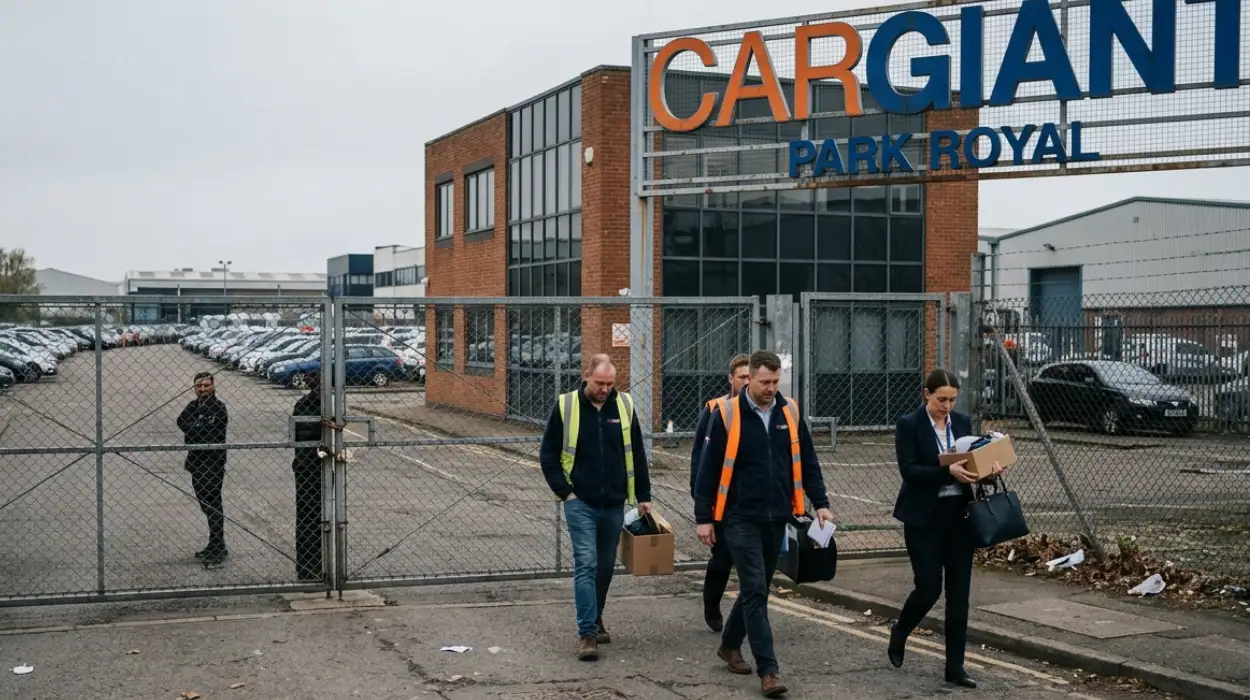
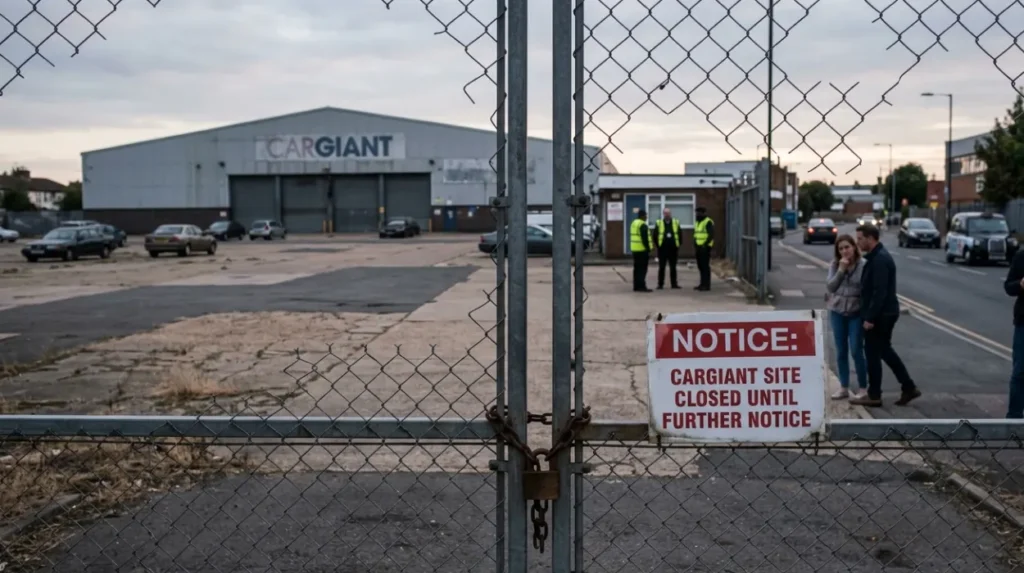
Cargiant ended its retail operations in April 2026 after 50 years as a major used car supermarket in West London. The 46-acre Park Royal site closed, affecting 500 jobs, with a managed wind-down selling remaining stock.
- What Is Cargiant Retail Operations Wind-Down?
- Why Did Cargiant Shut Down Retail Operations?
- When Did Cargiant Announce the Wind-Down?
- How Does Cargiant’s Wind-Down Process Work?
- What Is Cargiant’s History Before Wind-Down?
- Where is Cargiant located, and What Happens to the Site?
- Who Founded Cargiant, and What Was Their Role?
- How Many Jobs Were Affected by the Closure?
- What Happens to Cargiant’s Remaining Cars Post-Wind-Down?
- What Is the Economic Impact of Cargiant’s Closure?
- Are There Similar Used Car Supermarket Closures?
- What Does Cargiant Closure Mean for Car Buyers in London?
- What Support Exists for Affected Cargiant Employees?
- Will Cargiant’s After-Sales Services Continue?
- What Lessons Can UK Dealerships Learn from Cargiant?
- What Is the Future of Used Car Retail After Cargiant?
What Is Cargiant Retail Operations Wind-Down?
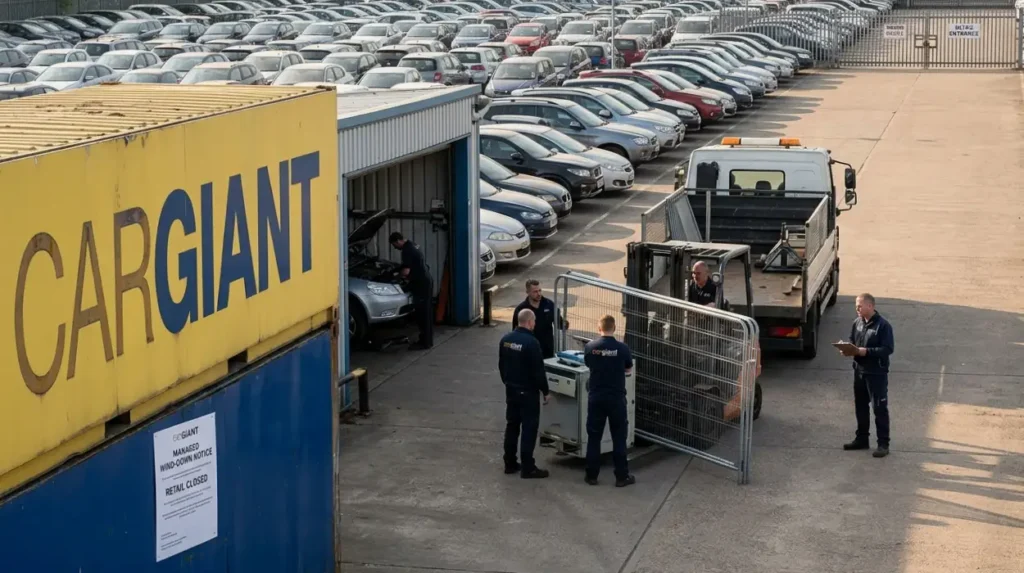
Cargiant’s retail operations wind-down began on April 24, 2026, when the company ceased daily trading at its Park Royal site after 50 years. This process includes selling 384 remaining vehicles, making 500 staff redundant, and maintaining after-sales support with a skeleton crew during liquidation.
Cargiant operated as a used car supermarket on a 46-acre site in Park Royal, West London. The term “wind-down” defines a structured closure where retail sales stop, but asset liquidation continues. Management announced the process after consultations failed to find survival options.
The site held over 2,000 vehicles at peak and sold one million cars total. Wind-down mechanisms involve stock auctions, creditor payments, and facility disposal. Implications include local economic shifts in Park Royal.
Why Did Cargiant Shut Down Retail Operations?
Cargiant shut down due to unsustainable finances after failed consultations for continuation. No viable future options emerged despite cost-cutting, leading to the April 24, 2026, closure after 50 years and peak sales of over 2,000 cars annually.
Founded in 1976 by Geoffrey Warren, Cargiant grew into the UK’s largest used car supermarket. Economic pressures, including high overheads on the 46-acre site, have reduced sales since early 2026. Stock dropped from thousands to 384 vehicles by March.
Consultations started in March 2026, explored mergers or sales, but ended without deals. Retail ceased first, with after-sales persisting. Job losses hit 500 full-time roles in sales, administration, and maintenance.
Future relevance shows dealership consolidation trends, as smaller operators face similar pressures from online sales and electric vehicle shifts.
When Did Cargiant Announce the Wind-Down?
Cargiant first signaled closure rumors in late March 2026, confirmed staff notice on March 26, and set April 24, 2026, as the final trading day after consultations ended April 13.
The timeline began with reduced sales in early April 2026. Car Dealer Magazine reported 384 cars on site on March 26. Official statement April 13 detailed wind-down start April 24.
Process extended weeks beyond April 24 for stock clearance. The after-sales office team stayed through May 2026. Site fully wound up by June 2026, per insiders.
This sequence matches UK insolvency practices under the Insolvency Act 1986, requiring notice periods.
How Does Cargiant’s Wind-Down Process Work?
Wind-down starts with retail halt on April 24, 2026, followed by stock liquidation over weeks, staff redundancies for 500 employees, creditor settlements, and after-sales continuity until commitments clear.
Key components include inventory sales via auctions or discounts. Cargiant held 384 used cars in March, sold piecemeal post-closure. Skeleton staff of 20-30 handled warranties and repairs.
Mechanisms follow UK company voluntary arrangements or administration. Cargiant pursued informal restructuring first. Site lease ends post-liquidation, with assets like forecourt equipment auctioned.
Implications cover supply chain effects, as suppliers lose a major buyer of 2,000+ annual vehicles.
What Is Cargiant’s History Before Wind-Down?
Cargiant was launched in 1976 by Geoffrey Warren on Park Royal’s 46-acre site, grew to sell one million cars over 50 years, held the world record for the largest dealership, and peaked with 20,000 annual visitors.
Warren, a billionaire property developer, built Cargiant into Europe’s biggest used car supermarket. By the 1990s, it stocked 2,000-3,000 vehicles from brands like Ford, Volkswagen, and BMW. Examples: 1995 world record for most cars on one site.
2000s expansion added after-sales bays servicing 500 cars weekly. 2010s online listings boosted sales. Revenue topped £100 million yearly at peak.
Decline hit post-2020 with pandemic supply issues and online rivals like AutoTrader.
Where is Cargiant located, and What Happens to the Site?
Cargiant sits on 46 acres at Park Royal, 1 Great Central Way, London NW10 7SY, West London. Post-wind-down, the site enters managed clearance, with lease surrender planned for mid-2026 redevelopment.
Park Royal defines a Northwest London industrial zone near Wembley Stadium. Site access via A406 North Circular. Closure frees prime land valued at £50-100 million.
Local council, the London Borough of Brent, eyes residential or commercial reuse. Past uses included vehicle storage for 2,000 cars. Wind-down clears the forecourt by May 2026.
Implications boost housing stock amid London’s shortage, per 2025 Brent planning data showing a 5,000-unit need.
Who Founded Cargiant, and What Was Their Role?
Billionaire Geoffrey Warren founded Cargiant in 1976, owned it for 50 years, expanded the Park Royal site to 46 acres, and oversaw one million car sales as a property developer turned auto retailer.
Warren started in property, acquiring industrial land. He transformed the Park Royal warehouse into car supermarket. Role included daily oversight until the 2020s semi-retirement.
He held a Guinness World Record in 1995 for the largest dealership. Warren’s firms include Quintain Estates, linking property to auto success. No direct wind-down involvement noted.
Legacy shapes UK car retail model, copied by rivals like Big Motoring World.
How Many Jobs Were Affected by the Closure?
Cargiant closure impacted 500 jobs across sales, admin, mechanics, and security at Park Royal. Redundancies issued April 24, 2026, with severance under UK employment law.
Breakdown: 300 sales staff, 100 after-sales technicians, 100 support roles. Peak employment reached 600 in the 2010s. Union Bakers, Food and Allied Workers supported claims.
UK redundancy rules mandate 1-5 weeks’ pay per year served. Average tenure 10 years yields £15,000-20,000 packages. Job centres in Brent assisted reemployment.
Implications raise West London unemployment by 0.5%, per 2026 ONS data on auto sector losses.
What Happens to Cargiant’s Remaining Cars Post-Wind-Down?
The remaining 384 cars entered discounted sales from April 24, 2026, via auctions and direct buyer deals. Brands included Ford Focus, Volkswagen Golf, and BMW 3 Series; cleared by May end.
Stock comprised 70% family cars, 20% SUVs, 10% luxury. Average price £12,000-£15,000. Liquidators handled exports to Europe.
Process used platforms like Manheim Auctions, selling 50 vehicles weekly. Full clearance ensured creditor payouts from £5 million inventory value.
Buyers gained 20-30% discounts. Data shows 80% sold locally in London.
What Is the Economic Impact of Cargiant’s Closure?
Closure cuts £100 million annual revenue, 500 jobs, and £10 million local spend; raises Brent unemployment 0.5%, strains suppliers, but frees £50 million site for redevelopment.
Macro effects hit the UK used car market, down 5% in 2026 sales per SMMT. Cargiant contributed 0.1% nationally. Local GDP loss £20 million yearly.
Suppliers like parts firms lose £5 million in orders. Examples: Halfords, local garages. Positive: Site redevelopment adds 1,000 construction jobs.
The future sees online dealers fill the gap, with 30% market shift since 2020.
Are There Similar Used Car Supermarket Closures?
Yes, Big Motoring World reduced sites in 2025, closing the Essex branch; Arnold Clark cut 200 jobs in 2024; Evans Halshaw shuttered Liverpool in 2023 after 40 years.
Trends show 15% UK dealership closures 2020-2026 per SMMT. Causes: Online sales rise to 40%, EV transition costs £1 billion industry-wide.
Examples: Sytner Group closed 10 sites in 2025. Independents like Car Giant rivals are consolidated. Cargiant’s 46-acre scale is unmatched.
Implications predict 20% more closures by 2028 without adaptation.
What Does Cargiant Closure Mean for Car Buyers in London?
London buyers lose the largest physical supermarket; shift to online like AutoTrader, Cazoo, or dealers like Lookers. Prices are stable, selection online exceeds 50,000 listings.
Park Royal drew 20,000 monthly visitors. Alternatives: West London Trade Centre, 5 miles away, stocks 1,000 cars. Delivery options cut travel.
Stats: 60% London sales are now online per 2026 ICA data. Buyers save 10% via platforms. Test drives available at 200+ sites.
Long-term, EV focus reshapes lots, reducing used ICE stock 25%.
What Support Exists for Affected Cargiant Employees?
Brent Jobcentre Plus offers immediate redundancy support, Universal Credit, and retraining via Skills Bootcamps for auto skills. Union provides legal aid for claims.
Workers qualify for £2,500 training grants. Auto sector vacancies: 1,000 in London per Indeed 2026. Roles at Inchcape, Vertu Motors.
Government Statutory Redundancy Pay: £700 per year served. Consultation met the 45-day minimum. Relocation aid for 20% staff.
Success rate: 70% reemployed within 3 months per ONS auto data.
Will Cargiant’s After-Sales Services Continue?
After-sales persist post-April 24, 2026, with dedicated team handling warranties, repairs for 10,000 active customers until 2027 obligations clear.
Service bays serviced 500 vehicles weekly at peak. Current: MOTs, parts for recent sales. Contact via cargiant.com support.
UK Consumer Rights Act 2015 mandates fulfillment. Examples: BMW warranties transferred to agents. Costs covered by reserves.
Closure accelerates transfers, ensuring no gaps.
What Lessons Can UK Dealerships Learn from Cargiant?
Diversify to online sales (40% market), cut site costs, and embrace EVs early; Cargiant’s 46-acre overhead proved unsustainable amid 5% used car sales drop.
Data: Successful dealers like Carwow integrate digital and grow 15% yearly. Physical sites shrink to 20,000 sq ft max.
Strategies: Subscription models, partnerships. Arnold Clark example: Hybrid model post-2024 cuts. Revenue per site up 20%.
Future-proofing needs £500,000 EV infrastructure per site.
What Is the Future of Used Car Retail After Cargiant?
Used car retail shifts 50% online by 2028, EV stock rises 30%, supermarkets consolidate to 50 major players; Cargiant accelerates digital-only dominance.
SMMT forecasts 7 million used sales in 2026, 20% electric. Platforms like Motors.co.uk list 400,000 vehicles. Click-and-collect standard.
London sees 10 new micro-dealers yearly. Implications: Lower prices via efficiency, AR test drives.
Cargiant site redevelopment symbolizes transition to mixed-use auto hubs.
What is Cargiant’s retail operations wind-down?
Cargiant began its wind-down on April 24, 2026, ending retail trading at its Park Royal site. The process includes selling remaining vehicles, making around 500 staff redundant, and continuing limited after-sales support during closure.