Brick Lane and Spitalfields form one of London’s most significant cultural districts. Their history reflects successive waves of migration, industrial growth, religious diversity, artistic expression, and food traditions that have shaped East London from the medieval period to the twenty-first century.
- How did Spitalfields develop from a medieval religious settlement into an urban district?
- Why did Brick Lane become a centre of migration and cultural diversity?
- What role has food played in shaping Brick Lane’s identity?
- How did Spitalfields Market influence the economic development of East London?
- Why is street art an important part of Brick Lane’s modern cultural landscape?
- What historic buildings and landmarks define the Brick Lane and Spitalfields walking experience?
- How have preservation efforts protected the heritage of Brick Lane and Spitalfields?
- What does Brick Lane and Spitalfields reveal about London’s long-term historical development?
Located in London’s East End, Brick Lane and Spitalfields occupy a unique position within the historic development of the capital. The area sits immediately east of the medieval boundaries of the City of London and developed as a settlement zone for migrants, craftspeople, merchants, and labourers.
Spitalfields derives its name from St Mary Spital, a large priory and hospital established in 1197. The institution occupied extensive land outside the City walls and became one of medieval England’s largest charitable foundations. Following the Dissolution of the Monasteries under King Henry VIII between 1536 and 1541, the priory was demolished, opening land for urban development.
Brick Lane developed as a rural route connecting London to Essex. By the fifteenth century, brick-making industries operated nearby, giving the street its modern name. The area’s growth accelerated during the seventeenth century as London expanded beyond its traditional boundaries.
The significance of Brick Lane and Spitalfields lies in their continuous role as gateways for newcomers. Three major migration eras illustrate this pattern: French Huguenots in the seventeenth century, Eastern European Jewish communities in the nineteenth century, and Bangladeshi immigrants during the twentieth century. Each group left lasting cultural, architectural, and economic influences.
Today, the district represents one of Britain’s most visible examples of layered urban history. Historic houses stand beside contemporary galleries, while traditional markets operate alongside modern restaurants and creative businesses.
How did Spitalfields develop from a medieval religious settlement into an urban district?
Spitalfields evolved from monastic land surrounding St Mary Spital into a densely populated urban neighbourhood through Tudor redevelopment, textile manufacturing, commercial expansion, and nineteenth-century industrialisation, creating one of London’s most historically significant districts.
The foundation of St Mary Spital in 1197 established the area’s earliest organised settlement. The hospital provided medical care, religious services, and charitable assistance to travellers and residents. Archaeological excavations conducted during the redevelopment of Spitalfields Market uncovered extensive evidence of medieval burials and structures associated with the institution.
Following the Dissolution of the Monasteries, former church lands became available for private ownership and development. During the sixteenth century, new housing appeared across the area. Population growth accelerated as London’s commercial influence expanded.
The seventeenth century marked a decisive transformation. Large numbers of French Protestant refugees known as Huguenots arrived after religious persecution in France intensified following the Revocation of the Edict of Nantes in 1685. Many settled in Spitalfields because property was available and textile production opportunities existed.
Huguenot weavers introduced advanced silk-weaving techniques. Wealth generated by the silk industry funded elegant Georgian houses that remain visible today. Streets such as Fournier Street, Princelet Street, and Wilkes Street preserve examples of eighteenth-century domestic architecture.
By the eighteenth century, Spitalfields had become Britain’s principal silk-weaving centre. Thousands of looms operated in workshops and upper-floor rooms. Large attic windows found on many houses were specifically designed to maximise natural light for weaving activities.
Industrial competition during the nineteenth century weakened the local silk industry. Economic decline followed, but the district remained an important centre of manufacturing, trade, and migration. New arrivals continually reshaped the neighbourhood’s identity.
Why did Brick Lane become a centre of migration and cultural diversity?
Brick Lane became a migration hub because affordable housing, employment opportunities, and proximity to London’s commercial districts attracted successive immigrant communities who established religious institutions, businesses, cultural traditions, and social networks across several centuries.
Migration has defined Brick Lane more than any other factor.
The first major wave involved Huguenot refugees during the late seventeenth century. These skilled artisans contributed significantly to textile production and commercial development. Their churches and residences became important landmarks.
The second major transformation occurred during the nineteenth century when Jewish immigrants from Eastern Europe arrived in large numbers. Many fled political persecution, anti-Semitic violence, and economic hardship in Russia, Poland, and surrounding regions.
Jewish communities established synagogues, schools, charities, and businesses throughout the East End. Brick Lane became known for tailoring workshops, bakeries, and commercial enterprises linked to London’s garment industry.
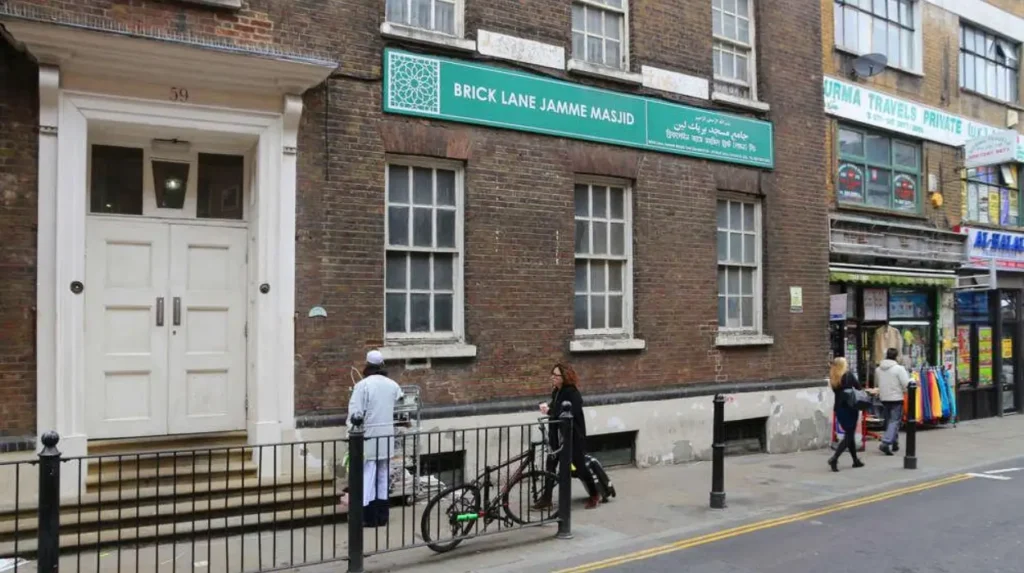
One building illustrates this historical layering particularly well. The structure now known as the Brick Lane Mosque has served different religious communities over time. Originally constructed as a Huguenot chapel in 1743, it later became a Methodist chapel, then a synagogue, and eventually a mosque. Few buildings in Britain demonstrate such a continuous sequence of cultural adaptation.
The third major migration era involved Bangladeshi settlers, particularly from the Sylhet region. Significant migration occurred after the Second World War and expanded further during the 1960s and 1970s.
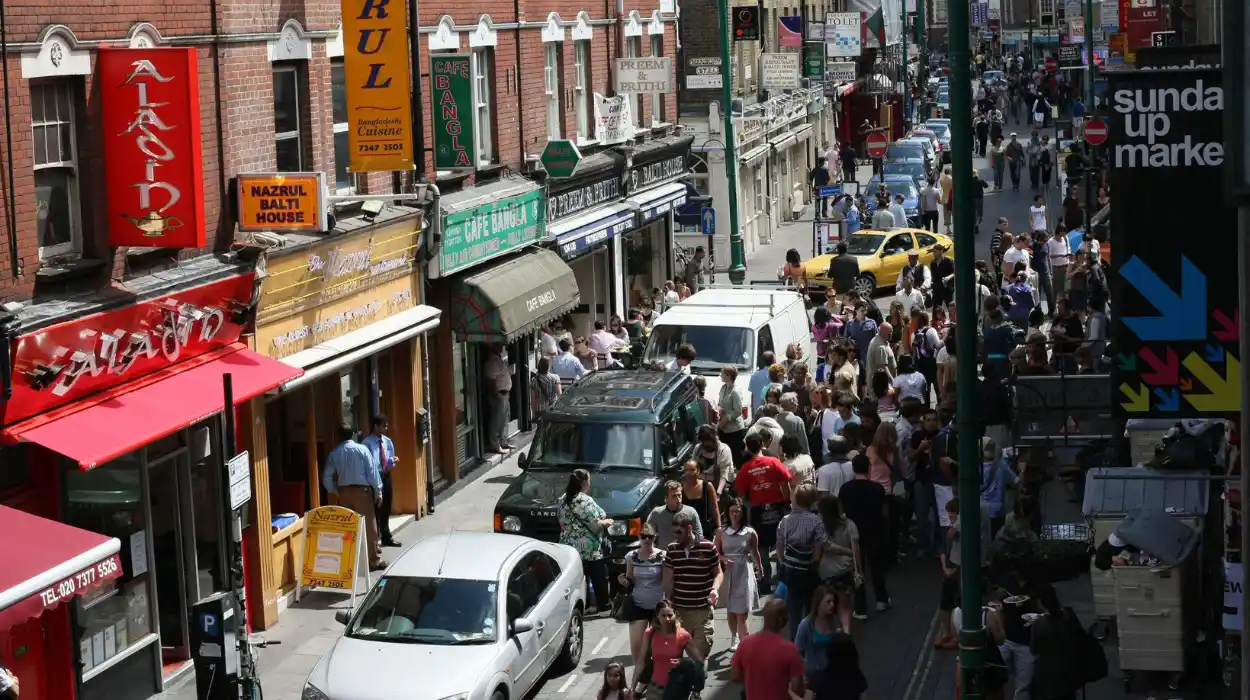
Bangladeshi entrepreneurs established restaurants, grocery stores, cultural centres, and community organisations. Brick Lane subsequently became internationally recognised for South Asian cuisine and Bengali cultural heritage.
This sequence of migrations created a district where architectural, religious, linguistic, and culinary influences coexist within a compact urban area.
What role has food played in shaping Brick Lane’s identity?
Food has served as a visible expression of migration, entrepreneurship, and cultural continuity in Brick Lane, reflecting centuries of community change through bakeries, markets, restaurants, cafés, and street-food traditions established by diverse populations.
Food history provides one of the clearest ways to understand Brick Lane’s evolution.
During the Huguenot period, culinary influences reflected French traditions and artisanal production. Although textile manufacturing dominated local economic activity, refugee communities also introduced food customs associated with continental Europe.
Jewish immigration transformed the area’s food culture during the nineteenth and early twentieth centuries. Traditional bakeries, delicatessens, and food shops became central features of East End life. Foods such as bagels, salt beef, smoked fish, and pastries gained prominence.
One of Brick Lane’s most famous culinary institutions is the historic bagel tradition. Several bakeries operating today trace their origins to Jewish community food culture. These businesses represent surviving links to the area’s immigrant past.
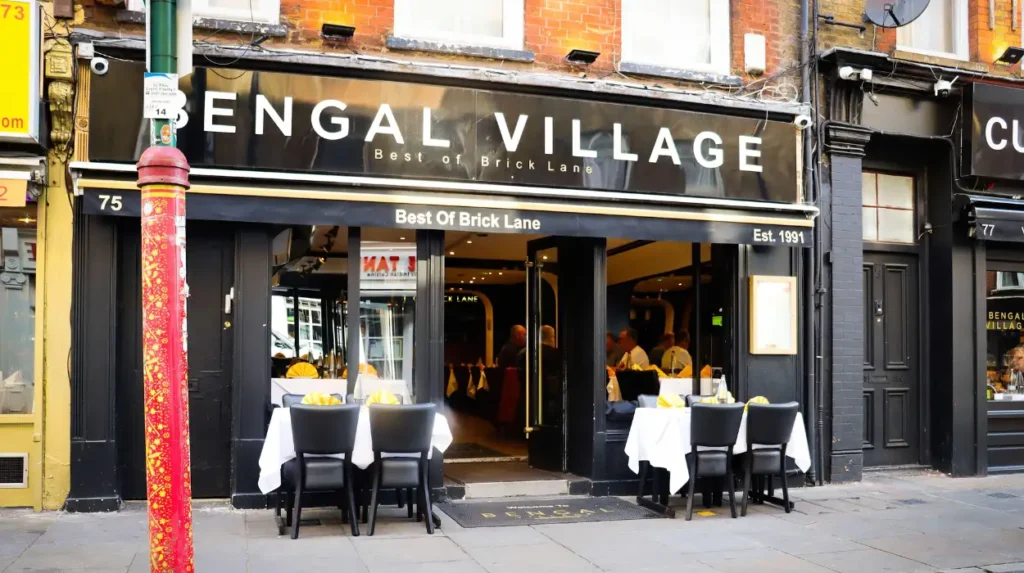
The arrival of Bangladeshi communities introduced new culinary traditions during the twentieth century. Restaurants specialising in Bengali and South Asian cuisine became increasingly prominent from the 1970s onward.
The concentration of curry houses led to the area becoming known internationally as London’s “Curry Capital.” Although restaurant offerings have diversified significantly, South Asian cuisine remains a defining feature of Brick Lane’s identity.
Modern food culture extends beyond traditional restaurants. Weekend markets showcase global street food, artisanal products, and independent culinary businesses. Visitors encounter influences from multiple continents within a relatively small geographical area.
Food therefore functions as both a historical record and a contemporary expression of cultural diversity.
How did Spitalfields Market influence the economic development of East London?
Spitalfields Market served as a major commercial centre for over three centuries, supporting wholesale trade, employment, agricultural distribution, and urban growth while connecting East London to regional and national economic networks.
Spitalfields Market occupies a central position in the economic history of East London.
The market received a royal charter in 1682, formalising commercial activity already occurring in the area. It quickly became an important destination for traders supplying food and agricultural products to London’s expanding population.
Throughout the eighteenth and nineteenth centuries, the market handled large volumes of fruit, vegetables, flowers, and other produce. Merchants transported goods from rural regions into the capital through increasingly sophisticated distribution networks.
Employment opportunities generated by the market supported thousands of workers. Examples included porters, wholesalers, transport operators, traders, and warehouse staff.
The market also stimulated surrounding economic activity. Shops, lodging houses, workshops, and service businesses emerged to support commercial operations.
The Victorian market buildings reflected London’s growing economic power. Architectural improvements increased efficiency while accommodating expanding trade volumes.
Wholesale operations eventually relocated during the late twentieth century. The historic market structures survived redevelopment and now house retail businesses, restaurants, and cultural venues.
This preservation effort demonstrates how historic commercial infrastructure can be adapted for modern use while retaining heritage value.
To experience this historic landmark in person today, consult our comprehensive [The History of London’s East End: Immigration, Industry, and Change] for itineraries and visiting parameters.
Why is street art an important part of Brick Lane’s modern cultural landscape?
Street art represents Brick Lane’s contemporary role as a centre of creativity, public expression, and urban regeneration, transforming streets and building façades into constantly evolving spaces that attract artists, visitors, and researchers.
Street art emerged as a major cultural feature during the late twentieth century and continues to influence perceptions of the area.
Brick Lane’s industrial buildings, warehouse walls, and side streets created ideal conditions for public art. Artists utilised these surfaces to produce murals, stencils, paste-ups, and large-scale installations.
The district gained international recognition as a destination for urban art. Works frequently address themes such as migration, identity, politics, community, and social change.
Unlike permanent monuments, street art changes continuously. New works replace older pieces, creating an evolving visual landscape. This process reflects broader patterns of cultural adaptation visible throughout Brick Lane’s history.
Academic researchers increasingly study street art as a form of urban communication. Scholars analyse how visual interventions influence neighbourhood identity, tourism, and public engagement.
The growth of street art tourism has generated economic benefits while encouraging wider interest in East London’s cultural heritage.
Importantly, modern artistic activity exists alongside historic preservation efforts. Georgian houses, religious buildings, markets, and contemporary murals collectively illustrate different phases of urban development.
What historic buildings and landmarks define the Brick Lane and Spitalfields walking experience?
The area’s walking routes are defined by Georgian houses, former religious buildings, market structures, industrial sites, and preserved streetscapes that collectively document more than eight centuries of London history and cultural transformation.
Several landmarks illustrate the district’s historical development.
Christ Church Spitalfields stands among Britain’s finest examples of English Baroque architecture. Designed by architect Nicholas Hawksmoor and completed in 1729, the church formed part of a programme to strengthen Anglican presence in rapidly expanding eastern districts.
Fournier Street contains exceptionally well-preserved Georgian houses associated with the Huguenot silk-weaving industry. Architectural features reveal the economic prosperity generated by textile production.
Princelet Street offers another important historical landscape. Buildings there reflect changing patterns of residential occupation across multiple centuries.
The former Truman Brewery complex represents East London’s industrial heritage. Established in the seventeenth century, it became one of Britain’s largest breweries before later redevelopment transformed the site into a creative and commercial hub.
The Brick Lane Mosque illustrates the area’s religious and demographic transitions. Its changing functions document the movement of different communities through the district over nearly three centuries.
Old Spitalfields Market remains a focal point for visitors exploring the neighbourhood’s commercial history.
Together, these landmarks create a walkable historical environment where architectural evidence survives from multiple periods.
How have preservation efforts protected the heritage of Brick Lane and Spitalfields?
Preservation initiatives have protected historic buildings, archaeological remains, conservation areas, and cultural landmarks, ensuring that significant evidence of migration, commerce, religion, and architecture remains accessible for future generations.
Conservation efforts intensified during the late twentieth century as redevelopment pressures increased across East London.
Many Georgian buildings faced demolition risks due to neglect and urban renewal schemes. Heritage organisations, local authorities, and community groups advocated for protection measures.
Conservation area designation helped preserve historic streetscapes. Planning controls limited inappropriate alterations and encouraged restoration projects.
Archaeological investigations also played a crucial role. Excavations associated with development projects uncovered medieval cemeteries, monastic remains, and evidence of early settlement patterns.
Research findings expanded the understanding of London’s growth and provided valuable data for historians and archaeologists.
Preservation increasingly recognises intangible heritage as well as physical structures. Examples include migration histories, religious traditions, community memories, food cultures, and linguistic diversity.
Museums, archives, educational institutions, and local history organisations continue documenting these cultural resources.
The combination of architectural conservation and historical research ensures that Brick Lane and Spitalfields remain valuable educational environments.
What does Brick Lane and Spitalfields reveal about London’s long-term historical development?
Brick Lane and Spitalfields reveal how migration, commerce, religion, industry, and cultural exchange continuously shaped London, creating a dynamic urban environment where historical layers remain visible within contemporary city life.
The district serves as a microcosm of broader London history.
Its origins connect to medieval religious institutions. Its expansion reflects early modern urban growth. Its prosperity emerged through international trade and textile manufacturing. Its diversity developed through repeated migration.
Three major communities—Huguenots, Jewish immigrants, and Bangladeshis—demonstrate how newcomers contributed skills, entrepreneurship, religious traditions, and cultural practices that enriched London society.
Architectural evidence supports this narrative. Georgian houses, churches, synagogues, mosques, markets, and industrial buildings survive as physical records of change.
Economic history remains equally visible. Silk weaving, garment production, brewing, market trading, and modern creative industries illustrate evolving patterns of employment and commerce.
Contemporary food culture, street art, and cultural tourism represent the latest chapter in this long historical sequence.
For educators, historians, genealogists, and cultural tourists, Brick Lane and Spitalfields provide an exceptional case study of urban continuity and transformation. Few locations in Britain demonstrate so clearly how successive generations adapted existing spaces while preserving traces of the past.
As London continues evolving, Brick Lane and Spitalfields remain powerful reminders that the city’s identity has always been shaped by movement, exchange, creativity, and cultural diversity. Their streets preserve more than local history. They preserve the story of London itself.
What are Brick Lane and Spitalfields known for?
Brick Lane and Spitalfields are known for their rich immigrant history, historic architecture, street art, markets, food culture, and role in shaping London’s East End. They are among the capital’s most popular cultural and heritage destinations.