London has one of the world’s richest bookshop cultures. Its independent and specialist booksellers occupy Georgian terraces, Edwardian interiors, underground basements, former market spaces, historic streets, and even a floating Dutch barge. These places sell new books, second-hand volumes, rare editions, political literature, queer writing, travel works, children’s titles, and scholarly research materials.
- What makes London’s independent bookshops historically important?
- Which historic bookshop is the oldest in London?
- Why is Daunt Books Marylebone one of London’s most famous independent bookshops?
- Why should visitors explore John Sandoe Books in Chelsea?
- Why is Gay’s the Word important in London’s literary history?
- Why is Skoob Books a major destination for second-hand books in London?
- Why should book lovers visit Persephone Books in Bloomsbury?
- What makes Word on the Water one of London’s most unusual bookshops?
- Why is Housmans Bookshop significant to London’s political history?
- Why should visitors explore London’s independent bookshops as part of a literary heritage trip?
- How has London’s bookshop culture changed from the Georgian period to the digital age?
- Why do independent bookshops remain important for London’s future heritage?
For visitors, London’s bookshops provide more than retail space. They preserve the city’s literary history and connect modern readers with centuries of publishing, bookselling, political debate, education, and cultural exchange. The best independent bookshops in London also reveal how the capital’s neighbourhoods developed around institutions, universities, theatres, publishers, libraries, and international communities.
The following guide examines the history, identity, collections, architecture, and cultural importance of some of the best independent bookshops in London. It includes historic establishments, specialist booksellers, second-hand destinations, community bookshops, and unusual literary spaces.
What makes London’s independent bookshops historically important?
London’s independent bookshops are historically important because they preserve local literary traditions, specialist knowledge, community institutions, and physical evidence of changing reading culture from the Georgian period to the digital age.
Bookselling has been part of London’s commercial and intellectual life for centuries. The capital’s book trade expanded alongside printing, publishing, literacy, education, political debate, and the growth of urban consumer culture.
The Georgian period created important conditions for the modern bookselling industry. London’s expanding middle class created demand for novels, political pamphlets, religious works, travel accounts, scientific publications, newspapers, and educational materials. Booksellers operated as retailers, publishers, distributors, and cultural intermediaries.
The nineteenth century transformed the scale of reading. Industrial printing reduced production costs. Railway expansion improved distribution. Rising literacy increased demand for newspapers and books. Public libraries and educational institutions widened access to printed material.
The twentieth century introduced new pressures. Large retailers, department stores, suburban development, television, mass-market publishing, and later online commerce changed the bookselling economy. Independent bookshops survived through specialist knowledge, carefully selected stock, local loyalty, community activity, and distinctive premises.
London’s independent bookshops therefore function as cultural archives. Their buildings, catalogues, staff expertise, specialist collections, author events, and community networks document how reading habits have changed over time.
Which historic bookshop is the oldest in London?
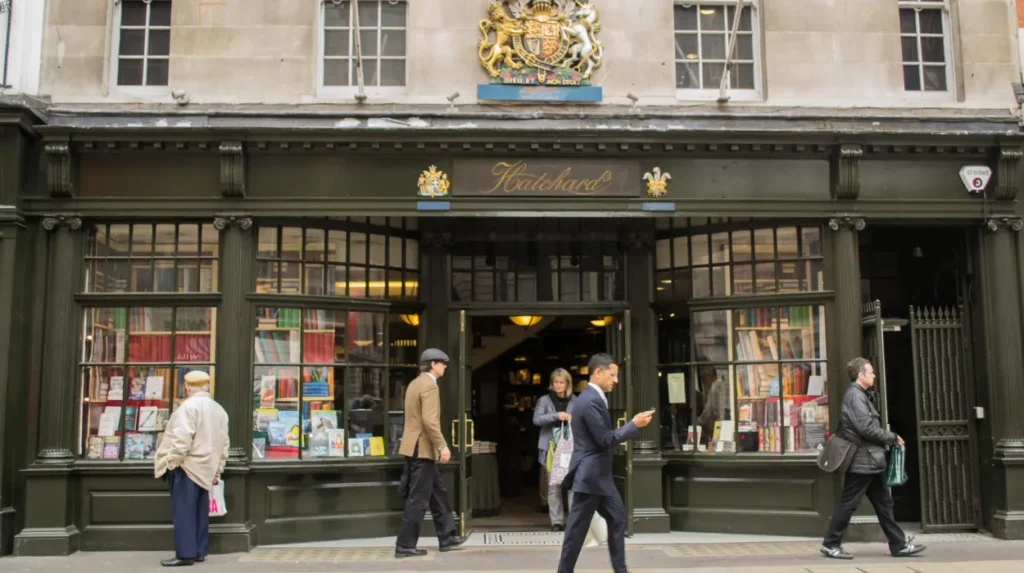
Hatchards on Piccadilly is the oldest surviving bookshop in the United Kingdom, founded by John Hatchard in 1797, and its history connects Georgian bookselling with royal patronage, Victorian literary culture, and modern specialist retail.
Hatchards is one of the essential historic bookshops to visit in London. John Hatchard founded the business in 1797, during the Georgian era, when Piccadilly was developing as an important West End commercial and cultural district.
The original business operated within a bookselling tradition in which retail and publishing remained closely connected. John Hatchard had worked in the printing and bookselling trade before establishing his own business. His early success came partly from publishing political material and developing a reputation within London’s expanding literary market.
Hatchards later became associated with prominent writers and public figures. During the Victorian period, the shop remained part of London’s literary culture. Oscar Wilde was among the writers connected with the shop’s historical literary world.
The Piccadilly shop remains a major literary landmark. The present premises at 187 Piccadilly occupy a five-storey building near Fortnum & Mason and the Royal Academy. The shop holds a Royal Warrant and continues to stock fiction, non-fiction, biography, history, travel, science, music, children’s books, signed editions, and specialist titles.
Its historical value comes from continuity. The same institution has operated across more than two centuries of political, technological, and social change. Hatchards therefore represents the long survival of specialist bookselling in a rapidly changing capital.
Why is Daunt Books Marylebone one of London’s most famous independent bookshops?
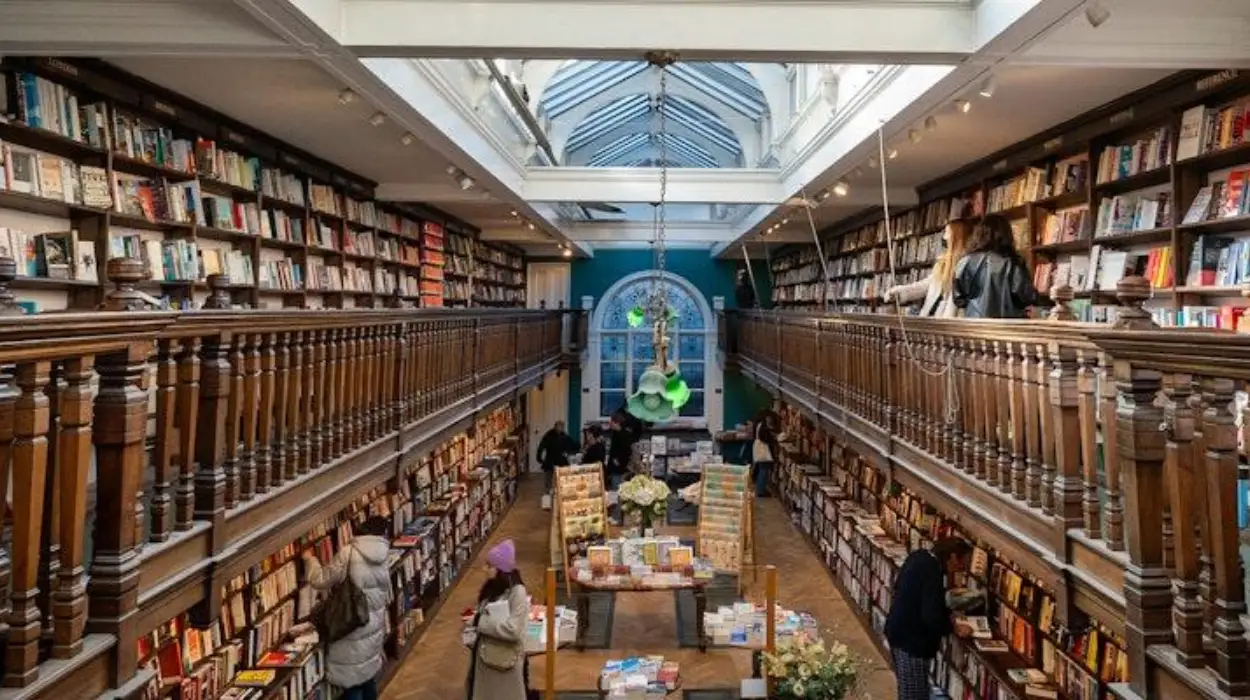
Daunt Books Marylebone is famous for its Edwardian architecture, oak galleries, long central hall, travel-focused organisation, and carefully curated stock, creating a distinctive relationship between historic architecture and modern independent bookselling.
Daunt Books Marylebone occupies a former Edwardian bookshop building on Marylebone High Street. Its architectural character is central to its identity. Long oak galleries, balconies, timber shelving, and a large central space create an interior designed for browsing.
The shop is especially known for organising much of its stock geographically. Travel writing, fiction, history, biography, and non-fiction connected with particular regions are arranged to support exploration through books.
This arrangement reflects a broader history of travel literature. London has long been a centre for publishing accounts of imperial expansion, scientific expeditions, cultural encounters, migration, and international politics. Modern travel books now include memoir, literary reportage, history, anthropology, geography, and contemporary cultural analysis.
Daunt Books also represents the evolution of the independent bookselling model. The business has developed a group of London shops while retaining a strong emphasis on curated stock and specialist bookselling. Its publishing division, established in 2010, extends this relationship between bookselling and literary production.
The Marylebone branch also holds selected second-hand books, particularly titles connected with travel and writing about place. This creates a direct connection between modern retail and the historical traditions of collecting, preservation, and re-use.
To experience London’s literary landmarks and historic cultural districts in person, consult our comprehensive [London’s Literary History Through the Centuries and Its Most Influential Writers] for itineraries and visiting parameters.
Why should visitors explore John Sandoe Books in Chelsea?
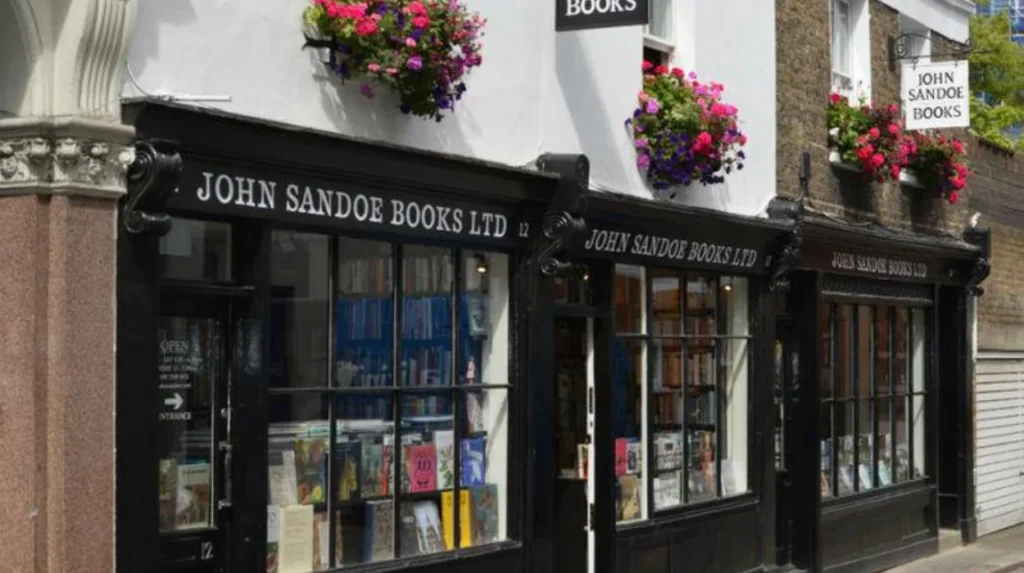
John Sandoe Books is a long-established independent bookshop founded in 1957, known for its historic Chelsea setting, carefully selected stock, expert booksellers, and more than 30,000 titles across fiction, non-fiction, literature, and specialist subjects.
John Sandoe Books was established in 1957 near Sloane Square. The shop occupies an eighteenth-century building, connecting modern bookselling with the historic architectural fabric of Chelsea.
The shop’s collection includes more than 30,000 titles. Its stock covers fiction, non-fiction, children’s literature, classics, contemporary writing, biography, history, and other subjects. The business also provides services connected with private libraries, subscriptions, catalogues, and mail order.
John Sandoe demonstrates the importance of the independent bookseller as a curator. Large retailers often depend on extensive volume and standardised distribution. An independent shop can instead develop a distinctive identity through staff knowledge, selection, and long-term relationships with readers.
The shop also contributes to the history of Chelsea as a cultural district. Chelsea has been associated with artists, writers, designers, publishers, and political figures across different periods. Its historic streets provide a setting in which a modern literary institution operates within older urban architecture.
For history enthusiasts and genealogical researchers, shops such as John Sandoe also offer access to books about London neighbourhoods, family history, biography, architecture, art, and social history.
Why is Gay’s the Word important in London’s literary history?
Gay’s the Word is the United Kingdom’s oldest LGBT+ bookshop, established in 1979, and its history demonstrates how specialist bookselling created access to queer literature, community knowledge, political writing, and cultural representation.
Gay’s the Word opened in January 1979. It was established by a group of gay socialists at a time when mainstream bookselling provided limited access to queer literature and specialist LGBT+ publications.
The shop is located on Marchmont Street in Bloomsbury. Its location places it within one of London’s most important literary and educational districts. Bloomsbury has long been associated with universities, publishers, writers, libraries, and intellectual organisations.
The bookshop stocks fiction, poetry, history, biography, queer studies, graphic novels, young adult literature, and other specialist material. Its collection documents the development of LGBTQ+ publishing and the changing language of identity, sexuality, politics, history, and community.
Gay’s the Word also functions as a cultural centre. Book launches, discussions, and community events create a direct connection between bookselling and public life.
Its history illustrates a major change in the British publishing landscape. Literature that was previously difficult to find became more accessible through specialist institutions created by the communities they served.
For researchers, the shop provides a valuable point of access to queer history. Books documenting activism, literature, social movements, legal change, and personal experience form an important record of modern British cultural history.
Why is Skoob Books a major destination for second-hand books in London?
Skoob Books is one of London’s major second-hand booksellers, with roots in the historic Charing Cross Road book trade and a long association with students, academics, collectors, researchers, and readers seeking out-of-print titles.
Skoob Books began through former employees of Poole’s, a Charing Cross Road bookseller. Its early history reflects the importance of second-hand bookselling in central London.
The business first operated in Covent Garden before developing a major presence in Bloomsbury. For around two decades, Skoob operated in Sicilian Avenue, where students, academics, and office workers searched for out-of-print books.
The shop later moved to the Brunswick Centre. Today, Skoob is located at 66 The Brunswick, off Marchmont Street, in the Bloomsbury area.
Second-hand bookselling has a different economic mechanism from conventional new-book retail. The stock is not produced in a predictable sequence. It enters through private collections, estate clearances, libraries, dealers, and individual sellers. The result is a constantly changing catalogue.
Skoob’s importance extends beyond casual browsing. Second-hand academic books provide access to earlier scholarship, discontinued editions, specialist subjects, and historical works. Students and researchers often use second-hand booksellers to locate material unavailable in ordinary retail channels.
The business also operates a large book-hire operation for film, television, theatre, photography, and other productions. This demonstrates how physical books continue to function as cultural objects, visual evidence, and historical props.
Why should book lovers visit Persephone Books in Bloomsbury?
Persephone Books is a specialist publisher and bookshop dedicated largely to neglected works by women writers, creating a focused literary collection that connects modern readers with overlooked twentieth-century fiction, diaries, essays, and non-fiction.
Persephone Books was founded by Nicola Beauman. The first books were published in March 1999. The business became associated with its London premises at 59 Lamb’s Conduit Street in Bloomsbury.
The publisher focuses on carefully selected works that have often been overlooked by mainstream literary history. Many titles were written by women and represent different forms of twentieth-century writing.
The shop’s identity demonstrates how publishing can change the historical record. Literary history is not determined only by the books that remain famous. Reprinting forgotten authors restores texts to public circulation and gives researchers new evidence about social experience, gender, domestic life, work, war, education, class, and cultural change.
Persephone’s distinctive grey covers create a recognisable visual identity. The physical design of the editions also demonstrates the relationship between modern publishing and historical preservation.
The Bloomsbury location adds another layer of significance. The district’s Georgian streets, literary institutions, university buildings, and publishing history provide a fitting urban context for a business devoted to recovering overlooked writing.
For educators and students, the shop offers a useful entry point into questions about canon formation. A literary canon is the body of works widely recognised as important. Persephone Books demonstrates how publishing decisions can expand that canon.
What makes Word on the Water one of London’s most unusual bookshops?
Word on the Water is a floating bookshop housed on a roughly century-old Dutch barge, combining second-hand and new books with literary events, poetry, music, creative writing, and a distinctive relationship between bookselling and London’s waterways.
Word on the Water operates from a 100-year-old Dutch barge in central London. The shop sells new and second-hand books, including classics, contemporary fiction, children’s books, art, photography, and unusual titles.
The barge creates a distinctive form of adaptive cultural reuse. A vessel originally designed for transport has become a permanent literary space. This reflects London’s wider history of converting older infrastructure into cultural uses.
The shop also hosts readings, book launches, poetry events, live music, and creative writing activities. These activities demonstrate how modern independent bookshops operate as cultural venues rather than simple retail outlets.
The location connects the bookshop with the Regent’s Canal and the King’s Cross area. The canal was part of London’s industrial transport network, carrying goods through the capital during the nineteenth and early twentieth centuries.
The presence of a floating bookshop within this historic environment creates a direct connection between transport history and contemporary cultural life. It also provides visitors with a physical example of how historic urban infrastructure can support new uses without losing its identity.
The shop’s literary programme strengthens its community function. Creative writing groups and public events create spaces for participation, not only consumption.
Why is Housmans Bookshop significant to London’s political history?
Housmans Bookshop is Britain’s longest continuously running radical bookshop, founded in 1945, and its history connects pacifism, human rights, feminism, environmental justice, anti-war activism, and progressive political publishing.
Housmans Bookshop opened on 26 October 1945. Its origins lay in the British pacifist movement and the Peace Pledge Union, founded in 1934 by Dick Sheppard.
The shop was named after Laurence Housman, a writer, dramatist, pacifist, and political activist. Its founding followed the Second World War, when debates about peace, human rights, international cooperation, and political reconstruction had become central to British public life.
The first shop operated on Shaftesbury Avenue. Housmans later moved to Kings Cross, where it has operated since 1959. Its present premises are at 5 Caledonian Road.
The shop specialises in radical political literature, pamphlets, magazines, newsletters, zines, and books. Its subjects include feminism, pacifism, Black politics, LGBTQIA+ politics, environmental justice, anarchism, and other progressive movements.
Housmans is also important because its building has housed organisations connected with social movements. The physical premises therefore form part of London’s political history.
Its second-hand basement demonstrates the continuing importance of affordable access to political and historical literature. Its events and book groups extend the institution’s role beyond retail.
For historians, Housmans provides a direct link between bookselling and social movements. The shop’s history records how printed material helped organise, educate, and connect political communities.
Why should visitors explore London’s independent bookshops as part of a literary heritage trip?
London’s independent bookshops form a distributed literary heritage network, linking historic streets, universities, political movements, publishing districts, specialist communities, architectural landmarks, and modern reading culture across the capital.
A literary heritage trip does not need to depend on one museum or one writer’s former home. London’s bookshops provide a broader structure because they connect reading with urban geography.
Hatchards represents Georgian continuity. John Sandoe represents long-term independent bookselling within historic Chelsea. Daunt Books demonstrates the preservation of Edwardian commercial architecture. Gay’s the Word records the development of queer literary culture. Skoob documents the second-hand academic book trade. Persephone Books demonstrates literary recovery and reprinting. Word on the Water demonstrates adaptive reuse. Housmans preserves the relationship between bookselling and political activism.
These institutions also reveal how London’s neighbourhoods developed. Bloomsbury connects bookselling with universities, publishing, and literary culture. Piccadilly represents the historic West End commercial economy. Chelsea reflects a long history of cultural consumption and independent retail. Kings Cross connects bookselling with transport, migration, activism, and urban redevelopment.
The result is a geographically distributed archive. Each shop preserves different evidence about London’s social history.
For educators, these locations provide practical examples of cultural history. For genealogists, books about local communities, family history, migration, and social change support research into London lineages. For tourists, the shops create routes through districts that combine literary, architectural, and historical interest.
How has London’s bookshop culture changed from the Georgian period to the digital age?
London’s bookshop culture has changed through industrial printing, mass literacy, railway distribution, specialist publishing, large-scale retail, online commerce, and digital media, while independent booksellers have survived through expertise, curation, community, and cultural identity.
The Georgian period established the foundations of modern commercial bookselling. Booksellers served growing urban audiences and often combined retail with publishing and distribution.
The Victorian period brought major technological change. Steam-powered printing, improved paper production, railways, postal systems, and rising literacy expanded the circulation of books and periodicals.
The twentieth century introduced mass publishing and new forms of retail. Chain stores and department stores increased access to popular titles. Independent shops responded by specialising in particular subjects, communities, neighbourhoods, and literary traditions.
The late twentieth and early twenty-first centuries introduced online retail and digital books. These technologies changed how readers search for, buy, and consume literature.
Independent bookshops responded through different mechanisms. Some developed highly curated collections. Some focused on specialist communities. Some expanded into publishing. Some created event programmes. Some preserved second-hand markets. Others used unusual buildings or formats.
This history explains why London retains such a diverse bookselling landscape. Independent shops are not simply smaller versions of large retailers. Their survival depends on distinct forms of cultural value.
Why do independent bookshops remain important for London’s future heritage?
Independent bookshops remain important because they preserve specialist knowledge, physical collections, community networks, historic buildings, and literary traditions that digital platforms cannot fully reproduce as local cultural institutions.
A bookshop creates a physical record of selection. The subjects displayed on shelves reveal the interests of a community, the priorities of booksellers, and the cultural debates of a particular period.
Specialist shops also preserve knowledge that is difficult to obtain through automated search. Booksellers understand editions, authors, subjects, publishers, local history, and reader interests.
Independent bookshops also contribute to the preservation of historic buildings. Hatchards occupies a long-established West End location. John Sandoe operates within an eighteenth-century building. Word on the Water preserves a historic vessel through cultural reuse.
Community institutions also preserve social history. Gay’s the Word records the development of queer literary culture. Housmans documents decades of political activism and radical publishing. Persephone Books demonstrates how forgotten authors can return to public circulation.
The long-term historical value of these institutions therefore extends beyond the books they sell. They preserve relationships between people, places, ideas, architecture, and printed culture.
For visitors, the best independent bookshops in London provide an opportunity to experience the capital through its literary infrastructure. They reveal how books have shaped education, politics, identity, commerce, architecture, and public life.
London’s bookshop heritage remains active rather than frozen. The same city that produced Georgian booksellers, Victorian publishers, radical pamphlets, university libraries, and modern literary institutions continues to support new forms of independent bookselling.
That continuity makes London one of Europe’s most important destinations for readers interested in books, history, culture, and the changing life of the city.
What is the best independent bookshop in London?
Hatchards on Piccadilly is one of London’s most historic independent bookshops. Founded in 1797, it is widely recognised as the oldest surviving bookshop in the United Kingdom and remains a major destination for literary visitors.