Located in the historic Temple district beside the River Thames, Temple Church stands among the most important surviving medieval churches in Britain. Built by the Knights Templar during the 12th century, the church reflects the religious, military, and political influence of one of medieval Europe’s most powerful organisations.
- Why did the Knights Templar build Temple Church in London?
- How does Temple Church reflect Crusader architecture?
- Who are the famous knights buried inside Temple Church?
- How did Temple Church influence London’s legal district?
- Why did the Knights Templar collapse?
- How was Temple Church damaged during the Second World War?
- Why does Temple Church remain important today?
The Knights Templar established their English headquarters in London after expanding rapidly during the Crusades. Founded around 1119, the order protected Christian pilgrims travelling to Jerusalem following the First Crusade. Over time, the Templars developed into an international military and financial institution with extensive estates across Europe and the Middle East.
Temple Church formed the spiritual centre of the New Temple complex, a large riverside estate acquired by the Templars around 1160 after they relocated from Holborn. Its position between Westminster and the City of London gave the order direct access to royal government, commerce, and river transport.
The church became a symbol of Crusader authority in England. Medieval kings, nobles, and diplomats visited the Temple precincts for political negotiations, legal discussions, and financial administration. Today, the building preserves nearly 900 years of architectural and institutional history within central London.
Why did the Knights Templar build Temple Church in London?
The Knights Templar built Temple Church to establish a permanent English headquarters supporting Crusader campaigns, royal finance, and religious administration. Its strategic location beside the Thames connected the order with London’s political institutions, commercial networks, and international trade routes.
The Templars first settled in England during the early 12th century under royal patronage. Their original London base in Holborn soon became inadequate as the order accumulated property, wealth, and political influence.
The move to the New Temple site around 1160 transformed the organisation’s English operations. Positioned near the River Thames, the location provided secure access to shipping routes linking England with continental Europe and the eastern Mediterranean.
Temple Church itself was consecrated in 1185 by Heraclius, demonstrating the church’s international significance within the Christian world. The event reinforced London’s role within broader Crusader networks.
The Temple complex functioned as more than a monastery. It included residential quarters, training grounds, gardens, storage facilities, and administrative offices. The Templars also developed sophisticated financial systems that enabled nobles and monarchs to deposit valuables and transfer funds across Europe.
English kings relied heavily on the order’s resources. During the reigns of Henry II and Richard I, the Templars helped finance military campaigns and Crusader expeditions.
Temple Church therefore became both a sacred building and an institutional headquarters supporting medieval England’s political and military ambitions.
How does Temple Church reflect Crusader architecture?
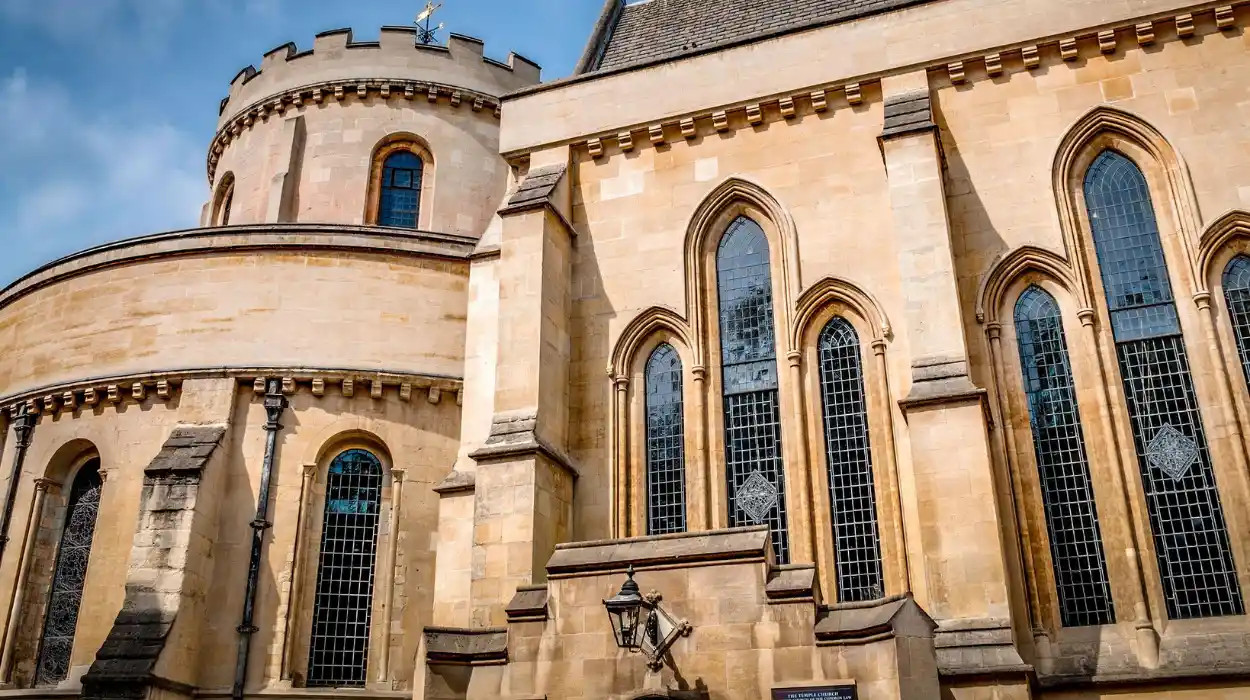
Temple Church reflects Crusader architecture through its circular nave, fortified appearance, Romanesque stonework, and symbolic imitation of Jerusalem’s Church of the Holy Sepulchre. These architectural choices reinforced the Knights Templar’s spiritual connection to the Crusades and the Holy Land.
The most distinctive feature of Temple Church is its round nave. Circular churches were rare in medieval England but carried deep symbolic meaning within Crusader culture.
The design directly referenced the Church of the Holy Sepulchre, believed to contain the tomb of Jesus Christ. By recreating this sacred geometry in London, the Knights Templar reinforced their role as guardians of Christianity’s holiest sites.
The nave measures roughly 55 feet in diameter and contains massive Purbeck marble columns supporting rounded Norman arches. Thick walls and heavy stone construction reflected the Romanesque architectural style dominant during the late 12th century.
During the early 13th century, a rectangular Gothic chancel was added under the patronage of Henry III. Pointed arches, ribbed vaulting, and larger windows introduced architectural innovations associated with early Gothic design.
Temple Church therefore preserves two major medieval architectural traditions within a single structure. The transition from Romanesque to Gothic style remains visible throughout the interior.
The church also demonstrates advanced medieval engineering. Stone vaulting improved acoustics while strengthening the structure against fire and collapse. Craftsmen used imported marble and finely carved limestone to create visual contrast and ceremonial grandeur.
Who are the famous knights buried inside Temple Church?
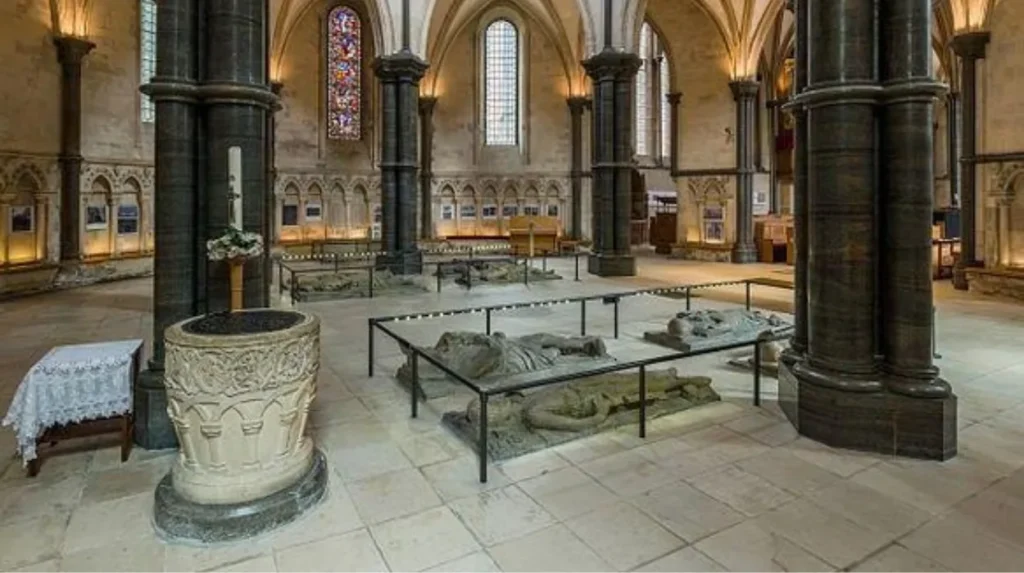
Temple Church contains several celebrated medieval knight effigies, including the tomb monument traditionally associated with William Marshal. These burials demonstrate the church’s importance among England’s aristocracy, military elites, and political leadership during the Middle Ages.
Among the church’s most famous features are its recumbent stone effigies. These sculptures depict medieval knights and nobles dressed in chainmail armour and Crusader-style garments.
The best-known monument commemorates William Marshal. Historians regard Marshal as one of the greatest knights of the medieval period. He served four English monarchs and acted as regent for the young Henry III following the death of King John in 1216.
William Marshal played a decisive role during the political crisis surrounding Magna Carta. His leadership stabilised England during civil war and preserved the Plantagenet monarchy.
Burial within Temple Church reflected exceptional prestige. The site served as a ceremonial and spiritual centre closely connected to royal authority and Crusader ideals.
Modern research indicates that not all effigies belonged to Knights Templar members. Several represented noble patrons who supported the order financially or politically.
The sculptures remain valuable archaeological resources. Conservation studies identified traces of medieval paint, proving the effigies originally displayed vivid colours rather than bare stone surfaces.
Temple Church therefore preserves one of Britain’s most important collections of medieval funerary sculpture.
How did Temple Church influence London’s legal district?
Temple Church influenced London’s legal district after former Templar lands became occupied by legal societies during the late Middle Ages. The Inner Temple and Middle Temple developed into major Inns of Court, shaping English legal education and common law traditions.
Following the suppression of the Knights Templar in the early 14th century, the Temple estate entered a period of institutional transition. Lawyers gradually leased buildings within the former monastic complex.
By the late medieval era, the Inner Temple and Middle Temple had emerged as permanent legal societies known as Inns of Court. These institutions trained barristers and provided accommodation, libraries, and professional networks for legal practitioners.
Temple Church became the shared chapel for both Inns. This arrangement created a direct institutional connection between medieval Crusader history and the evolution of English common law.
The Inns of Court played a major role in shaping constitutional development across Britain and the wider English-speaking world. Legal scholars trained in the Temple contributed to parliamentary governance, judicial reform, and colonial legal systems.
Notable legal figures associated with the Temple included Sir Edward Coke and William Blackstone, whose writings influenced constitutional law in Britain and the United States.
Today, the Temple district remains one of London’s most historic legal environments. Quiet courtyards, Georgian chambers, and medieval pathways preserve centuries of professional continuity.
To experience this historic legal district in person today, consult our comprehensive [Exploring London’s Inns of Court: A Quiet Courtyard Walk] for itineraries and visiting parameters.
Why did the Knights Templar collapse?
The Knights Templar collapsed after political accusations, royal financial pressures, and papal intervention destroyed the order during the early 14th century. Arrests, confiscations, and allegations of heresy led to the dissolution of one of medieval Europe’s most powerful organisations.
The decline of the Knights Templar accelerated after the fall of Acre in 1291, which ended the last major Crusader stronghold in the Holy Land. Without active military operations in Jerusalem, the order’s original mission weakened significantly.
At the same time, European monarchs accumulated large debts owed to the Templars. Philip IV of France faced severe financial difficulties after prolonged wars and currency instability.
On Friday 13 October 1307, Philip IV ordered mass arrests of Templars throughout France. Officials accused the order of heresy, blasphemy, and secret rituals. Many confessions were extracted under torture.
Pope Clement V eventually dissolved the order in 1312 through the papal decree Vox in excelso. Templar property across Europe transferred to other institutions, especially the Knights Hospitaller.
In England, the transition occurred less violently, but Temple Church and its surrounding lands still passed out of Templar control. Over time, legal institutions replaced military monastic administration within the Temple precincts.
The fall of the Templars remains one of medieval Europe’s most dramatic political collapses. Historians continue debating the extent to which accusations reflected genuine suspicion versus royal financial opportunism.

How was Temple Church damaged during the Second World War?
Temple Church suffered major destruction during the Blitz in 1941 when German bombing raids ignited fires throughout the Temple district. Postwar restoration rebuilt damaged interiors while preserving surviving medieval architectural elements and historical features.
Temple Church survived many earlier crises, including political unrest and the Great Fire of London in 1666. However, the Second World War caused unprecedented structural damage.
During bombing raids in May 1941, incendiary devices struck the Temple precincts. Fires spread through nearby legal chambers and eventually engulfed sections of the church.
The roof suffered severe destruction. Heat-damaged stone surfaces, cracked architectural details, and destroyed Victorian interior fittings. The church’s historic organ was also lost.
Restoration began after the war under architect Walter Godfrey. Conservation teams focused on recovering the church’s medieval appearance rather than replicating later decorative additions.
Temple Church reopened in 1958 following extensive repairs. Craftsmen reconstructed vaulting, restored masonry, and stabilised surviving monuments.
The restoration reflected broader postwar conservation efforts across London, where historic churches, civic buildings, and cultural landmarks required emergency preservation after wartime destruction.
Today, Temple Church stands as both a medieval monument and a symbol of London’s architectural resilience.
Why does Temple Church remain important today?
Temple Church remains important because it preserves rare Crusader architecture, medieval funerary monuments, and centuries of legal history within a living London institution. The church connects the history of the Crusades, English law, heritage conservation, and urban development in one surviving site.
Modern London contains relatively few intact Norman religious structures. Temple Church therefore provides rare evidence of 12th-century architecture and medieval craftsmanship within the modern city.
The church also preserves connections to major historical developments including the Crusades, Magna Carta, medieval banking, and the formation of English common law.
Its association with the Inner Temple and Middle Temple continues today. Barristers still use the church for ceremonial events, memorial services, and legal traditions linked to the Inns of Court.
Academic researchers regularly study the site’s archives, archaeological remains, and architectural features. Genealogists examine burial records and memorial inscriptions connected to aristocratic and legal families.
Temple Church additionally serves as a major cultural tourism destination. Visitors exploring St Paul’s Cathedral, Westminster Abbey, and the historic Temple district frequently include the church within walking itineraries focused on medieval London.
The building remains an active place of worship while functioning simultaneously as a heritage landmark, educational resource, and architectural monument.
Temple Church endures because it preserves physical evidence of how religion, warfare, law, and political power shaped the long-term development of London from the Crusader era to the present day.
What is Temple Church?
Temple Church is a medieval church in central London built by the Knights Templar during the 12th century. It served as the spiritual centre of the Templars’ English headquarters.