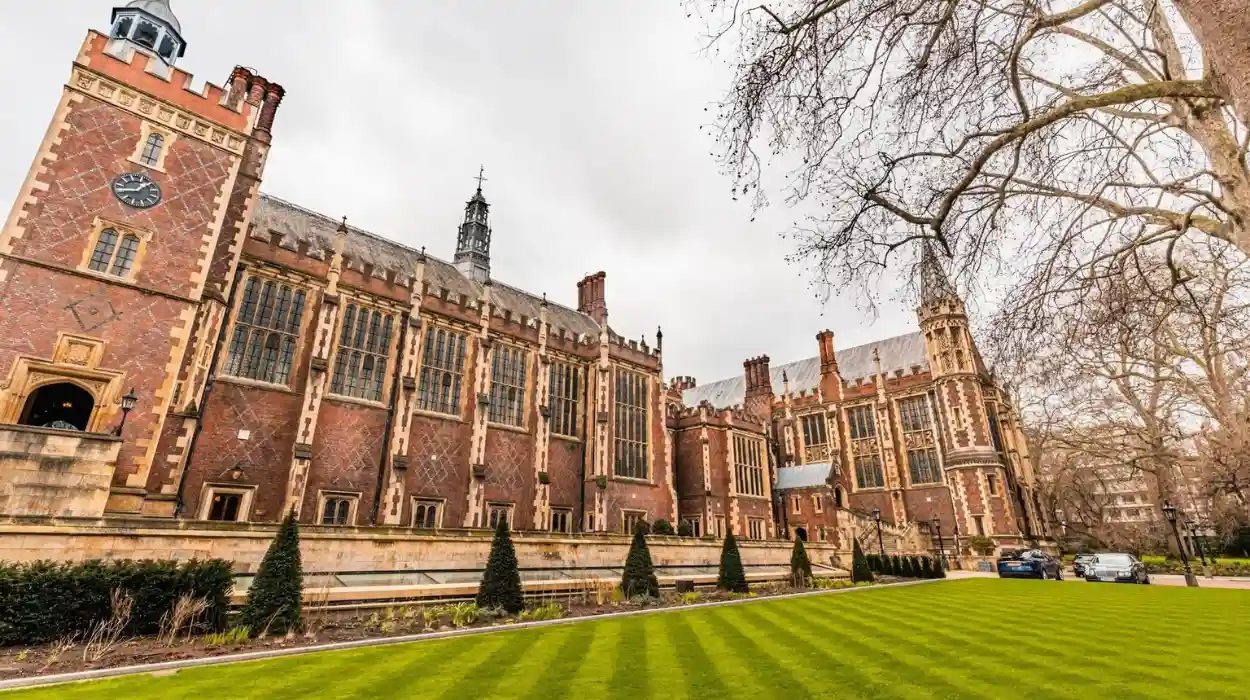
Lincoln’s Inn is one of the four historic Inns of Court that have educated barristers, governed legal practice, preserved constitutional traditions, and maintained one of London’s most significant legal estates for more than six centuries through continuous institutional development and architectural conservation.
- How did Lincoln’s Inn originate during medieval England?
- How did Lincoln’s Inn shape the education of English barristers?
- What historic buildings define Lincoln’s Inn today?
- Why have Lincoln’s Inn Gardens remained historically significant?
- How did Lincoln’s Inn influence England’s constitutional and legal development?
- Which notable historical figures have been associated with Lincoln’s Inn?
- How has Lincoln’s Inn survived wars, fires, and urban redevelopment?
- What role does Lincoln’s Inn play in modern London?
- Why does Lincoln’s Inn remain important to England’s cultural heritage?
Lincoln’s Inn occupies a unique place within England’s legal history. As one of the four Inns of Court in central London, it functions as both a professional association for barristers and a historic institution responsible for legal education, governance, and heritage preservation. Together with the Inner Temple, Middle Temple, and Gray’s Inn, Lincoln’s Inn has shaped the English legal profession since the late medieval period.
Located between Holborn and Covent Garden, the Inn developed within an area that gradually became London’s legal district. Its proximity to the Royal Courts of Justice, Westminster, and the City of London strengthened its importance as the English legal system expanded.
Unlike universities, the Inns of Court historically provided practical legal education. Students learned through observation, formal readings, debates, and participation in legal proceedings. This apprenticeship-based model influenced legal education for centuries before modern vocational training emerged.
Today, Lincoln’s Inn continues to admit barristers to the Bar while maintaining a remarkable collection of medieval, Tudor, Georgian, Victorian, and twentieth-century buildings. Its grounds remain private in parts but welcome visitors to selected historic spaces, reflecting an enduring balance between professional use and public heritage.
How did Lincoln’s Inn originate during medieval England?
Lincoln’s Inn emerged during the fourteenth century as lawyers established permanent communities outside the City of London’s jurisdiction, creating dedicated centres for legal education, accommodation, professional governance, and courtroom preparation that evolved into England’s Inns of Court.
The precise origins of Lincoln’s Inn remain uncertain because few contemporary records survive from its earliest decades. Historical evidence places the Inn’s existence by the early 1400s, while legal communities occupied the surrounding land during the late thirteenth and fourteenth centuries.
Most historians associate the Inn’s name with Henry de Lacy, 3rd Earl of Lincoln, whose London property likely occupied part of the site before legal practitioners established permanent chambers there. Although direct ownership links remain debated, the association became firmly embedded in the institution’s identity.
The fourteenth century witnessed substantial growth in England’s legal administration. Royal courts handled increasing numbers of property disputes, inheritance claims, commercial litigation, and criminal prosecutions. Lawyers required accommodation close to Westminster while remaining outside restrictive municipal regulations imposed within the City of London.
The Inns of Court emerged as self-governing communities that combined residential life with legal education. Students, experienced barristers, judges, and legal clerks lived and worked together. This environment encouraged professional standards, institutional continuity, and practical learning.
Lincoln’s Inn steadily acquired neighbouring land, allowing its buildings and gardens to expand as membership increased. By the fifteenth century, it had become one of England’s leading legal institutions.
How did Lincoln’s Inn shape the education of English barristers?
Lincoln’s Inn transformed legal education by combining residential learning, professional mentoring, courtroom observation, formal lectures, and institutional discipline into a structured pathway that prepared generations of barristers for advocacy and judicial service.
Before modern law schools existed, aspiring barristers joined one of the Inns of Court to receive practical legal instruction.
Education centred on several complementary activities.
Students attended formal readings delivered by experienced lawyers interpreting statutes and legal precedents. Moot courts allowed members to argue hypothetical disputes before senior barristers. Dining in Hall formed another educational component because legal discussions continued during shared meals.
This educational model emphasized practical reasoning instead of theoretical instruction alone.
The Inn regulated admission standards, professional conduct, and eventual qualification for legal practice. Only members who satisfied educational requirements received the right to be called to the Bar.
Many distinguished judges, legal scholars, government ministers, and Lord Chancellors trained within Lincoln’s Inn. Their careers reinforced the institution’s national reputation.
Even after universities introduced formal legal degrees, vocational training remained closely connected with the Inns of Court. Today, Lincoln’s Inn continues supporting professional development through scholarships, educational programmes, advocacy training, and continuing legal education.

What historic buildings define Lincoln’s Inn today?
Lincoln’s Inn preserves an exceptional collection of medieval, Tudor, Georgian, Victorian, and modern buildings that collectively illustrate more than six centuries of architectural development within England’s legal profession and institutional history.
The architectural landscape of Lincoln’s Inn reflects continuous adaptation rather than large-scale replacement.
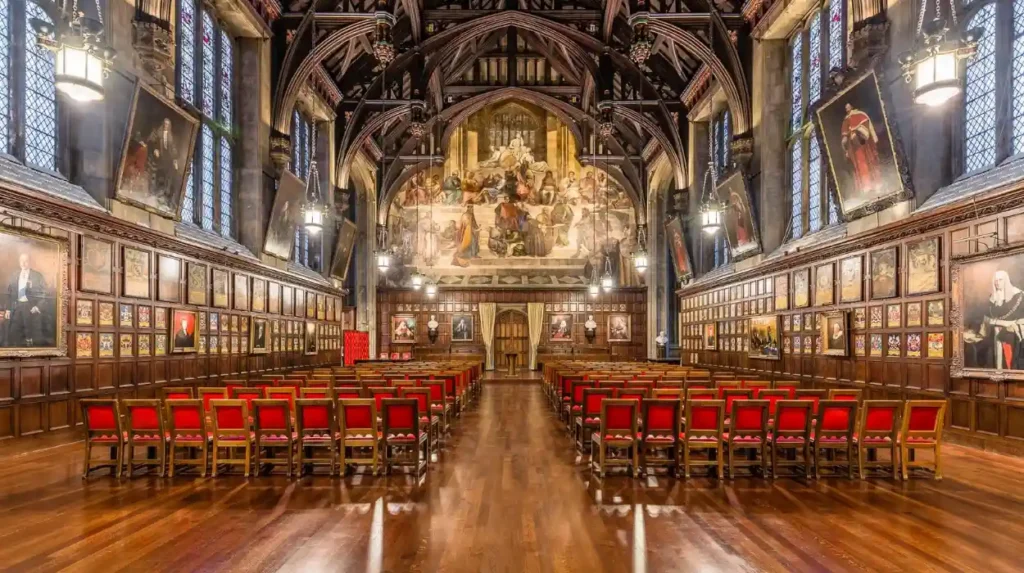
The Great Hall stands among London’s finest examples of Tudor institutional architecture. Completed in 1845 after extensive restoration and earlier rebuilding phases, it occupies the historic site where communal dining and legal education occurred for centuries. Its timber roof, stained glass, heraldic decoration, and portraits commemorate prominent legal figures associated with the Inn.
The Chapel, designed by Inigo Jones and consecrated in 1623, represents one of London’s earliest classical ecclesiastical buildings. Its restrained Renaissance architecture marked an important transition from medieval Gothic styles toward classical design.
The Old Hall preserves elements dating from the late fifteenth century. Before construction of the present Great Hall, it served as the principal gathering place for members.
Stone Buildings, completed during the eighteenth century, introduced Georgian architectural principles into the Inn while providing additional accommodation for barristers.
New Square and adjoining chambers demonstrate how later generations expanded facilities without abandoning the historic layout established during the medieval period.
Together these structures create one of Britain’s most complete surviving legal architectural ensembles.
Why have Lincoln’s Inn Gardens remained historically significant?
Lincoln’s Inn Gardens represent one of central London’s earliest planned green spaces, providing recreation, reflection, and environmental continuity while preserving historic landscape traditions within an active professional legal community for several centuries.
The gardens form an essential component of the Inn’s historic character rather than merely decorative surroundings.
Historical records indicate landscaped grounds existed by the sixteenth century. Over time they developed into carefully managed open spaces reserved primarily for members while occasionally welcoming the wider public.
The gardens offered practical benefits. Lawyers and judges used them for exercise, conversation, and informal professional meetings between court sessions.
Their design reflects changing landscape fashions from formal Renaissance layouts toward more natural eighteenth-century planting schemes.
Mature trees planted over several centuries contribute ecological as well as historical value. Some specimens date back well over one hundred years, preserving biodiversity within central London.
The gardens also create visual separation between legal chambers and surrounding urban development, maintaining the distinctive atmosphere that characterizes the Inns of Court.
Today they remain among London’s most tranquil historic landscapes despite their location near busy commercial districts.
To experience this historic landmark in person today, consult our comprehensive [Exploring Lincoln’s Inn: Historic Buildings, Gardens and Guided Walks] for itineraries and visiting parameters.
How did Lincoln’s Inn influence England’s constitutional and legal development?
Lincoln’s Inn contributed directly to England’s constitutional evolution by educating judges, legislators, and barristers who interpreted common law, advised governments, and participated in landmark legal reforms across multiple historical periods.
England’s constitutional system developed gradually through judicial decisions, parliamentary legislation, and legal precedent rather than a single written constitution.
Barristers trained at Lincoln’s Inn participated in many of these developments.
Members served as judges in the superior courts, where judicial decisions established precedents that shaped property law, criminal justice, commercial regulation, and constitutional interpretation.
Numerous Lord Chancellors belonged to the Inn. The office historically combined judicial leadership with political responsibility, making its holders influential figures within government.
The Inn also contributed to parliamentary governance because many members entered the House of Commons or House of Lords after distinguished legal careers.
Legal education at Lincoln’s Inn emphasized close study of common law principles. This tradition reinforced continuity within England’s evolving constitutional framework while allowing gradual legal reform through precedent.
The institution therefore influenced both the administration of justice and the broader development of British government.
Which notable historical figures have been associated with Lincoln’s Inn?
Lincoln’s Inn has educated and hosted numerous distinguished judges, lawyers, statesmen, scholars, and public officials whose legal careers significantly influenced English law, parliamentary government, imperial administration, and international jurisprudence across several centuries.
Among the Inn’s most celebrated members was Sir Thomas More, lawyer, scholar, and Lord Chancellor under King Henry VIII. His legal education reflected the close relationship between humanist scholarship and Tudor governance.
William Blackstone, whose Commentaries on the Laws of England became one of the most influential legal texts in the English-speaking world, maintained strong associations with the Inns of Court tradition that shaped legal education.
Lord Mansfield, widely regarded as one of England’s greatest judges, transformed commercial law during the eighteenth century. His judicial reasoning influenced legal systems across Britain, North America, and many Commonwealth jurisdictions.
Throughout the nineteenth and twentieth centuries, Lincoln’s Inn continued producing senior judges, Attorneys General, Lord Chancellors, diplomats, and legal academics.
Its scholarship programmes have also supported students from across the Commonwealth, reinforcing international legal connections established during the era of the British Empire.
How has Lincoln’s Inn survived wars, fires, and urban redevelopment?
Lincoln’s Inn preserved its historic identity through careful rebuilding, institutional continuity, conservation planning, and heritage protection despite experiencing fires, wartime bombing, architectural alteration, and extensive changes across central London during several centuries.
Like much of historic London, Lincoln’s Inn experienced repeated threats from fire.
Individual buildings required rebuilding or extensive repairs following accidental damage during different historical periods.
The twentieth century presented new challenges. German bombing during the Second World War damaged several structures across the Inn’s estate. Restoration programmes carefully repaired historic buildings while respecting their original architectural character.
Unlike many parts of central London, Lincoln’s Inn escaped wholesale redevelopment during the post-war decades.
Its status as an active legal institution encouraged long-term stewardship rather than commercial replacement.
Conservation policies introduced during the twentieth century further strengthened protection for historic buildings, landscapes, and archaeological remains.
Today many structures within the estate hold statutory listed status, recognising their national architectural and historical significance.
What role does Lincoln’s Inn play in modern London?
Lincoln’s Inn remains an active legal institution that combines professional education, heritage conservation, public engagement, scholarly research, and historic preservation while continuing its centuries-old responsibility for training England’s future barristers.
Although deeply rooted in history, Lincoln’s Inn functions as a living institution rather than a museum.
The Inn continues admitting student members seeking qualification as barristers.
Professional education now combines advocacy training, ethics instruction, practical skills development, mentoring, scholarships, and continuing education programmes.
Historic buildings remain fully integrated into daily legal practice. Barristers occupy chambers surrounding the estate, maintaining the traditional relationship between residence, professional work, and institutional life.
The Inn also supports academic research through its library, which contains extensive collections of legal manuscripts, rare books, parliamentary materials, and historical archives.
Public engagement has expanded through heritage open days, guided tours, educational partnerships, exhibitions, and cultural events that introduce wider audiences to England’s legal history.
This combination of professional activity and heritage preservation distinguishes Lincoln’s Inn from many historic institutions that no longer perform their original functions.
Why does Lincoln’s Inn remain important to England’s cultural heritage?
Lincoln’s Inn preserves an unbroken connection between medieval legal education, constitutional history, architectural heritage, and contemporary justice, making it one of Britain’s most significant surviving institutional landscapes and an enduring symbol of the English common law tradition.
Lincoln’s Inn represents far more than a collection of historic buildings.
Its continuous operation for more than six centuries provides rare institutional continuity within English history.
The estate preserves architectural evidence from successive historical periods, including medieval foundations, Renaissance design, Georgian expansion, Victorian restoration, and modern conservation.
Its educational traditions helped establish professional standards that influenced legal systems throughout Britain and across many Commonwealth nations.
The gardens demonstrate how historic landscapes continue serving practical functions within dense urban environments.
Its archives preserve invaluable documentary evidence for historians researching legal practice, governance, genealogy, architecture, and London’s urban development.
For cultural tourists, Lincoln’s Inn offers direct access to one of the environments where English common law evolved through centuries of professional practice.
For educators and students, it provides a tangible connection to constitutional development, legal education, and institutional history.
For heritage specialists, it demonstrates how active professional communities can successfully preserve historic places while adapting to changing social and legal requirements.
As London continues evolving, Lincoln’s Inn remains one of the capital’s most remarkable examples of living heritage. It combines architectural conservation, legal education, historical scholarship, and public engagement within the same historic estate. This enduring balance explains why Lincoln’s Inn continues to rank among England’s foremost legal, cultural, and historical landmarks, preserving the traditions of the common law while serving the legal profession of the twenty-first century.
What is Lincoln’s Inn?
Lincoln’s Inn is one of the four historic Inns of Court in London responsible for educating and admitting barristers to the Bar of England and Wales. It has served the legal profession for more than 600 years.