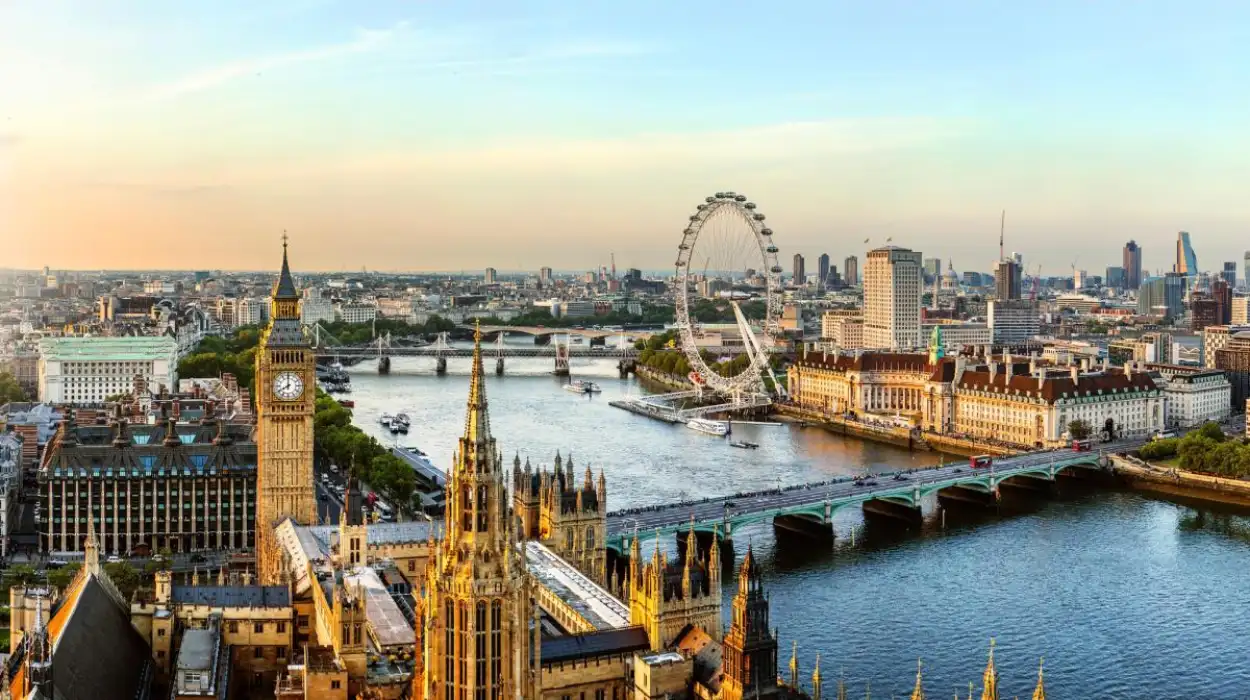
London’s iconic landmarks represent more than architectural achievements. They preserve the political, cultural, religious, commercial, and social history of England across nearly two millennia. Roman foundations, medieval fortifications, Tudor palaces, Victorian engineering, and modern conservation efforts combine to create one of the world’s richest historic urban landscapes. Today, these landmarks remain essential national heritage assets, internationally recognised tourist destinations, and valuable educational resources that explain how London developed into a global capital.
- Why are London’s iconic landmarks historically significant?
- How did London’s history shape its most famous landmarks?
- Roman Londinium (AD 43–410)
- Norman England (1066–1485)
- Tudor and Stuart London
- Georgian and Victorian London
- What stories does the Tower of London tell about British history?
- Why is Westminster Abbey one of Britain’s most important historic buildings?
- Why has Buckingham Palace become the symbol of the British monarchy?
- How did Tower Bridge become an engineering icon?
- Why is the Palace of Westminster central to British democracy?
- What makes St Paul’s Cathedral a masterpiece of British architecture?
- How has the British Museum preserved global history?
- Why does the Monument to the Great Fire of London remain historically important?
- How are London’s historic landmarks protected for future generations?
- Why do London’s iconic landmarks remain relevant today?
- Frequently Asked Question
Why are London’s iconic landmarks historically significant?
London’s iconic landmarks preserve nearly 2,000 years of continuous history, illustrating the evolution of political authority, royal power, religion, trade, engineering, and public life. Together they document the city’s transformation from Roman Londinium into one of the world’s leading cultural and financial capitals.
Every major period of British history has left visible evidence across London’s built environment. Roman walls, Norman castles, medieval churches, Tudor palaces, Georgian public squares, Victorian bridges, and twentieth-century memorials remain integrated into the modern city.
Unlike many European capitals that experienced widespread rebuilding after war, London retains an exceptional concentration of historic structures representing multiple eras within relatively short distances.
These landmarks also provide evidence for significant historical developments including the Norman Conquest of 1066, the English Reformation, the Great Fire of London in 1666, the Industrial Revolution, the expansion of the British Empire, and post-war reconstruction following the Second World War.
Their preservation reflects centuries of conservation policy led by organisations including Historic England, the City of London Corporation, English Heritage, and UNESCO.
How did London’s history shape its most famous landmarks?
Successive periods of conquest, monarchy, commerce, industrialisation, and urban expansion shaped London’s landmark buildings. Each generation adapted existing structures or constructed new monuments that reflected changing political priorities, religious practices, technological advances, and economic growth across England.
Roman Londinium (AD 43–410)
The Romans established Londinium around AD 43 following Emperor Claudius’ invasion of Britain.
Roman engineers constructed roads, defensive walls, temples, bathhouses, and bridges that established London’s first permanent urban framework.
Fragments of the Roman Wall remain visible near Tower Hill and the Barbican, demonstrating advanced military engineering and urban planning.
Norman England (1066–1485)
Following William the Conqueror’s victory at the Battle of Hastings in 1066, Norman rulers transformed London’s skyline.
Stone castles, fortified churches, and administrative buildings projected royal authority while strengthening political control.
The Tower of London became the most prominent Norman symbol of power.
Tudor and Stuart London
The Tudor dynasty expanded royal residences and strengthened London’s political influence.
Westminster developed into the permanent centre of government.
Churches and monasteries changed dramatically during Henry VIII’s Dissolution of the Monasteries between 1536 and 1541.
Georgian and Victorian London
Rapid population growth during the eighteenth and nineteenth centuries created demand for improved transport, sanitation, government buildings, museums, and railway stations.
Victorian engineers introduced cast iron, steel, and new construction techniques that enabled larger bridges, public buildings, and infrastructure projects.
What stories does the Tower of London tell about British history?
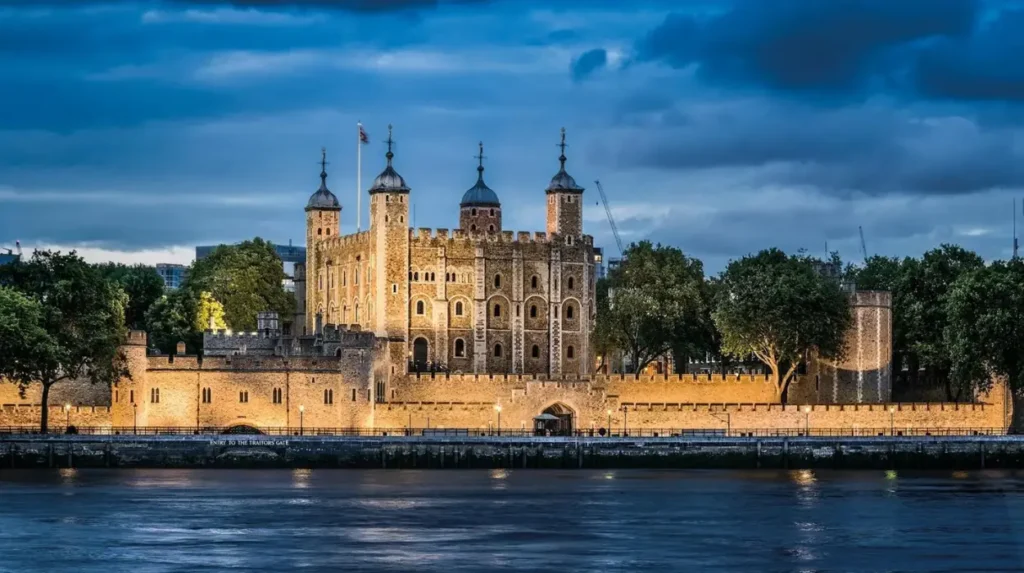
The Tower of London records nearly one thousand years of monarchy, military defence, imprisonment, royal ceremony, and constitutional development. Built after the Norman Conquest, it remains one of Britain’s most significant medieval fortresses and a UNESCO World Heritage Site.
Norman origins
William the Conqueror ordered construction of the White Tower around 1078.
Its massive stone walls demonstrated Norman military superiority over recently conquered England.
The fortress later expanded into a complex containing defensive walls, towers, gates, barracks, and royal accommodation.
Royal residence and prison
Although originally designed as a royal fortress, the Tower served multiple purposes.
It housed monarchs, government records, the Royal Mint, the Royal Menagerie, and eventually famous prisoners.
Notable prisoners included Anne Boleyn, Sir Thomas More, Lady Jane Grey, and Guy Fawkes.
Several political executions connected the Tower directly to constitutional and religious conflicts during the Tudor period.
Modern significance
Today the Tower protects the Crown Jewels and welcomes millions of visitors annually.
Its preservation illustrates medieval military architecture while supporting ongoing archaeological research into Norman London.
To experience this historic landmark in person today, consult our comprehensive [Most Instagrammable Places in London for Stunning Travel Photos and Social Media Content] for itineraries and visiting parameters.
Why is Westminster Abbey one of Britain’s most important historic buildings?
Westminster Abbey has hosted royal coronations since 1066 and contains the burial places of monarchs, scientists, poets, military leaders, and statesmen. It represents nearly one thousand years of religious, political, and national ceremonial history.
Construction of the present Gothic church began under King Henry III in 1245, replacing earlier religious buildings.
The Abbey became England’s ceremonial church because coronations established political legitimacy through religious ritual.
Every British monarch since William the Conqueror has been crowned inside Westminster Abbey except Edward V and Edward VIII.
The building contains more than 3,300 burials and memorials.
Prominent historical figures commemorated include Isaac Newton, Charles Darwin, Geoffrey Chaucer, Elizabeth I, Mary I, Stephen Hawking, and numerous prime ministers.
Poets’ Corner developed into Britain’s principal national memorial for writers and literary achievement.
The Abbey remains an active church while functioning as one of Britain’s most important heritage sites.
Why has Buckingham Palace become the symbol of the British monarchy?
Buckingham Palace evolved from an eighteenth-century townhouse into the official London residence of the British monarch. Today it symbolises constitutional monarchy, state ceremony, national continuity, and the modern role of the Royal Family.
Originally constructed in 1703 as Buckingham House, the property became royal ownership in 1761 when King George III purchased it for Queen Charlotte.
Architect John Nash supervised major expansions during the reign of George IV.
Queen Victoria became the first monarch to reside permanently in Buckingham Palace following her accession in 1837.
The palace now contains approximately 775 rooms, including state apartments, offices, guest suites, and ceremonial spaces.
Events including Trooping the Colour, state visits, royal receptions, and balcony appearances reinforce its constitutional significance.
The palace also houses valuable artworks within the Royal Collection.
How did Tower Bridge become an engineering icon?
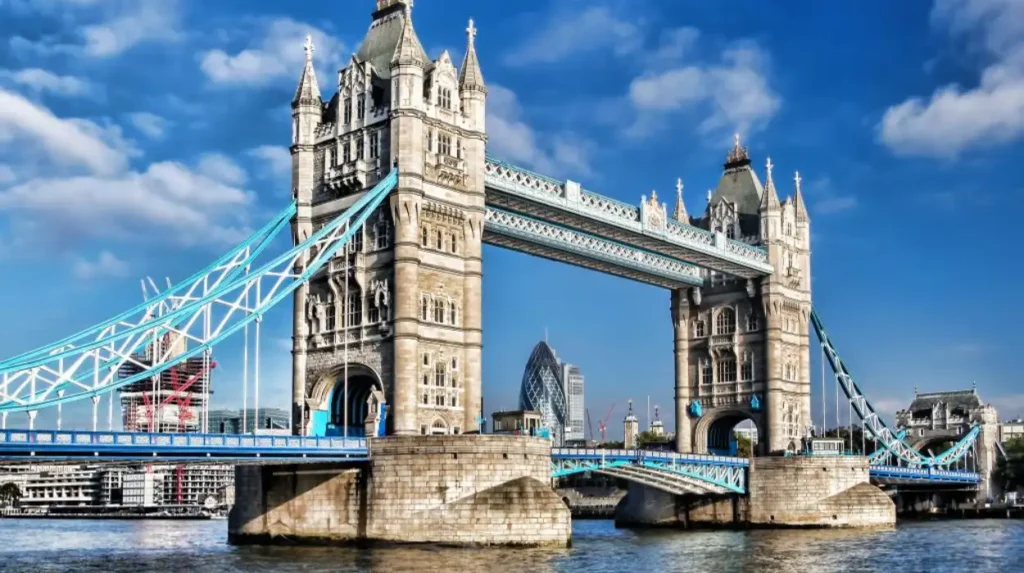
Tower Bridge demonstrates Victorian engineering innovation through its combined bascule and suspension bridge design. Completed in 1894, it solved growing transport demands while preserving river navigation along the busy commercial Port of London.
During the nineteenth century, increased commercial traffic required additional Thames crossings.
Engineers Sir John Wolfe Barry and Sir Horace Jones designed a bridge that allowed ships to pass without interrupting road transport.
Construction began in 1886.
More than 11,000 tons of steel formed the structural framework before granite and Portland stone created its Gothic appearance.
Originally powered by steam-driven hydraulic machinery, the bridge now operates using modern hydraulic systems.
Tower Bridge remains one of London’s most photographed structures while continuing its original transportation function.
Why is the Palace of Westminster central to British democracy?
The Palace of Westminster houses the United Kingdom Parliament and represents centuries of constitutional development. Its buildings reflect democratic governance, legislative authority, and the evolution of parliamentary institutions following medieval royal government.
The original medieval palace served as England’s principal royal residence.
A devastating fire destroyed much of the complex in 1834.
Architect Charles Barry and designer Augustus Pugin created the current Gothic Revival structure between 1840 and 1876.
The complex includes the House of Commons, House of Lords, committee rooms, Westminster Hall, libraries, and offices.
The Elizabeth Tower, completed in 1859, contains the Great Bell known worldwide as Big Ben.
Parliament continues to legislate from this historic site, linking modern democracy with centuries of constitutional tradition.
What makes St Paul’s Cathedral a masterpiece of British architecture?
St Paul’s Cathedral symbolises London’s recovery after the Great Fire of London in 1666. Designed by Sir Christopher Wren, it represents scientific engineering, Baroque architecture, religious continuity, and national resilience.
The medieval cathedral suffered catastrophic destruction during the Great Fire.
Architect Sir Christopher Wren designed a completely new cathedral between 1675 and 1710.
Its dome reaches approximately 111 metres, making it one of Europe’s largest cathedral domes.
Innovative structural engineering enabled the impressive triple-dome design.
St Paul’s hosted nationally significant ceremonies including the funeral of Sir Winston Churchill, the wedding of Charles, Prince of Wales, and Lady Diana Spencer, and numerous national thanksgiving services.
The cathedral famously survived the Blitz despite extensive bombing across surrounding areas during the Second World War.
Its silhouette became an enduring symbol of London’s resilience.
How has the British Museum preserved global history?
The British Museum preserves millions of archaeological, artistic, and historical objects representing human civilisation across continents. Since opening in 1759, it has become one of the world’s leading research institutions and public museums.
Established through the collections of physician Sir Hans Sloane, the museum became the world’s first national public museum.
Its holdings now exceed eight million objects.
Collections document civilisations including Ancient Egypt, Mesopotamia, Greece, Rome, Asia, Africa, Oceania, and the Americas.
Notable artefacts include the Rosetta Stone, Parthenon sculptures, Lewis Chessmen, and extensive Roman Britain collections.
Researchers use these collections to study archaeology, anthropology, art history, conservation science, and ancient languages.
The museum continues to expand digital access while undertaking conservation research.
Why does the Monument to the Great Fire of London remain historically important?
The Monument commemorates the Great Fire of London in 1666, one of the most transformative disasters in British urban history. It symbolises London’s rebuilding programme and the emergence of modern urban planning and fire prevention.
Designed by Sir Christopher Wren and Dr Robert Hooke, the Monument stands precisely 202 feet from the bakery on Pudding Lane where the fire began.
Completed in 1677, it reaches the same height of 202 feet.
The Great Fire destroyed approximately 13,200 houses, 87 parish churches, numerous civic buildings, and St Paul’s Cathedral.
Although the disaster devastated medieval London, reconstruction introduced wider streets, improved building regulations, and greater use of brick and stone instead of timber.
The Monument remains both a scientific achievement and an architectural memorial.
How are London’s historic landmarks protected for future generations?
Government legislation, conservation organisations, scientific research, and international cooperation protect London’s landmarks through restoration, legal designation, archaeological investigation, and sustainable visitor management that preserves historic authenticity while supporting public access.
Historic England maintains the National Heritage List for England, identifying listed buildings according to architectural and historic significance.
Many London landmarks receive Grade I listing, the highest level of statutory protection.
UNESCO designated the Tower of London, Maritime Greenwich, Westminster, and Kew Gardens as World Heritage Sites because of their Outstanding Universal Value.
Conservation specialists employ laser scanning, structural monitoring, digital modelling, and traditional craftsmanship to maintain ageing buildings.
Archaeological investigations continue beneath London’s streets, regularly uncovering Roman roads, medieval foundations, Tudor artefacts, and Victorian infrastructure.
Climate change has increased attention toward flood resilience, pollution management, and long-term conservation planning.
Educational programmes encourage public understanding of heritage preservation while supporting responsible tourism.
Why do London’s iconic landmarks remain relevant today?
London’s historic landmarks continue serving educational, constitutional, cultural, economic, and community purposes. They connect contemporary society with documented historical evidence while supporting tourism, academic research, national identity, and international cultural exchange across generations.
These landmarks generate substantial economic value through tourism, hospitality, education, and cultural industries.
Millions of visitors travel to London each year specifically to explore its historic environment, contributing significantly to the city’s economy.
Universities, schools, historians, archaeologists, architects, and genealogical researchers rely upon these sites to study Britain’s political development, urban growth, architectural innovation, and family histories.
Modern technology has expanded access through digital archives, virtual tours, laser documentation, and three-dimensional modelling.
These initiatives strengthen historical research while reducing physical pressure on vulnerable structures.
The continued preservation of London’s iconic landmarks demonstrates that historic buildings are active educational resources rather than static monuments. Their architecture records changing engineering techniques. Their interiors preserve evidence of political decisions, religious transformation, royal ceremony, and scientific achievement. Their surrounding landscapes reveal centuries of urban development.
Together, the Tower of London, Westminster Abbey, Buckingham Palace, Tower Bridge, the Palace of Westminster, St Paul’s Cathedral, the British Museum, and the Monument to the Great Fire of London form an interconnected historical narrative spanning nearly two thousand years. They explain how London evolved from a Roman settlement into a global city while preserving the physical evidence of Britain’s constitutional, cultural, and architectural heritage.
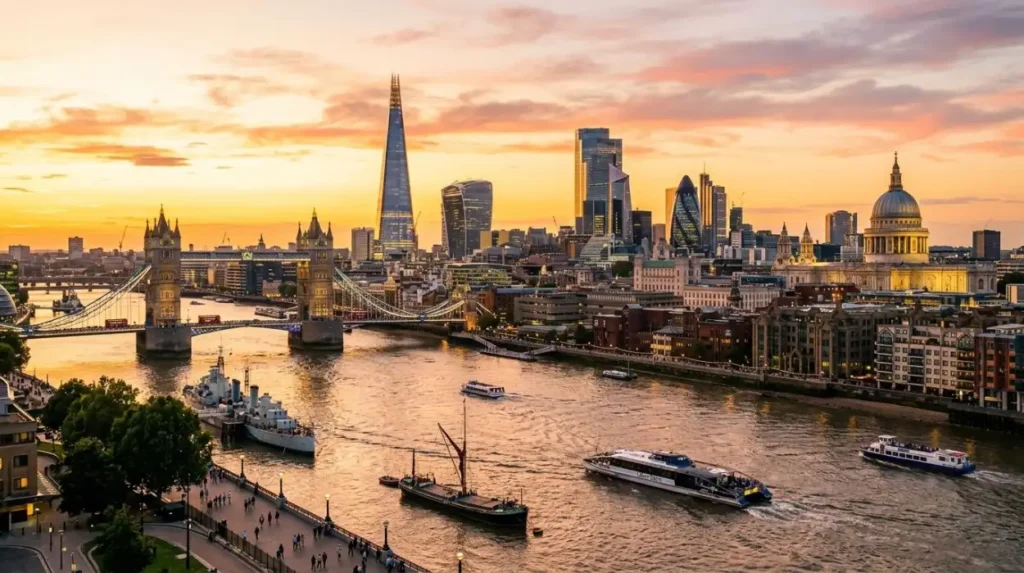
As conservation science advances and public engagement grows, these landmarks will continue informing future generations about the people, institutions, and events that shaped London. Their enduring historical significance ensures they remain among the world’s most valuable cultural assets and among the strongest symbols of Britain’s national heritage.
Frequently Asked Question
What are London’s most iconic historical landmarks?
London’s most iconic historical landmarks include the Tower of London, Westminster Abbey, Buckingham Palace, Tower Bridge, the Palace of Westminster, St Paul’s Cathedral, the British Museum, and the Monument to the Great Fire of London.