Notting Hill is one of west London’s most recognisable districts, known for Victorian terraces, Portobello Road Market, colourful residential streets, independent cafés, cultural institutions, and Notting Hill Carnival. Its present character developed through 19th-century urban expansion, migration, commerce, transport investment, social conflict, and later regeneration.
- Why is Notting Hill historically important?
- Which Notting Hill streets are the most beautiful and historically significant?
- How did Portobello Road become one of London’s most famous streets?
- What architecture should visitors look for in Notting Hill?
- Where can visitors find Notting Hill’s historic cafés and local food culture?
- How did migration transform Notting Hill?
- Why is Notting Hill Carnival historically important?
- Which local attractions best explain Notting Hill’s history?
- How has Notting Hill changed since the 1970s?
- How is Portobello Road being preserved for the future?
- What does Notting Hill reveal about London’s wider history?
- How can visitors explore Notting Hill’s historic streets today?
- Frequently Asked Question
The district forms part of the Royal Borough of Kensington and Chelsea. Its historic environment contains Victorian and Edwardian architecture alongside later commercial development. The Ladbroke Conservation Area, Colville Conservation Area, and surrounding protected areas preserve important elements of the neighbourhood’s historic townscape. The Royal Borough identifies Ladbroke as an area mainly developed during the 19th century, with substantial Victorian and Edwardian architecture.
Notting Hill is also a useful place for understanding London’s wider social history. Portobello Road developed from a rural lane into a market street. Railway construction accelerated urbanisation. Caribbean migration transformed local culture after the Second World War. The area later became associated with the Notting Hill Carnival, independent retail, antiques, music, fashion, film, and international tourism.
Its streets therefore have significance beyond appearance. Their layouts, terraces, shopfronts, markets, churches, public spaces, and surviving buildings record successive phases of London’s development.
Why is Notting Hill historically important?
Notting Hill is historically important because its streets preserve Victorian urban growth, market development, migration, Caribbean culture, anti-racist activism, conservation, and changing patterns of commerce within one densely developed London district.
Before large-scale development, much of the area consisted of fields, farms, lanes, brickworks, and scattered settlements west of central London. The district was outside the dense urban core and retained a semi-rural character during the 18th century.
Portobello Road provides one of the clearest examples of this transformation. London Museum records that the road began as a country lane through farmland and took its name from Portobello Farm. The farm commemorated Britain’s naval victory at Porto Bello in Panama in 1739.
The 19th century fundamentally changed Notting Hill. London’s population expanded rapidly, transport infrastructure improved, and developers constructed terraces, villas, crescents, mews, shops, and working-class housing.
The arrival of railway infrastructure accelerated this process. The Hammersmith and City Railway was completed through the area in 1864, and Ladbroke Grove station opened as part of this expansion. The railway connected the developing neighbourhood with wider London and strengthened demand for housing and commercial services.
Notting Hill subsequently became a mixed residential and commercial district. Affluent residents occupied some of the larger terraces and villas, while labourers, servants, artisans, traders, and other working residents occupied smaller properties and denser housing.
This mixture remained important throughout the 20th century. Post-war migration added Caribbean, Spanish, Portuguese, and other communities. These communities influenced food, music, commerce, religion, festivals, and street life.
The district’s heritage therefore combines architectural history with social history. A walk through Notting Hill reveals both.
Which Notting Hill streets are the most beautiful and historically significant?
Notting Hill’s most distinctive historic streets include Portobello Road, Westbourne Grove, Elgin Crescent, Lansdowne Crescent, Ladbroke Gardens, Pembridge Road, and Kensington Park Road, where Victorian architecture and commercial heritage remain highly visible.
Portobello Road is the area’s best-known historic street. Its importance comes from the combination of market activity, Victorian development, migration, antiques, fashion, music, and popular culture.
Westbourne Grove forms another major commercial corridor. Its shops, cafés, restaurants, and Victorian buildings illustrate the transition from a traditional local shopping street to a high-profile urban destination.
Elgin Crescent is notable for its long terrace of 19th-century houses. The street forms part of the wider Ladbroke estate development, where planned residential construction transformed former agricultural land.
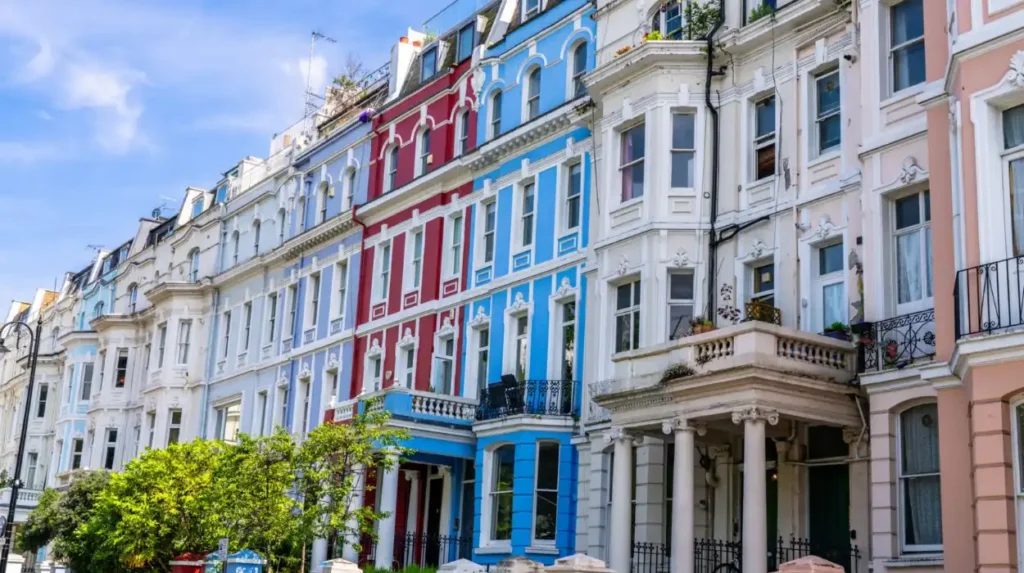
Ladbroke Gardens also reflects the area’s planned Victorian expansion. The architecture includes stuccoed terraces, decorative details, railings, balconies, and repeated façades typical of west London’s 19th-century residential development.
Lansdowne Crescent and nearby streets provide further examples of the estate-based development that shaped Notting Hill. Their curved layouts and consistent terraces demonstrate how developers used planned streets to create desirable residential districts.
Pembridge Road has an important relationship with Portobello Road. The Royal Borough identifies smaller Victorian properties and boutiques along Pembridge Road as part of the approach to Portobello Road.
Kensington Park Road provides another connection between residential architecture and the commercial life of North Kensington. Its historic buildings sit within a neighbourhood shaped by successive waves of development and migration.
These streets are not simply picturesque locations. Their architectural consistency records a period when London developers created large residential estates outside the older central districts.
How did Portobello Road become one of London’s most famous streets?
Portobello Road became famous through a sequence of rural origins, Victorian urbanisation, market formation, post-war antiques trading, Caribbean settlement, creative industries, tourism, and popular culture that transformed a country lane into an internationally recognised destination.
Portobello Road’s early history was agricultural. Portobello Farm stood in the countryside west of London, and the lane leading towards it eventually adopted the Portobello name.
Urban development accelerated during the middle decades of the 19th century. Growing populations in Paddington and Bayswater created demand for local shops and food markets. New houses brought residents, while railway connections increased accessibility.
The market was established by about 1870. London Museum describes the original activity as a fresh-food and essentials market serving the growing local population.
The market changed significantly after the Second World War. Antique dealers and second-hand traders moved into Portobello following changes elsewhere in London’s market network. Antiques gradually became a defining part of the street’s identity.
The market also became connected with London’s creative communities during the 1950s and 1960s. Artists, musicians, designers, collectors, and independent traders were attracted by relatively inexpensive premises and the street’s established market culture.
Portobello’s Caribbean influence became particularly significant during the post-war period. Caribbean migrants settled in Notting Hill and contributed to the area’s commercial and cultural identity. Food stalls introduced ingredients including yams, sweet potatoes, and green bananas alongside established British produce.
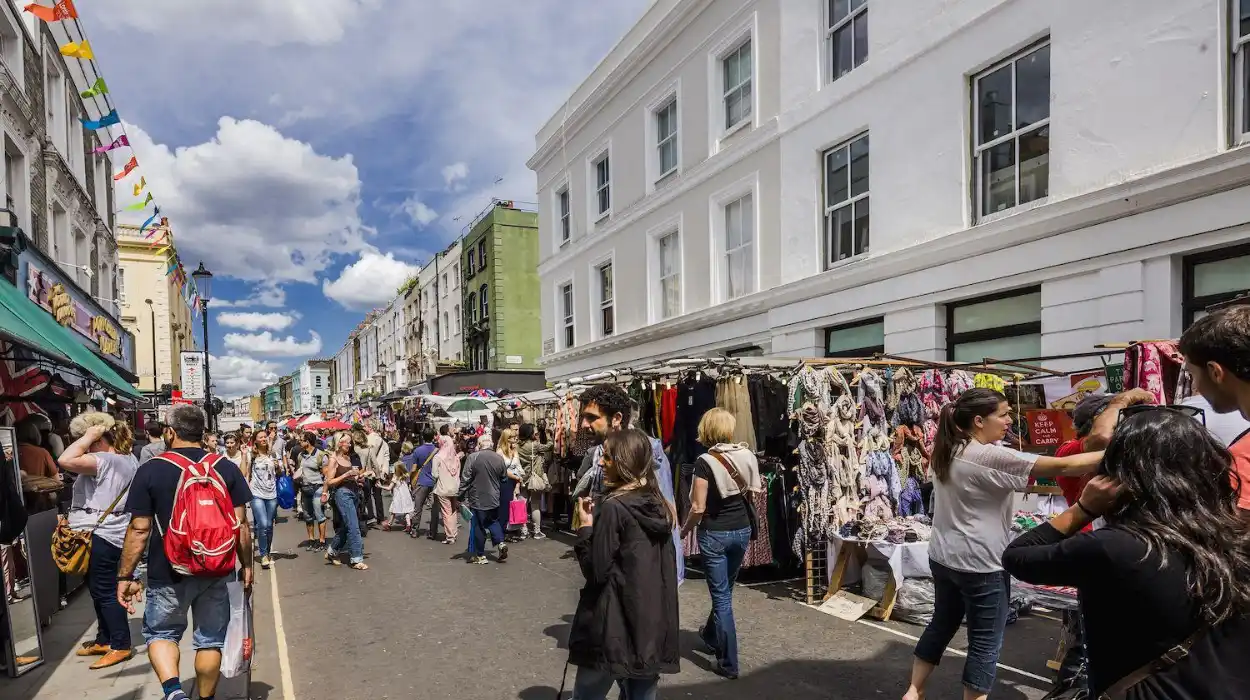
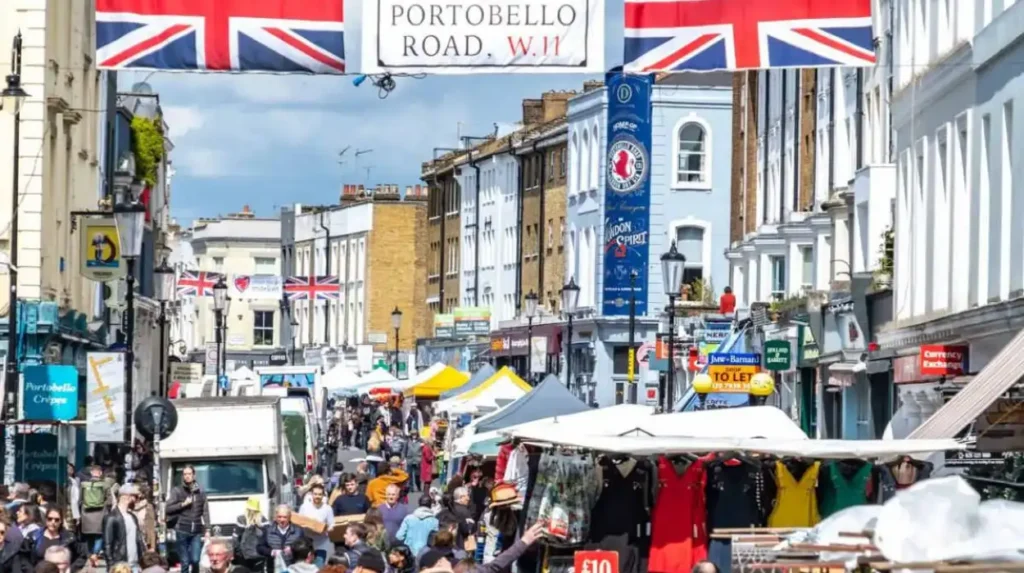
By the late 20th century, Portobello Road had become a major visitor attraction. London Museum records that the market extends for roughly a mile and attracts more than 100,000 visitors on Fridays and Saturdays.
The 1999 film Notting Hill added another layer of international recognition. The film used Portobello Road and surrounding locations as part of its setting, linking the neighbourhood with global popular culture.
What architecture should visitors look for in Notting Hill?
Visitors should look for Victorian stucco terraces, Italianate details, bay windows, decorative ironwork, painted façades, historic shopfronts, garden squares, mews buildings, and planned crescents that reveal Notting Hill’s 19th-century architectural development.
The architectural character of Notting Hill is closely connected with estate development. Developers created coordinated streets containing repeated house types, consistent building lines, ornamental façades, and planned gardens.
Stucco is especially visible across many residential terraces. Stucco is a plaster-like external finish applied over masonry and became widely used in fashionable London residential architecture during the 19th century.
Bay windows are another characteristic feature. They extend beyond the main wall plane and increase internal daylight while creating visual rhythm along terraces.
Many houses also contain decorative cornices, window surrounds, balconies, pilasters, iron railings, and recessed entrances. These features were not random additions. They formed part of the architectural language used to market middle-class residential property.
Garden squares and crescents also have historical importance. Their layouts demonstrate how developers integrated private or semi-private open space into dense urban neighbourhoods.
The Royal Borough’s conservation policies recognise the architectural significance of streets within Notting Hill. Article 4 Directions apply additional controls to selected properties, including buildings on Portobello Road, Pembridge Crescent, Pembridge Place, Penzance Place, and other streets.
These controls protect elements of historic character that standard planning rules do not always cover. Windows, doors, roofs, façades, shopfronts, and other external features can form part of a building’s heritage value.
The result is a streetscape where architectural details remain important evidence of the district’s development.
Where can visitors find Notting Hill’s historic cafés and local food culture?
Notting Hill’s café culture developed from its market economy, migrant communities, independent shops, and later creative reputation, creating a food landscape where historic commercial streets support cafés, bakeries, delis, restaurants, and specialist food businesses.
Cafés in Notting Hill are closely connected with the area’s commercial evolution. Portobello Road began as a food and essentials market, so food retail has deep roots in the district.
Migration expanded this tradition. Spanish and Portuguese communities established businesses around Portobello Road during the 20th century. London Museum records a Spanish delicatessen, R. Garcia and Sons, trading from 1957 and serving Spanish and Portuguese communities with products including meat, fish, cheese, olive oil, and wine.
Caribbean settlement created another important food tradition. Market traders adapted their produce to serve changing local demand, introducing ingredients that reflected Caribbean cooking.
The later growth of cafés reflects another stage of Notting Hill’s history. During the 1960s and 1970s, relatively affordable premises attracted creative workers and independent businesses. The area’s reputation for independent retail and cultural activity strengthened.
Westbourne Grove subsequently became an important destination for restaurants, cafés, fashion shops, and specialist retailers.
Historic cafés and food businesses should therefore be understood within the broader commercial history of the neighbourhood. Their importance comes from the continuity of street-based commerce rather than from individual premises alone.
For visitors, this creates a practical route through local history. A walk from Notting Hill Gate towards Portobello Road passes through commercial streets where present-day cafés occupy a landscape shaped by Victorian development and post-war migration.
To experience this historic neighbourhood in person today, consult our comprehensive [How Notting Hill Transformed Into One of London’s Most Iconic Neighborhoods] for itineraries and visiting parameters.
How did migration transform Notting Hill?
Migration transformed Notting Hill by introducing Caribbean, Spanish, Portuguese, and other communities whose businesses, food traditions, cultural organisations, music, photography, and political activism became central to the district’s modern historical identity.
Migration is fundamental to understanding Notting Hill after 1945. The 1948 British Nationality Act expanded citizenship rights across the British Commonwealth, while the arrival of the Empire Windrush in June 1948 became a major symbol of post-war Caribbean migration to Britain.
Many Caribbean migrants settled in London, including Notting Hill. They encountered serious housing problems and racial discrimination.
London Museum records that Notting Hill’s Black community was among London’s largest during the 1950s, while residents faced discrimination in employment and housing.
The social tensions became particularly severe in 1958. White gangs attacked Black residents, while extremist and fascist groups exploited racial tensions.
In 1959, Kelso Cochrane, an Antiguan carpenter, was murdered in a racist attack. His death became one of the most significant events in the history of post-war Notting Hill and strengthened anti-racist activism.
Migration was not limited to Caribbean communities. Spanish refugees and political exiles also settled around Portobello Road and Notting Hill following the Spanish Civil War, which began in 1936.
These communities changed the neighbourhood’s commercial and cultural landscape. Shops supplied new foods. Music venues reflected Caribbean influences. Photographers documented changing social relationships. Political organisations challenged discrimination.
The resulting heritage is visible in businesses, cultural events, photographs, oral histories, community organisations, and street traditions.
Why is Notting Hill Carnival historically important?
Notting Hill Carnival is historically important because it emerged from Caribbean cultural activism and became a major public expression of Black British identity, community organisation, music, resistance to racism, and multicultural London.
The origins of Notting Hill Carnival are connected with the racial tensions of the late 1950s and Caribbean cultural activism.
Claudia Jones, a Trinidad-born journalist and activist, organised a Caribbean carnival at St Pancras Town Hall on 30 January 1959. The event celebrated Caribbean culture during a period of intense racial tension.
Outdoor celebrations developed in Notting Hill during the 1960s. London Museum identifies 1966 as the beginning of the Notting Hill Carnival tradition in its modern local form.
The event developed through Caribbean music, costume, food, dancing, sound systems, community organisation, and street performance.
Reggae and dub became increasingly important during the 1970s. Carnival also became a major space for interaction between London’s Black Caribbean communities and wider populations.
The festival’s geographical importance is equally significant. Carnival occupies residential streets rather than a purpose-built festival venue. This transforms everyday urban infrastructure into a temporary cultural space.
The Royal Borough currently publishes access restrictions for roads within the Carnival area, demonstrating the scale of the event and its continuing effect on the neighbourhood’s streets.
Today, Notting Hill Carnival is one of London’s largest annual cultural events and a major expression of Caribbean heritage.
Its historical importance rests on community participation and the relationship between cultural identity and urban space.
Which local attractions best explain Notting Hill’s history?
The strongest historical attractions include Portobello Market, Notting Hill Gate, the neighbourhood’s conservation areas, historic terraces, Carnival streets, local cultural venues, and surviving market buildings that connect architectural and social history.
Portobello Market is the most important historical attraction. Its market history extends back to approximately 1870, while its antiques tradition developed strongly after the Second World War.
The market currently contains several distinct trading areas. London Museum describes sections for second-hand goods, fashion, household essentials, fruit and vegetables, and antiques.
Notting Hill Gate provides a contrasting historical environment. The site was a turnpike toll gate until 1864 on the old Roman road west from London. The present town centre contains substantial post-war development, although older Georgian and Victorian buildings survive nearby.
The modern Notting Hill Gate Underground station serves the Central, District, and Circle lines. Its transport role demonstrates how infrastructure shaped the area’s accessibility and commercial growth.
The Gate Theatre and the Coronet are also associated with the cultural history of Notting Hill Gate. The area once had a stronger bohemian identity before major post-war redevelopment changed its physical environment.
The surrounding conservation areas are equally important. They preserve residential streets that demonstrate the architectural planning of the 19th century.
Historic shopfronts provide another form of evidence. Conservation documents record surviving historic commercial details, including traditional glazing, recessed entrances, fascia elements, and original architectural features in neighbouring Kensington streets.
Together, these attractions show that Notting Hill’s heritage is distributed across streets rather than concentrated in one monument.
How has Notting Hill changed since the 1970s?
Since the 1970s, Notting Hill has changed through rising property values, tourism, commercial redevelopment, conservation policies, creative industries, and demographic change, while Portobello Road, Victorian terraces, Carnival, and independent businesses continue to preserve elements of its historic identity.
The 1970s marked an important period in Notting Hill’s transition. The neighbourhood had become associated with creative industries, music, independent retail, fashion, and Caribbean culture.
Portobello Road attracted artists, musicians, designers, collectors, and vintage traders. The market became part of London’s wider cultural economy.
Property values subsequently increased substantially. Royal Borough planning documents state that property prices rose dramatically, particularly from the 1990s, contributing to demographic and commercial change.
The growth of tourism produced another transformation. Portobello Market became an international visitor attraction, while film and television increased the area’s global visibility.
The 1999 film Notting Hill had a major effect on popular perceptions of the district. Portobello Road became closely associated with the film’s fictional characters and locations.
Commercial change also created heritage pressures. Rising rents and property values affected independent traders and changed the types of shops operating in the area. London Museum notes that some long-established traders were priced out as chains, cafés, and expensive restaurants expanded.
Conservation policies provide an important counterbalance. Protected areas and Article 4 Directions help preserve architectural details and historic townscape.
The current challenge is therefore not simply preserving old buildings. It involves maintaining the relationship between architecture, markets, independent commerce, cultural identity, and community life.
How is Portobello Road being preserved for the future?
Portobello Road is being preserved through conservation controls, community engagement, market protection, public-realm investment, improved accessibility, flood resilience, greenery, lighting, and planning measures designed to retain its historic character.
The Royal Borough approved a £4.4 million improvement programme for Portobello Road in February 2026. The programme addresses safety, accessibility, flood resilience, lighting, and greenery. Construction is expected to begin in January 2027.
The project followed three years of community engagement. Its stated objective includes protecting the historic character of Portobello Road while meeting modern safety requirements.
The scheme illustrates a central principle of urban heritage management. Historic streets remain active public infrastructure. They require modern drainage, accessibility, security, transport management, lighting, and environmental improvements.
Preservation therefore does not mean freezing a street in one historical period. It involves managing change while retaining significant architectural and cultural characteristics.
The market itself has existed for more than 160 years. Its longevity makes it an important example of continuous urban commerce.
Conservation controls provide another layer of protection. Article 4 Directions regulate alterations to selected historic properties, helping prevent inappropriate changes to architectural features.
The Royal Borough also operates a local action plan for Notting Hill Gate and Earl’s Court Road. Its objectives include making the area greener, safer, and more accessible while strengthening local identity.
These measures demonstrate that Notting Hill’s future heritage depends on both physical conservation and active management of public space.
What does Notting Hill reveal about London’s wider history?
Notting Hill reveals how London developed through suburban expansion, railway investment, migration, market commerce, social conflict, cultural activism, property change, conservation, and tourism, making the district a concentrated example of the capital’s broader urban history.
Notting Hill demonstrates the relationship between transport and urban expansion. Railway construction connected developing residential areas with the wider city and encouraged population growth.
It demonstrates the economic role of markets. Portobello Road began by serving local food and household needs before developing specialist trading identities.
It also demonstrates the importance of migration. Caribbean, Spanish, Portuguese, and other communities reshaped the district’s businesses, food culture, social networks, music, and political life.
The history of racism in 1950s Notting Hill illustrates another aspect of post-war Britain. Housing discrimination and racist violence affected everyday life, while community activism developed in response.
Carnival demonstrates how cultural traditions can transform urban space. Residential streets became an international cultural venue without losing their everyday function.
Architecture provides the physical record of earlier development. Victorian terraces, crescents, villas, shopfronts, and garden layouts survive as evidence of 19th-century planning.
Modern regeneration demonstrates the pressures affecting historic districts. Tourism, property values, commercial investment, accessibility requirements, and environmental improvements all influence the future of the neighbourhood.
For educators and heritage researchers, Notting Hill therefore provides a compact case study of urban change. Its history can be examined through architecture, planning records, market history, migration archives, photography, oral histories, transport records, and cultural institutions.
For visitors, the same evidence can be read directly from the streets.
How can visitors explore Notting Hill’s historic streets today?
Visitors can explore Notting Hill most effectively by connecting Notting Hill Gate with Pembridge Road, Portobello Road, Westbourne Grove, Elgin Crescent, Ladbroke Gardens, and surrounding residential streets, combining architecture, markets, food culture, and social history.
A practical historical route begins at Notting Hill Gate. The location establishes the relationship between transport, road infrastructure, retail development, and the wider neighbourhood.
From Notting Hill Gate, Pembridge Road leads towards Portobello Road. This route connects modern retail with Victorian properties and the historic market district.
Portobello Road then provides the strongest concentration of market heritage. Visitors can observe the relationship between shops, market stalls, residential buildings, historic façades, and changing commercial uses.
The surrounding streets provide a quieter architectural context. Elgin Crescent, Ladbroke Gardens, Lansdowne Crescent, and nearby terraces demonstrate the planned residential expansion of the 19th century.
Westbourne Grove provides a different experience. Its commercial buildings illustrate the continuing evolution of Notting Hill’s retail economy.
A historical visit should also recognise the area’s Caribbean heritage. Carnival routes and cultural landmarks demonstrate how post-war migration changed the identity of the neighbourhood.
The best approach is to treat Notting Hill as a connected historical landscape rather than a collection of isolated attractions.
Each street contributes evidence. Portobello Road represents market history. The terraces represent Victorian expansion. Notting Hill Gate represents transport and post-war redevelopment. Carnival represents Caribbean cultural heritage. Cafés and independent shops represent continuing commercial change.
Notting Hill remains historically significant because these layers continue to coexist.
The district is therefore both a preserved architectural environment and an active urban community. Its streets remain places of residence, trade, transport, cultural celebration, and public life.
That combination explains why Notting Hill remains one of London’s most studied and visited neighbourhoods. Its beauty is inseparable from its history, and its history remains visible in the streets, buildings, markets, businesses, and cultural traditions that define the district today.
Frequently Asked Question
What is Notting Hill famous for?
Notting Hill is famous for Portobello Road Market, colourful Victorian streets, independent cafés and shops, Notting Hill Carnival, Caribbean culture, and its distinctive west London architecture.