Key Points
- A construction worker, identified as a man in his thirties, tragically lost his life after falling from a significant height at a building site in Central London.
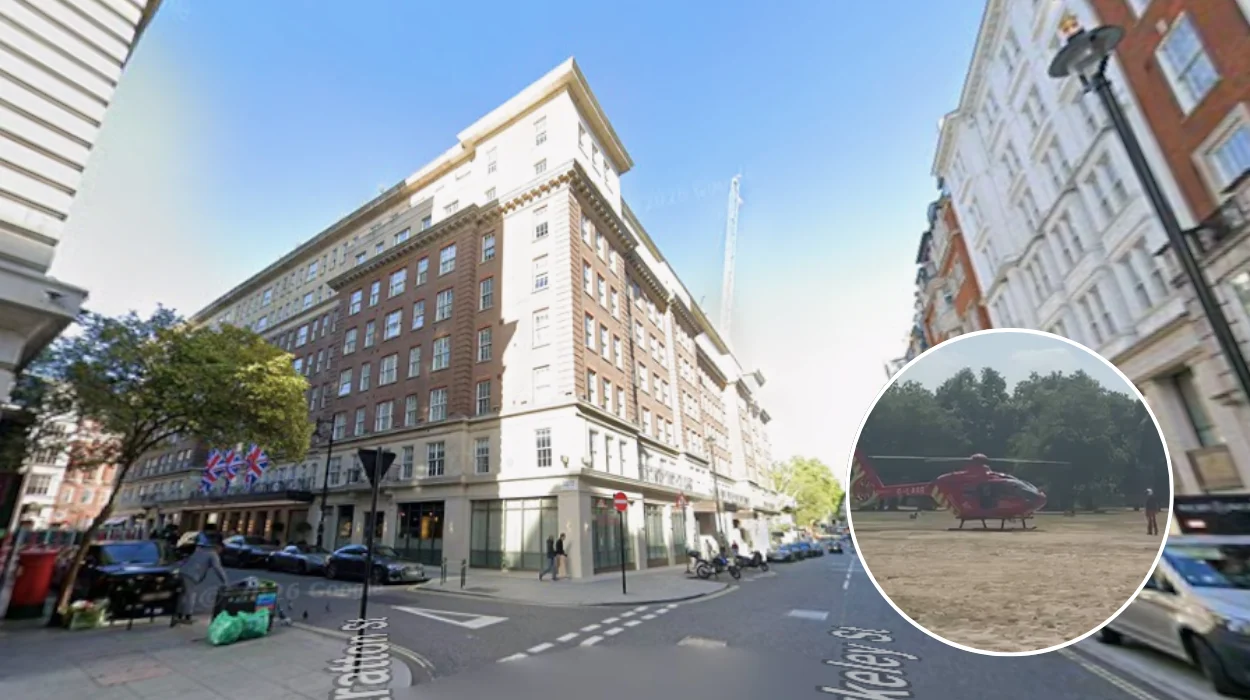
- The fatal incident occurred on the afternoon of Thursday, 9 July 2026, at the busy junction of Berkeley Street and Stratton Street in the heart of Mayfair.
- Emergency responders from the Metropolitan Police Service and the London Ambulance Service rushed to the scene following urgent calls shortly before 2:00 pm.
- Despite the rapid arrival of medical personnel, including a crew from London’s Air Ambulance that landed in nearby Green Park, the victim was pronounced dead at the scene.
- The Health and Safety Executive (HSE) has been formally notified and has launched an investigation into the circumstances surrounding the workplace tragedy.
- Major thoroughfares in the West End, specifically Berkeley Street and Stratton Street, were closed to traffic and cordoned off by police to facilitate ongoing forensic and structural enquiries.
- Specialist family liaison officers from the Metropolitan Police are currently supporting the next of kin of the deceased worker.
Mayfair (Extra London News) July 10, 2026 – A profound sense of shock has enveloped the Central London construction sector following the tragic death of a construction worker who fell from a height at a high-profile site in Mayfair. The victim, described by authorities as a man aged in his 30s, sustained fatal injuries after plunging from an elevated section of a development situated at the junction of Berkeley Street and Stratton Street. Emergency services, including specialized medical teams and law enforcement, converged on the West End financial and luxury district on the afternoon of Thursday, 9 July, but were ultimately unable to save the man’s life.
- Key Points
- What Happened At The Mayfair Construction Site?
- How Did Emergency Services Respond To The Scene?
- What Statements Have Been Released By The Metropolitan Police?
- Who Is Investigating The Fatal Fall?
- Why Are Roads Cordoned Off In Central London?
- What Is The Broader History Of Construction Site Safety Incidents In Mayfair?
- What Regulations Govern Industrial Height Safety In The United Kingdom?
- How Does This Tragedy Impact The Construction Industry In Central London?
As reported by Stewart Carr of MyLondon, the Metropolitan Police Service confirmed that emergency protocols were activated immediately after receiving reports of the incident. Law enforcement officials and medical personnel from the London Ambulance Service arrived at the scene within minutes of the initial emergency call, which was logged at approximately 1:51 pm. Tragically, despite the concerted efforts of first responders, the worker’s injuries proved insurmountable, and he was pronounced deceased at the construction site shortly after their arrival. The identities of the worker and his employing contractor have not yet been publicly released, as specialist officers continue to support his immediate family through the initial stages of grief and notification.
What Happened At The Mayfair Construction Site?
The precise sequence of events leading up to the fatal fall remains the subject of intensive investigation by both local authorities and workplace safety regulators. According to accounts published by Samuel Turner, a breaking news reporter for London Now, the incident occurred during routine operations at a highly active urban regeneration development in Zone 1. The junction of Berkeley Street and Stratton Street is well-known for its high-end commercial properties, luxury hotels, and premium residential spaces, many of which undergo periodic structural updates and extensive redevelopments.
Witnesses in the surrounding area reported an immediate escalation in emergency activity as the scale of the accident became clear to on-site supervisors. As documented in a report by Grant Prior for Construction Enquirer News, the worker fell from an unspecified upper level of the building structure down to the lower tiers or ground level of the cordoned-off site. The suddenness of the accident left colleagues and nearby office workers stunned, prompting an immediate halt to all construction operations across the entire project footprint as site management enacted emergency evacuation and containment plans.
How Did Emergency Services Respond To The Scene?
The emergency response to the Mayfair construction site was swift, involving a multi-agency effort designed to provide advanced trauma care. As reported by the editorial team at London Now, the London Ambulance Service deployed a significant number of resources to Stratton Street immediately after the alarm was raised at 1:36 pm. The response medical deployment included multiple standard ambulance crews, advanced single responders in specialized vehicles, officers from the Hazardous Area Response Team (HART), and two operational tactical commanders.
In addition to ground units, the critical nature of the trauma necessitated the dispatch of London’s Air Ambulance. The helicopter crew, consisting of specialized pre-hospital doctors and critical care paramedics, successfully executed a complex urban landing in nearby Green Park. From there, medical teams rushed on foot to the construction junction to deliver advanced emergency surgical and resuscitative interventions. However, as noted by Stewart Carr of MyLondon, the severity of the impact meant that the air ambulance physician had no choice but to pronounce the man dead at the scene, transitioning the site from a medical rescue operation into a formal forensic and regulatory investigation.
What Statements Have Been Released By The Metropolitan Police?
In the aftermath of the tragedy, the Metropolitan Police Service issued official communications detailing their initial response and the status of the ongoing investigation. As recorded by Samuel Turner of London Now, a spokesperson for the Metropolitan Police stated:
“Police were called at around 13:51hrs on Thursday, 9 July following reports that a man had fallen from height on a construction site at the junction of Berkeley Street and Stratton Street, W1. Officers attended with the London Ambulance Service. Sadly, a man in his 30s was pronounced dead at the scene. His next-of-kin have been informed and are being supported by officers.”
The statement further clarified the immediate logistical measures taken by law enforcement to preserve the integrity of the scene. The Metropolitan Police confirmed that both Berkeley Street and Stratton Street were closed to all vehicular and pedestrian traffic. According to the police dispatch details published by MyLondon, these closures remained strictly in place for several hours while specialized collision investigation units and structural engineers conducted preliminary examinations of the scaffolding and upper walkways.
Who Is Investigating The Fatal Fall?
The statutory responsibility for investigating workplace fatalities in the United Kingdom falls under a joint framework involving local law enforcement and federal safety regulators. As reported by Grant Prior of Construction Enquirer News, the Health and Safety Executive (HSE) was formally notified of the worker’s death within hours of the incident. The HSE is Britain’s national regulator for workplace health and safety, tasked with preventing work-related death, injury, and ill health through rigorous inspection and legal enforcement.
HSE inspectors arrived at the Mayfair site to work alongside detectives from the Metropolitan Police Service. The primary objective of the initial joint inquiry is to ascertain whether there were any systemic breaches of the Health and Safety at Work etc. Act 1974 or the Construction (Design and Management) Regulations 2015. Investigators will specifically examine the adequacy of the fall-arrest systems, the structural integrity of the scaffolding platforms, the provision of safety harness points, and whether the deceased worker had received the mandatory height-safety training required for high-rise urban developments.
Why Are Roads Cordoned Off In Central London?
The implementation of an extensive police cordon around Berkeley Street and Stratton Street caused significant disruption throughout the West End transport network, yet authorities emphasized its necessity. As highlighted by Stewart Carr of MyLondon, the closure of these critical arteries was essential not only for the preservation of forensic evidence but also to ensure public safety. In dense urban environments like Mayfair, the risk of falling debris or unstable scaffolding components following a major workplace incident requires a wide safety perimeter.
Transport for London (TfL) monitored the situation closely, advising commuters to avoid the area surrounding Berkeley Square due to severe localized traffic delays. The physical restrictions prevented access to several local businesses and high-end hospitality venues, with police cordons remaining active late into the evening. Journalistic updates from London Now noted that forensic teams utilized specialized laser scanning equipment to map the vertical profile of the construction site, a process that requires completely clear, undisturbed terrain beneath the point of the fall.
What Is The Broader History Of Construction Site Safety Incidents In Mayfair?
This latest tragedy reopens historical conversations surrounding the inherent dangers of high-density construction and structural renovation projects within older, architecturally complex districts like Mayfair. Over the past two decades, the West End has seen a series of high-profile legal battles and regulatory overhauls resulting from fatal site accidents.
The Hanover Square Incident (2012)
As reported by Tom Foot of the Camden New Journal, a landmark case occurred in August 2012 when intellectual property and media lawyer Amanda Telfer, 43, was crushed to death by unglazed window frames outside a construction site in Hanover Square, Mayfair. The subsequent criminal trial at the Old Bailey in 2017 resulted in the imprisonment of a construction worker for gross negligence manslaughter. The victim’s parents, Barry and Ann Telfer, issued a poignant joint statement warning that “the health and safety training being given is totally inadequate, if risk of death to passers-by is ignored.” The case underscored the severe legal liabilities faced by individual workers and corporate entities when basic site safety measures are neglected.
The Grosvenor Square Building Collapse (2014)
In another significant Mayfair incident documented by Ben Morgan of the London Evening Standard, Lithuanian construction worker Dainius Rupsys, 33, was killed instantly in April 2014 during the £250 million redevelopment of a former US Navy headquarters in Grosvenor Square. As detailed by Justin Davenport, John Dunne, and Rachel Blundy of The Standard, a mechanical mini-digger operating on an upper concrete slab plunged through the floor, crushing Mr Rupsys below. Declan Sherry, the chief executive of the contracting firm McGee, expressed deep sympathy at the time, stating that the worker was a “popular and valued member of the team.” An ITV News report later clarified that the disaster involved a complex interaction of structural demolition stresses, highlighting how quickly urban site environments can become catastrophic.
Explore more Croydon News:
Croydon Council Faces High Court Over Homeless Service Closure: London 2026
Thameslink and Southern Train Delays: East Croydon Station Fire 2026
What Regulations Govern Industrial Height Safety In The United Kingdom?
Work at height remains one of the leading causes of occupational fatalities and major injuries within the British construction industry. To combat this, the Work at Height Regulations 2005 place strict legal duties on employers, site managers, and main contractors to ensure that all activities are properly planned, supervised, and carried out by competent persons.
The regulatory framework mandates a strict hierarchy of control measures:
- Avoid: Avoid working at height whenever reasonably practicable by performing tasks at ground level.
- Prevent: Use existing safe places of work or collective equipment (such as guardrails, scaffolding, and working platforms) to prevent falls.
- Minimise: Utilize personal fall protection systems (such as safety harnesses, netting, or soft-landing systems) to minimise both the distance and consequences of any potential fall.
As the HSE continues its investigation into the Berkeley Street tragedy, inspectors will scrutinize the project’s risk assessments to verify if these sequential preventive steps were thoroughly integrated into the daily site operations.
How Does This Tragedy Impact The Construction Industry In Central London?
The death of a worker in his thirties serves as a stark reminder of the human cost associated with the commercial boom in Central London property development. Industry bodies are expected to closely monitor the findings of the HSE report to determine if new safety bulletins need to be issued regarding high-rise operations in confined urban spaces.
Trade unions representing construction professionals often emphasize that every workplace death is entirely preventable. The focus in the coming weeks will remain squarely on the findings of the Met Police and the HSE, as they work to provide the victim’s family with definitive answers regarding the structural or procedural failures that led to this loss of life in the heart of London’s West End.