Somerset House stands among London’s most historically significant public buildings. Situated on the north bank of the River Thames between the City of London and Westminster, it has served as a royal palace, a government headquarters, a centre of scientific administration, and today one of Britain’s leading cultural venues. Its transformation reflects more than 475 years of English political, architectural, artistic, and institutional history.
- What is the history of Somerset House?
- Why did the Tudor monarchy build Somerset House?
- How did Somerset House become a royal residence?
- Why was Somerset House rebuilt during the Georgian period?
- What architectural features define Somerset House?
- Which important institutions operated from Somerset House?
- How did Somerset House influence British administration?
- How did Somerset House become a cultural landmark?
- What remains from Somerset House’s earlier history?
- Why does Somerset House remain historically important today?
- How has Somerset House shaped London’s historical landscape?
Rather than representing a single historical period, Somerset House illustrates successive phases of London’s development, from the Tudor monarchy through the Georgian era and into the twenty-first century. Every reconstruction, adaptation, and restoration has preserved its role as an important national institution while allowing the site to evolve alongside Britain’s changing society.
To experience this historic landmark in person today, consult our comprehensive [Visiting Somerset House: Exhibitions, Courtyards and Seasonal Events] for itineraries and visiting parameters.
What is the history of Somerset House?
Somerset House is a historic riverside complex that evolved from a sixteenth-century Tudor palace into Britain’s foremost Georgian government building before becoming an internationally recognised centre for arts, culture, heritage, and public events. Its history reflects changing political priorities, architectural innovation, and cultural preservation.
The site occupied by Somerset House has witnessed continuous redevelopment since the sixteenth century. Located strategically along the Strand, it connected the medieval City of London with Westminster, the seat of royal and parliamentary government. This prominent position made it an ideal location for elite residences and later national institutions.
The first Somerset House was commissioned in 1547 by Edward Seymour, Duke of Somerset and Lord Protector of England during the minority of King Edward VI. Seymour demolished several medieval buildings, including churches and inns, to assemble an extensive riverside estate. His palace became one of the grandest examples of Tudor Renaissance architecture in England.
Edward Seymour’s political downfall interrupted construction. He was arrested in 1549 and executed in 1552 following accusations of abuse of power. The unfinished palace reverted to the Crown, establishing the site’s long association with royal ownership.
During the following centuries, Somerset House served successive royal households before becoming increasingly unsuitable for administrative and ceremonial needs. The original palace eventually deteriorated, leading to complete reconstruction during the eighteenth century.
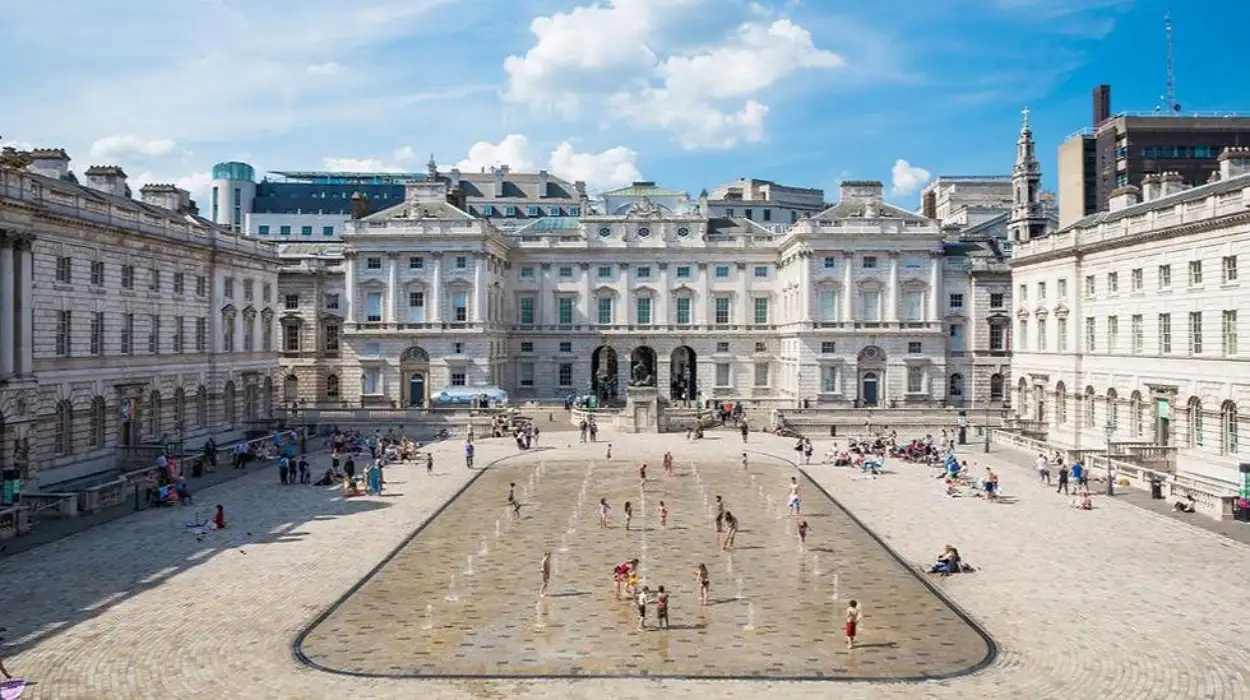
Today’s Somerset House largely dates from between 1776 and 1801, when architect Sir William Chambers designed an ambitious neoclassical complex for government departments and learned societies. This redevelopment permanently altered the appearance of the site while preserving its national importance.
Why did the Tudor monarchy build Somerset House?
Somerset House originated as Edward Seymour’s political statement during England’s Tudor Renaissance. The palace demonstrated royal authority, continental architectural influence, and the growing importance of London as England’s political and administrative centre during the mid-sixteenth century.
Edward Seymour became Lord Protector after the death of Henry VIII in 1547. Acting as regent for the young Edward VI, he possessed extraordinary political authority.
Construction began almost immediately after Seymour assumed power. Builders acquired neighbouring land through purchase, confiscation, and demolition, creating one of London’s largest aristocratic estates.
The palace reflected Renaissance architectural ideas imported from Italy and France. Classical symmetry, decorative stonework, and formal courtyards distinguished Somerset House from earlier medieval residences. These innovations demonstrated England’s increasing engagement with continental artistic movements.
Its riverside frontage also held strategic significance. During the Tudor period, the Thames functioned as London’s principal transport route. Royal processions frequently travelled by water between Westminster, Greenwich, Hampton Court, and the City.
Possessing an impressive palace facing the river projected political authority to everyone navigating London’s busiest transportation corridor.
Although Seymour never fully enjoyed the completed residence, his palace established Somerset House as one of the capital’s most prestigious addresses.
How did Somerset House become a royal residence?
Following Edward Seymour’s execution, the Crown acquired Somerset House and assigned it to queens, princesses, and foreign royal visitors. For more than 200 years, it remained closely connected with England’s monarchy and international diplomacy.
After Seymour’s execution, Somerset House became royal property under Edward VI.
During the reign of Elizabeth I, the palace accommodated distinguished royal guests. It later became the residence of Anne of Denmark, wife of James I, who extensively remodelled its interiors.
Anne of Denmark transformed Somerset House into a vibrant cultural court. She sponsored elaborate masques, theatrical productions, diplomatic receptions, and artistic commissions. The palace became one of London’s foremost centres of Jacobean court culture.
Following Anne’s death in 1619, the building remained associated with queens consort. Henrietta Maria, wife of Charles I, also occupied the palace after extensive renovation.
Its proximity to Whitehall Palace strengthened its political role. Foreign ambassadors frequently visited Somerset House during diplomatic negotiations, making it an important location in England’s international relations.
Despite these prestigious occupants, centuries of incremental alterations created structural problems that ultimately made comprehensive rebuilding unavoidable.
Why was Somerset House rebuilt during the Georgian period?
The eighteenth-century government replaced the deteriorating Tudor palace with a purpose-built administrative complex that centralised public offices while demonstrating Britain’s growing political stability, imperial confidence, and commitment to neoclassical architecture.
By the mid-eighteenth century, the Tudor palace had become outdated. Poor maintenance, changing administrative needs, and architectural deterioration reduced its usefulness.
Parliament approved plans for complete redevelopment in the 1770s.
Sir William Chambers, Surveyor-General of the King’s Works, designed an ambitious neoclassical complex inspired by ancient Roman architecture and contemporary European public buildings.
Construction began in 1776.
Unlike the former palace, the new Somerset House was conceived primarily as a government complex. Numerous departments occupied its offices, including the Navy Board, the Stamp Office, the Salt Office, and the Board of Taxes.
The project also accommodated important learned institutions, creating an unusual combination of administration, science, education, and culture within one architectural complex.
Construction continued in stages until approximately 1801, making Somerset House one of Georgian London’s largest public building projects.
What architectural features define Somerset House?
Somerset House is recognised for its monumental neoclassical design, symmetrical courtyards, grand river terrace, restrained decorative programme, and carefully proportioned façades that exemplify late eighteenth-century British civic architecture.
Sir William Chambers adopted neoclassicism because it symbolised order, rational government, and permanence.
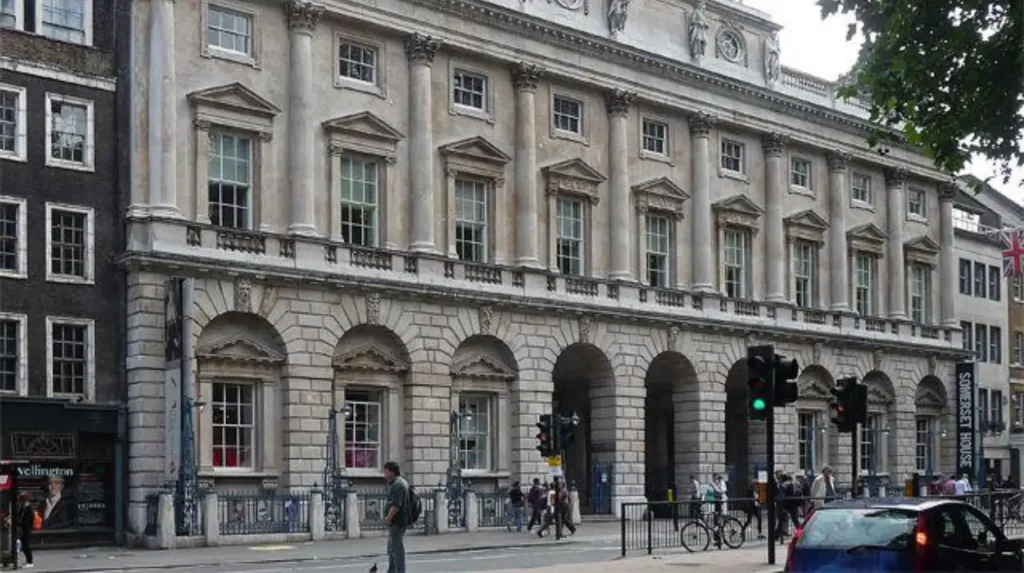
The building’s principal façade along the Strand presents remarkable symmetry. Classical columns, pediments, balustrades, and rusticated stonework create visual harmony without excessive ornamentation.
The central courtyard remains one of London’s finest urban public spaces. Originally designed for ceremonial arrivals and official administration, it now hosts exhibitions, concerts, public gatherings, and seasonal events.
The riverside terrace provided both architectural grandeur and practical access via the Thames before railways became London’s dominant transport system.
Internally, Somerset House incorporated spacious offices, staircases, committee rooms, archives, and institutional meeting spaces suited to government administration.
Its architectural influence extended well beyond London, inspiring later civic buildings across Britain and throughout the expanding British Empire.
Which important institutions operated from Somerset House?
Somerset House became one of Britain’s principal centres of government, science, taxation, and cultural administration by housing numerous departments, professional organisations, and learned societies throughout the eighteenth and nineteenth centuries.
Government offices occupied much of Somerset House for nearly two centuries.
The Stamp Office collected taxes on legal documents and newspapers.
The Board of Taxes administered national revenue systems.
The Navy Board managed naval logistics during Britain’s period of maritime expansion.
The Royal Academy of Arts occupied Somerset House from 1780 until relocating to Burlington House in 1868. Annual Summer Exhibitions established the site as one of Britain’s leading artistic venues.
The Royal Society, Britain’s oldest scientific academy, also operated from Somerset House for many years.
The Society of Antiquaries contributed archaeological and historical scholarship from offices within the complex.
These organisations transformed Somerset House into an intellectual centre where government administration intersected with scientific discovery, artistic innovation, and historical research.
How did Somerset House influence British administration?
Somerset House improved government efficiency by concentrating multiple departments within one coordinated complex, reflecting Britain’s transition towards a professional civil service during the Georgian and Victorian periods.
Before purpose-built government offices became common, departments operated from scattered rented buildings throughout London.
Somerset House centralised administration.
Officials responsible for taxation, naval affairs, auditing, record keeping, and public finance worked within the same complex.
This arrangement improved communication between departments while standardising administrative procedures.
The building also became associated with Britain’s expanding bureaucracy during the Industrial Revolution.
Population growth, imperial expansion, commercial regulation, and public finance required increasingly sophisticated record management.
Somerset House provided secure offices, archive storage, and meeting facilities suited to these expanding governmental responsibilities.
Its administrative success influenced later public building design across Britain.
How did Somerset House become a cultural landmark?
During the late twentieth century, Somerset House gradually shifted from government administration towards arts, education, heritage, and public engagement, becoming one of London’s most important cultural destinations.
Government departments progressively relocated during the twentieth century.
Large-scale restoration programmes preserved the historic fabric while adapting interiors for modern public use.
Since opening as a cultural venue, Somerset House has hosted internationally recognised exhibitions covering photography, design, architecture, fashion, digital art, and contemporary visual culture.
The Courtauld Institute of Art established its internationally respected collection within the complex, significantly enhancing Somerset House’s cultural importance.
Public spaces also diversified.
The central courtyard hosts concerts, film screenings, festivals, and educational programmes throughout the year.
During winter, the courtyard transforms into one of London’s best-known outdoor skating venues.
These activities demonstrate successful adaptive reuse, allowing historic architecture to remain economically sustainable while preserving public access.

What remains from Somerset House’s earlier history?
Although the Tudor palace disappeared during Georgian reconstruction, archaeological evidence, documentary archives, architectural continuity, and surviving historic alignments preserve Somerset House’s earlier historical significance.
Very little visible fabric survives from Edward Seymour’s original palace.
However, archaeological investigations have uncovered foundations, structural remains, ceramics, decorative fragments, and evidence of Tudor occupation beneath later construction.
Historic maps also document the changing footprint of Somerset House across successive centuries.
The riverside relationship remains particularly significant.
Although the Thames Embankment altered London’s waterfront during the nineteenth century, Somerset House continues to overlook the river from its elevated terrace.
Historic archives preserve thousands of architectural drawings, government documents, correspondence, taxation records, and institutional papers associated with Somerset House.
These collections remain valuable resources for historians, architectural researchers, genealogists, and heritage professionals.
Why does Somerset House remain historically important today?
Somerset House preserves nearly five centuries of British political, architectural, administrative, and cultural history while demonstrating how historic buildings successfully adapt to changing public needs without losing historical significance.
Few buildings encapsulate as many aspects of Britain’s national development.
Its Tudor origins reflect royal politics.
Its Georgian reconstruction represents Enlightenment ideals and institutional government.
Its nineteenth-century offices illustrate administrative modernisation.
Its contemporary cultural role demonstrates heritage-led urban regeneration.
The site also contributes significantly to London’s tourism economy.
Millions of visitors pass through Somerset House annually to attend exhibitions, educational programmes, concerts, festivals, and seasonal attractions.
Heritage conservation continues through ongoing restoration projects designed to preserve original stonework, structural integrity, historic interiors, and public accessibility.
Its success provides an internationally recognised example of adaptive reuse that balances preservation with contemporary cultural relevance.
How has Somerset House shaped London’s historical landscape?
Somerset House has influenced London’s architectural identity, public administration, artistic development, and cultural life for nearly five centuries, making it one of the capital’s defining historic landmarks.
Somerset House occupies a unique position within London’s built environment.
Its location between Westminster and the City symbolises the historic relationship between royal authority, government administration, commerce, and public life.
Architecturally, Sir William Chambers’ masterpiece established standards for British civic design that influenced public buildings across the country.
Historically, the complex accommodated institutions that shaped taxation, naval administration, scientific research, artistic education, and public governance during periods of profound national transformation.
Culturally, Somerset House continues to evolve without abandoning its historical identity. Rather than functioning solely as a preserved monument, it remains an active public institution where heritage supports education, creativity, research, and civic engagement.
This continuous adaptation explains why Somerset House occupies an exceptional position within Britain’s historic environment. It represents the evolution of London itself—from Tudor monarchy through Georgian administration to a globally recognised cultural capital. As long as conservation, scholarship, and public participation remain central to its future, Somerset House will continue serving as one of London’s most enduring historical landmarks and one of the finest examples of successful heritage preservation in Europe.
When was Somerset House first built?
Somerset House was originally commissioned in 1547 by Edward Seymour, Duke of Somerset and Lord Protector to King Edward VI. The original Tudor palace was later demolished and replaced by the current Georgian building between 1776 and 1801.