Few historic marketplaces in London combine medieval origins, Victorian architecture, modern retail activity, and cinematic appeal as successfully as Leadenhall Market. Located in the heart of the City of London, the market represents more than seven centuries of commercial activity. Its ornate roof structures, painted arcades, independent retailers, restaurants, and concealed passageways make it one of London’s most significant heritage destinations.
- What is Leadenhall Market and why is it historically important?
- How did Leadenhall Market develop from a medieval marketplace?
- How did Victorian architecture shape the market visitors see today?
- What architectural features should visitors look for?
- Which shops and businesses define Leadenhall Market today?
- Where can visitors find Leadenhall Market’s hidden passages and lesser-known corners?
- Why is Leadenhall Market considered one of London’s best photography locations?
- How has Leadenhall Market been preserved in the modern era?
- What does Leadenhall Market reveal about London’s historical development?
- Why does Leadenhall Market remain relevant for visitors today?
Today, visitors arrive to admire the architecture, photograph its elegant interiors, dine beneath Victorian ironwork, and explore one of the capital’s most enduring commercial landmarks. Understanding Leadenhall Market requires examining its history, architectural development, retail evolution, and preservation within London’s modern financial district.
What is Leadenhall Market and why is it historically important?
Leadenhall Market is a historic covered market in the City of London that traces its origins to the fourteenth century. It served as a major centre for food trading, commerce, and urban life while preserving significant Victorian architecture that remains active today.
Situated between Gracechurch Street, Lime Street, and Whittington Avenue, Leadenhall Market occupies a site that has functioned as a marketplace for hundreds of years. Historical records identify commercial activity on the location as early as the 1300s.
The market derives its name from a large manor known as Leaden Hall, which stood on the site during the medieval period. The structure featured a lead-covered roof, an uncommon and prestigious architectural feature at the time.
Throughout the medieval era, Leadenhall became a major centre for the sale of poultry, game, dairy products, and meat. Merchants transported goods from surrounding counties into London, making the market an essential component of the city’s food distribution network.
The market also reflected London’s broader economic development. As trade expanded, the City of London grew into a major commercial hub connecting England with European markets. Leadenhall supported this growth by facilitating the movement of agricultural products into the urban population.
Unlike many historic markets that disappeared through redevelopment, Leadenhall survived multiple phases of urban transformation. Its continued operation provides a rare example of commercial continuity spanning several centuries.
How did Leadenhall Market develop from a medieval marketplace?
Leadenhall Market evolved from an open-air medieval trading space into a structured commercial complex through centuries of urban growth, regulatory reforms, and rebuilding projects. These changes transformed a local food market into one of London’s most recognised commercial landmarks.
The earliest market activities occurred in an open courtyard arrangement typical of medieval English trading centres. Vendors occupied designated areas according to the goods they sold.
By the fifteenth century, municipal authorities recognised the market’s economic importance. The City of London invested in facilities supporting food storage and trade regulation. These improvements strengthened London’s ability to supply a rapidly growing population.
During the sixteenth century, Leadenhall became associated with several specialised trading functions. Different sections handled poultry, eggs, leather, and imported products. This organisation improved efficiency and reflected broader developments in urban commerce.
The market experienced significant challenges during the seventeenth century. The Great Fire of London in 1666 devastated large portions of the city. Although the market survived more successfully than many neighbouring areas, reconstruction efforts altered surrounding streets and commercial patterns.
Eighteenth-century expansion increased market activity further. London’s population grew dramatically, generating demand for food imports and local agricultural products. Leadenhall adapted by expanding trading spaces and introducing new commercial facilities.
The nineteenth century marked the most significant transformation. Victorian planners sought modern infrastructure capable of supporting industrial-era commerce while improving sanitation and circulation. These objectives ultimately led to the market’s famous architectural redesign.
How did Victorian architecture shape the market visitors see today?
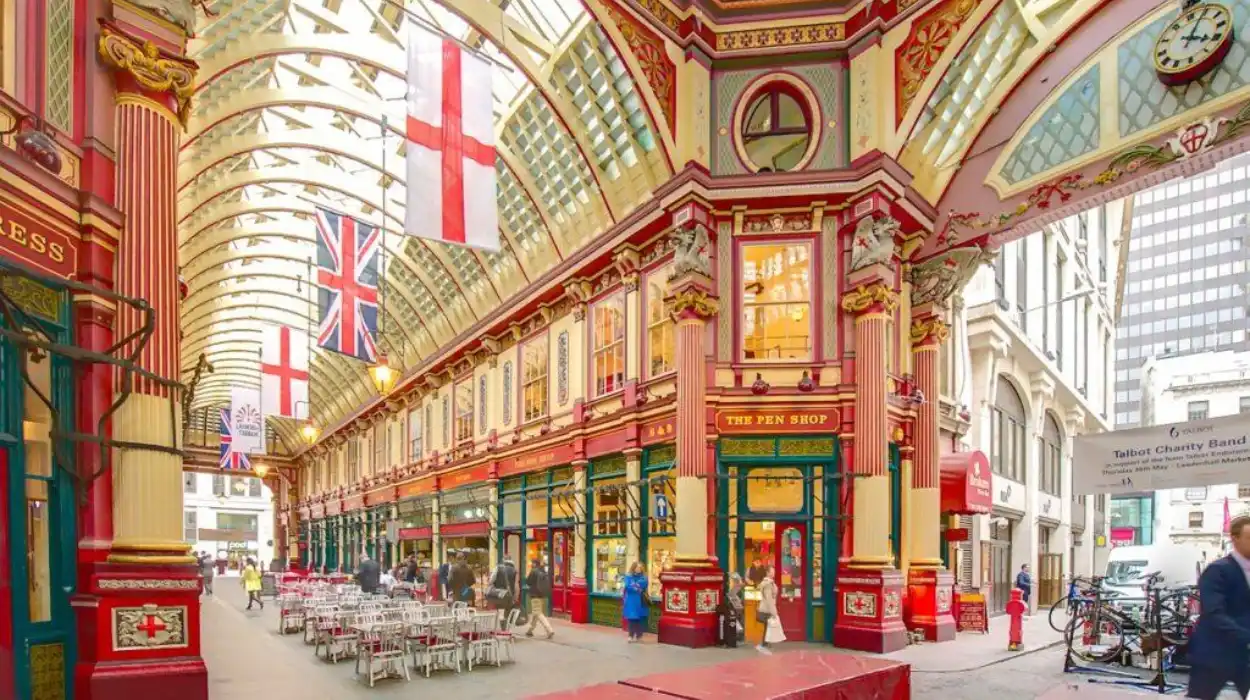
The current appearance of Leadenhall Market largely results from an extensive Victorian reconstruction completed in 1881. Architect Sir Horace Jones created a covered arcade system featuring ironwork, glass roofs, decorative ornamentation, and distinctive colour schemes.
The market visible today emerged through the work of Sir Horace Jones, the City Architect responsible for several major London projects. Jones also designed the famous Smithfield Market redevelopment and contributed to the planning of Tower Bridge.
His design replaced older structures with a sophisticated covered marketplace reflecting Victorian engineering capabilities. Iron framing allowed larger spans than traditional timber construction. Glass roofing admitted natural light while protecting shoppers and traders from weather conditions.
The resulting architecture combines practicality with decorative richness. Ornamental arches, geometric patterns, painted surfaces, and elaborate detailing create a visually striking environment.
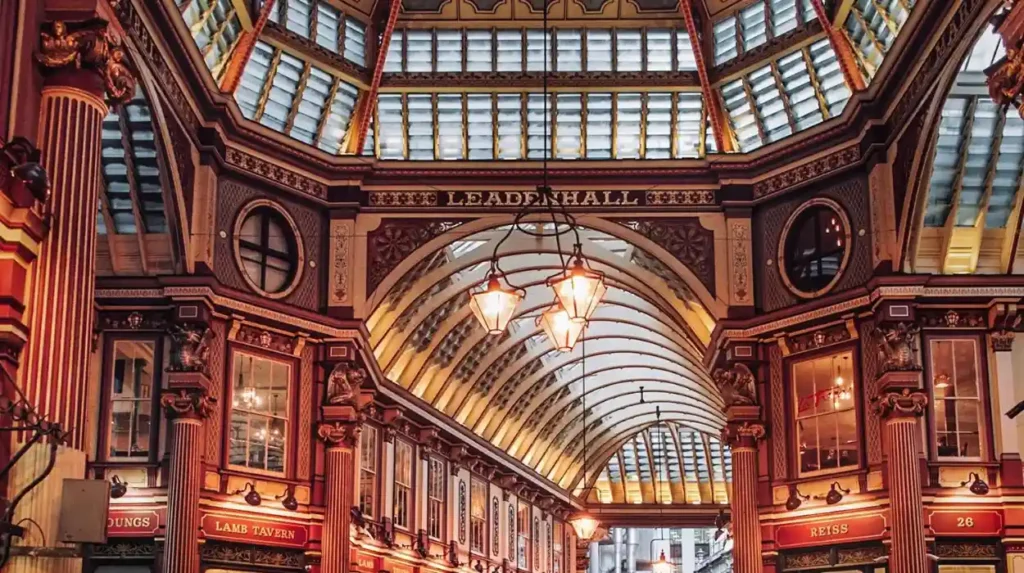
One defining characteristic is the market’s colour palette. Deep reds, greens, creams, and gold accents highlight architectural features throughout the complex. These colours reinforce the Victorian emphasis on ornament while enhancing visual identity.
The roof structure remains among the market’s most celebrated features. Intersecting arcades create a network of covered walkways beneath glass canopies that flood the interior with daylight.
The architecture demonstrates broader Victorian principles. Designers sought to merge engineering innovation with artistic craftsmanship. Leadenhall Market represents one of London’s finest surviving examples of this approach.
What architectural features should visitors look for?
Visitors should focus on the ornate roof structures, decorative ironwork, painted arcades, historic shopfronts, cobbled surfaces, and symmetrical passageways that collectively define Leadenhall Market’s distinctive Victorian character and architectural significance.
The central roof system serves as the market’s architectural focal point. Iron ribs support extensive glazing panels that create a bright interior environment.
Decorative ironwork appears throughout the complex. Columns, brackets, arches, and structural supports feature ornamental detailing characteristic of late nineteenth-century design.
Historic shopfronts contribute significantly to the market’s visual appeal. Many retain traditional proportions and decorative elements that complement the broader architectural setting.
The cobbled paving reinforces the historic atmosphere. These surfaces provide visual continuity with earlier periods of London urban development.
Architectural symmetry also deserves attention. The intersecting arcades create balanced sightlines that enhance spatial coherence and photographic opportunities.
The market’s central intersections reveal particularly impressive views. Looking upward from these points highlights the complexity of the roof structure and decorative framework.
Architectural historians frequently cite Leadenhall Market as an outstanding example of Victorian commercial architecture because it successfully combines aesthetics, functionality, and urban integration.
Which shops and businesses define Leadenhall Market today?
Modern Leadenhall Market combines independent retailers, restaurants, pubs, boutiques, and service businesses within a preserved historic setting. This mixture maintains commercial vitality while supporting the market’s heritage character and visitor appeal.
The market no longer functions primarily as a wholesale food exchange. Instead, it serves office workers, tourists, and local residents through a diverse retail environment.
Independent shops contribute significantly to the visitor experience. These businesses often emphasise specialty products, gifts, fashion, and artisan goods.
Restaurants occupy many historic units throughout the market. Dining options range from casual cafés to full-service establishments. The architectural surroundings enhance the appeal of outdoor and arcade seating areas.
Traditional pubs represent another important component. Several establishments maintain historic connections to the City’s commercial culture and provide insight into London’s social history.
Specialty food retailers continue aspects of the market’s original purpose. Although wholesale trading has largely disappeared, food remains an important element of daily activity.
The mix of businesses supports year-round visitation. Unlike heritage sites functioning primarily as museums, Leadenhall remains a living commercial environment integrated into modern urban life.
Where can visitors find Leadenhall Market’s hidden passages and lesser-known corners?
Hidden passageways, connecting arcades, side entrances, and quieter corridors reveal aspects of Leadenhall Market often overlooked by casual visitors. These spaces illustrate how Victorian designers integrated the market into the surrounding City street network.
Many first-time visitors focus exclusively on the central arcade. However, the market extends through interconnected passages linking multiple streets.
Whittington Avenue provides one of the most atmospheric approaches. This route offers excellent perspectives on the market’s architectural composition and reveals the relationship between historic and modern buildings.
Several side corridors feature reduced foot traffic compared with the main thoroughfares. These quieter areas allow closer examination of decorative details and historic shopfronts.
The market’s layout reflects practical commercial considerations. Victorian planners designed multiple access points to facilitate circulation and improve connectivity with surrounding business districts.
Exploring these passages also highlights the density of the City of London. Historic structures coexist alongside contemporary office towers, demonstrating the layered evolution of the urban landscape.
To experience this historic landmark in person today, consult our comprehensive [The History of Leadenhall Market: From Roman Forum to Victorian Landmark] for itineraries and visiting parameters.
Why is Leadenhall Market considered one of London’s best photography locations?
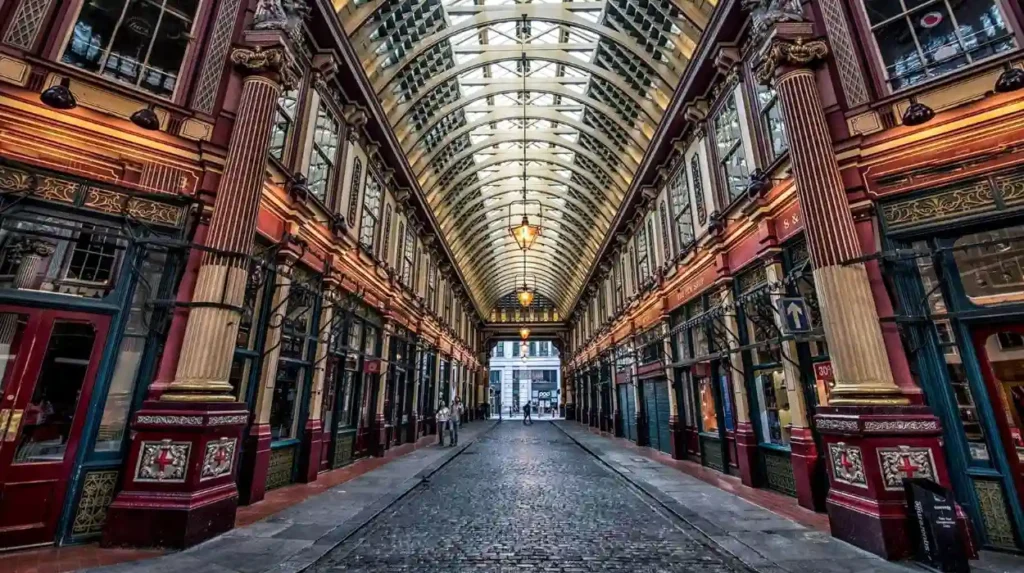
Leadenhall Market offers exceptional photography opportunities because of its symmetrical architecture, colourful interiors, natural lighting, historic details, and visual contrast between Victorian design and modern City skyscrapers.
Photographers frequently regard Leadenhall Market as one of London’s most photogenic indoor public spaces.
The glass roof creates favourable lighting conditions throughout much of the day. Natural illumination reduces harsh shadows while highlighting architectural details.
Symmetrical sightlines produce strong compositions. Looking along the main arcade reveals repeating arches and structural elements that naturally guide viewer attention.
Colour contributes significantly to photographic appeal. Rich reds, greens, creams, and gold accents create visual depth and distinction.
Historic textures provide additional interest. Cobblestones, painted ironwork, carved details, and traditional shopfronts enrich image composition.
The surrounding financial district introduces another layer of visual contrast. Contemporary glass towers rise beyond the historic market, illustrating centuries of urban development within a single frame.
Film enthusiasts also recognise the location because portions of the market appeared as a filming location associated with the Harry Potter and the Philosopher’s Stone franchise. This connection has increased international visibility and visitor interest.
How has Leadenhall Market been preserved in the modern era?
Preservation efforts protect Leadenhall Market’s architectural integrity while allowing continued commercial use. Conservation policies, heritage protections, and restoration projects ensure the market remains both historically authentic and economically sustainable.
The market benefits from statutory heritage protections that recognise its architectural and historical significance.
Conservation initiatives focus on maintaining original Victorian features while addressing modern operational requirements. Restoration projects regularly repair decorative surfaces, structural elements, and glazing systems.
Preservation presents unique challenges because the market remains commercially active. Conservation strategies must balance heritage objectives with contemporary business needs.
The City of London Corporation plays a central role in managing and protecting the site. Its responsibilities include maintenance, planning oversight, and long-term conservation planning.
Successful preservation demonstrates how historic commercial architecture can remain relevant within modern cities. Rather than converting the market into a static museum, stakeholders have maintained its original function as a place of commerce and public gathering.
This approach supports authenticity. Visitors experience a living marketplace rather than a reconstructed historical display.
What does Leadenhall Market reveal about London’s historical development?
Leadenhall Market illustrates London’s transformation from a medieval trading centre into a global commercial capital. Its evolution reflects changes in commerce, architecture, urban planning, transportation, and heritage conservation across several centuries.
The market’s history mirrors broader developments within London itself.
Medieval trading activities reveal the city’s dependence on regional agricultural networks. Food distribution shaped economic relationships between urban and rural communities.
Victorian reconstruction reflects industrial-era confidence and technological advancement. Iron and glass construction embodied new engineering possibilities transforming cities throughout Britain.
The market’s continued survival demonstrates changing attitudes toward heritage. Earlier generations frequently demolished historic structures during redevelopment. Modern conservation policies increasingly recognise the cultural and economic value of preservation.
Leadenhall also illustrates how historic environments adapt to contemporary conditions. Retail functions evolve while architectural identity remains intact.
For educators and researchers, the market provides tangible evidence of urban continuity. Few locations demonstrate such a clear connection between medieval commerce, Victorian architecture, and twenty-first-century city life.
Its significance extends beyond aesthetics. The market represents centuries of economic activity, municipal governance, architectural innovation, and heritage stewardship.
Why does Leadenhall Market remain relevant for visitors today?
Leadenhall Market remains relevant because it combines architectural excellence, commercial activity, historical significance, dining opportunities, and cultural heritage within a single accessible location in central London.
Modern visitors seek experiences that connect history with contemporary urban life. Leadenhall Market satisfies this interest by preserving historic character while remaining active and functional.
The market appeals to diverse audiences. History enthusiasts study its development. Architects examine its Victorian design. Photographers capture its visual qualities. Tourists enjoy dining and shopping opportunities. Educators use it as a case study in urban evolution.
Its location within the City of London adds further significance. Surrounded by global financial institutions, the market illustrates the historical foundations of London’s commercial success.
More than 700 years after its emergence as a marketplace, Leadenhall continues to serve its original purpose as a gathering place for commerce and community. Its architectural splendour, preserved passageways, thriving businesses, and enduring historical relevance ensure its position among London’s most important and best-loved heritage destinations.
For visitors exploring the capital, Leadenhall Market offers a rare opportunity to experience living history beneath one of the most remarkable Victorian market roofs ever constructed.
Is Leadenhall Market free to visit?
Yes. Entry to Leadenhall Market is free, and visitors can explore its historic arcades, architecture, shops, and public spaces without purchasing a ticket.