Key Points
- Massive E-Bike Gathering: Mabley Green park in Hackney was completely overwhelmed by thousands of Lime e-bikes following the weekend’s Hackney Half Marathon.
- The ‘Super Bowl’ of E-Bikes: Regular marathon competitor Lizzy Pollot described the phenomenon as the “Super Bowl” for rental e-bikes due to the unprecedented scale of deployment and usage.
- Strategic Transport Alternative: Because of widespread road closures throughout the borough during the race day, participants and spectators turned to e-bikes as the primary mode of transport.
- Organised Chaos: Lime and event organisers co-ordinated in advance to set up massive, designated parking areas, though the sheer volume baffled local residents and social media users.
- Viral Sensation: Digital spectators jokingly compared the rows of green-and-white bicycles to wildlife, sharing videos overlaid with David Attenborough’s famous voice clips regarding “migrating herds”.
- Sustainability Focus: The incident highlighted both the massive operational success of London’s micro-mobility network and the visual challenges of managing dockless vehicles during major civic events.
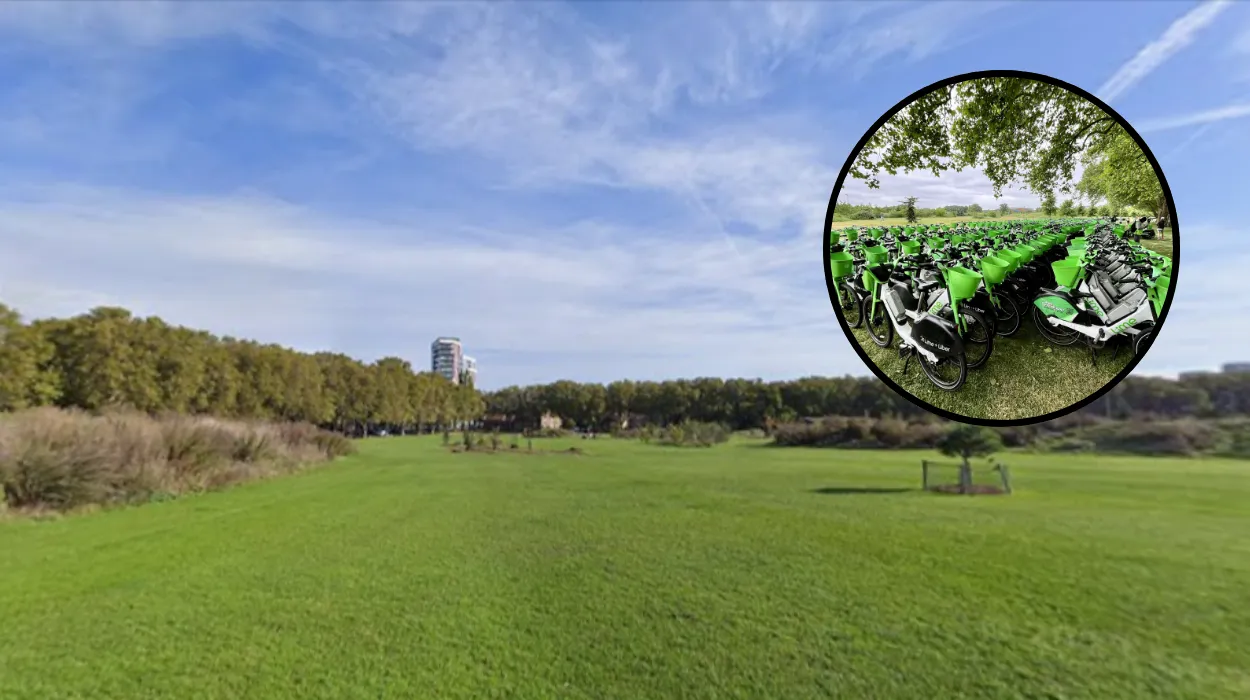
London (Extra London News) May 18, 2026 – A staggering influx of rental e-bikes transformed a prominent East London park into a literal “sea of green” this weekend, as thousands of runners and spectators descended upon the area for the annual Hackney Half Marathon. Mabley Green, a popular public parklands situated in Hackney, became the central storage ground for an unprecedented concentration of Lime dockless bicycles. The sheer scale of the gathering, neatly arranged in massive, dense rows that stretched across the grass, left local residents, passers-by, and social media onlookers entirely baffled by the surreal visual spectacle.
- Key Points
- Why were there so many Lime bikes at Mabley Green?
- What did participants say about the Hackney Half Marathon transport situation?
- How did social media react to the ‘sea’ of Lime bikes?
- Is dockless bike parking becoming a problem for London parks?
- How did Lime manage the clearance of the vehicles?
- What does this incident mean for the future of London marathon logistics?
The incident occurred following the conclusion of the sporting event, which routinely sees tens of thousands of participants take to the streets of London. Due to the extensive network of road closures required to facilitate the half marathon safely, traditional vehicular transport—including buses, taxis, and private cars—was severely restricted throughout the borough. Consequently, micro-mobility options became the primary lifeline for commuters, forcing Lime to orchestrate one of the largest single-day vehicle deployments in the history of London’s dockless bike schemes to meet the spike in transit demand.
Why were there so many Lime bikes at Mabley Green?
The presence of the massive fleet of e-bikes was not an accidental oversight or a case of widespread fly-tipping; rather, it was the result of meticulous pre-event logistical planning.
As reported by local news desk writers covering the event, London’s extensive road closures meant that standard transport infrastructure was effectively paralysed for the morning.
Participants required a reliable, rapid method to reach the starting line on time, and Lime bikes offered the most viable alternative to navigating blocked streets on foot.
To prevent the surrounding residential roads from being completely blocked by discarded bicycles, the event organisers collaborated directly with Lime management. Together, they established a series of high-capacity, designated parking zones within Mabley Green.
This allowed riders to formally end their trips in a controlled environment, ensuring that the micro-mobility influx did not spill out into critical pedestrian walkways or emergency vehicular access routes.
Explore More Hackney News
Hackney Half Marathon Route Change Sparks Business Backlash: Hackney 2026
SHP First Local Charity to Headline HOKA Hackney Half, Hackney 2026
What did participants say about the Hackney Half Marathon transport situation?
For those running the race, the availability of dockless transport was viewed as a major operational success, despite the striking visual impact it left on the park. Marathon runner Lizzy Pollot, 43, who has been competing in the Hackney Half since 2015 and is a well-known stand-up comedian from Highbury, north London, noted that she relies heavily on the vehicles.
As reported by social media correspondents tracking participant feedback, Pollot referred to the massive gathering of vehicles as the “Super Bowl” for the rental e-bike company. Highlighting her preference for the service, Pollot stated:
“I always Lime bike around London, because it’s just the best, it’s the fastest, it’s the most sustainable. All the roads are closed during race days, so it’s one of the main ways everyone gets there. Lime is really good, because the organisers tell you in advance where to park up, and they have designated parking areas.”
Despite her familiarity with London’s transit quirks and her experience running marathons globally, Pollot admitted to being stunned by the final scale of the setup.
She recounted seeing “hundreds” upon hundreds of the e-bikes parked in the designated areas near the event, creating an dense grid of machinery that dominated the park’s landscape.
How did social media react to the ‘sea’ of Lime bikes?
The visual imagery of thousands of identical green and white bicycles neatly aligned across an urban green space quickly transitioned from a local curiosity into a viral internet phenomenon.
Digital audiences across London began documenting the park from various vantage points, expressing amusement and mild disbelief at the industrial takeover of Mabley Green.
As reported by digital lifestyle reporters monitoring online trends, social media users jokingly compared the phenomenon to packs of wild animals congregated in a field.
In one particularly viral instance, an Instagram user posted a video capturing the vast rows of bikes, creatively accompanied by a dubbed audio track of broadcaster Sir David Attenborough speaking eloquently about “migrating herds” moving across the plains.
The comedic juxtaposition of nature documentary narration with corporate micro-mobility infrastructure served to highlight how unusual the sight was to ordinary Londoners.
Is dockless bike parking becoming a problem for London parks?
While the Hackney Half Marathon setup was planned in advance, the event has reignited an ongoing civic debate regarding the spatial footprint of dockless bike schemes across Greater London.
Critics have frequently pointed out that while e-bikes provide an excellent, low-emission alternative to cars, their storage requirements often infringe upon public spaces, parks, and pavements.
Local councils across the capital have been wrestling with regulatory frameworks to better govern where these private vehicles can be left.
The sight at Mabley Green, though orderly, demonstrated just how much physical space is required to support a modern, large-scale micro-mobility network during peak demand periods.
How did Lime manage the clearance of the vehicles?
Following the conclusion of the half marathon, the logistical challenge shifted from accumulation to redistribution.
A fleet of transport vans and logistics personnel were tasked with clearing Mabley Green to restore the park to its original state for local residents.
According to operational updates tracked by transport journalists, Lime employs logistics teams who work through the afternoon and evening following major events to retrieve, recharge, and redistribute the bicycles across various high-traffic zones in London.
This ensures that the local infrastructure is not permanently overwhelmed and that the bikes are moved to areas where normal commuting patterns resume on Monday morning.
What does this incident mean for the future of London marathon logistics?
The integration of e-bikes into major sporting events provides a blueprint—and a warning—for future urban planning in the capital. As London continues to push for greener transit solutions and car-free initiatives, large-scale events will increasingly rely on dockless networks to move massive crowds without causing gridlock on the underground or rail systems.
The success of the Hackney Half Marathon deployment proves that with proper communication and designated zoning, micro-mobility can successfully handle the burden of tens of thousands of displaced commuters. However, the visual shock of the Mabley Green “sea of bikes” suggests that future event planners will need to think carefully about how to balance logistical efficiency with the preservation of public recreational spaces.