London’s extensive rail network provides direct access to some of England’s most significant historic cities, medieval towns, royal residences, cathedral centres, coastal destinations, and protected landscapes. Many of these locations developed centuries before the capital became Britain’s political and economic centre, preserving castles, Roman remains, Norman churches, Georgian architecture, Tudor palaces, Victorian engineering, and UNESCO World Heritage Sites. Travelling by train allows visitors to reach these destinations efficiently while avoiding road congestion, making day trips an enduring part of British tourism and heritage exploration.
- Why are day trips from London by train among England’s best heritage experiences?
- Which historic cities can visitors reach from London in under two hours?
- Which castles near London preserve England’s royal history?
- Which countryside destinations offer outstanding natural and historical landscapes?
- Why is Bath considered one of England’s finest historic day trips?
- What makes Canterbury one of England’s most important pilgrimage destinations?
- Which university cities preserve Britain’s academic heritage?
- Which coastal towns near London combine maritime heritage with historic attractions?
- How did Britain’s railway network transform heritage tourism?
- Why do these destinations remain important for heritage conservation?
- What should travellers consider when planning historic day trips from London?
Why are day trips from London by train among England’s best heritage experiences?
Day trips from London by train combine efficient transport, preserved historic landscapes, royal residences, medieval streets, Roman archaeology, cathedral cities, and protected countryside into accessible journeys. Britain’s railway network connects visitors with centuries of architectural, political, religious, and cultural history within two hours of central London.
Britain’s railway system remains one of the world’s oldest national rail networks. The first public passenger railway opened in 1825, while the railway expansion of the Victorian era transformed travel throughout England. Today, major London termini including Paddington, King’s Cross, St Pancras International, Waterloo, Liverpool Street and Victoria continue to serve routes that follow many nineteenth-century railway corridors.
The development of rail transport fundamentally reshaped tourism. Historic cities that once required several days by horse-drawn coach became reachable within hours. This accessibility encouraged preservation, museum development and heritage tourism across southern England.
For modern visitors, train travel provides direct access to royal castles, Roman settlements, medieval market towns, university cities, coastal resorts and Areas of Outstanding Natural Beauty without requiring a car.
Which historic cities can visitors reach from London in under two hours?
Several of England’s most historically important cities lie within two hours of London by train. These destinations include Bath, Canterbury, Oxford, Cambridge, Winchester and York, each preserving architecture and historical records spanning multiple centuries of English history.
Bath
Bath developed around natural hot springs used by the Romans from approximately AD 43. The settlement became one of Roman Britain’s most important spa towns.
The city’s Georgian transformation during the eighteenth century created one of Europe’s finest collections of Palladian architecture. Landmarks include the Royal Crescent, The Circus and Pulteney Bridge.
Bath forms part of the UNESCO World Heritage List because of both its Roman archaeological remains and Georgian urban planning.
Canterbury
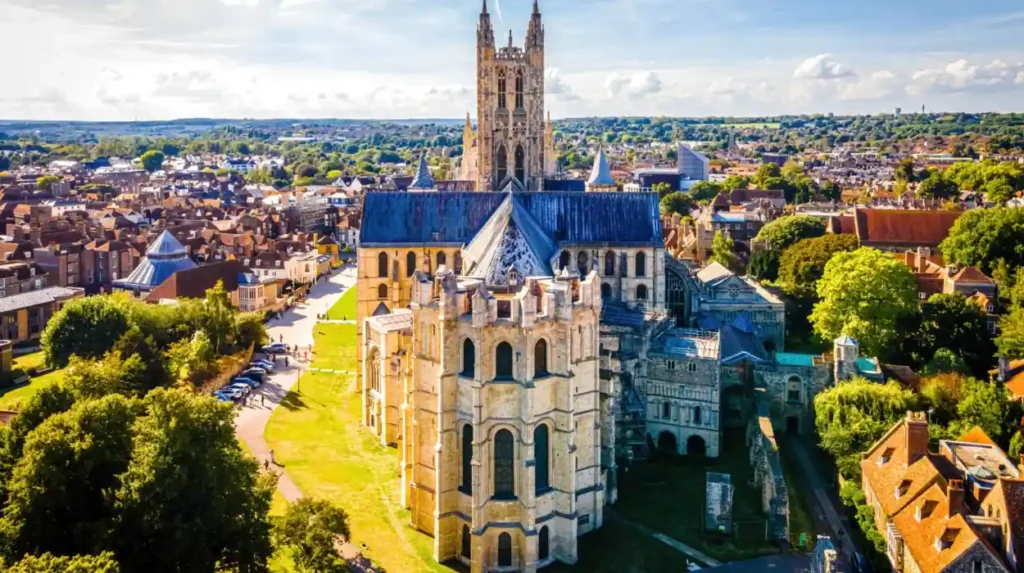
Canterbury became England’s foremost religious centre following the arrival of Saint Augustine in AD 597.
The murder of Archbishop Thomas Becket inside Canterbury Cathedral in 1170 transformed the city into one of medieval Europe’s greatest pilgrimage destinations. Geoffrey Chaucer’s The Canterbury Tales immortalised these pilgrimages during the late fourteenth century.
Canterbury Cathedral remains the seat of the Archbishop of Canterbury, leader of the Church of England.
Oxford
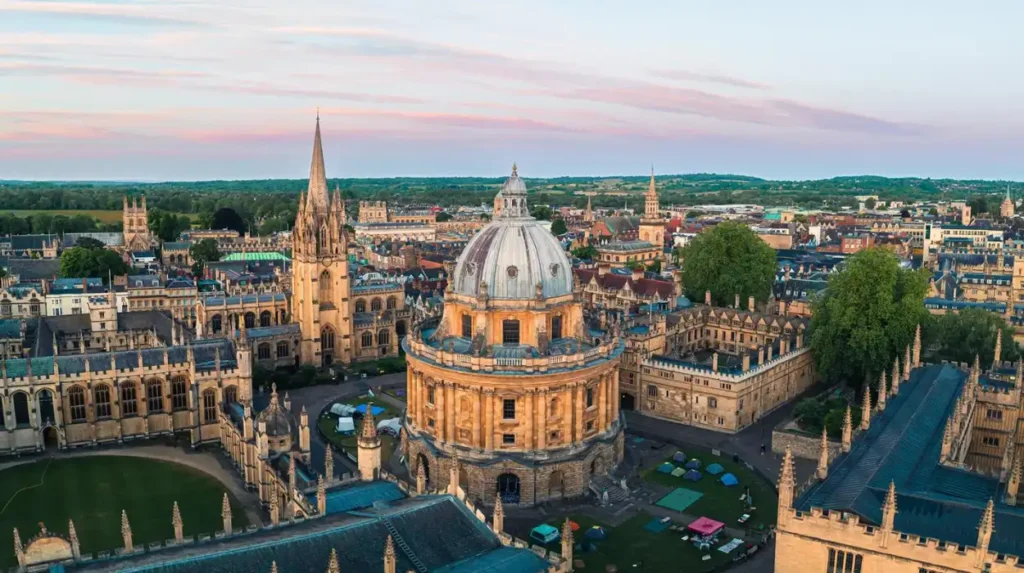
Oxford evolved into a centre of scholarship during the twelfth century. The University of Oxford, comprising 39 colleges including Christ Church, Balliol College and Magdalen College, remains one of the world’s oldest universities.
Its medieval colleges, libraries and chapels preserve architecture dating from the Norman, Gothic and Renaissance periods.
Cambridge
Cambridge developed around its university after scholars migrated from Oxford in 1209.
The city’s colleges, including King’s College, Trinity College and St John’s College, showcase centuries of academic architecture and intellectual history.
The River Cam contributes to Cambridge’s distinctive historic landscape.
Winchester
Before London emerged as England’s political capital, Winchester served as the principal city of Anglo-Saxon England.
King Alfred the Great strengthened Winchester during the ninth century, making it an administrative and military centre against Viking invasions.
Winchester Cathedral ranks among Europe’s longest medieval cathedrals.
York
Although requiring slightly longer journeys on many services, York remains achievable as an extended day trip.
Founded as the Roman fortress of Eboracum in AD 71, York later became an important Viking capital known as Jórvík.
York Minster represents one of northern Europe’s greatest Gothic cathedrals.
Which castles near London preserve England’s royal history?
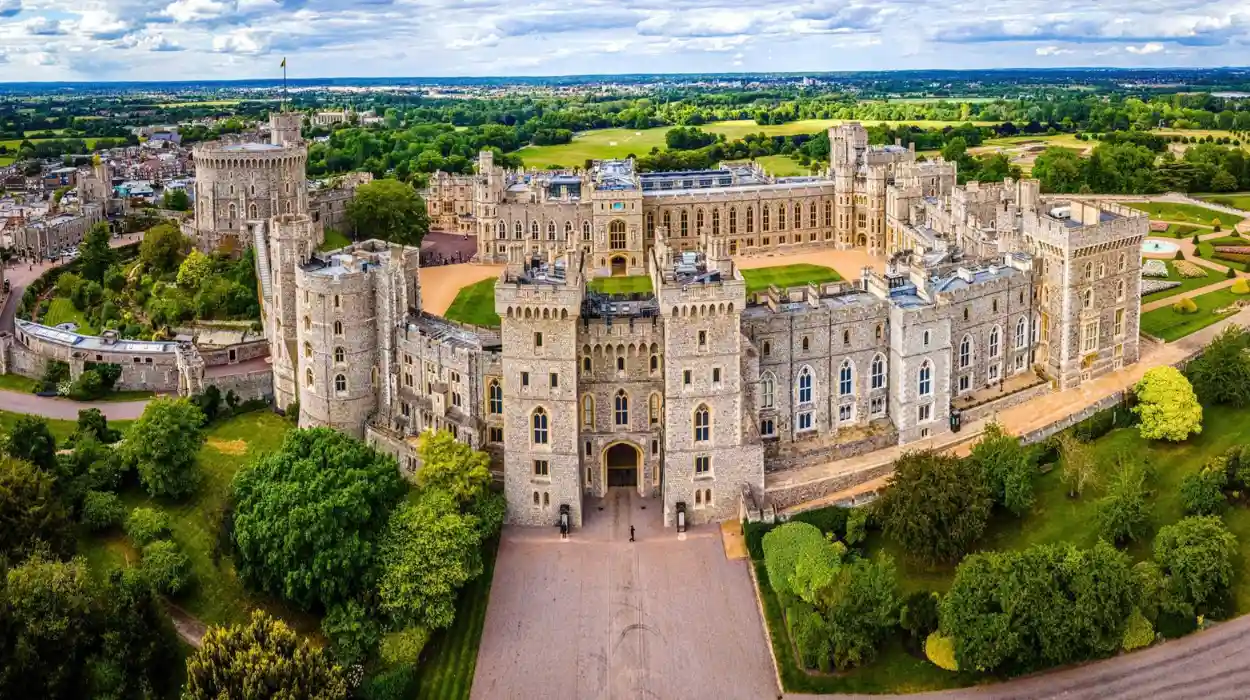
Historic castles surrounding London illustrate England’s military, political and royal development across nearly one thousand years. Windsor Castle, Dover Castle, Leeds Castle and Arundel Castle preserve Norman fortifications, royal apartments and defensive engineering from successive historical periods.
Windsor Castle
Windsor Castle was established by William the Conqueror shortly after the Norman Conquest of 1066.
It remains the world’s oldest and largest occupied castle.
Successive monarchs expanded Windsor across nearly 950 years. St George’s Chapel houses the tombs of numerous British monarchs including Henry VIII, Charles I and Queen Elizabeth II.
Dover Castle
Known as the “Key to England,” Dover Castle occupies strategic high ground overlooking the English Channel.
Henry II rebuilt much of the castle during the twelfth century.
Its military significance continued through both World Wars, when underground tunnels served as command centres.
Leeds Castle
Despite its name, Leeds Castle stands in Kent rather than Yorkshire.
The castle originated as a Norman stronghold before becoming a royal residence for six medieval queens, including Eleanor of Castile and Catherine of Aragon.
Its setting within a lake enhances both its defensive history and architectural beauty.
Arundel Castle
Arundel Castle has remained the seat of the Dukes of Norfolk for centuries.
Originally constructed in the late eleventh century, it combines Norman fortifications with Victorian restoration work.
Its collections include armour, paintings, manuscripts and decorative arts.
Which countryside destinations offer outstanding natural and historical landscapes?
England’s protected countryside combines geological history, agricultural heritage, traditional villages and historic estates. The Chiltern Hills, Cotswolds, South Downs and Surrey Hills preserve centuries-old rural landscapes shaped through farming, conservation and settlement development.
Protected landscapes preserve both environmental and cultural heritage.
Traditional villages, ancient woodlands, chalk hills and agricultural fields demonstrate long-term interaction between people and the natural environment.
The Cotswolds
The Cotswolds cover nearly 800 square miles across south-central England.
The region’s honey-coloured limestone villages reflect centuries of prosperity generated by the medieval wool trade.
Historic settlements include Bourton-on-the-Water, Bibury and Stow-on-the-Wold.
The Chiltern Hills
The Chiltern Hills contain ancient beech woodlands, Iron Age hillforts and traditional market towns.
This chalk landscape has supported agriculture for thousands of years.
Walking routes frequently follow historic drovers’ roads and medieval pathways.
South Downs
The South Downs National Park protects rolling chalk hills stretching across southern England.
The landscape contains prehistoric monuments including Cissbury Ring and Devil’s Dyke.
Historic market towns and villages remain integral parts of the protected landscape.
Surrey Hills
Located close to London, the Surrey Hills preserve woodland, farmland and historic estates.
Many country houses reflect Georgian and Victorian architectural traditions.
To experience these historic landscapes in person today, consult our comprehensive [How Railways Connected London to Britain and Transformed National Travel Forever] for itineraries and visiting parameters.
Why is Bath considered one of England’s finest historic day trips?
Bath preserves exceptional Roman archaeology, Georgian urban planning, neoclassical architecture and thermal spa heritage. Its UNESCO designation recognises nearly two thousand years of continuous development from Roman Britain through eighteenth-century urban expansion to modern conservation efforts.
Roman engineers constructed elaborate bathing complexes supplied by natural hot springs.
Archaeological excavations have revealed temples, baths, drainage systems and inscriptions that document Roman religious practices.
During the eighteenth century, architects John Wood the Elder and John Wood the Younger reshaped Bath into an elegant Georgian city.
The Royal Crescent, completed in 1774, exemplifies Georgian residential planning.
Bath’s conservation policies have protected much of this architectural heritage, enabling visitors to experience remarkably intact historic streets.
What makes Canterbury one of England’s most important pilgrimage destinations?
Canterbury became England’s leading Christian pilgrimage destination after Archbishop Thomas Becket’s assassination in 1170. The cathedral, medieval streets, defensive walls and religious institutions collectively illustrate nearly fifteen centuries of English ecclesiastical history.
Saint Augustine established Christianity’s principal English mission in Canterbury during the late sixth century.
The city’s cathedral evolved through Norman and Gothic rebuilding campaigns.
Thomas Becket’s murder transformed Canterbury into an international pilgrimage destination visited by thousands annually throughout the Middle Ages.
Medieval walls continue to surround much of the historic city centre.
The Canterbury Roman Museum preserves archaeological remains beneath modern streets.
Which university cities preserve Britain’s academic heritage?
Oxford and Cambridge preserve centuries of educational excellence through historic colleges, libraries, chapels and scientific institutions. Their architectural development reflects changing educational traditions from the medieval period through the modern research university system.
Oxford and Cambridge have educated monarchs, scientists, philosophers, writers and political leaders.
Libraries including the Bodleian Library in Oxford and Cambridge University Library preserve millions of manuscripts, books and archival materials.
Architectural styles range from Norman and Gothic to Baroque and Victorian Gothic Revival.
Scientific discoveries associated with these universities include breakthroughs in physics, biology, mathematics and medicine.
Museums add further historical significance.
Oxford’s Ashmolean Museum, founded in 1683, ranks among the world’s oldest public museums.
Cambridge’s Fitzwilliam Museum preserves internationally important collections of antiquities, manuscripts and fine art.
Which coastal towns near London combine maritime heritage with historic attractions?
Southern England’s coastal towns preserve naval history, defensive fortifications, royal pavilions and Victorian seaside architecture. Brighton, Portsmouth and Hastings each represent distinct chapters in Britain’s maritime, military and social development.
Brighton developed from a fishing village into a fashionable seaside resort during the Georgian era.
The Royal Pavilion reflects Indo-Saracenic architectural influences commissioned by the future King George IV.
Portsmouth has served as a Royal Navy base for centuries.
Its Historic Dockyard preserves HMS Victory, Admiral Lord Nelson’s flagship at the Battle of Trafalgar in 1805.
Hastings occupies a central place in English history because of the Norman Conquest.
Although the Battle of Hastings occurred nearby at Battle in 1066, Hastings preserves medieval streets and defensive remains illustrating its later development.
How did Britain’s railway network transform heritage tourism?
Britain’s railway expansion during the nineteenth century democratised travel, increased public access to historic destinations and encouraged heritage preservation. Rail transport enabled millions to visit castles, cathedrals, countryside landscapes and seaside towns previously accessible only through lengthy journeys.
Railway companies actively promoted leisure travel.
Guidebooks, excursion tickets and holiday packages emerged throughout the Victorian period.
Improved accessibility increased visitor numbers to heritage destinations.
Growing tourism encouraged local authorities to preserve medieval buildings, establish museums and protect archaeological sites.
Many historic stations themselves became architectural landmarks.
London St Pancras, Paddington and King’s Cross exemplify Victorian railway engineering and design.
Why do these destinations remain important for heritage conservation?
Historic destinations near London preserve nationally significant architecture, archaeological evidence, documentary archives and cultural traditions. Conservation organisations, local authorities and heritage institutions protect these places to ensure their educational, cultural and historical value continues for future generations.
England’s heritage sector contributes substantially to education, tourism and local economies.
Conservation balances visitor access with preservation.
Organisations including Historic England, the National Trust and English Heritage maintain castles, archaeological monuments, landscapes and historic houses.
UNESCO World Heritage Sites receive international recognition for their outstanding universal value.
Universities continue archaeological research.
Museums interpret discoveries through exhibitions, educational programmes and digital archives.
Historic railway access remains central to sustainable tourism by reducing reliance on private vehicles while supporting regional economies.
What should travellers consider when planning historic day trips from London?
Successful day trips combine efficient rail planning, realistic itineraries, advance ticket booking and prioritised attractions. Selecting destinations according to travel time enables visitors to experience historic landmarks thoroughly while preserving time for museums, walking tours and local heritage sites.
Many destinations receive frequent direct rail services from central London throughout the day.
Advance ticket purchases often reduce travel costs.
Historic attractions frequently require timed admission, particularly castles, royal residences and popular museums.
Walking remains the most effective way to explore historic centres such as Bath, Canterbury, Oxford and Cambridge because medieval street layouts limit vehicle access.
Seasonal events including heritage festivals, archaeological exhibitions and guided tours provide additional historical interpretation throughout the year.
England’s rail-connected destinations continue to demonstrate how centuries of political change, religious development, academic achievement, military history and architectural innovation shaped the nation’s identity.
From Roman baths and Norman castles to university colleges and protected countryside, these locations preserve tangible evidence of nearly two millennia of history, making day trips from London by train one of the most rewarding ways to experience England’s enduring cultural heritage.
What are the best day trips from London by train?
Some of the best day trips from London by train include Bath, Oxford, Cambridge, Canterbury, Windsor, York, Brighton, Winchester, Dover, and the Cotswolds. These destinations offer historic landmarks, countryside scenery, museums, and cultural attractions within easy rail access.