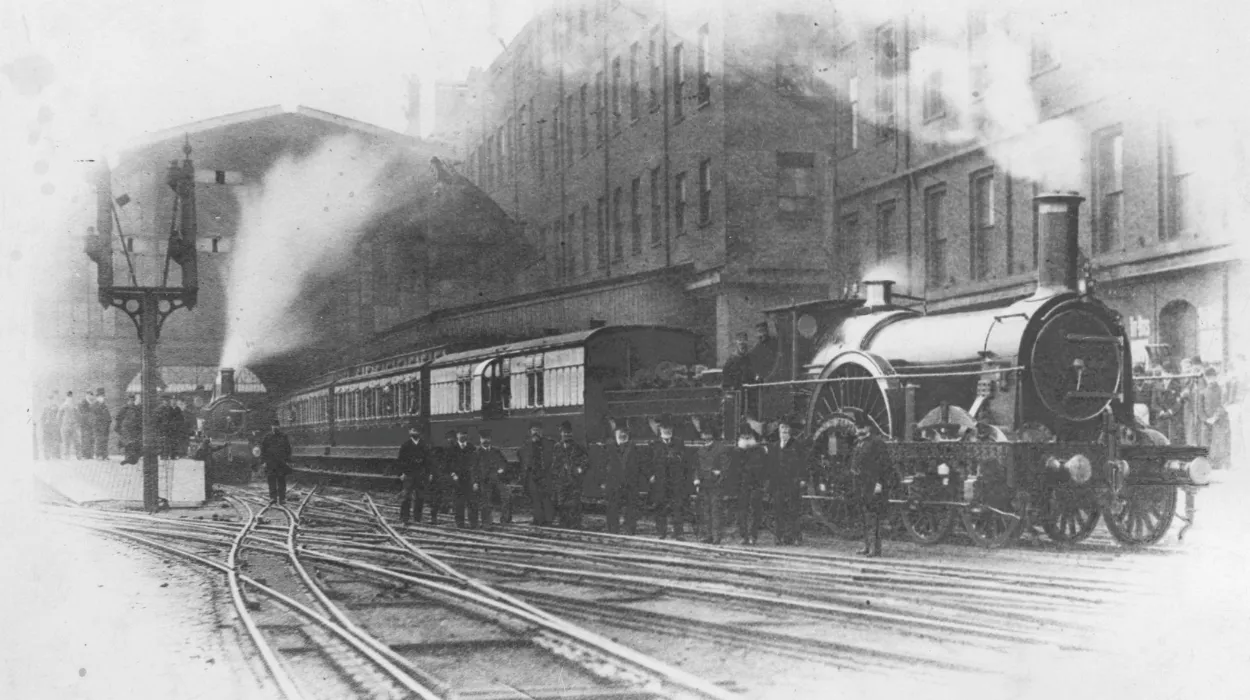
Railways transformed Britain by linking London with every major region through a rapidly expanding transport network during the nineteenth century. The development of passenger and freight rail reshaped commerce, industry, migration, communication, tourism, and national identity, making London the central hub of Britain’s modern transport system.
- Why did railways become the foundation of Britain’s national transport network?
- How did travel across Britain function before the railway age?
- How did London’s first railways begin?
- Which London railway stations transformed national travel?
- Why was Railway Mania important to Britain’s development?
- How did railways change everyday life in Britain?
- How did railways strengthen London’s economic importance?
- Which engineers and innovators shaped Britain’s railway revolution?
- How did railways standardise time across Britain?
- What role did railways play during Britain’s industrial expansion?
- What historic railway heritage remains visible today?
- Why do historians consider Britain’s railway revolution globally significant?
Why did railways become the foundation of Britain’s national transport network?
Railways connected London with industrial towns, ports, agricultural regions, and coastal cities through fast, reliable transport. The network reduced travel times dramatically, supported economic growth, standardised national travel, encouraged tourism, and permanently reshaped Britain’s geography, society, and commercial development from the 1830s onwards.
Before the railway era, Britain’s transport relied on turnpike roads, canals, coastal shipping, and horse-drawn stagecoaches. These systems carried passengers and goods but suffered from slow speeds, weather disruption, seasonal limitations, and relatively high transport costs.
The arrival of steam-powered railways fundamentally changed transport. Railways operated on fixed schedules, transported large numbers of passengers, moved heavy freight efficiently, and linked distant regions regardless of weather conditions.
London naturally became the centre of this expanding network. As Britain’s political capital, financial centre, and largest consumer market, the city generated enormous demand for passenger movement and commercial distribution.
Between the 1830s and the late nineteenth century, railway companies built thousands of miles of track connecting London with the Midlands, northern England, Wales, Scotland, and major ports. By the early twentieth century, Britain possessed one of the world’s densest railway systems.
This national connectivity supported industrial production, agricultural distribution, postal services, military logistics, and domestic tourism while reducing regional isolation.
How did travel across Britain function before the railway age?
Travel before railways depended on horses, canals, river navigation, coastal shipping, and stagecoaches. Journeys required significantly longer travel times, transport costs remained high, and many communities stayed geographically isolated despite Britain’s expanding economy during the eighteenth and early nineteenth centuries.
Stagecoach travel
Stagecoaches represented Britain’s principal long-distance passenger transport.
Major coaching routes connected London with cities including:
- Birmingham
- Bristol
- York
- Edinburgh
- Exeter
Although coaching services improved substantially after road upgrades, journeys remained lengthy.
Travelling from London to Birmingham often required approximately 12 hours under favourable conditions.
The journey from London to Edinburgh frequently exceeded two days.
Passengers encountered poor road surfaces, changing weather, accidents, and overnight stops.
Canal transport
Britain’s canal system expanded rapidly after the 1761 opening of the Bridgewater Canal.
Canals efficiently transported coal, iron, building materials, pottery, grain, and manufactured goods.
However, canal boats travelled slowly, generally averaging only a few miles per hour.
Coastal shipping
Sea transport remained economical for bulky cargo.
Ports including Liverpool, Bristol, Hull, Newcastle, and London handled growing trade volumes.
Weather conditions frequently delayed sailings.
Consequently, Britain’s expanding industrial economy increasingly required a faster national transport solution.
How did London’s first railways begin?
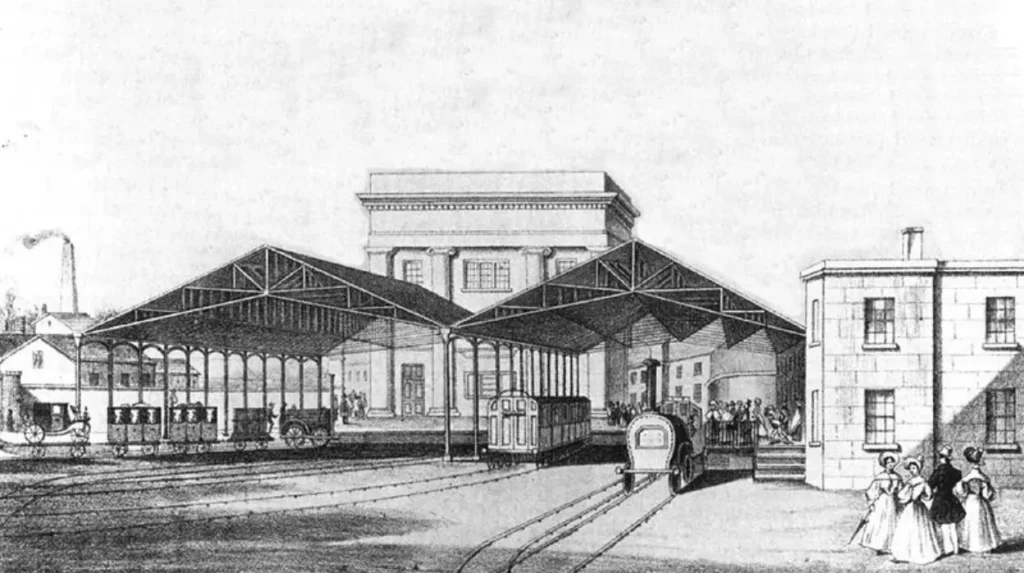
London’s railway age began during the 1830s when private railway companies constructed lines connecting the capital with emerging industrial centres. Early success demonstrated railway efficiency and triggered rapid nationwide investment known as Britain’s Railway Mania during the 1840s.
The first modern passenger railway using steam locomotives, the Liverpool and Manchester Railway, opened in 1830.
Its commercial success convinced investors that railways offered enormous economic opportunities.
London soon became the focus of competing railway companies seeking direct access to Britain’s largest market.
Major early railway companies included:
- London and Birmingham Railway
- Great Western Railway
- London and South Western Railway
- South Eastern Railway
- Eastern Counties Railway
Construction required enormous engineering projects involving tunnels, bridges, embankments, cuttings, and viaducts.
Thousands of labourers known as “navvies” excavated earthworks by hand using picks, shovels, and wheelbarrows.
The London and Birmingham Railway opened fully in 1838.
Designed by engineer Robert Stephenson, it established one of Britain’s most important railway corridors.
Which London railway stations transformed national travel?
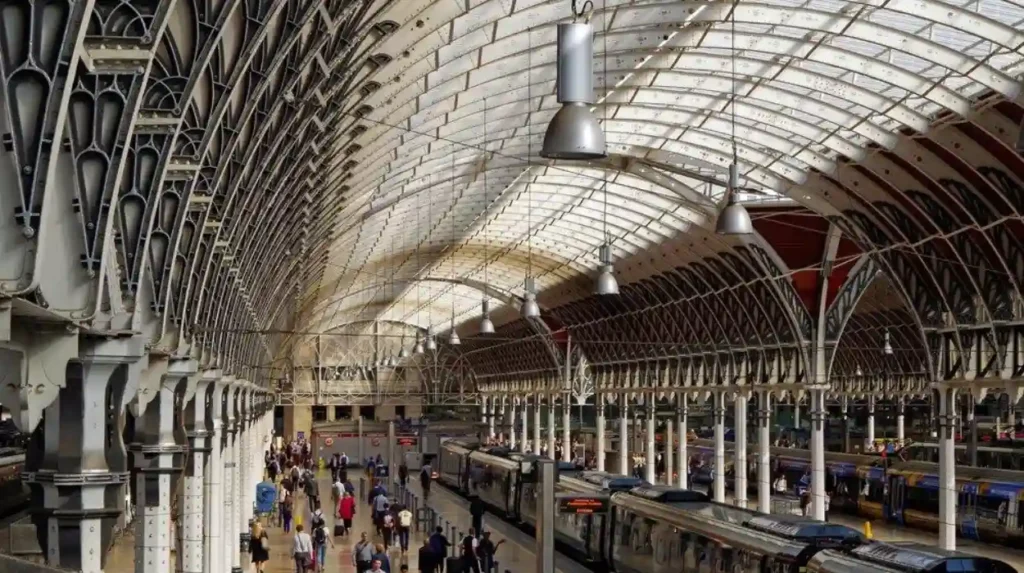
London’s great Victorian railway stations became gateways linking every region of Britain with the capital. Their engineering, architecture, and operational scale reflected industrial confidence while supporting millions of passengers and substantial freight movement throughout the nineteenth century.
London developed multiple terminal stations because competing private railway companies built independent routes into the capital.
Major stations included:
Euston Station
Opened in 1837.
Served the London and Birmingham Railway.
Connected London with the Midlands, north-west England, and later Scotland.
Paddington Station
Opened in 1838.
Designed by Isambard Kingdom Brunel for the Great Western Railway.
Linked London with Bristol, South Wales, and western England.
King’s Cross Station
Opened in 1852.
Served northern England and Scotland.
Became one of Britain’s busiest railway terminals.
St Pancras Station
Opened in 1868.
Constructed by the Midland Railway.
Its Barlow train shed became one of the world’s largest single-span iron structures.
Waterloo Station
Developed during the mid-nineteenth century.
Served south-west England.
Later became Britain’s busiest railway station.
These stations combined engineering innovation with monumental architecture, symbolising Victorian industrial achievement.
Many remain central to Britain’s transport network today.
Why was Railway Mania important to Britain’s development?
Railway Mania between approximately 1844 and 1847 produced unprecedented railway investment across Britain. Although many speculative companies failed financially, the construction boom rapidly expanded national infrastructure and permanently transformed transport accessibility for businesses, workers, and travellers.
Railway Mania represented one of Britain’s largest nineteenth-century investment booms.
Thousands of investors purchased railway shares.
Parliament authorised hundreds of railway schemes.
Some proposed routes never progressed beyond planning.
Others became vital transport corridors.
The period financed thousands of miles of railway construction.
Engineering firms expanded rapidly.
Iron production increased substantially.
Coal demand grew.
Brickmaking, bridge construction, surveying, and locomotive manufacturing experienced significant expansion.
Although many investors lost money after speculative bubbles collapsed, Britain retained the physical railway infrastructure created during this extraordinary investment period.
How did railways change everyday life in Britain?
Railways transformed daily life by reducing journey times, expanding employment opportunities, lowering freight costs, supporting urban growth, improving communication, and making regular long-distance travel practical for millions of people across Victorian Britain.
Rail travel fundamentally altered how people lived and worked.
Workers could commute longer distances.
Families visited relatives more frequently.
Businesses expanded into national markets.
Fresh food reached urban populations more quickly.
Postal services became faster and more reliable.
Newspapers circulated nationally on the day of publication.
Railways also supported population mobility.
People increasingly relocated for employment.
Industrial cities expanded rapidly as improved transport encouraged migration.
Affordable excursion tickets introduced leisure travel to wider sections of society.
Working-class families increasingly visited seaside destinations including Blackpool, Brighton, Scarborough, and Southend-on-Sea.
The railway therefore helped establish Britain’s domestic tourism industry.
How did railways strengthen London’s economic importance?
Railways reinforced London’s position as Britain’s commercial, political, and financial capital by concentrating passenger traffic, freight distribution, banking activity, wholesale markets, government administration, and industrial investment within the expanding metropolitan region throughout the Victorian period.
London already functioned as Britain’s largest city before railways.
Rail transport magnified its influence.
Agricultural products from East Anglia, dairy produce from western England, manufactured goods from Birmingham, textiles from Lancashire, and coal from northern England reached London more efficiently.
Financial institutions coordinated railway investment.
Insurance companies expanded alongside transport growth.
Wholesale markets increased their national reach.
The capital’s population grew from roughly one million people in 1801 to more than six million by 1901.
Railways supported this extraordinary urban expansion by transporting food, building materials, fuel, workers, and manufactured products into London daily.
Which engineers and innovators shaped Britain’s railway revolution?
Engineers, entrepreneurs, investors, and skilled workers collectively created Britain’s railway system through technological innovation, large-scale construction, locomotive design, surveying expertise, and organisational leadership that established international engineering standards during the nineteenth century.
George Stephenson
George Stephenson pioneered practical railway engineering.
He developed improved steam locomotives and contributed significantly to railway construction.
He promoted the standard railway gauge measuring 4 feet 8½ inches (1,435 millimetres), which became the international standard across much of the world.
Robert Stephenson
Robert Stephenson expanded his father’s work.
He designed important railway lines, tunnels, bridges, and locomotives.
His engineering achievements included major sections of the London and Birmingham Railway.
Isambard Kingdom Brunel
Brunel designed the Great Western Railway.
He introduced innovative engineering techniques and created numerous bridges, tunnels, and stations.
Although Brunel initially favoured a broad gauge measuring 7 feet ¼ inch (2,140 millimetres), Britain later standardised most lines to Stephenson’s gauge.
Railway navvies
The workforce behind railway construction included tens of thousands of manual labourers.
They excavated enormous cuttings, constructed embankments, laid track, and built bridges under demanding conditions throughout Britain.
How did railways standardise time across Britain?
Railways introduced consistent national timekeeping because safe train operation required identical schedules across multiple regions. Railway companies adopted Greenwich Mean Time, eventually replacing varying local solar times throughout Britain during the nineteenth century.
Before railways, towns calculated local time using the position of the sun.
Time differences between cities created few practical problems because journeys remained slow.
Railways required precise scheduling.
Train departures, passing loops, signalling systems, and connections depended on uniform time.
Railway companies therefore adopted Greenwich Mean Time (GMT).
Public clocks gradually synchronised with railway clocks.
In 1880, GMT became Britain’s legally recognised standard time.
This seemingly administrative change profoundly influenced business, government, education, communication, and everyday life.
What role did railways play during Britain’s industrial expansion?
Railways accelerated industrialisation by transporting raw materials, manufactured goods, workers, machinery, and agricultural produce quickly between factories, ports, mines, and urban markets, significantly increasing national productivity throughout the nineteenth century.
Coal travelled efficiently from mining districts to factories.
Iron reached engineering works.
Cotton arrived at textile mills.
Finished goods reached ports for export.
Farmers accessed wider consumer markets.
Ports including London, Liverpool, Southampton, Hull, and Bristol benefited from improved inland connections.
Manufacturing became increasingly integrated into national supply chains.
Lower transport costs encouraged larger production volumes.
Businesses expanded distribution networks beyond regional markets.
Railways therefore strengthened Britain’s global trading position during the Industrial Revolution.
What historic railway heritage remains visible today?
Britain preserves extensive railway heritage through operating stations, museums, bridges, tunnels, preserved railways, historic locomotives, and protected engineering structures that continue illustrating the technological achievements of the Victorian railway revolution for modern visitors and researchers.
Many nineteenth-century railway structures remain operational.
London’s Victorian stations continue serving millions of passengers annually.
Historic viaducts, tunnels, bridges, and signal boxes survive across Britain.
Several preserved railways operate heritage steam services using restored locomotives and historic rolling stock.
The National Railway Museum in York preserves one of the world’s largest railway collections, documenting Britain’s railway development through locomotives, engineering records, carriages, signalling equipment, and archival collections.
Many former railway buildings hold statutory protection through heritage listing systems managed by Historic England and equivalent organisations throughout Britain.
To experience many of these surviving railway landmarks today, consult our comprehensive [Best Day Trips From London by Train for Unforgettable Countryside and Historic Adventures] for itineraries and visiting parameters.
Why do historians consider Britain’s railway revolution globally significant?
Britain’s railway revolution established engineering standards, transport systems, commercial practices, and technological innovations adopted worldwide. London became the operational centre of a network that influenced railway construction across Europe, North America, Asia, Africa, and Australia.
Britain pioneered many features of modern railway operation.
These included:
- Standardised signalling
- Scheduled passenger services
- Railway timetables
- Centralised stations
- Freight logistics
- Professional railway management
British engineers exported expertise internationally.
Railway technology spread rapidly throughout the nineteenth century.
British locomotives, engineering methods, bridge designs, surveying techniques, and financial investment influenced railway construction across numerous countries.
Today, historians recognise Britain’s railway network as one of the defining infrastructure achievements of the Industrial Revolution.
Its influence extended far beyond transport.
Railways reshaped economic geography, accelerated urbanisation, encouraged tourism, standardised national time, expanded communication, and strengthened political integration.
London remained at the heart of this transformation, functioning as the principal interchange connecting Britain’s regions through a transport network that continues supporting millions of passenger journeys every week.
When did railways first connect London to other parts of Britain?
London’s first major railway connection opened in 1838 with the completion of the London and Birmingham Railway. During the following decades, additional lines linked the capital with cities across England, Wales, and Scotland, creating a nationwide rail network.