
Key Points
- Commuter Relief: A northwest London Underground station suffering from persistent, severe flooding has been successfully safeguarded by the natural engineering of a family of reintroduced Eurasian beavers.
- The Location: The animals reside within a managed 10-hectare (20-acre) enclosed urban wetland site at Paradise Fields in Greenford, situated within the London Borough of Ealing.
- Historical Context: Eurasian beavers (Castor fiber) were hunted to national extinction in Britain roughly 400 years ago during the Tudor era for their meat, fur, and castoreum.
- Project Genesis: The Ealing Beaver Project launched in October 2023 with the release of an initial family of five wild beavers relocated from Scotland, marking the first time the species has inhabited West London in four centuries.
- Population Growth: The urban colony has successfully flourished and expanded to at least eight individuals following the historic birth of multiple beaver kits on the site.
- Natural Flood Defence: The mammals have constructed a complex network of at least five to eight dams across local waterways, effectively turning the former golf course into a natural sponge that retains heavy rainfall and regulates water release downstream.
- Infrastructure Success: For the first time in decades, Transport for London (TfL) infrastructure at Greenford Tube station has remained entirely dry and flood-free during heavy downpours, eliminating the need for costly artificial reservoirs or levees.
- Broader Benefits: Alongside flood mitigation, the project has triggered a significant boost in regional biodiversity—attracting rare birds, bats, and butterflies—while simultaneously reducing local antisocial behaviour by 90 per cent.
The Inverted Pyramid of News Writing
Ealing (Extra London News) June 16, 2026 – A northwest London Underground station plagued by chronic, disruptive flooding has been saved by a group of relocated beavers who have used their natural dam-building skills to bail out the local commuter network.
- Key Points
- The Inverted Pyramid of News Writing
- Why Did Greenford Tube Station Regularly Flood?
- How Did a Beaver Family Become London’s Infrastructure Engineers?
- What Do the Project Ecologists and Experts Say About the Results?
- How Has the Beaver Project Impacted the Local Community and Biodiversity?
- How Have Politicians and National Figures Responded to the Project?
- Are There Any Conflicts Associated with Expanding the Beaver Population?
The pioneering urban rewilding initiative, situated at Paradise Fields nature reserve in Greenford, has effectively solved an infrastructure crisis that human engineers had struggled to resolve for decades. By constructing a highly sophisticated network of natural wooden dams, the semi-aquatic mammals have managed to slow the flow of downstream water and transform a former golf course into a highly absorbent wetland sponge. Local commuters who previously faced severe travel delays and waterlogged ticket offices during heavy rainfall are now able to access the transport network without disruption, drawing widespread praise from local residents, ecologists, and municipal leaders alike.
Why Did Greenford Tube Station Regularly Flood?
Prior to the biological intervention, Greenford Tube station suffered from repeated infrastructure failures whenever West London experienced significant downpours. While the train tracks themselves sit safely aboveground, the ground-level ticket office and passenger corridors were routinely inundated with surface water runoff, forcing staff to line corridors with sandbags and occasionally close the station entirely.
As reported by Lauren Frayer of NPR, climate change has exacerbated Britain’s famous drizzle, making regional rainfall notably heavier and more erratic. This shift has increasingly left urban spaces waterlogged that historically escaped flooding. In response to the escalating crisis, Ealing Council had initially planned to commit significant public funds toward heavy civil engineering interventions, including the construction of a traditional artificial reservoir and an expansive earthen levee system.
How Did a Beaver Family Become London’s Infrastructure Engineers?
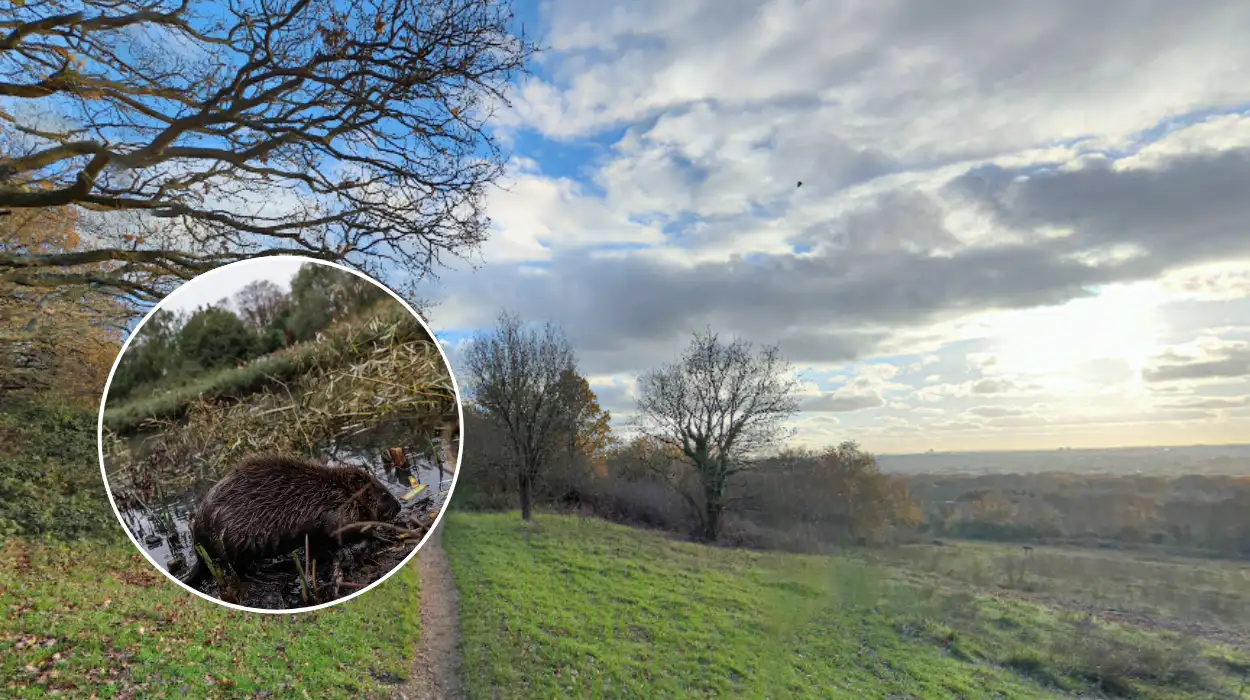
The structural remedy arrived not via concrete pouring, but through the reintroduction of a long-lost native keystone species. In October 2023, the Ealing Beaver Project successfully released a family of five Eurasian beavers—two adults and three kits—into the 10-hectare enclosed perimeter of Paradise Fields under a specialized license granted by Natural England.
Writing for the Huffington Post, journalist Aggie Chambre detailed that the Eurasian beaver is a native British species that was systematically hunted to extinction around 400 years ago. While a small-scale trial was initiated in Enfield, North London, in 2022, the Ealing rollout targeted an explicitly urban catchment area to test natural flood management.
Using their exceptionally sharp incisors, the nocturnal herbivores quickly began felling willow and aspen trees along the local creek. By weaving branches, mud, and stones together, the animals engineered a resilient multi-dam network that altered the local hydrology.
What Do the Project Ecologists and Experts Say About the Results?
The scientific team monitoring Paradise Fields has reported that the behavioral impact of the mammals exceeded their initial projections. As noted by Harriette Boucher of The Independent, Urban Beaver Officer Seniz Mustafa confirmed that 2024 marked the first year in memory that the local area did not experience seasonal flooding, directly vindicating the project’s ecological parameters.
Furthermore, as reported by Lauren Frayer of NPR, local veterinarian Sean McCormack, who founded the Ealing Beaver Project, explained the exact mechanism behind the success:
“They effectively turned this site into a giant sponge that can take heavy rainfall and slowly release water back into the landscape, creating a lot more resilience for flooding.”
This sentiment was mirrored by other key conservation groups involved in the joint venture. In an interview broadcast by Roxana Diba of the Londoner, Elliot Newton, the director of rewilding at Citizen Zoo—which collaborated alongside the Ealing Wildlife Group, Friends of Horsenden Hill, and the Beaver Trust—emphasised that the animals are “nature’s engineers.” He noted that their physical presence has dramatically reshaped the landscape, allowing scrub and meadow to grow where dense canopies once blocked sunlight, creating ideal conditions for wetland wildlife.
How Has the Beaver Project Impacted the Local Community and Biodiversity?
Beyond preserving public transit infrastructure, the rewilding site has provided major social and environmental dividends to the Borough of Ealing. According to official data published by Citizen Zoo, recorded incidents of antisocial behaviour inside the park area fell by an astounding 90 per cent following the site’s transformation into an active conservation zone.
Because Paradise Fields operates as the only fully publicly accessible urban beaver enclosure in the United Kingdom, it has grown into a major hub for eco-tourism. Local residents regularly gather for guided evening safaris and “beaver walks” to observe the creatures, which have grown to the size of a large dog.
Speaking to reporter Roxana Diba of the Londoner, Greenford resident Mary Finucane described the transformative impact the animals have had on local urban life:
“I think it makes us better inhabitants of this area. When I walk, I’m much more mindful of birdsong, and I’ve got my binoculars.”
The structural changes to the wetlands have also prompted an immediate ecological resurgence. Ecologists have documented the arrival of eight entirely new species of birds, two distinct species of bats, and a variety of rare butterflies that had long abandoned the industrialized sector of West London.
Explore more Ealing News:
Police Appeal After Violent Train Station Assault: West Ealing 2026
London Air Ambulance Walk: Mum’s 100k Challenge After Daughter’s Crash, Ealing 2026
How Have Politicians and National Figures Responded to the Project?
The striking success of the Ealing experiment has attracted attention from high-ranking political figures and veteran naturalists, including Sir David Attenborough. The Mayor of London, Sadiq Khan, has publicly championed the initiative as a model blueprint for future urban climate adaptation strategies across the capital.
As reported by Aggie Chambre for the Huffington Post, Mayor Sadiq Khan took to social media to officially praise the colony’s civic utility, stating on Instagram:
“Beavers are nature’s engineers – we just didn’t realise how efficient they could be. These incredible creatures have already stepped up to stop flooding at a Tube station and restore local habitats.”
The municipal success has also coincided with a major shift in national conservation policy. David Mooney, the Chief Executive Officer of the London Wildlife Trust, celebrated the broader national framework following a government decision to expand licensed river catchment releases across England.
As documented in official statements from the London Wildlife Trust, Mooney remarked:
“The reintroduction of this keystone species, absent in Ealing for centuries, really is going to help make London one step wilder. In the face of a climate and ecological emergency, it is partnerships like this one that will give hope for nature’s recovery and at the same time help us all recover our lost connection with the natural world.”
Are There Any Conflicts Associated with Expanding the Beaver Population?
While the urban trial in West London has been met with near-unanimous local enthusiasm, the wider reintroduction of beavers across Great Britain has highlighted operational friction between environmentalists and the agricultural sector, particularly where animals are not bound by urban containment fencing.
Reporting on the wider national landscape for NPR, Lauren Frayer highlighted that unmanaged, free-roaming beaver populations in rural areas like Scotland have created distinct challenges for food producers. Kate Maitland, a regional representative for Scotland’s National Farmers Union, noted:
“As the beaver population has expanded, we’ve seen more [farmers] getting concerned.”
Maitland clarified that unmonitored beaver dams can frequently block vital agricultural irrigation channels, inadvertently flooding valuable commercial crops.
Even supportive rural landowners acknowledge the inherent chaos of introducing wild rodents to managed land. Tom Bowser, a fifth-generation farmer in central Scotland who hosts wild beavers on his estate, expressed empathy for his industry peers during an interview with NPR:
“When you’re trying to grow food, the presence of a fat semiaquatic rodent who wants to raise water levels is understandably going to be unpopular!”
Despite these rural concerns, urban planners in London remain focused on the clear economic benefits shown in Ealing. By choosing to let nature manage the water table rather than constructing concrete levees, municipal authorities have saved significant capital, proved that wildlife can coexist within a sprawling metropolis, and provided a permanent fix for commuters heading to work.