Key Points
- Project Approval: Camden Council has officially granted planning permission for the £1 billion “Camden Film Quarter” regeneration scheme in North London.
- Narrow Margin: The critical vote passed with a knife-edge 6 to 5 majority at the planning committee’s first assembly since recent local government elections.
- Massive Redevelopment: The project will breathe life into a long-neglected brownfield site in Kentish Town, which has spent nearly a decade earmarked for development.
- Studio Facilities: Developer Yoo Capital has pledged a world-class urban production hub comprising 11 sound stages alongside dedicated educational facilities.
- Educational Integration: The complex is designed to house and nurture over 500 future industry professionals from the London Screen Academy and National Film and Television School.
- Housing and Employment: Plans outline 485 new residential dwellings, 243 of which are classified as affordable, with the entire scheme estimated to generate 1,365 operational and construction jobs.
- Public Concern: Community resistance mounted through 441 official objections targeting the massive 159-metre height profile, loss of trees, traffic pollution, and significant fire hazards stemming from a nearby waste treatment depot.
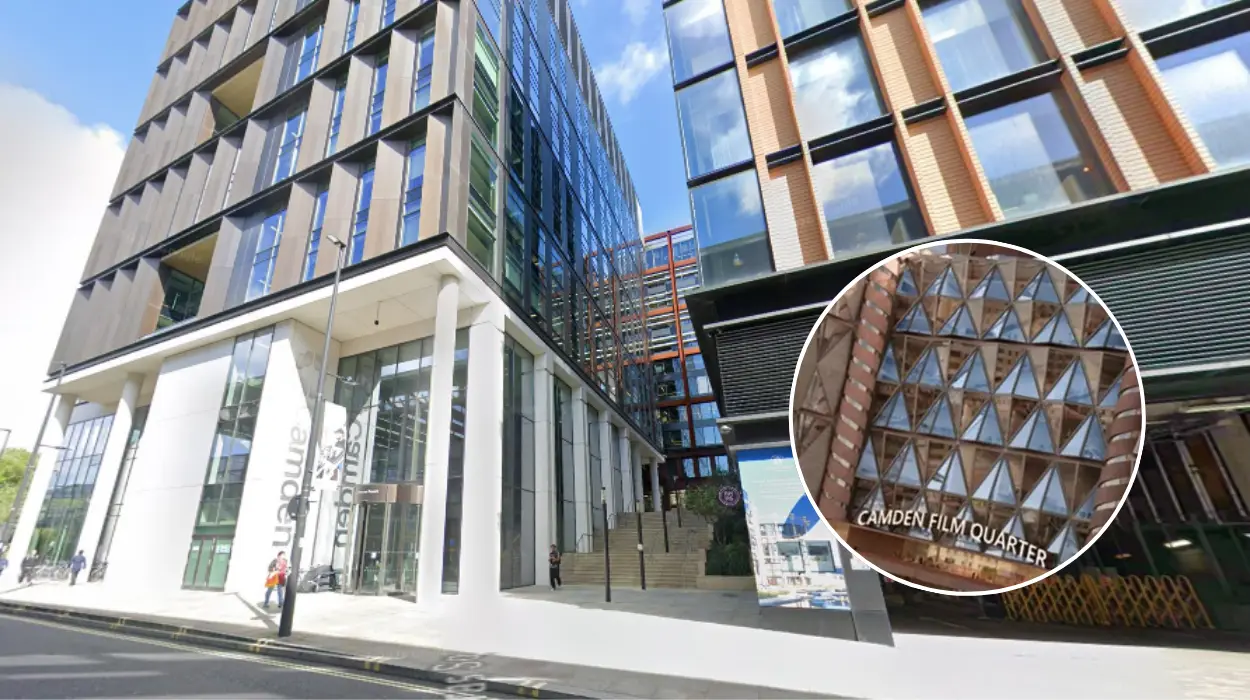
Kentish Town (Extra London News) June 17, 2026 – A monumental £1 billion regeneration scheme designed to morph an industrial brownfield plot in North London into a landmark film and television production district has secured critical planning approval from Camden Council. The sprawling venture, designated as the Camden Film Quarter, was pushed through by a razor-thin majority of just one vote during a highly charged municipal planning assembly on Monday evening. The decision marks an end to nearly ten years of political deadlock and planning delays over the future utilization of the prime Kentish Town real estate, paving the way for a radical reshaping of the borough’s commercial and architectural landscape.
The ambitious proposal is spearheaded by prominent commercial developer Yoo Capital—the real estate investment firm widely recognized for its high-profile stewardship of the multi-million-pound Olympia Exhibition Centre overhaul and the city’s famed Sky Garden development. Company executives have committed to delivering a world-class, purpose-built, urban city-centre media infrastructure network that includes 11 modern sound stages. These commercial facilities will feature tightly integrated educational campuses engineered to accommodate, train, and support more than 500 creative students from both the National Film and Television School (NFTS) and the London Screen Academy (LSA).
Beyond its foundational media production infrastructure, the broad master plan incorporates a sizable residential component consisting of 485 newly built homes. In a rare move for private sector developments in modern London, exactly 243 of these residential units have been officially designated under affordable housing definitions. The mixed-use urban quarter will also integrate contemporary infrastructure developments including modernized cycle corridors, pedestrian-only transit pathways, and expansive public parklands. According to technical documentation supplied by the developers, the widespread construction and subsequent operational phases of the media hub are anticipated to generate approximately 1,365 new localized employment opportunities.
Explore more Camden News:
Barfly Camden Music Venue Returns: Propaganda Revives Grassroots Icon, London 2026
Camden Fringe Celebrates 20th Anniversary with 400 Shows: London 2026
Why was the Planning Vote so Closely Contested?
The parliamentary arithmetic governing local decisions within the borough shifted markedly following recent local government elections, directly impacting the final outcome of the project’s planning assessment. As reported by journalist Josef Steen of The London Standard, the newly seated, Labour-run Camden Council Planning Committee voted 6 to 5 in favor of endorsing the massive development. This marginal victory reflects wider political re-alignments within the local authority; Labour’s overall historic majority across the council chambers was slashed down to 30 seats during the May electoral races as rival Green Party and Liberal Democrat candidates registered major structural gains.
Consequently, the physical allocation of opposition politicians sitting on the influential planning committee doubled overnight, vastly eroding the historically absolute grip the Labour Party previously maintained over Camden’s long-term macro-development strategies. Local authority planning officers openly noted during proceedings that while it remains “very rare” for private inner-city developments to offer such a robust level of localized affordable housing provision, deep divisions among committee members mirrored the intense anxiety felt throughout the surrounding neighborhood.
The sprawling commercial development faced robust, organized pushback from a coalition of 441 local residents and community advocacy groups. Opponents expressed sharp dissatisfaction with several core tenets of the massive master plan, highlighting the overarching structural scale of the complex—which is slated to ascend to a maximum height profile of up to 159 meters. Community members formally raised concerns regarding the systemic loss of mature trees, the permanent elimination of limited urban open green spaces, and the severe downward pressure a rapid influx of new residents would place on heavily burdened local schools and medical infrastructure.
What Environmental Objections did Opponents Raise?
The environmental footprint of the massive construction process served as a primary battleground during the heated committee debate. As reported by Josef Steen of The London Standard, Alice Brown, an active political campaigner representing the Green Party at the upcoming Regent’s Park local by-election, labeled the entire redevelopment venture as “disastrous” and “extreme” when addressing the planning committee. Brown focused her criticisms heavily on the sustained, long-term greenhouse gas emissions and intensive diesel lorry movements inevitably required to execute the extensive civil engineering works. She took particular issue with the excavation demands of the project, stating to the panel:
“The planners know this is a very damaging scheme but are under political pressure.”
Brown further decried the execution of what she described as “obscenely large” subterranean basements beneath the studio structures. These ecological warnings were directly supported from within the committee chambers by Councillor Tim Simon, an elected representative for the Liberal Democrats, who echoed identical community fears regarding the “substantial upfront CO2 impact” bound up with structural construction of this magnitude.
Municipal planning officers reviewing the case files openly admitted that the net localized environmental disruption tied to the construction phase would undeniably be “significant” in scope. They acknowledged that the anticipated output of greenhouse gases throughout the multi-year development timeline would fundamentally exceed the council’s own formally established environmental benchmarks. However, the planning department countered these criticisms by arguing that the extreme long-term energy efficiency mechanisms built into the completed buildings’ designs would eventually slash net carbon emissions by 63 percent over time. Officials noted that the council’s baseline environmental benchmarks “were not targets we need to meet” when weighed against broader economic benefits.
How Great are the Local Fire and Public Safety Risks?
Apart from environmental sustainability, the physical safety of future residents and local school children emerged as a major point of contention during the public hearing. As reported by Josef Steen of The London Standard, Councillor Lorna Jane Russell, Leader of the Opposition, explicitly condemned the proposed architectural design, labeling the massive building a “monstrosity” that would permanently block and overshadow long-protected historic views. Russell directed harsh criticism toward the controversial spatial configuration of the residential blocks, opposing the literal placement of high-density housing flats directly above an active municipal waste management facility.
Community objectors forcefully argued that co-locating residential housing directly on top of waste operations introduced unacceptable fire hazards to future occupants. To substantiate their warnings, local representatives cited a major industrial fire that tore through a similar recycling facility in Bermondsey on June 8, alongside the escalating global frequency of volatile lithium-ion battery fires erupting within urban waste streams. Furthermore, delegates speaking on behalf of the Kentish Town Neighbourhood Forum argued that endorsing the industrial-scale project posed an ongoing physical danger to young children, primarily because heavy construction lorries would be forced to navigate narrow residential roads passing next to local primary schools.
To address these safety concerns, the developer’s designated fire safety consultant testified that the team would actively investigate the integration of advanced automatic checking machinery within the facility. This specialized technology is designed to detect and isolate volatile batteries before they enter mechanical waste compactors. Local authority planning officers clarified that additional independent regulatory bodies would still be legally required to thoroughly review and sign off on the safety of the building’s final design before any physical structures could be raised.
Who is Backing the Project and What Happens Next?
Despite the fierce local opposition, both the developers and the creative forces backing the scheme have consistently framed the Camden Film Quarter as an irreplaceable economic asset for London’s cultural economy. As reported by Josef Steen of The London Standard, Lloyd Lee, a senior executive representing Yoo Capital, mounted a firm defense of the commercial initiative, explaining that the completed Film Quarter would successfully bring together “community and industry” under a single unified ecosystem.
This sentiment was supported by Trevor Morris, the project’s Camden-based lead architect. Morris noted that while he fully understood the community skepticism, the Film Quarter represented a:
“Once in a lifetime opportunity to offer meaningful regeneration.”
Morris further emphasized that the towering physical structure would remain “firmly rooted in its local context,” balancing global media production needs with local community growth.
Moving forward, the day-to-day operations of the 11 high-tech production sound stages will be formally managed by Oxygen Studios, an established studio operator with a track record running major British media production sites including Longcross, Arborfield, and Fairbanks Studios. Representatives from the Queen’s Crescent Neighbourhood Forum challenged this long-term management layout, alleging it was “almost certain” the project would eventually change its usage. The forum claimed Yoo Capital had “stated they intend to sell the film studios when built.”
However, management figures for the Camden Film Quarter flatly denied those assertions. Yoo Capital has publicly positioned the development as a long-term vehicle for global capital investment, built specifically to serve as a permanent, urban city-centre film and television production campus for decades to come. With municipal planning approval secured, the developer will now shift toward finalizing regulatory safety sign-offs and solidifying construction schedules for the Kentish Town site.