Canary Wharf transformed from part of London’s historic Docklands into a major global financial district through industrial decline, state-led regeneration, private investment, new transport infrastructure, and large-scale commercial development. Its history connects the British Empire, maritime trade, slavery, urban planning, architecture, and modern finance.
- How did Canary Wharf begin as part of London’s historic Docklands?
- Why were the West India Docks so important to London’s economy?
- Where did the name Canary Wharf come from?
- How did the Second World War affect the historic Docklands?
- Why did London’s historic docks decline and close?
- How did government policy begin the regeneration of Canary Wharf?
- How did Canary Wharf become a major financial development?
- Why did Canary Wharf face financial difficulties during the 1990s?
- How did transport infrastructure help Canary Wharf become successful?
- How did Canary Wharf become a global financial powerhouse?
- What historic evidence of the Docklands remains at Canary Wharf today?
- What does the transformation of Canary Wharf reveal about London’s history?
- Why is Canary Wharf important for London’s future historical record?
- Frequently Asked Question
The modern skyline of Canary Wharf stands on land shaped by more than two centuries of commercial activity. Before glass towers, banking headquarters, and high-speed rail connections, the Isle of Dogs contained one of the most important dock complexes in the Port of London.
The transformation was neither sudden nor simple. It followed a sequence of major historical changes: the construction of the West India Docks in 1802, the expansion of imperial trade, wartime destruction, the decline of London’s traditional port, the closure of the docks, and the redevelopment policies of the 1980s.
Canary Wharf therefore represents a major example of urban regeneration in modern Britain. Its landscape preserves physical evidence of its industrial past while functioning as one of London’s principal centres for international business.
How did Canary Wharf begin as part of London’s historic Docklands?
Canary Wharf developed on the Isle of Dogs around the West India Docks, which opened in 1802 to handle expanding maritime trade. The enclosed dock system transformed previously industrial riverside land into a secure commercial infrastructure serving the growing Port of London.
The history of Canary Wharf begins with the geography of the Isle of Dogs. This peninsula sits within a large curve of the River Thames in east London. Its riverside position made it strategically valuable for shipping and industry.
By the late eighteenth century, London had become one of the world’s leading commercial ports. Ships carrying imported goods faced serious congestion along the traditional quays between London Bridge and the Tower of London. Cargoes remained aboard vessels for long periods, creating delays, losses, theft, and logistical problems.
Merchants involved in Caribbean trade promoted a new solution: enclosed commercial docks.
The West India Dock Act of 1799 authorised the construction of the West India Docks and established the West India Dock Company. The project represented an important change in the organisation of London’s maritime economy. Parliament had created a legal framework for a specialised, privately operated commercial dock system.
Construction began in 1800. The docks opened in 1802.
The engineering project created large enclosed water spaces separated from the River Thames by locks and controlled entrances. This arrangement allowed ships to unload and load cargoes in a more secure and organised environment.
Historic England identifies the West India Docks as a pioneering development in commercial dock engineering. The Import and Export Docks covered approximately 54 acres and formed one of the defining infrastructure projects of the early nineteenth-century Port of London.
The new dock complex established the historical foundation on which Canary Wharf was later built.
What were the West India Docks designed to handle?
The West India Docks were designed primarily for trade connected with Britain’s Caribbean colonies and plantations. Their warehouses stored commodities including sugar, rum, coffee, spices, timber, and other imported goods.
The docks were promoted by merchants and plantation owners with substantial economic interests in the West Indies. Robert Milligan, a plantation owner and merchant, became a leading figure in the development of the West India Dock Company.
This history requires direct recognition of the economic system that financed much of the original infrastructure.
The West India Docks were closely connected to the products of plantation economies that depended on the enslavement of African people. Sugar, rum, coffee, and other commodities entered London through commercial systems connected to the transatlantic slave trade and colonial slavery.
Historic England records that the surviving warehouses at West India Quay hold exceptional historical significance because they were built specifically to receive products produced through enslaved labour.
This connection makes the history of Canary Wharf broader than a story of engineering and finance. The area’s commercial development formed part of Britain’s imperial and colonial economy.
Why were the West India Docks so important to London’s economy?
The West India Docks increased London’s capacity to manage international shipping by providing secure, specialised facilities for large volumes of imported goods. They strengthened the Port of London’s commercial infrastructure and supported Britain’s expanding nineteenth-century imperial trading system.
The early nineteenth century brought rapid expansion in Britain’s overseas trade. London required infrastructure capable of handling increasing quantities of goods arriving from the Caribbean, Asia, Europe, and other regions.
Before enclosed docks, ships frequently unloaded along congested stretches of the Thames. The West India Docks introduced a more controlled commercial system.
The complex contained large dock basins, warehouses, offices, security arrangements, and specialised infrastructure. The London Museum records that the dock system was almost a kilometre long and had space for up to 500 vessels.
The warehouses became equally important.
Goods arriving in London required secure storage before distribution through British markets. The North Quay warehouses were constructed as substantial brick commercial buildings designed to hold large quantities of imported cargo.
Historic England records that the original warehouse range extended for more than half a mile. Only Warehouses Nos. 1 and 2 survived the destruction caused by bombing during the Second World War.
The scale of the complex demonstrated the importance of maritime infrastructure to Britain’s nineteenth-century economy.
How did the dock system change the Isle of Dogs?
The West India Docks converted large areas of the Isle of Dogs into a highly organised industrial and commercial landscape. Water basins, warehouses, roads, railway connections, offices, and workers’ communities gradually reshaped the peninsula.
The docks also influenced employment.
Thousands of people worked directly or indirectly within London’s dock economy. Occupations included dock labourers, warehouse workers, ship crews, clerks, customs কর্মকর্তারা, engineers, transport workers, merchants, and construction workers.
The surrounding districts developed strong working-class communities connected to the Port of London.
For genealogical researchers, Docklands history is therefore significant because historical records often contain connections between families and maritime employment. Census records, parish registers, employment records, electoral registers, and local archives document generations associated with east London’s industrial economy.
The Isle of Dogs became a place where global commerce and local communities existed within the same physical landscape.
Where did the name Canary Wharf come from?
The name Canary Wharf originated from a dockside area associated with imports from the Canary Islands. A warehouse constructed in the twentieth century handled fruit and vegetables from the islands, giving the location the name later adopted by the financial district.
The modern name Canary Wharf does not originate from the Canary Islands as a financial concept or from the skyscraper development of the late twentieth century.
It originated from the commercial history of the docks.
The London Museum records that a warehouse was constructed in 1936 to handle fruit and vegetables arriving from the Canary Islands. This dockside location became known as Canary Wharf.
Imports included products such as bananas and other fruit.
The name therefore preserved a direct connection to the international trading activity of the Port of London.
This is an important example of historical continuity in the modern landscape. The towers of Canary Wharf represent twenty-first-century commercial activity, but the district retains a name created by twentieth-century maritime trade.
The modern financial centre occupies a place whose identity was originally shaped by ships and imported cargo.
How did the Second World War affect the historic Docklands?
The Second World War caused extensive destruction across London’s Docklands because the port was essential to Britain’s food supplies, imports, transport networks, and war economy. Bombing damaged warehouses and infrastructure, permanently changing the physical landscape of the West India Docks.
London’s docks became important military targets during the German bombing campaign of 1939–1945.
The Port of London handled essential imports. Food, raw materials, industrial supplies, and other goods passed through the docks. Disrupting this infrastructure formed part of Germany’s wider campaign against Britain’s economy and war capacity.
The Docklands experienced extensive bombing during the Blitz.
West India Docks suffered substantial damage. Historic warehouse buildings were destroyed, including much of the original North Quay warehouse range.
Only two of the original warehouses survived.
The destruction created a visible break in the architectural continuity of the dock complex. Buildings that had defined the nineteenth-century industrial landscape disappeared.
The surviving structures later became important heritage assets.
The London Museum records that the docks were rebuilt after the war and returned to significant commercial activity within approximately a decade. By the 1960s, the Port of London was again operating at a large scale.
However, the recovery did not solve the long-term technological changes affecting traditional dock systems.
Why did London’s historic docks decline and close?
London’s historic docks declined because modern shipping technology required larger vessels, container handling facilities, and deeper port infrastructure. Trade increasingly moved downstream to locations such as Tilbury, leaving older enclosed docks commercially obsolete and eventually abandoned.
The decline of the Docklands resulted from structural changes in international shipping.
Containerisation transformed maritime transport after the mid-twentieth century. Standardised containers allowed cargo to move efficiently between ships, trains, and road vehicles.
Traditional docks had been designed for a different system.
Cargo was previously unloaded in individual packages, sacks, barrels, crates, and other forms. This required large numbers of dock workers and extensive warehouse facilities.
Container shipping reduced the need for this traditional labour-intensive system.
Ships also became larger.
Many vessels could no longer operate efficiently within London’s older enclosed dock complexes. Modern ports required deeper water, larger handling areas, and direct connections to expanding national transport networks.
The London Museum identifies containerisation and the increasing size of ships as central reasons for the decline of the West India Docks. Shipping increasingly moved further east along the Thames.
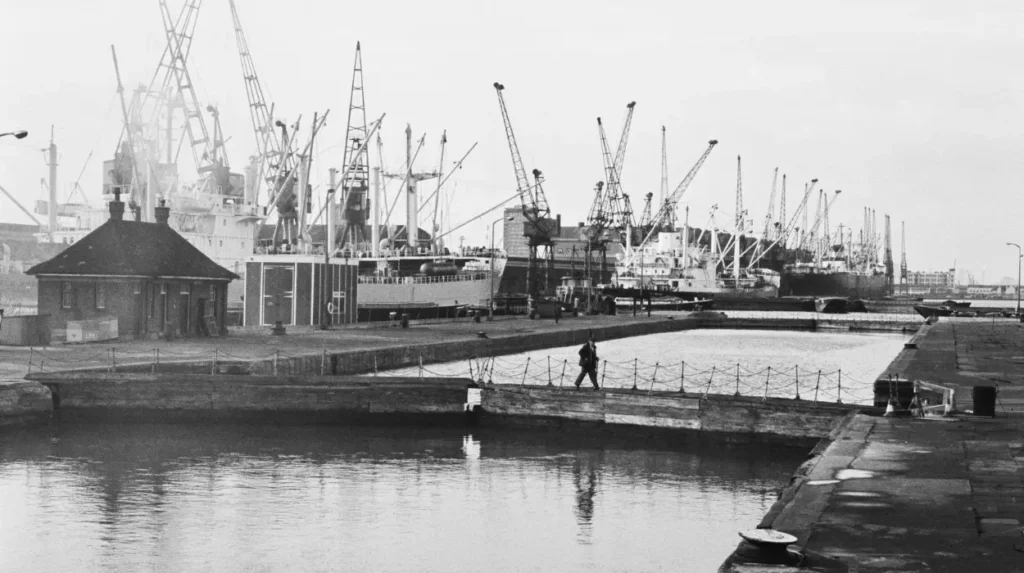
The West India Docks closed in 1980, ending almost 180 years of commercial dock operations.
The closure left extensive areas of industrial land underused or derelict.
This created the conditions for one of Britain’s largest urban regeneration programmes.
How did government policy begin the regeneration of Canary Wharf?
Government regeneration policy began transforming Docklands in 1981 through the London Docklands Development Corporation and Enterprise Zone incentives. These policies encouraged private investment, accelerated development, and transferred former industrial land into new commercial and residential uses.
The closure of London’s docks created a major urban challenge.
Large areas of east London contained vacant industrial land, deteriorating infrastructure, and communities affected by the loss of dock employment.
In 1981, the government designated London Docklands as an urban development area and established the London Docklands Development Corporation, commonly known as the LDDC.
The LDDC received responsibility for bringing land and buildings back into productive use.
Its statutory objectives included encouraging industry and commerce, improving the environment, and supporting housing and social facilities.
The Isle of Dogs became an Enterprise Zone.
An Enterprise Zone provided financial and planning incentives intended to encourage private-sector investment. The policy formed part of the broader economic strategy of the 1980s, which emphasised private development and market-led regeneration.
This institutional change was essential to the creation of modern Canary Wharf.
The transformation required land assembly, infrastructure planning, transport investment, and developers capable of financing large-scale construction.
How did Canary Wharf become a major financial development?
Canary Wharf became a financial district when private developers built large modern office complexes designed for banks and international corporations. The Olympia & York development of the late 1980s established the high-rise business district that replaced former dock infrastructure.
The idea of developing a major office district on the Isle of Dogs emerged during the 1980s.
The location offered an unusual opportunity.
Large amounts of land existed close to central London. The former docks provided a site large enough for modern office buildings that could accommodate major corporate operations.
Olympia & York, a Canadian property developer led by the Reichmann family, became the principal developer of the Canary Wharf project in 1987.
Construction began on a new commercial district.
The development represented a fundamental change in land use.
Ships and warehouses were replaced by offices, transport infrastructure, public spaces, retail facilities, and residential development.
The centrepiece became One Canada Square.
Why did One Canada Square become the symbol of the new Canary Wharf?
One Canada Square became the defining symbol of Canary Wharf because its scale represented the transition from industrial Docklands to modern corporate London. Completed in 1991, the skyscraper established a new visual and commercial identity for the former docklands.
The tower was designed by César Pelli & Associates with associated architectural firms.
Construction began during the late 1980s, and the building was completed in 1991. The Council on Tall Buildings and Urban Habitat records the building’s completion in 1991.
The building became Britain’s tallest completed building at the time and dominated London’s eastern skyline.
Its significance extended beyond architecture.
One Canada Square demonstrated the ambition of the regeneration project. The building was intended to attract major corporations requiring large, modern office floors unavailable in many historic buildings within the City of London.
The tower became a geographic marker for London’s expanding financial economy.
It also established the architectural model for further development.
Additional office towers and commercial buildings followed.
The modern Canary Wharf skyline developed through a concentration of high-rise corporate architecture rather than the incremental growth typical of many older London districts.
Why did Canary Wharf face financial difficulties during the 1990s?
Canary Wharf experienced serious financial difficulties because its initial development coincided with a major property downturn and recession. Olympia & York entered bankruptcy in 1992, delaying the project before new ownership and improving infrastructure supported recovery.
The first phase of Canary Wharf did not achieve immediate commercial success.
Large-scale property developments require substantial investment before rental income becomes established. The project was also dependent on transport improvements and sustained corporate demand for office space.
The early 1990s brought a major property market downturn.
Olympia & York entered financial difficulty, and the Canary Wharf development went into administration during 1992.
The crisis demonstrated an important feature of the district’s history.
Canary Wharf was not created through uninterrupted economic success. Its development depended on repeated restructuring, refinancing, infrastructure investment, and changing corporate demand.
The project was subsequently acquired and reorganised.
By the mid-1990s, Paul Reichmann returned with an international investment consortium to regain control of Canary Wharf.
The recovery accelerated as major companies committed to the area.
Financial institutions, professional services firms, media organisations, and multinational corporations increasingly relocated to the Isle of Dogs.
How did transport infrastructure help Canary Wharf become successful?
Transport infrastructure made Canary Wharf commercially viable by connecting the former Docklands more effectively with central London and surrounding regions. The Docklands Light Railway, Jubilee line, roads, and later Elizabeth line transformed accessibility for workers and businesses.
Accessibility was one of the central challenges facing the redevelopment.
A financial district requires large numbers of workers to travel reliably to and from offices every day.
The redevelopment of Canary Wharf therefore depended on major infrastructure investment.
The Docklands Light Railway, commonly known as the DLR, created an automated rail connection between Docklands and other parts of London.
The Limehouse Link improved road connections.
The opening of the Jubilee line extension transformed the area’s connection to central London. Canary Wharf station became one of the major transport hubs created during the expansion.
The London Museum identifies the modern Canary Wharf area as accessible through the DLR, Jubilee line, and Elizabeth line, demonstrating the multiple transport networks that now serve the district.
Transport changed the economic geography of east London.
Canary Wharf became easier to reach from central London, southeast London, and later wider parts of the capital.
This infrastructure helped employers recruit from a much larger labour market.
The success of the district therefore depended on more than architecture. Transport networks converted a former industrial peninsula into an integrated part of metropolitan London.
How did Canary Wharf become a global financial powerhouse?
Canary Wharf became a global financial centre through the concentration of banking, financial services, professional firms, technology businesses, and international corporations. Large modern offices and improved transport enabled employers to establish major headquarters outside London’s historic City financial district.
The modern district developed as a second major centre of London’s financial economy.
The City of London remained historically important, but Canary Wharf provided a different type of corporate environment.
Its large office buildings offered extensive floor space designed for major organisations.
Banks and financial institutions became prominent occupiers.
The district developed around corporate headquarters, professional services, technology infrastructure, retail services, and supporting businesses.
The Institution of Civil Engineers describes Canary Wharf as a major redevelopment of former docklands and reports approximately 105,000 workers in the district in its overview of the project.
This concentration of employment represents a complete reversal from the dereliction that followed dock closure.
The economic function of the land changed.
In the nineteenth century, value came primarily from the movement and storage of physical commodities.
In the modern district, economic activity is concentrated around financial transactions, professional services, corporate management, digital systems, and international business networks.
The physical infrastructure changed accordingly.
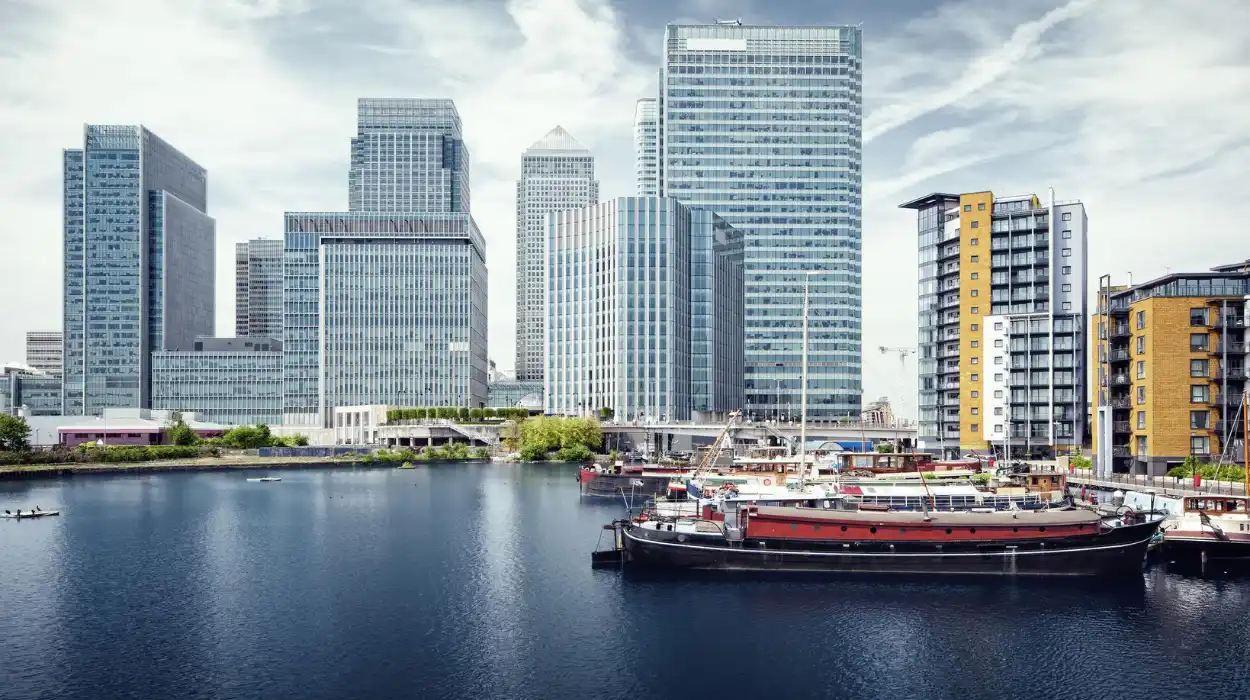
Warehouses became heritage buildings. Docks became landscaped waterways and public spaces. Industrial transport systems were replaced by rail stations, underground pedestrian routes, and modern commercial infrastructure.
To experience this historic transformation in person today, consult our comprehensive [Best Attractions in Canary Wharf Beyond Skyscrapers for Curious London Visitors Today] for itineraries and visiting parameters.
What historic evidence of the Docklands remains at Canary Wharf today?
Canary Wharf retains significant evidence of its dockland past through surviving warehouses, dock basins, quay walls, historic street patterns, and conservation areas. These structures connect the modern financial district directly to the industrial and maritime landscape established in the nineteenth century.
The redevelopment of Canary Wharf did not erase every element of the former Docklands.
The West India Docks remain physically visible.
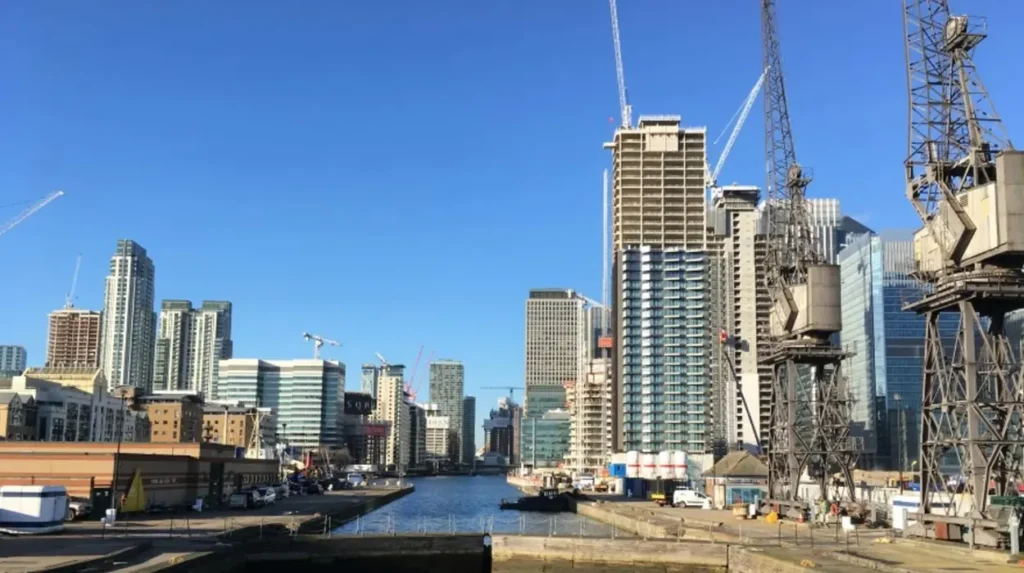
The large water basins continue to define the geography of the area. Modern office buildings stand beside nineteenth-century dock infrastructure.
Historic England lists the quay walls, copings, and buttresses of the West India Docks at Grade I, the highest category of statutory heritage protection in England.
The surviving warehouses are particularly important.
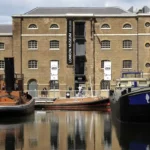
Warehouse No. 1 now houses London Museum Docklands. The museum occupies one of the historic structures built as part of the original West India Dock complex.
Historic England records that Warehouses Nos. 1 and 2 are the only surviving buildings from the original extensive warehouse range after wartime destruction.
These buildings provide physical evidence of the area’s nineteenth-century commercial history.
How does London Museum Docklands preserve Canary Wharf’s history?
London Museum Docklands preserves the history of the area by interpreting the River Thames, the Port of London, maritime trade, industrial communities, wartime experience, and Docklands regeneration within a surviving historic West India Dock warehouse.
The museum occupies No. 1 Warehouse at West India Quay.
Its setting is historically significant.
Visitors enter a nineteenth-century commercial building that originally formed part of one of Britain’s most important dock systems.
The museum documents more than four centuries of Docklands history and includes exhibitions addressing the history of London’s involvement in slavery and the trade that shaped the West India Docks.
This preservation work is essential because modern redevelopment can obscure earlier landscapes.
Without historic buildings, museum collections, archival records, and archaeological research, the financial district could appear to have emerged entirely during the late twentieth century.
The museum places the modern skyline within a much longer historical context.
What does the transformation of Canary Wharf reveal about London’s history?
Canary Wharf demonstrates how London repeatedly changes its economic landscape in response to technology, trade, infrastructure, and global markets. The district records the transition from imperial maritime commerce and industrial labour to international finance, corporate services, and digital economic activity.
Canary Wharf is a concentrated record of several major transformations in British history.
The first transformation involved maritime commerce.
The West India Docks reflected London’s growth as an international trading centre during the nineteenth century.
The second involved industrialisation and urban labour.
Dock workers and associated industries created communities whose employment depended on the movement of goods through the Thames.
The third involved technological change.
Containerisation and larger ships made traditional enclosed dock systems economically obsolete.
The fourth involved urban regeneration.
Government agencies, planning powers, private developers, and infrastructure investment converted former industrial land into a modern commercial district.
The fifth involved the changing geography of global finance.
Canary Wharf became part of London’s international financial system.
These historical phases explain why the area contains such contrasting architecture.
Georgian warehouses stand beside modern skyscrapers. Historic dock water remains beside corporate headquarters. Industrial heritage exists within one of Europe’s major business districts.
Why is Canary Wharf important for London’s future historical record?
Canary Wharf is important to London’s future historical record because it demonstrates how industrial heritage can coexist with large-scale redevelopment. Its preserved docks and warehouses provide evidence of earlier economic systems while the modern district documents changing patterns of finance, employment, technology, and urban planning.
The history of Canary Wharf continues to develop.
Every generation changes the meaning of the landscape.
The nineteenth-century dock builders did not anticipate the disappearance of traditional cargo handling. The dock workers of the twentieth century did not work within a landscape dominated by skyscrapers and global financial institutions.
Modern Canary Wharf demonstrates that cities are continuously reconstructed.
Heritage preservation plays an important role in maintaining historical evidence during this process.
The Grade I-listed dock walls, surviving warehouses, and preserved waterways ensure that the earlier landscape remains visible.
The West India Dock Conservation Area also protects surviving elements associated with the original dock complex and its supporting infrastructure.
For educators, the district provides a concentrated case study in economic history, engineering, urban geography, architecture, colonial history, and regeneration policy.
For history enthusiasts, it provides visible evidence of London’s changing relationship with the River Thames.
For cultural tourists, it demonstrates how historic infrastructure survives within a modern business environment.
For genealogical researchers, Docklands archives preserve connections to families involved in shipping, warehousing, transport, and industrial employment.
Canary Wharf ultimately represents continuity as well as change.
The economic activity has changed from cargo to capital.
The buildings have changed from warehouses to skyscrapers.
The transport systems have changed from sailing ships and industrial infrastructure to rail networks and modern metropolitan connections.
Yet the location remains connected to the same fundamental advantage that shaped its history more than two centuries ago: its position within London and beside the River Thames.
From the opening of the West India Docks in 1802 to the rise of One Canada Square and the modern financial district, Canary Wharf records one of the most significant transformations in London’s urban history. Its preserved heritage ensures that the story of the historic Docklands remains part of the landscape even as the district continues to evolve.
Frequently Asked Question
When did the West India Docks open?
The West India Docks opened in 1802. They were built to improve the handling, storage and security of goods arriving in London through Britain’s expanding international trade networks.