Canary Wharf is widely recognised for its modern skyline, global financial institutions and high-rise architecture. Its deeper significance, however, lies in the history preserved beneath and around those towers. The district occupies part of the Isle of Dogs, a riverside landscape shaped by international trade, industrial labour, imperial commerce, wartime destruction and one of Britain’s largest urban regeneration programmes.
- What makes Canary Wharf historically important beyond its skyscrapers?
- Which historical attraction provides the best introduction to Canary Wharf?
- Where can visitors see the original dockland landscape?
- How did Canary Wharf change from a working port into a financial district?
- What can Crossrail Place Roof Garden teach visitors about geography and modern London?
- Which public spaces reveal a quieter side of Canary Wharf?
- How did the Second World War affect the history of Canary Wharf?
- Why is Canary Wharf important for architecture and urban regeneration studies?
- What should history enthusiasts and educators explore in Canary Wharf?
- Why does Canary Wharf remain relevant to London’s future history?
- Frequently Asked Question
For curious visitors, the most important attractions in Canary Wharf extend beyond observation decks, offices and shopping centres. Historic docks, Georgian warehouses, museum collections, public landscapes, waterways and carefully preserved industrial structures reveal how this part of east London changed over more than two centuries.
The area provides an unusually clear record of London’s transformation from a maritime port into a post-industrial global business district. The surviving West India Docks demonstrate the early nineteenth-century expansion of enclosed commercial docks. West India Quay preserves warehouse architecture associated with international trade. London Museum Docklands interprets the economic and social systems that connected London with the Caribbean, Africa, Europe and other parts of the world. Modern attractions such as Crossrail Place Roof Garden also demonstrate how contemporary development has incorporated geography, infrastructure and public space into the historic dockland landscape.
For visitors interested in history, architecture and urban change, Canary Wharf is therefore a major cultural landscape rather than simply a concentration of skyscrapers.
What makes Canary Wharf historically important beyond its skyscrapers?
Canary Wharf is historically important because it developed from the West India Docks, a major centre of global trade opened in the early nineteenth century, before experiencing industrial decline, wartime damage and large-scale regeneration into a modern financial district.
The history of Canary Wharf begins with London’s position as a major commercial port. By the late eighteenth century, the Port of London handled an enormous volume of goods arriving from Britain’s expanding overseas trading networks.
The traditional riverside system created serious practical problems. Ships waited for access to crowded wharves. Cargoes were vulnerable to theft. Merchants required more secure and efficient facilities for unloading, storing and processing valuable commodities.
The response was the construction of enclosed docks.
The West India Docks were developed specifically to improve the handling of goods associated with Britain’s West Indian trade. The Import Dock opened during the period from 1800 to 1802, followed by the Export Dock in the early nineteenth century. These facilities represented a major technological and commercial development in London’s port infrastructure.
The docks were designed as controlled commercial spaces. Ships entered enclosed basins through locks, while warehouses stored goods close to the water. The system improved security and increased the efficiency of cargo handling.
This history remains visible today.
The water of the former docks survives within the modern Canary Wharf landscape. Historic quay walls continue to define the district. Georgian and later industrial buildings stand beside contemporary offices. The contrast between brick warehouses and glass towers provides direct physical evidence of the area’s changing economic functions.
The name Canary Wharf itself also has a specific historical origin. During the twentieth century, the West India Docks handled goods from many international locations. A warehouse built in 1936 for fruit and vegetables associated with the Canary Islands became known as Canary Wharf.
The modern district therefore inherited its name from the trading landscape that preceded the financial centre.
How did the West India Docks change London?
The West India Docks helped establish a new model for the organisation of London’s commercial waterfront. Instead of relying entirely on open river wharves, cargo moved through enclosed and controlled dock systems.
This transformation had economic consequences for merchants, workers and consumers.
Goods passing through the docks included commodities such as sugar, rum, timber and later food products from many parts of the world. London’s prosperity became increasingly connected to maritime networks and overseas commerce.
The development also created a specialised dockland economy. Labourers, warehouse workers, ship crews, merchants, customs officials and transport workers became part of the social infrastructure surrounding the docks.
For genealogical researchers, this history is especially important. East London records contain generations of families connected with shipping, warehousing, customs administration and port labour.
Canary Wharf therefore represents both a physical landscape and a record of London’s working population.
Which historical attraction provides the best introduction to Canary Wharf?
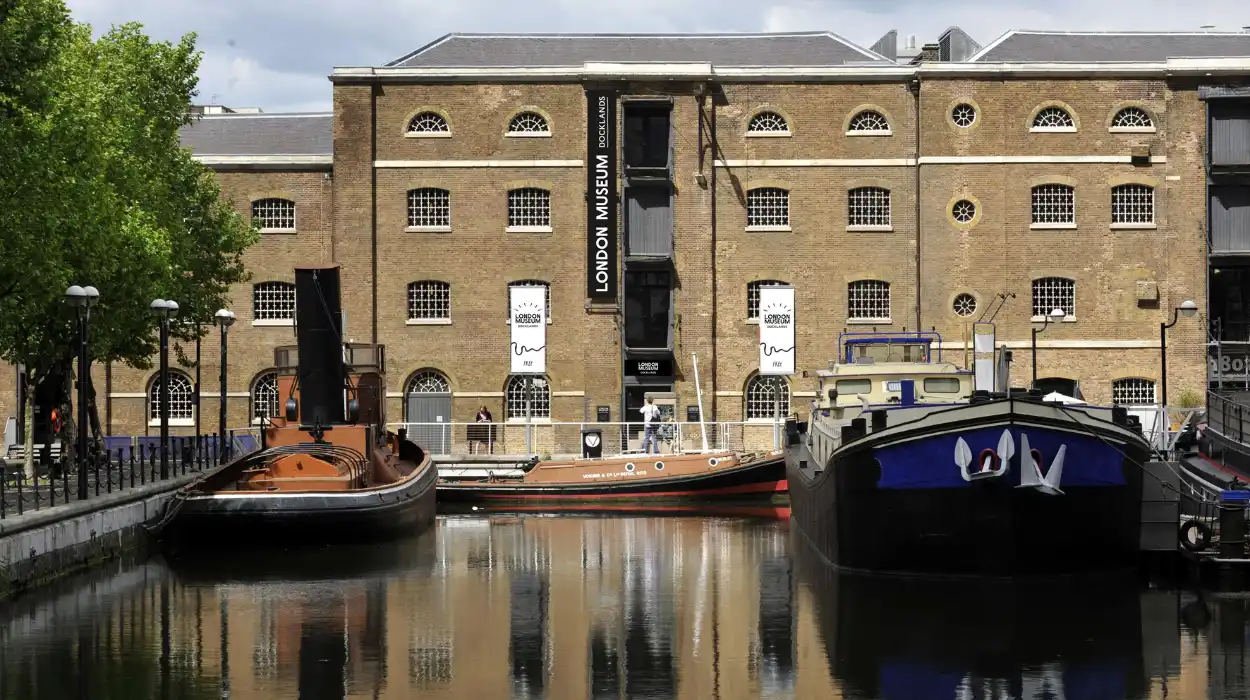
London Museum Docklands provides the strongest historical introduction because its collections explain more than 400 years of river, port and docklands history inside a surviving Grade I-listed warehouse at West India Quay.
London Museum Docklands is the central historical attraction for visitors exploring Canary Wharf beyond its modern architecture.
The museum occupies No. 1 Warehouse at West India Quay. The building itself forms part of the historical experience. It was constructed for commercial storage during the period when London’s docks formed one of the world’s most important trading systems.
Today, the museum interprets the relationship between London’s river, port and population. Its permanent displays examine subjects including maritime trade, industrial development, wartime history and post-war regeneration.
The museum also addresses one of the most important and difficult aspects of docklands history: the relationship between London’s commercial wealth and slavery.
Why is the history of sugar and slavery essential to understanding Canary Wharf?
The West India Docks were directly connected to commodities produced within plantation economies, including sugar. These economic systems were inseparable from the transatlantic trafficking and enslavement of African people.
A factual interpretation of Canary Wharf therefore requires more than architectural history.
The district’s surviving warehouses demonstrate the infrastructure through which goods entered London. The economic value represented by those goods was connected to systems of colonial expansion, forced labour and international finance.
London Museum Docklands addresses these subjects through its historical interpretation of sugar, slavery and London’s commercial networks.
This context gives visitors a fuller understanding of the physical landscape.
A warehouse is not simply a historic building. It is evidence of a commercial system. A dock is not simply an attractive body of water. It represents the infrastructure required to move ships, people and commodities through an expanding global economy.
For educators and students, this makes the museum particularly valuable. The site connects local geography with global history.
Where can visitors see the original dockland landscape?
Visitors can see the original dockland landscape around West India Docks and West India Quay, where surviving water basins, quay walls, warehouses and historic infrastructure preserve the physical framework of nineteenth-century London’s commercial port.
The West India Docks are among the most important surviving historical features in Canary Wharf.
The water remains a defining element of the district despite the extensive redevelopment that followed dock closure. Modern buildings rise beside spaces originally designed for sailing ships and commercial cargo.
This survival allows visitors to understand the scale of the former port.
The docks were not isolated buildings. They formed an integrated industrial landscape. Ships entered through controlled access points. Cargo was unloaded beside warehouses. Goods moved through storage and transport networks before reaching markets across London and Britain.
Tower Hamlets’ conservation documentation identifies the surviving West India Dock landscape as a significant reminder of London’s great enclosed docks. The surviving historic warehouses and dock structures retain particular architectural and historical importance.
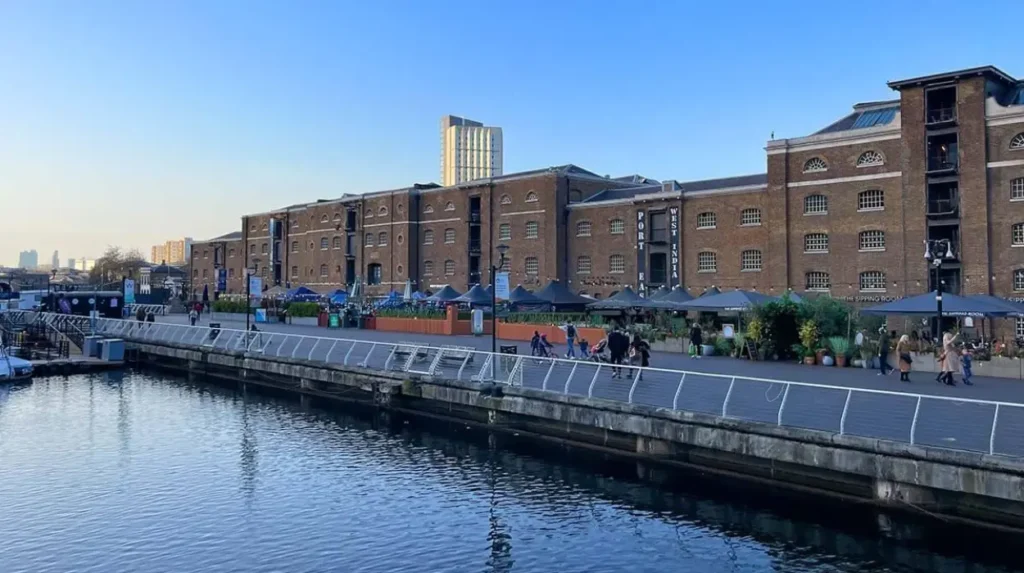
What should visitors look for around West India Quay?
West India Quay contains some of the clearest architectural evidence of the historic dock system.
The large brick warehouses demonstrate the scale of commercial storage required by London’s maritime economy. Their construction contrasts sharply with the contemporary towers surrounding them.
This contrast is historically useful.
The older warehouses were designed for storing physical commodities. Modern office towers accommodate financial and professional services. The landscape therefore documents a transition from an industrial economy based heavily on cargo movement to a service economy based on global finance, information and business activity.
The surviving warehouse environment also demonstrates the importance of preservation within regeneration.
London Museum Docklands occupies one of these historic structures. The building has acquired a new public function without losing its connection to the former port.
This is a practical example of adaptive reuse. Adaptive reuse means the conversion of an existing historic building for a new purpose while retaining significant elements of its original structure and character.
To experience this historic district in person today, consult our comprehensive [How Canary Wharf Transformed From Historic Docklands Into Financial Powerhouse] for itineraries and visiting parameters.
How did Canary Wharf change from a working port into a financial district?
Canary Wharf changed through twentieth-century industrial decline, dock closure and state-led regeneration, replacing a port economy disrupted by container shipping with offices, transport infrastructure and major international financial institutions.
The transformation of Canary Wharf resulted from structural changes in global shipping.
The docks remained commercially important during much of the twentieth century. London Museum records describe the West India Docks as particularly busy during the 1960s.
The system then faced rapid decline.
Modern cargo ships became larger. Containerisation changed the movement of goods. Older enclosed docks were poorly suited to new methods of handling standardised shipping containers.
Containerisation is the transport system in which goods are packed into standard containers that can move efficiently between ships, trains and lorries.
London’s older docks struggled to compete with newer facilities located farther down the Thames and elsewhere.
The West India Docks closed in 1980, and the surrounding landscape entered a period of dereliction before redevelopment accelerated during the 1980s.
Why was the regeneration of Canary Wharf historically significant?
The regeneration of Canary Wharf became one of Britain’s most significant examples of post-industrial urban redevelopment.
The redevelopment changed land use on a massive scale.
Former commercial docks became locations for offices, transport stations, public spaces, residential development and retail facilities. The modern district established a second major business centre for London alongside the historic City of London.
The transformation also created debates about heritage, public access and urban identity.
Historic dock structures were preserved in selected locations. Other industrial buildings disappeared. New infrastructure was inserted into the historic landscape.
Canary Wharf therefore demonstrates the central challenge of urban preservation: determining how a city can retain evidence of its past while accommodating new economic functions.
What can Crossrail Place Roof Garden teach visitors about geography and modern London?
Crossrail Place Roof Garden demonstrates how modern Canary Wharf connects public landscape, transport infrastructure and global geography, using planting arranged around the Prime Meridian to represent botanical traditions from eastern and western hemispheres.
Crossrail Place Roof Garden is one of the most distinctive modern attractions in Canary Wharf.
Its historical relevance comes from location and design rather than age.
The garden sits above major transport infrastructure within the former dockland environment. Its position reflects the continued importance of Canary Wharf as a transport and commercial hub.
The planting also incorporates geographical symbolism.
According to the official visitor information, Crossrail Place sits on the Meridian line, and the garden’s plants are arranged to reflect eastern and western hemispheres. Ferns represent the western side, while species including bamboo, acer and Japanese magnolia represent the eastern side.
Why does the Meridian connection matter?
The Prime Meridian is the internationally recognised reference line associated with longitude and global geographical measurement.
Its historical significance is strongly associated with Greenwich and the Royal Observatory, where the development of astronomical observation and navigation contributed to the establishment of Greenwich Mean Time and the Greenwich Meridian as international standards.
Canary Wharf and Greenwich occupy connected positions within the broader geography of east London and the Thames.
One landscape represents the development of maritime science and navigation. Another represents the infrastructure of international commerce. Together, these locations explain how London’s relationship with the wider world depended on measurement, navigation, shipping and trade.
Crossrail Place therefore provides a modern interpretation of an older geographical idea.
The garden also demonstrates how contemporary urban design can provide public green space within dense commercial development.
Which public spaces reveal a quieter side of Canary Wharf?
Canary Wharf’s parks, dockside routes and waterside spaces reveal a quieter historical landscape by preserving open views of former commercial basins and providing access to waterways that once formed part of London’s industrial transport system.
The most effective way to understand Canary Wharf is to move through it at ground level.
Skyscrapers dominate distant views, but the historic geography becomes clearer beside the water.
The docks create long visual corridors between buildings. Their scale reveals the engineering requirements of maritime commerce. The edges of the basins preserve the boundaries of the former working port.
West India Docks also remain connected to London’s wider waterways. The Canal & River Trust identifies the area as part of a continuing navigable landscape and notes the survival of the docks as a reminder of London’s historic port.
Walking routes around the water therefore provide more than recreation.
They allow visitors to examine the relationship between old infrastructure and new development.
What evidence of industrial heritage survives in the modern district?
Industrial heritage survives through physical structures, spatial patterns and place names.
The most obvious examples include the historic docks and warehouses. Less obvious evidence includes the alignment of waterways, former entrances and the continued use of dock-related names.
West India Quay preserves the vocabulary of the former commercial landscape. The docks preserve the water-based organisation of the site. Historic buildings retain the materials and architectural forms of the port economy.
These remnants are important because redevelopment can obscure historical geography.
When industrial buildings disappear, maps and archives become increasingly important. Where structures survive, visitors can directly compare past and present.
Canary Wharf provides both forms of evidence.
Historic records explain the former port, while surviving infrastructure demonstrates its physical scale.
How did the Second World War affect the history of Canary Wharf?
The Second World War caused severe damage across London’s docklands because the port supplied essential goods and military resources, leaving West India Docks heavily affected by bombing and requiring extensive reconstruction after 1945.
London’s docks were strategically important during the Second World War.
The port supplied food, raw materials and other essential goods to the capital and the wider country. This made dock infrastructure a major target during German bombing campaigns.
The West India Docks suffered serious damage during the war.
London Museum historical records explain that bombing badly affected the docks and that only two warehouses survived from the earlier warehouse landscape in the relevant area.
The consequences extended beyond buildings.
Dock workers and local communities experienced destruction, disruption and loss. Transport systems required repair. Commercial operations had to be restored under difficult post-war conditions.
How did post-war reconstruction reshape the docks?
Reconstruction restored the docks to commercial activity.
Within the following decades, London experienced renewed economic growth and the dock system returned to intensive use. By the 1960s, the West India Docks were again extremely busy.
This recovery was historically significant because it was followed quickly by structural decline.
The docks recovered from wartime destruction but faced a different challenge: technological change in global shipping.
The sequence explains the complexity of Canary Wharf’s twentieth-century history.
The area experienced destruction, reconstruction, commercial success, industrial decline and redevelopment within several decades.
Each phase left evidence in the modern landscape.
Why is Canary Wharf important for architecture and urban regeneration studies?
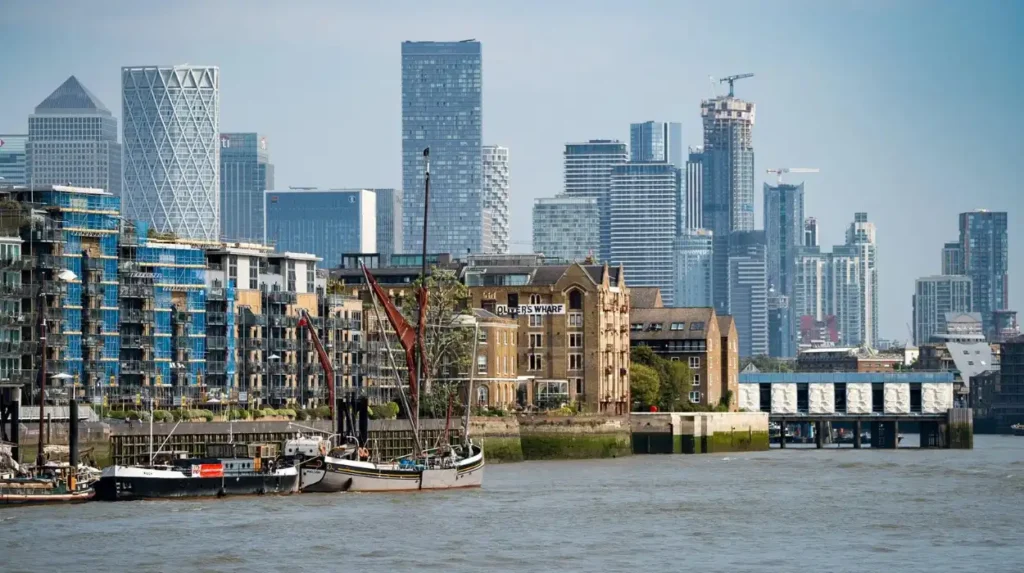
Canary Wharf is important for architecture and urban regeneration studies because it combines surviving Georgian dock infrastructure with late twentieth-century commercial towers and twenty-first-century transport-led development in one continuously changing urban landscape.
Few areas of London demonstrate economic transformation as visibly as Canary Wharf.
The district contains different architectural periods within a relatively compact geographical area.
The early dock infrastructure represents the age of maritime commerce. The surviving warehouses demonstrate Georgian industrial architecture. Modern towers represent London’s role in international finance. Crossrail-related development demonstrates the continuing importance of transport investment.
These structures should be understood as parts of one historical sequence.
The modern skyline did not replace an empty landscape.
It replaced and incorporated a former industrial district with a long history of commercial activity.
What does adaptive reuse reveal about preservation?
Adaptive reuse demonstrates that historic buildings can remain economically and culturally relevant.
London Museum Docklands provides a clear example.
A former warehouse now serves as a public museum. The building retains its relationship with the historic docks while supporting education and cultural interpretation.
This approach preserves material evidence while changing function.
The principle is important across London.
Historic buildings often survive when they receive new uses that support maintenance and public engagement. Museums, cultural institutions and mixed-use developments can preserve structures that would otherwise become vulnerable to demolition or neglect.
Canary Wharf shows both the benefits and limitations of this process.
Some historic infrastructure survives prominently. Much of the wider industrial landscape has been transformed beyond recognition.
What should history enthusiasts and educators explore in Canary Wharf?
History enthusiasts and educators should explore London Museum Docklands, West India Quay, the surviving dock basins and public spaces because these locations connect local industrial evidence with wider subjects including empire, slavery, war, transport and regeneration.
A meaningful historical visit should begin with the broader context.
London Museum Docklands provides the strongest foundation because it explains the development of the port and its communities.
Visitors can then move into the surrounding landscape.
West India Quay demonstrates the scale and architecture of commercial storage. The dock basins demonstrate the engineering of maritime infrastructure. Public routes reveal how contemporary development has been organised around the surviving water.
The sequence creates a clear educational framework:
First, understand the historical system.
Second, examine the surviving physical evidence.
Third, compare the historic landscape with contemporary Canary Wharf.
This approach is useful for students because it connects documentary history with place-based observation.
What questions should visitors ask while exploring?
Visitors should ask what existed before the modern buildings.
They should ask why the docks were built in this location.
They should examine how water controlled the organisation of trade.
They should identify which buildings survived wartime destruction and later redevelopment.
They should also consider which historical stories remain visible and which require museum collections and archives to understand.
These questions encourage factual historical interpretation.
They also reveal why heritage preservation matters.
A preserved structure provides evidence. A museum collection provides context. Together, they allow the public to understand historical change more accurately.
Why does Canary Wharf remain relevant to London’s future history?
Canary Wharf remains relevant to London’s future history because its continuing development records how a global city adapts former industrial land while preserving selected evidence of trade, infrastructure, labour and the communities that shaped its waterfront.
History does not end when a district is regenerated.
Modern Canary Wharf is itself becoming part of London’s historical record.
Future researchers will study its financial institutions, architecture, transport networks and public spaces. They will also examine how redevelopment affected the surviving industrial landscape.
The area’s continuing importance lies in this connection between past and present.
The West India Docks demonstrate the expansion of nineteenth-century maritime commerce. The twentieth century records war, reconstruction and technological change. The modern district demonstrates the rise of post-industrial finance and global business services.
These developments occurred on the same waterfront.
That continuity makes Canary Wharf a valuable historical case study.
For curious London visitors, the district offers a broader experience than its skyline initially suggests. Its attractions include historic warehouses, dock waters, museum collections, preserved industrial structures, public gardens and the geographical ideas embedded within modern architecture.
The most rewarding way to visit is therefore to look beyond the towers.
The skyscrapers explain what Canary Wharf is today.
The docks, warehouses and historical collections explain how it became one of the most recognisable landscapes in modern London.
Canary Wharf is ultimately a record of transformation. Its waterfront connects the history of empire and international trade with the history of labour, wartime destruction, technological change and urban regeneration. For history enthusiasts, cultural tourists, educators and researchers, these layers make the district one of east London’s most significant places to explore.
Frequently Asked Question
What are the best attractions in Canary Wharf beyond skyscrapers?
The best attractions beyond Canary Wharf’s skyscrapers include London Museum Docklands, West India Quay, the historic West India Docks and Crossrail Place Roof Garden. These places reveal the area’s maritime history, industrial heritage, global trade connections and modern urban transformation.