Key Points
- Anti-Demonstration Attendees: An anti-demonstration organised by West London Stand Up to Racism (SUTR) managed to attract about 150 protesters who wanted to stand against the far-right march.
- Wide Political Base: The anti-march was supported by the Brent Trades Council, Ealing NEU union branch, Hammersmith and Fulham Unison, Green Party councillors from the area, Ealing Community Independents, Sudanese community members, and Palestine activists.
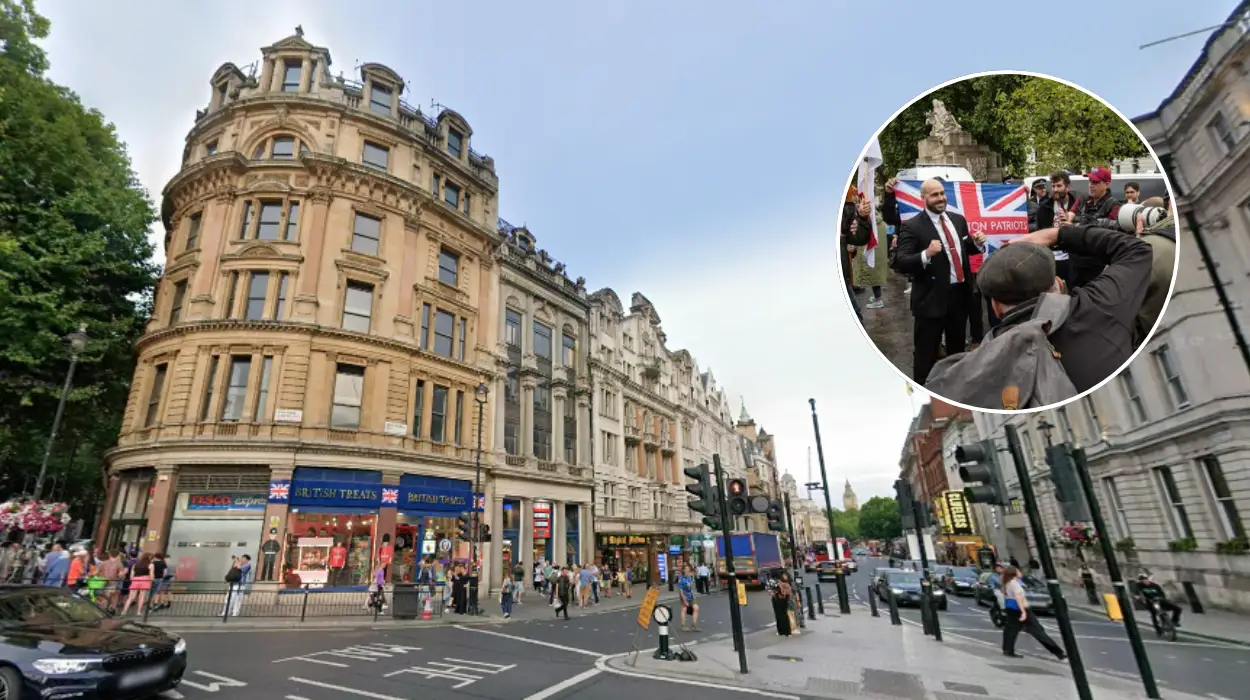
- Ukip’s Defiance and Rhetoric: The leader of Ukip Nick Tenconi headed a small crowd consisting of around 20 followers marching through London’s Hyde Park under an Islamophobic slogan of “No to sharia law” after their march to East London had been banned by the police.
- Community and Educator Activism: Activists and trade unionists pointed out the importance of working class solidarity and community organising in combating the far-right rhetoric directed at students and immigrants.
- Striker Support: There were delegations of strikers – the members of the Unite union from the Institute of Cancer Research – who joined the protest against the far-right movement.
London (Extra London News) October 27, 2025 — Anti-racists significantly outnumbered Ukip leader Nick Tenconi and his supporters in central London on Saturday, pushing back against an Islamophobic demonstration despite the police’s best efforts to manage the routes. Originally intending to march through the heavily Muslim borough of Tower Hamlets, Ukip’s event—billed as a “crusade against Islamism” under the banner of “No to sharia law”—was redirected by police restrictions following widespread community outrage. Instead making their way through London’s Hyde Park with a core group of about 20 supporters, the far-right contingent was met with fierce and overwhelming opposition from a coalition of local trade unionists, community members, and anti-fascist campaigners.
Why Did West London Communities Mobilise Against the March?
The counter-demonstration, rapidly organised by West London Stand Up to Racism (SUTR), successfully pulled together a crowd of roughly 150 people determined to show that far-right politics have no place in the capital. The mobilisation drew strength from a diverse cross-section of civic society, including the Brent Trades Council, the Ealing National Education Union (NEU) branch, and Hammersmith and Fulham Unison, alongside active members of the local Sudanese community and Palestine solidarity networks.
As reported by Socialist Worker, SUTR and Women Against the Far Right activist Miça stated that
“It was truly a collective effort.”
Miça added that
“It shows we’ve got community on our side, we’ve got everyday, working people on our side.”
Elaborating on the broad coalition involved in the pushback, Miça further told Socialist Worker,
“We’ve got educators from the NEU union, we’ve got council workers from Unite and Unison, we’ve got people from the Ealing Community Independents and local Green Party councillors.”
Explore more London Local News:
Giant Inflatable Art Trail Takes Over Croydon 2026
£1.7m Healthy Streets Traffic Scheme Sparks Backlash in Hampstead, 2026
How Do Educators View the Rise of Far-Right Rhetoric?
With schools and young people frequently targeted by divisive political narratives, local teachers and education workers turned out in numbers to draw a red line against bigotry. Trade unionists argued that opposing far-right rhetoric is an essential part of safeguarding the wellbeing of students and maintaining inclusive learning environments.
As reported by Socialist Worker, Matt, an educator and member of Ealing NEU, stated that
“I think I can speak on behalf of pretty much every NEU member when I say that the far right and their rhetoric is a real danger to education and to the wellbeing of children.”
Matt explained to Socialist Worker how these dangerous narratives manifest in daily life, noting,
“We see this in their rhetoric on social media. It’s always migrants and Muslims they blame, many of whom are our students.”
Emphasizing the professional and moral duty felt by educators, Matt told Socialist Worker,
“It’s important for us as educators to take a principled stand, to support the students. But also to stand up to the people who want to ruin their futures.”
In What Ways Are Industrial Struggles Connected to Anti-Racist Movements?
The demonstration also drew active support from workers engaged in ongoing industrial disputes, illustrating a growing solidarity between trade union strikes and anti-fascist campaigns. Among the contingents was a delegation of striking workers from the Institute of Cancer Research, currently taking indefinite industrial action under the Unite union.
As reported by Socialist Worker, Mahmood, a striker participating in the delegation, explained the crossover of solidarity, stating,
“Through our strike, we’ve received a lot of support from people who are involved in other campaigns. SUTR is one of them. No Palantir in Our NHS is another.”
Highlighting the shared values underpinning these diverse movements, Mahmood told Socialist Worker,
“And I think many of our members feel there is a connection between what we’re doing and what other campaigners are fighting for. And we encourage each other to get involved in struggles beyond our strike. We feel these causes are connected, that the struggles are the same.”
Concluding on the morale boost provided by collective action, Mahmood told Socialist Worker,
“We’re here today to bring some of the confidence from our fight, and to take some encouragement away too.”