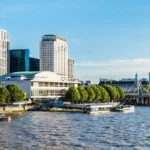
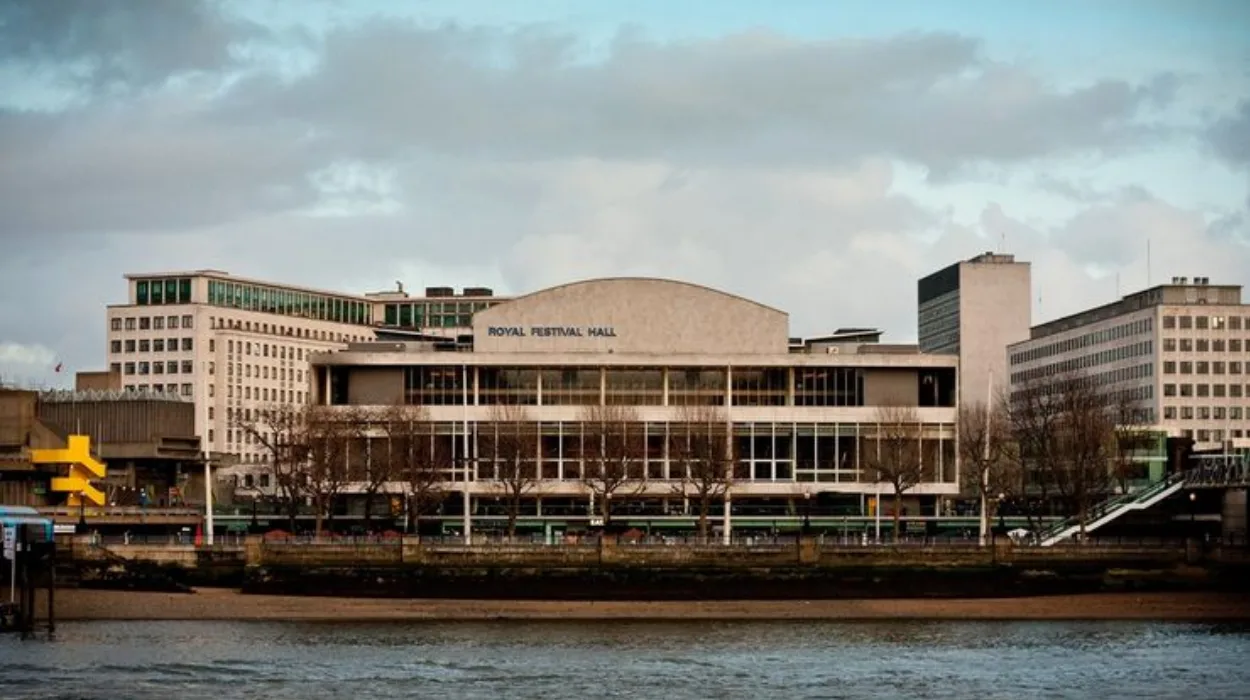
London’s South Bank became a world-class cultural destination through post-war reconstruction, the 1951 Festival of Britain, long-term public investment, landmark modern architecture, and the concentration of major arts institutions along the River Thames. Its transformation converted a damaged industrial riverside into an internationally recognised cultural district.
- Why Was London’s South Bank Originally an Industrial and Working District?
- How Did the Second World War Change the Future of the South Bank?
- What Was the Festival of Britain and Why Was It Held on the South Bank?
- Why Was the Royal Festival Hall So Important to the South Bank’s Transformation?
- How Did the Festival of Britain Create a Permanent Cultural Legacy?
- How Did Southbank Centre Expand After the 1951 Festival?
- How Did the National Theatre Strengthen the South Bank’s Cultural Status?
- Why Did Architecture Become Central to the South Bank’s International Identity?
- How Did the South Bank Become a Centre for Film, Music, Theatre and Visual Art?
- How Did Public Space Help Make the South Bank a Major Cultural Destination?
- How Has Heritage Preservation Protected the South Bank’s Cultural History?
- Why Does the South Bank Remain Important to London’s Cultural Future?
- How Did London’s South Bank Become a World-Class Cultural Destination?
- Frequently Asked Question
The South Bank is one of the most significant examples of twentieth-century urban cultural transformation in Britain. The district occupies the southern bank of the River Thames opposite central London, primarily within the London Borough of Lambeth and extending around Waterloo Bridge, Hungerford Bridge and Westminster Bridge.
Before the Second World War, this riverside area had a very different identity. Industry, warehouses, wharves, workshops, railway infrastructure and commercial buildings dominated much of the landscape. The district also contained densely developed neighbourhoods shaped by centuries of London’s economic growth.
The destruction and disruption caused by the Second World War created new opportunities for redevelopment. Bomb damage affected large areas of central London, including the South Bank. Post-war planners then faced a fundamental question: how should the capital rebuild its damaged urban landscape?
The answer on the South Bank produced one of Britain’s most influential cultural developments.
The 1951 Festival of Britain established the district as a national symbol of modern architecture, public culture, scientific achievement and post-war recovery. The Royal Festival Hall survived as the Festival’s principal permanent building. During subsequent decades, additional institutions transformed the area into a concentrated cultural landscape containing concert halls, theatres, galleries, cinemas, public spaces and educational facilities.
Today, the South Bank demonstrates how cultural infrastructure can reshape an urban district across generations.
Why Was London’s South Bank Originally an Industrial and Working District?
London’s South Bank developed as a working riverside shaped by industry, transport, manufacturing, warehouses and railway infrastructure. Its location beside the Thames supported trade and production, while nineteenth-century urban expansion created a densely built environment before twentieth-century redevelopment transformed the district into a cultural centre.
The River Thames defined London’s historical geography. For centuries, the river provided the city’s principal route for transporting people and goods. Communities on both banks developed according to their relationship with trade, shipping, industry and administration.
The northern bank became closely associated with the historic City of London and later the West End. The southern bank developed a more mixed landscape of industry, entertainment, housing and transport.
The South Bank’s position near Waterloo made it strategically important. Railway expansion increased the significance of the district during the nineteenth century. Waterloo Station developed into one of London’s major transport terminals, connecting the area with regional and national railway networks.
Industrial activity also shaped the riverside. Factories, workshops and commercial premises occupied land that later became associated with cultural institutions.
One important surviving reminder of this earlier industrial landscape was the Shot Tower, built in 1826 as part of the Lambeth Lead Works. The tower remained standing during the Festival of Britain and became a familiar visual feature of the 1951 exhibition before later redevelopment removed it.
This industrial identity explains why the later cultural transformation was so dramatic. The South Bank was not historically designed as a ceremonial cultural quarter. Its modern identity emerged through deliberate twentieth-century planning.
The change also reflected wider developments in London. The capital experienced industrial restructuring, wartime destruction, population change and new approaches to urban planning during the twentieth century.
The South Bank became a testing ground for a different idea of the modern city: one where public cultural institutions formed part of everyday urban infrastructure.
How Did the Second World War Change the Future of the South Bank?
The Second World War created the physical and political conditions for South Bank redevelopment. Bomb damage, post-war reconstruction planning and public debate about Britain’s future encouraged authorities to replace damaged industrial land with modern buildings, public spaces and nationally important cultural institutions.
London suffered extensive bombing during the Second World War. The Blitz and later attacks damaged residential districts, commercial buildings, industrial sites and transport infrastructure across the capital.
The South Bank’s industrial landscape sustained significant wartime damage. The area subsequently underwent clearance and redevelopment to create space for the Festival of Britain site.
Post-war Britain also faced a broader reconstruction challenge.
The country had experienced six years of war, economic disruption and physical destruction. Housing shortages were severe. Infrastructure required rebuilding. Government departments, local authorities and professional planners debated how reconstruction could improve public life.
The London County Council, commonly known as the LCC, played a central role in this process. The LCC was London’s principal strategic local authority before the creation of the Greater London Council in 1965.
Its responsibilities included planning, housing and major public projects.
The South Bank offered the LCC an exceptional redevelopment opportunity. Land beside the Thames had visibility, transport connections and national symbolic importance. A major cultural development there would be visible from central London and accessible through Waterloo Station and nearby bridges.
The post-war period therefore changed the South Bank through three connected processes: physical clearance, public planning and cultural investment.
Physical clearance created redevelopment opportunities after wartime damage. Public planning established long-term objectives for the riverside. Cultural investment provided institutions capable of attracting national and international audiences.
These processes established the foundations for the Festival of Britain.
What Was the Festival of Britain and Why Was It Held on the South Bank?
The Festival of Britain was a nationwide 1951 exhibition celebrating British achievement in science, industry, design and the arts. Its principal London site occupied the South Bank, where modern architecture and public culture presented a vision of national reconstruction after war and economic hardship.
The Festival of Britain opened on 3 May 1951 and continued until 30 September 1951.
The event marked one hundred years since the Great Exhibition of 1851. However, its purpose reflected the very different conditions of post-war Britain.
The Great Exhibition had celebrated Britain’s industrial strength during the Victorian era. The Festival of Britain addressed a country rebuilding after global war.
Its organisers promoted innovation, scientific achievement, industrial design, architecture and cultural life. The event became a national project designed to strengthen public confidence and demonstrate Britain’s future direction.
The South Bank Exhibition became the Festival’s principal London centre.
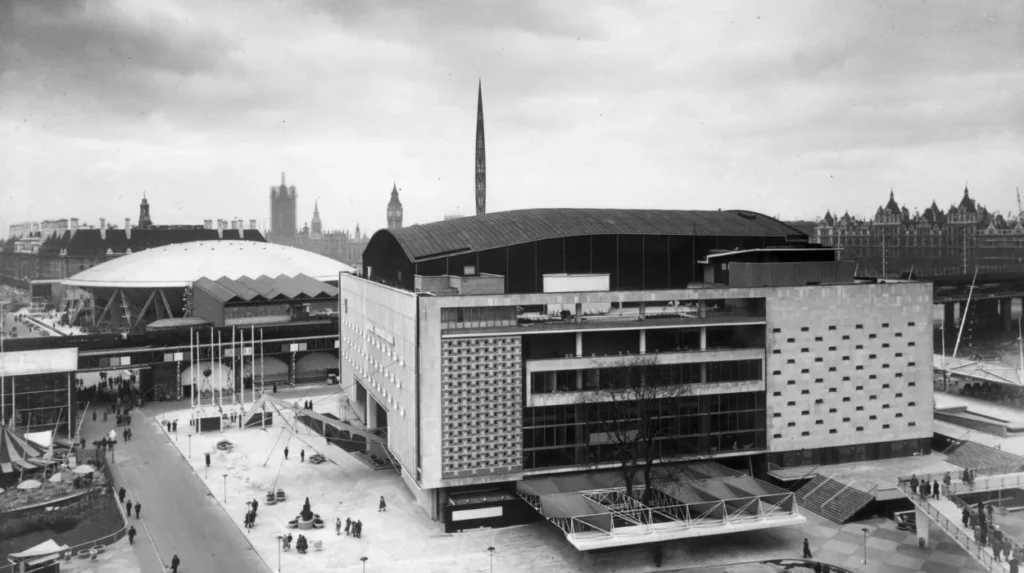
The site was transformed into a purpose-built landscape containing pavilions, exhibitions, public art and architectural experiments. Approximately 8.5 million people visited the main South Bank Festival site during the summer of 1951.
The Festival’s importance extended beyond visitor numbers.
It introduced millions of people to modern architecture and modern urban design. The Festival presented a complete townscape of modern buildings, architecture and landscape planning.
Most Festival structures were temporary.
Examples included the Dome of Discovery and the Skylon, a distinctive modern structure that became one of the Festival’s defining symbols. These buildings and structures disappeared after the exhibition ended.
The Royal Festival Hall remained.
That decision became the most important architectural legacy of the Festival.
Why Was the Royal Festival Hall So Important to the South Bank’s Transformation?
The Royal Festival Hall established the South Bank as a permanent cultural district because it survived the temporary Festival of Britain. Opened in 1951 as a major concert venue, it provided the institutional and architectural foundation for later theatres, galleries and performance spaces.
Construction of the Royal Festival Hall began in 1949.
The London County Council Architect’s Department designed the building as its major contribution to the Festival of Britain. Prime Minister Clement Attlee laid its foundation stone in 1949, and the completed building opened on 3 May 1951.
The building represented a new approach to public cultural architecture.
Its modern design contrasted sharply with many traditional London concert halls. The structure used a distinctive architectural arrangement often described as an “egg in a box” concept. The concert auditorium was acoustically separated within the wider building envelope.
The Royal Festival Hall also changed the relationship between cultural institutions and public space.
Its foyers and terraces encouraged movement through the building. The structure connected concert audiences with the surrounding riverside landscape.
This architectural approach became important for the wider South Bank.
The district developed around the principle that cultural buildings should form part of a public urban environment rather than operate as isolated monuments.
The Royal Festival Hall later received Grade I listed status. Its heritage recognition reflected its exceptional importance as a landmark of post-war British architecture.
Its survival provided continuity between the Festival of Britain and later cultural development.
Without the Royal Festival Hall, the South Bank would have retained far less physical evidence of its 1951 transformation.
How Did the Festival of Britain Create a Permanent Cultural Legacy?
The Festival created a permanent cultural legacy by establishing the South Bank as a nationally recognised location for public arts and modern architecture. Although most temporary structures disappeared, the Royal Festival Hall and subsequent institutions converted the Festival’s short-term exhibition site into a lasting cultural district.
The Festival was never intended to leave every structure standing.
Temporary architecture formed an essential part of its design. The event created an exhibition landscape rather than a conventional permanent neighbourhood.
After September 1951, debates began over the site’s future.
The London County Council already had ambitions for continued cultural development, including plans connected with extending cultural facilities and developing a national theatre near Waterloo Bridge. Post-war shortages of construction materials delayed many projects because housing and industrial reconstruction received priority.
This delay did not end the South Bank’s cultural development.
Instead, it created a gradual transformation extending across several decades.
The Festival also established public expectations.
Millions of visitors had experienced the South Bank as a place dedicated to exhibitions, architecture, music, science and public gathering. The district had acquired a powerful national identity.
That identity encouraged later cultural investment.
The Festival’s influence also extended into cinema.
The Telekinema was constructed as a Festival attraction in 1951. After the Festival, British Film Institute leaders recognised its potential as a permanent cinema venue.
The National Film Theatre subsequently developed from this Festival infrastructure.
The Telekinema operated as the National Film Theatre from 1952 to 1957, before a permanent National Film Theatre building opened beneath Waterloo Bridge in 1957.
This development established film as a central part of South Bank culture.
The first London Film Festival also took place at the National Film Theatre in 1957. The Festival subsequently developed into one of Britain’s major international film events.
The South Bank therefore developed through institutional continuity.
A temporary Festival cinema became a permanent film institution. A Festival concert hall became the centre of a larger arts complex. Post-war planning produced long-term cultural infrastructure.
How Did Southbank Centre Expand After the 1951 Festival?
Southbank Centre expanded through major post-war construction projects that added concert halls, galleries and public spaces to the Royal Festival Hall. The Queen Elizabeth Hall, Purcell Room and Hayward Gallery created a concentrated arts complex that established the South Bank’s modern cultural identity.
The most significant expansion occurred during the 1960s.
The post-war cultural district required additional performance and exhibition facilities. London had a growing population, expanding cultural organisations and increasing public demand for professional arts venues.
The Queen Elizabeth Hall opened in 1967.
The building provided a major performance space for music and other events. The smaller Purcell Room expanded the range of performances possible within the developing complex.
The Hayward Gallery followed in 1968.
The gallery became a major institution for temporary exhibitions and contemporary visual art.
The Queen Elizabeth Hall, Purcell Room and Hayward Gallery became nationally important elements of Britain’s post-war arts infrastructure. Together with the Royal Festival Hall and National Theatre, they formed a major cultural complex.
The architectural character of these buildings also mattered.
They reflected the development of British post-war modernism and Brutalist architecture. Brutalism was an architectural movement associated with exposed concrete, strong geometric forms and highly expressive structural design.
The South Bank became one of London’s most visible concentrations of post-war modern architecture.
This created an architectural identity distinct from the Georgian terraces, Victorian monuments and medieval buildings that define other parts of central London.
The South Bank therefore represented a different historical period.
Its major cultural buildings documented Britain’s reconstruction after 1945 and the expansion of public cultural institutions during the welfare-state era.
How Did the National Theatre Strengthen the South Bank’s Cultural Status?
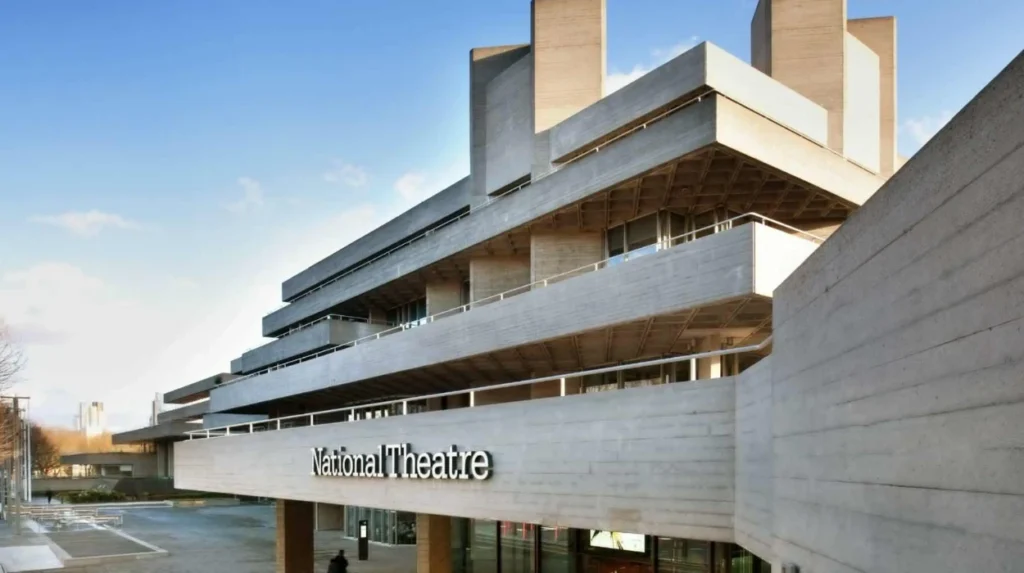
The National Theatre strengthened the South Bank by bringing Britain’s national publicly supported theatre institution to the riverside. Its permanent building, opened in 1976, added world-class drama to an established concentration of music, cinema and visual arts.
The National Theatre was created to provide Britain with a permanent national institution for theatrical performance.
Its permanent South Bank building was designed by architect Sir Denys Lasdun.
The structure became one of the defining examples of late twentieth-century British theatre architecture.
The National Theatre building opened in 1976.
Its arrival completed an important institutional transformation.
The South Bank already contained major facilities for orchestral music, smaller musical performances, contemporary art and cinema.
The National Theatre added large-scale professional drama.
The district now supported multiple cultural disciplines within a compact geographical area.
This concentration created an important economic and urban effect.
Visitors attending one institution encountered neighbouring venues, restaurants, public spaces and riverside attractions. Cultural activity therefore reinforced itself through proximity.
The South Bank became a cultural ecosystem rather than a collection of unrelated buildings.
Why Did Architecture Become Central to the South Bank’s International Identity?
Architecture became central to the South Bank’s identity because its major buildings represented successive stages of British post-war design. The Royal Festival Hall, Hayward Gallery, Queen Elizabeth Hall and National Theatre created a visible architectural record of reconstruction, modernism and public cultural investment.
Architecture gives the South Bank historical coherence.
The buildings were constructed during different decades and for different institutions. Yet they share a common historical context: Britain’s effort to rebuild and modernise public life after the Second World War.
The Royal Festival Hall represents the optimism of the Festival of Britain.
Its design combined modern engineering with a strong emphasis on public accessibility and acoustic performance.
The Queen Elizabeth Hall and Hayward Gallery represent later post-war architectural development.
Their concrete forms reflect the institutional confidence of the 1960s.
The National Theatre represents the next stage.
Its monumental concrete terraces and complex geometric forms established a major architectural landmark beside the Thames.
These structures also became important heritage assets.
Heritage protection recognises that historical significance is not limited to ancient or decorative buildings.
Twentieth-century architecture records major social, political and cultural changes.
The South Bank provides physical evidence of the growth of publicly funded cultural infrastructure in post-war Britain.
Its architecture also preserves the relationship between public space and cultural institutions.
Terraces, walkways, foyers and riverside routes connect buildings with one another.
The district therefore functions as an urban environment rather than a sequence of enclosed venues.
How Did the South Bank Become a Centre for Film, Music, Theatre and Visual Art?
The South Bank became a multidisciplinary cultural centre through the concentration of specialist institutions serving film, music, theatre and visual art. The BFI, Southbank Centre and National Theatre created a permanent cultural cluster where several major artistic disciplines operate within one connected riverside district.
Cultural specialisation formed a major part of the South Bank’s success.
The Royal Festival Hall established large-scale concert performance.
The Queen Elizabeth Hall and Purcell Room expanded musical programming.
The Hayward Gallery created dedicated space for visual art.
The National Theatre established a major centre for drama.
The National Film Theatre, later associated with BFI Southbank, created a specialist venue for cinema and film history.
These institutions served different audiences.
However, their geographical proximity created shared benefits.
Transport infrastructure brought visitors through Waterloo. Pedestrian routes connected the venues. The Thames provided a distinctive public setting.
Cultural programming also operated throughout the year.
This reduced dependence on a single seasonal attraction.
Concerts, exhibitions, theatrical productions and film screenings maintained regular activity across different periods.
The district also developed an international reputation because its institutions hosted artists, performers, filmmakers and exhibitions from Britain and other countries.
The South Bank’s importance therefore depended on institutional diversity.
One venue alone would not have created the same urban effect.
The concentration of multiple cultural disciplines produced a destination capable of serving local residents, national visitors, international tourists, students and researchers.
How Did Public Space Help Make the South Bank a Major Cultural Destination?
Public space made the South Bank accessible because its cultural institutions developed alongside pedestrian routes, terraces and the Thames riverside. Visitors can experience architecture, public art and river views without entering every venue, creating a cultural environment integrated with everyday city life.
The South Bank differs from many cultural districts because much of its historical experience occurs outdoors.
The Thames Path and adjoining riverside routes connect major landmarks.
Visitors encounter Waterloo Bridge, the Royal Festival Hall, Hungerford Bridge, the National Theatre and other cultural structures while moving through public space.
This urban design supports accessibility.
A person does not need a theatre ticket to understand the district’s architectural significance.
Public walkways provide direct contact with the buildings.
This principle began with the Festival of Britain.
The 1951 exhibition presented architecture, landscape and public movement as connected components of a modern environment.
Later development retained this relationship.
The terraces surrounding the cultural buildings became part of London’s public realm.
Public realm is the collective space accessible to the public, including streets, squares, walkways and riverside areas.
The South Bank’s public realm became increasingly important as London developed as a global tourist destination.
Visitors could combine cultural activities with sightseeing and walking.
The riverside location also connected the district visually with Westminster, the City of London and central London landmarks.
The result was a cultural destination with both institutional and geographic advantages.
How Has Heritage Preservation Protected the South Bank’s Cultural History?
Heritage preservation has protected the South Bank by recognising its post-war buildings as nationally important historical assets. Statutory listing and conservation research preserve evidence of Britain’s reconstruction, modern architecture and public cultural policy while allowing major institutions to continue operating.
The South Bank demonstrates an important change in British heritage practice.
Earlier preservation efforts often focused heavily on ancient buildings, churches and aristocratic architecture.
During the late twentieth century, historians and heritage organisations increasingly recognised the importance of modern architecture.
The Royal Festival Hall became a major example.
The building achieved Grade I listed status in 1987. Grade I is the highest category of statutory listing in England and is reserved for buildings of exceptional interest.
The National Theatre holds Grade II* status.
Grade II* identifies particularly important buildings of more than special interest.
The Queen Elizabeth Hall, Purcell Room and Hayward Gallery complex has also been recognised for its architectural significance.
Preservation does not mean freezing the district in one historical period.
Cultural buildings require maintenance, technical upgrades and changing visitor facilities.
The preservation challenge involves protecting historically significant architectural features while allowing institutions to remain functional.
The South Bank therefore represents living heritage.
Its buildings remain active cultural venues rather than museum objects.
Concerts continue in the Royal Festival Hall. Theatre continues at the National Theatre. Film continues at BFI Southbank.
This continued use strengthens historical continuity.
Why Does the South Bank Remain Important to London’s Cultural Future?
The South Bank remains important because its history demonstrates how long-term public investment in culture can transform urban space. Its institutions preserve post-war heritage while continuing to support contemporary performance, exhibitions, cinema and education for audiences from London and around the world.
The South Bank’s historical importance extends beyond its individual buildings.
The district provides evidence of a broader principle in urban development.
Cultural infrastructure can reshape land use, public identity and economic activity across generations.
The transformation began with a damaged industrial riverside.
The Festival of Britain established a national cultural vision in 1951.
The Royal Festival Hall created permanent infrastructure.
Subsequent decades added institutions for music, film, visual art and theatre.
The result became one of London’s most recognisable cultural districts.
The South Bank also remains historically relevant because its origins are still visible.
The Royal Festival Hall provides a direct physical connection with the Festival of Britain.
Southbank Centre continues to preserve historical material relating to the Festival and its cultural legacy.
In 2026, the area reached the seventy-fifth anniversary of the Festival of Britain era and the Royal Festival Hall’s opening, demonstrating the continuing importance of the 1951 transformation to the district’s identity.
The South Bank’s future also depends on the same principle that shaped its past: adaptation.
London changes continuously.
Transport systems evolve. Cultural audiences change. Buildings require restoration. Public expectations of accessibility and public space develop.
The district remains capable of responding because it was created through change rather than inherited as a fixed historical landscape.
How Did London’s South Bank Become a World-Class Cultural Destination?
London’s South Bank became a world-class cultural destination through a seventy-five-year process of reconstruction, architectural innovation and institutional growth. The 1951 Festival of Britain created the foundation, while permanent investment in music, film, theatre, art and public space established its enduring international significance.
The transformation of the South Bank followed a clear historical sequence.
Before the twentieth century, the riverside developed around work, industry, transport and commerce.
The Second World War damaged the area and accelerated demands for reconstruction.
The Festival of Britain then transformed the South Bank into a national exhibition landscape in 1951.
Approximately 8.5 million people visited the main Festival site, making the district a major symbol of post-war Britain.
The Royal Festival Hall provided the permanent foundation.
The National Film Theatre created a lasting film presence.
The Queen Elizabeth Hall, Purcell Room and Hayward Gallery expanded the South Bank into a major arts complex.
The National Theatre added Britain’s leading national theatre institution.
Heritage protection later recognised the architectural significance of these post-war buildings.
Public riverside space connected the institutions into a unified urban district.
London’s South Bank therefore became a world-class cultural destination through sustained development rather than a single event.
The Festival of Britain started the transformation.
Public institutions continued it.
Architecture gave it a visible identity.
Heritage preservation protected its historical significance.
Cultural programming ensured that the district remained active.
That combination explains why the South Bank occupies a distinctive place in London’s history. It is simultaneously a record of post-war reconstruction, a landmark of modern British architecture and one of the world’s most concentrated urban environments for music, theatre, cinema and visual art.
Its history demonstrates how a city can convert damaged and industrial land into a permanent public cultural landscape whose historical importance continues to grow with every generation.
Frequently Asked Question
What made London’s South Bank a world-class cultural destination?
London’s South Bank became a major cultural destination through post-war redevelopment, the 1951 Festival of Britain, and the creation of institutions including the Royal Festival Hall, Southbank Centre, BFI Southbank, Hayward Gallery and National Theatre.