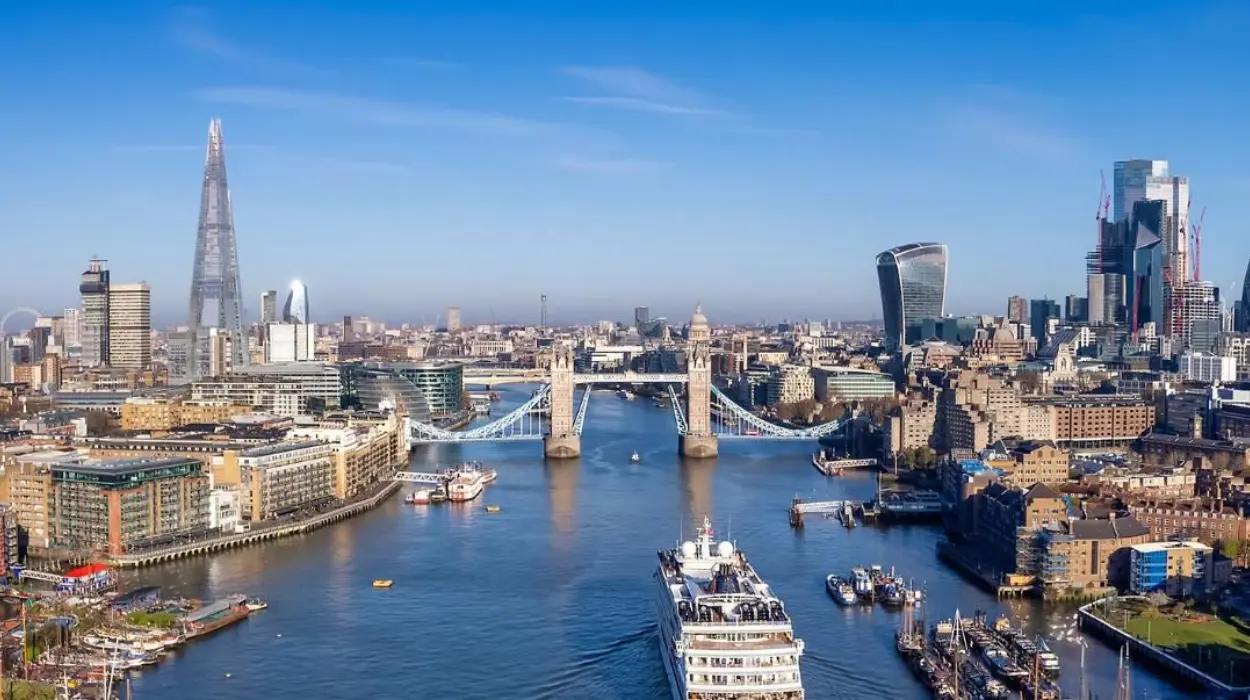
The River Thames is the longest river entirely in England, extending approximately 346 kilometres (215 miles) from its source at Thames Head near Kemble, Gloucestershire, to the North Sea through the Thames Estuary. For more than 2,000 years, the river has shaped London’s economic growth, political power, military defence, transport systems, culture, trade, and urban expansion. Every major stage of London’s development—from the Roman settlement of Londinium to the modern global capital—has been directly connected to the Thames.
- What is the River Thames, and why has it been central to London’s history?
- How did the River Thames influence the founding of Roman London?
- How did the River Thames shape medieval London’s growth?
- Why did the Port of London become one of the world’s greatest trading centres?
- How did the River Thames support Britain’s Industrial Revolution?
- How did the River Thames influence London’s government and national politics?
- What environmental challenges has the River Thames faced throughout history?
- How has the River Thames influenced London’s architecture and engineering?
- What archaeological discoveries reveal the River Thames’ ancient past?
- Why does the River Thames remain important to London today?
- What is the lasting historical significance of the River Thames?
What is the River Thames, and why has it been central to London’s history?
The River Thames is England’s principal historic river and London’s defining geographical feature. It provided freshwater, transport, defence, commerce, communication, and international trade, enabling London to become Britain’s political capital and one of the world’s most influential commercial cities over two millennia.
The River Thames drains a basin covering approximately 16,130 square kilometres, making it one of southern England’s largest river systems. More than 15 million people live within the Thames Basin today, representing roughly one-quarter of the population of England.
The river flows through numerous counties before reaching London, where it becomes tidal at Teddington Lock. The tidal section historically allowed ocean-going vessels to reach the city, creating one of Europe’s greatest natural trading advantages.
The name “Thames” derives from the ancient Celtic word Tamesas, meaning “dark river.” Classical Roman writers later recorded it as Tamesis.
Long before London existed, prehistoric communities settled beside the Thames because of reliable water supplies, fertile floodplains, fish populations, and navigable waterways. Archaeological discoveries show continuous human activity along the river dating back over 10,000 years, including Mesolithic camps, Bronze Age ceremonial sites, and Iron Age settlements.
The river therefore predates London as a centre of civilisation and provided the natural conditions that made permanent urban settlement possible.
How did the River Thames influence the founding of Roman London?
The River Thames enabled the Romans to establish Londinium around AD 47 because it offered a strategic crossing point, tidal navigation for merchant ships, and military supply routes. The river transformed a small settlement into Britain’s primary administrative and commercial centre.
When the Romans invaded Britain in AD 43, they required a secure location connecting southern England with inland territories.
The Thames crossing near present-day London provided exactly that strategic advantage.
Around AD 47–50, Roman engineers constructed the first timber bridge across the Thames. This bridge became the focal point around which Londinium rapidly expanded.
Why was the crossing strategically important?
The crossing represented the lowest practical bridge location while remaining accessible to sea-going vessels.
This created three interconnected advantages:
- Military movement across southern Britain
- Efficient commercial exchange
- Customs collection from incoming ships
Roman merchants imported luxury goods from across the empire, including wine from Gaul, olive oil from Hispania, ceramics from Germany, and marble from the Mediterranean.
Exports included wool, metals, grain, leather, and slaves.
Excavations by the Museum of London Archaeology (MOLA) have uncovered Roman wharves, warehouses, coins, pottery, and ship timbers buried beneath modern London streets, demonstrating the extensive commercial infrastructure built beside the Thames.
By the late second century, Londinium had become Roman Britain’s largest city, with an estimated population exceeding 45,000 people.
How did the River Thames shape medieval London’s growth?
During the medieval period, the River Thames became London’s commercial highway, food source, defensive barrier, and administrative boundary. Trade expanded rapidly through river transport, while markets, guilds, churches, and royal institutions developed along its banks.
Following the Norman Conquest in 1066, London continued expanding around its riverside economy.
The construction of London Bridge in stone between 1176 and 1209, under the supervision of Peter of Colechurch, permanently altered the city’s commercial geography.
Unlike earlier timber bridges, the stone bridge supported:
- Houses
- Shops
- Chapels
- Defensive gates
It remained London’s only bridge for more than 600 years.
River traffic increased dramatically because roads across medieval England remained slow and often impassable.
Boats carried:
- Building stone
- Timber
- Grain
- Fish
- Wool
- Cloth
- Wine
The Thames also supplied London’s growing population with freshwater fish including salmon, eels, lampreys, and sturgeon.
Royal palaces including Westminster Palace, Greenwich Palace, and Richmond Palace relied heavily upon river transport because travelling by water proved faster than travelling by road.
During this era, London’s civic government increasingly regulated river commerce through licensing, toll collection, and navigation rules.
Why did the Port of London become one of the world’s greatest trading centres?
The Port of London expanded because the Thames connected Britain directly with European and global maritime trade. Continuous investment in docks, warehouses, customs systems, and shipping infrastructure transformed London into the centre of international commerce for centuries.
From the sixteenth century onward, England’s overseas expansion dramatically increased maritime trade.
Ships arriving through the Thames carried products from every continent.
Major imports included:
- Sugar from the Caribbean
- Tea from China
- Coffee from Arabia
- Tobacco from North America
- Cotton from India
- Timber from Scandinavia
Exports included manufactured goods, textiles, machinery, and financial services.
By the eighteenth century, congestion along the Pool of London had become severe.
Cargo theft became widespread because vessels waited weeks before unloading.
This led Parliament and private investors to finance major enclosed dock systems.
Which docks transformed London’s economy?
Three major examples include:
- West India Docks (opened 1802)
- East India Docks (opened 1806)
- St Katharine Docks (opened 1828)
These enclosed dock complexes introduced secure warehouses, improved customs processing, and efficient cargo handling.
During the nineteenth century, the Port of London became the busiest port in the world.
By the early twentieth century, annual cargo handling exceeded 60 million tonnes, making London the commercial heart of the British Empire.
How did the River Thames support Britain’s Industrial Revolution?
The River Thames enabled industrialisation by providing transport for raw materials, manufactured goods, coal, engineering products, and international shipping. Industrial expansion reshaped London’s economy, employment, and urban geography throughout the eighteenth and nineteenth centuries.
Industrial growth depended upon reliable freight transport.
Before railways expanded nationwide, heavy cargo moved most efficiently by water.
Factories clustered beside the Thames because river access reduced transport costs.
Major industries included:
- Shipbuilding
- Brewing
- Flour milling
- Gas production
- Engineering
- Food processing
Large shipyards operated in areas including Deptford, Woolwich, and Blackwall.
The Royal Navy also depended upon Thames shipyards for warship construction and maintenance.
Coal transported from northern England powered factories, steam engines, and domestic heating across London.
Population growth accelerated rapidly.
London’s population expanded from approximately 959,000 in 1801 to over 6.5 million by 1901, placing enormous pressure upon housing, sanitation, and infrastructure.
How did the River Thames influence London’s government and national politics?
The River Thames shaped Britain’s political history because Parliament, royal palaces, courts, and ceremonial institutions developed beside its banks. The river connected national government with commerce, diplomacy, defence, and public life throughout successive centuries.
The Palace of Westminster, home of the UK Parliament, occupies a prominent riverside location selected for both strategic and ceremonial reasons.
The river enabled monarchs, diplomats, judges, and foreign ambassadors to travel efficiently through London.
State ceremonies frequently used royal barges.
Annual traditions such as the Lord Mayor’s Show historically incorporated river processions demonstrating civic authority.
The Thames also influenced military defence.
Fortifications, dockyards, and naval installations protected London’s maritime approaches.
The nearby Tower of London, established by William the Conqueror after 1066, guarded both the city and river access.
Control of the Thames therefore represented control of England’s capital.
What environmental challenges has the River Thames faced throughout history?
The River Thames experienced repeated environmental crises caused by population growth, industrial pollution, sewage disposal, and urban expansion. Scientific intervention, engineering innovation, and environmental regulation gradually restored one of Europe’s most historically polluted rivers.
Rapid nineteenth-century population growth overwhelmed London’s sanitation systems.
Most household waste entered the Thames untreated.
Industrial factories discharged chemicals directly into the river.
The result was severe pollution.
What was the Great Stink?
During the exceptionally hot summer of 1858, sewage accumulated throughout central London’s tidal river.
The resulting odour disrupted parliamentary business inside Westminster.
This crisis became known as the Great Stink.
Engineer Sir Joseph Bazalgette responded by designing London’s revolutionary sewer network.
His system included:
- Approximately 1,300 miles of street sewers
- More than 130 kilometres of major intercepting sewers
- Massive pumping stations
- New embankments
Completed largely during the 1860s and 1870s, Bazalgette’s system transformed public health.
Later environmental legislation further reduced pollution.
By the 1950s, however, the Thames became so polluted that scientists declared long stretches biologically dead.
Restoration programmes dramatically reversed this decline.
Today, more than 125 fish species inhabit the tidal Thames, alongside seals, porpoises, and numerous migratory birds.
How has the River Thames influenced London’s architecture and engineering?
The River Thames inspired continuous engineering innovation through bridges, embankments, tunnels, docks, flood barriers, and transport systems. These structures demonstrate how infrastructure adapted to changing commercial, environmental, and urban demands across successive historical periods.
Crossing the Thames remained a major engineering challenge for centuries.
Modern London contains over 30 road bridges across the Thames within Greater London.
Historic examples include:
- Westminster Bridge
- Waterloo Bridge
- Tower Bridge
- Blackfriars Bridge
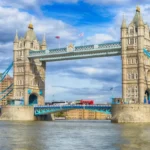
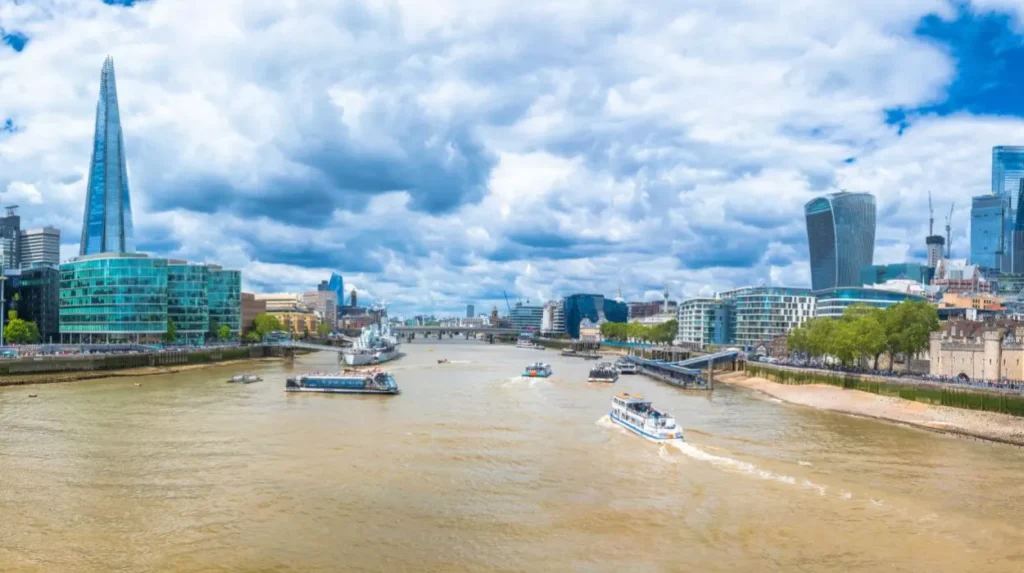
Among these, Tower Bridge, completed in 1894, remains one of Britain’s most recognisable engineering achievements.
Constructed as a combined bascule and suspension bridge, it allowed large ships to continue reaching upstream docks.
Victorian engineers also transformed the riverbanks through the construction of:
- Victoria Embankment
- Chelsea Embankment
- Albert Embankment
These projects reclaimed land, concealed sewer infrastructure, improved flood protection, and created major transport routes.
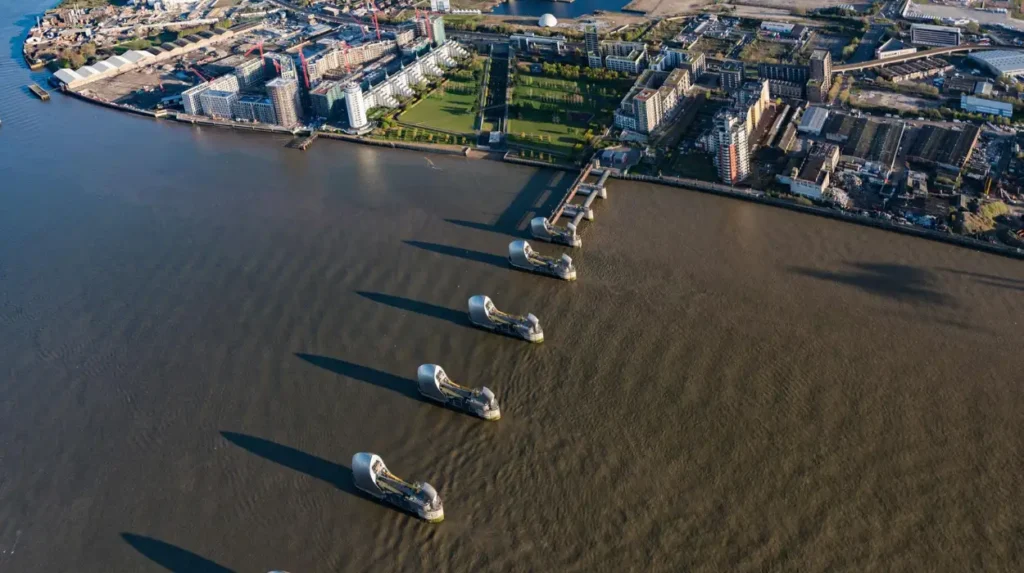
Another landmark engineering achievement is the Thames Barrier, completed in 1982.
The barrier protects central London against tidal flooding from the North Sea and remains one of the world’s largest movable flood defence systems.
What archaeological discoveries reveal the River Thames’ ancient past?
Archaeological excavations along the River Thames have uncovered prehistoric artefacts, Roman infrastructure, medieval waterfronts, ships, weapons, ceremonial objects, and everyday possessions. These discoveries provide direct evidence of continuous human activity spanning thousands of years.
Waterlogged river sediments preserve organic materials exceptionally well.
Important discoveries include:
- Bronze Age swords
- Roman coins
- Saxon jewellery
- Medieval boats
- Tudor ceramics
- Victorian industrial equipment
Excavations during infrastructure projects frequently reveal previously unknown sections of London’s historic waterfront.
The annual Thames Discovery Programme documents archaeological remains exposed by changing tides.
Researchers record ancient timber structures, river stairs, wharves, and causeways before erosion destroys them.
These investigations continue expanding understanding of London’s historical development.
Why does the River Thames remain important to London today?
The River Thames continues supporting London’s economy, transport, tourism, ecology, recreation, heritage, and flood protection. Modern investment preserves its historic significance while adapting the river to contemporary environmental, commercial, and urban requirements.
The Thames remains central to London’s identity.
Passenger river services connect numerous districts while reducing pressure on road and rail networks.
Major landmarks situated along the river include:
- Houses of Parliament
- Tower of London
- Tower Bridge
- Tate Modern
- Shakespeare’s Globe
- Greenwich
- Canary Wharf
The river also hosts international sporting events.
Examples include the annual Oxford and Cambridge Boat Race, the Great River Race, and numerous rowing championships.
Its banks contain protected conservation areas, museums, historic docks, and UNESCO-recognised heritage landscapes.
To experience this historic landmark in person today, consult our comprehensive [Best River Thames Experiences for Visitors Seeking Sightseeing, Cruises, and Riverside Adventures] for itineraries and visiting parameters.
Climate change has increased attention upon long-term flood resilience.
Organisations including the Environment Agency continue planning future flood management strategies beyond the current Thames Barrier’s design lifespan.
What is the lasting historical significance of the River Thames?
The River Thames represents the foundation of London’s historical evolution. It enabled settlement, commerce, defence, governance, industrialisation, engineering innovation, and environmental restoration, making it one of the world’s most influential urban rivers and an enduring symbol of Britain’s national development.
Few rivers have shaped a capital city as profoundly as the Thames shaped London.
Every historical era left physical evidence along its banks.
Roman bridge foundations evolved into medieval trading districts.
Royal palaces became parliamentary institutions.
Industrial docklands transformed into financial centres.
Historic embankments continue protecting millions of residents.
Archaeological excavations continue revealing new information about prehistoric communities, Roman engineers, medieval merchants, Tudor sailors, Victorian industrial workers, and modern conservation efforts.
The Thames therefore functions simultaneously as a natural river, historical archive, transport corridor, ecological habitat, engineering landmark, and cultural symbol.
Its importance extends beyond London.
The Thames reflects the broader history of England’s political institutions, maritime expansion, scientific innovation, economic transformation, and environmental recovery. Its continuous influence over more than two millennia explains why it remains one of the world’s most extensively studied and historically significant rivers, ensuring its enduring place within British heritage for future generations.
Why is the River Thames important to London’s history?
The River Thames provided the foundation for London’s growth by enabling trade, transportation, defence, freshwater access, and communication. It helped establish Roman Londinium and supported London’s development into Britain’s political and commercial capital.