The River Thames is the longest river entirely in England and the defining natural feature of London. Stretching approximately 215 miles (346 kilometres) from its source at Thames Head in Gloucestershire to the North Sea, the Thames has shaped Britain’s political history, commercial development, royal traditions, architecture, transport network, and tourism industry for nearly 2,000 years. Today, it remains one of Europe’s most visited urban rivers, welcoming millions of passengers annually through sightseeing cruises, riverside walking routes, historic attractions, cultural venues, and recreational activities.
- Why is the River Thames one of London’s most important visitor attractions?
- What are the best sightseeing experiences along the River Thames?
- How do River Thames cruises enhance a visitor’s understanding of London’s history?
- Which historic landmarks should visitors prioritise along the Thames?
- What riverside walking routes provide the best visitor experience?
- How has the River Thames influenced London’s economic and political development?
- What wildlife and natural environments can visitors discover along the Thames?
- How do engineering projects protect the River Thames and modern London?
- Why does the River Thames remain culturally significant today?
From medieval trade routes and Tudor palaces to modern river cruises and riverside entertainment districts, the Thames offers visitors an exceptional combination of history, architecture, wildlife, engineering, and leisure experiences that continue throughout the year.
Why is the River Thames one of London’s most important visitor attractions?
The River Thames forms the historical, cultural, and geographical centre of London. It connects major landmarks, supports passenger transport, preserves centuries of British history, and provides visitors with sightseeing cruises, riverside walks, museums, bridges, and internationally recognised heritage attractions throughout the capital.
The Thames has served as London’s principal transport corridor since the Roman foundation of Londinium around AD 47. Before extensive road construction, the river acted as Britain’s busiest commercial highway, carrying goods, people, livestock, and building materials between inland settlements and international ports.
Modern visitors experience this history while travelling between iconic locations such as Westminster, Tower Bridge, Greenwich, Canary Wharf, Richmond, Hampton Court, and Kew. The river provides continuous access to UNESCO World Heritage Sites, royal palaces, historic markets, theatres, public parks, and maritime museums.
The Port of London became one of the world’s largest ports during the nineteenth century. Although commercial shipping has reduced within central London, the Thames continues supporting freight transport, passenger ferries, tourism vessels, rowing competitions, environmental conservation, and flood management.
The river also hosts internationally recognised annual events, including the Oxford and Cambridge Boat Race, examples including the 2024 race and the 2025 race, the Great River Race, examples including traditional Thames rowing boats and historic cutters, and New Year’s Eve celebrations, examples including the London fireworks display.
What are the best sightseeing experiences along the River Thames?
The River Thames offers diverse sightseeing opportunities through river cruises, walking routes, historic bridges, riverside monuments, observation platforms, museums, and heritage districts that showcase London’s architectural evolution from Roman settlement to modern global capital.
Sightseeing along the Thames allows visitors to observe London’s development chronologically. Many landmarks stand directly beside the river because historic trade, defence, and government depended upon waterfront access.
Sightseeing cruises
River cruises remain among the most popular visitor experiences.
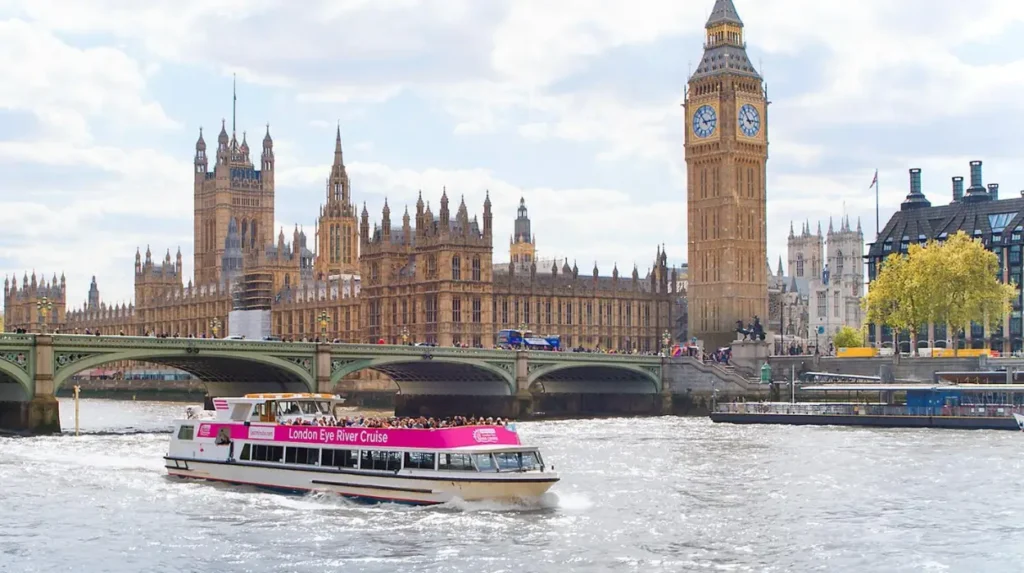
Operators provide journeys between Westminster Pier, Tower Pier, Greenwich Pier, London Eye Pier, and Canary Wharf. Many cruises include recorded historical commentary explaining riverside landmarks, engineering projects, and famous events associated with each location.
Passengers view major landmarks without road congestion while travelling beneath London’s historic bridges.
Westminster and the Palace of Westminster
The Palace of Westminster dominates the northern bank of the Thames.
Originally constructed during the medieval period and substantially rebuilt following the 1834 fire, it houses the UK Parliament. Its Gothic Revival architecture, designed principally by Charles Barry and Augustus Pugin, forms one of London’s most recognisable riverfront panoramas.
The London Eye
The London Eye opened in 2000 as part of Millennium celebrations.
Standing 135 metres tall, it provides panoramic views extending approximately 25 miles during favourable weather. Visitors can observe the Thames meandering through central London while identifying bridges, cathedrals, royal parks, and modern skyscrapers.
Tower Bridge
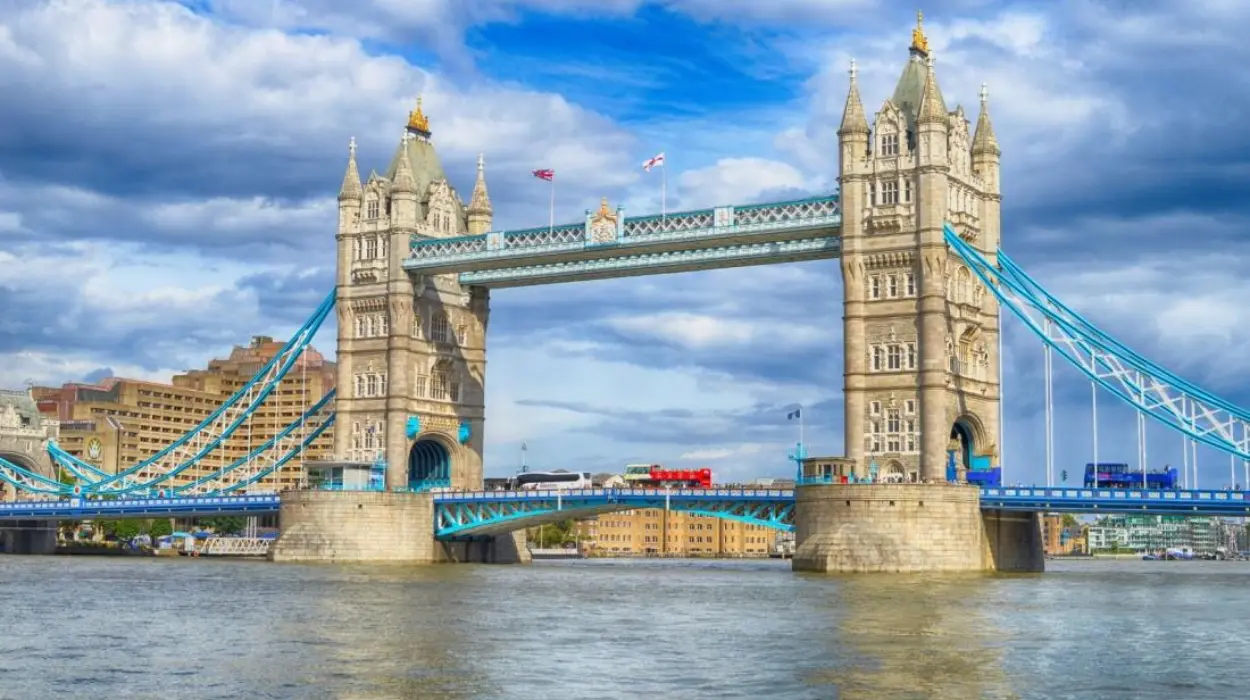
Completed in 1894, Tower Bridge combines Victorian Gothic architecture with pioneering engineering.
Its twin towers, bascules, and elevated walkways continue operating as both a road crossing and tourist attraction. The bridge opens for authorised river traffic, preserving historic navigation rights established centuries earlier.
Greenwich
Greenwich occupies a unique position within British maritime history.
Its riverside includes the Old Royal Naval College, the National Maritime Museum, the Queen’s House, and the Royal Observatory. Together these institutions explain Britain’s naval expansion, scientific achievements, and global trade networks.
To experience these historic riverside locations in person today, consult our comprehensive [The History of the River Thames and Its Importance to London’s Development] for itineraries and visiting parameters.
How do River Thames cruises enhance a visitor’s understanding of London’s history?
River Thames cruises present London’s historical development in geographical sequence, allowing visitors to observe Roman foundations, medieval trade districts, royal palaces, Victorian engineering, and contemporary architecture from the same transport route used for centuries.
Unlike road transport, river travel demonstrates why London expanded where it did.
The earliest Roman settlement developed beside a navigable crossing point. Medieval merchants constructed wharves and warehouses adjacent to shipping facilities. Tudor monarchs travelled extensively by water because river transport remained faster than poorly maintained roads.
Modern sightseeing cruises continue this historical journey.
Professional commentary frequently explains major historical periods.
Roman London
Roman engineers established Londinium beside the Thames around AD 47.
The river enabled military logistics, commercial trade, and communication throughout Roman Britain. Archaeological excavations continue revealing Roman waterfront structures buried beneath modern streets.
Medieval commerce
During the Middle Ages, London’s economy expanded through river commerce.
Merchant guilds regulated trade while warehouses lined the waterfront. Imported wine, wool, timber, grain, spices, and cloth passed through the city’s docks.
Tudor and Stuart monarchy
Royal barges transported monarchs between Westminster, Greenwich, Richmond, and Hampton Court.
Water travel represented prestige while avoiding congested streets.
Industrial expansion
The Industrial Revolution transformed the Thames into one of the world’s busiest commercial waterways.
New docks, examples including West India Docks and Royal Victoria Dock, accommodated increasingly large international vessels.
Which historic landmarks should visitors prioritise along the Thames?
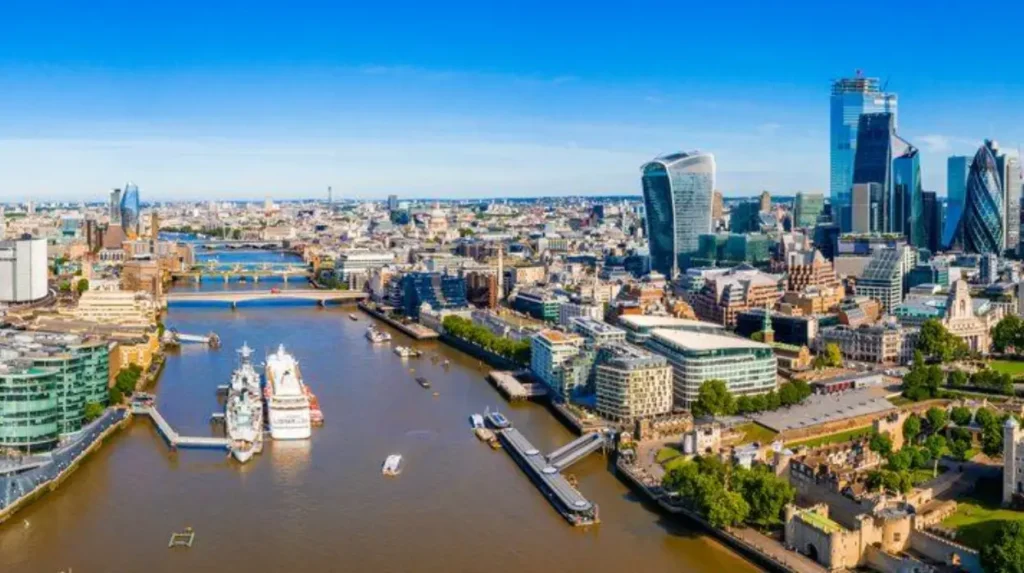
Visitors should prioritise Westminster Abbey, the Palace of Westminster, Tower of London, Tower Bridge, Shakespeare’s Globe, St Paul’s Cathedral, Greenwich, Hampton Court Palace, and Kew Gardens because these landmarks collectively represent nearly one thousand years of British political, cultural, architectural, and royal history.
Each riverside landmark illustrates a distinct chapter of London’s development.
Tower of London
Founded by William the Conqueror after 1066, the Tower of London functioned as a royal residence, fortress, armoury, treasury, mint, prison, and execution site.
Today it preserves the Crown Jewels and forms part of a UNESCO World Heritage Site.
Shakespeare’s Globe
The modern reconstruction commemorates the original Globe Theatre associated with William Shakespeare.
Educational performances explain Elizabethan theatre traditions and literary history.
St Paul’s Cathedral
Sir Christopher Wren designed the current cathedral after the Great Fire of London in 1666.
Its famous dome has become an enduring feature of London’s skyline viewed from the Thames.
Hampton Court Palace
Located upstream, Hampton Court Palace reflects Tudor royal life.
Originally developed by Cardinal Thomas Wolsey before becoming King Henry VIII’s residence, the palace contains historic kitchens, formal gardens, and significant Renaissance architecture.
Royal Botanic Gardens, Kew
Situated beside the Thames, Kew Gardens contains one of the world’s most scientifically important botanical collections.
The gardens became a UNESCO World Heritage Site in 2003.
What riverside walking routes provide the best visitor experience?
The Thames Path offers visitors continuous riverside walking through historic districts, modern cultural quarters, public parks, bridges, markets, and conservation areas while providing close access to London’s architectural, environmental, and archaeological heritage.
The Thames Path National Trail extends approximately 185 miles from the river’s source to the Thames Barrier.
Within London, visitors can explore shorter sections connecting major attractions.
Popular walking segments include Westminster to Tower Bridge, examples including South Bank and Bankside, Tower Bridge to Greenwich, examples including Wapping and Rotherhithe, and Richmond to Kew, examples including Petersham Meadows and Old Deer Park.
Walking reveals architectural details often overlooked during vehicle travel.
Interpretation panels explain former dockyards, medieval waterfronts, industrial redevelopment, and ecological restoration projects.
The South Bank has evolved into one of London’s principal cultural districts.
Visitors encounter performance venues, galleries, book markets, restaurants, and seasonal festivals throughout the year.
How has the River Thames influenced London’s economic and political development?
The River Thames enabled London’s rise as Britain’s political capital and commercial centre by supporting maritime trade, royal administration, industrial expansion, naval logistics, immigration, manufacturing, and international finance over nearly two millennia.
The Thames determined London’s strategic importance long before modern infrastructure developed.
Roman military planners recognised its navigable advantages.
Medieval monarchs controlled taxation through river trade.
The Tudor navy expanded Britain’s maritime influence from Thames shipyards.
The nineteenth century witnessed unprecedented commercial growth.
The Port of London handled enormous quantities of international cargo.
By the early twentieth century, it ranked among the world’s busiest ports.
Dock construction stimulated employment, housing development, railway expansion, and financial institutions.
Financial districts including the City of London benefited directly from river commerce.
Banks financed overseas trade while insurance companies developed specialist maritime services supporting international shipping.
Modern regeneration transformed former docklands into global business centres.
Canary Wharf now accommodates major financial institutions within redeveloped riverside infrastructure.
What wildlife and natural environments can visitors discover along the Thames?
Despite flowing through one of Europe’s largest cities, the River Thames supports diverse wildlife including seals, fish, birds, aquatic plants, and restored wetlands that demonstrate successful environmental conservation and ecological recovery.
The Thames experienced severe pollution during the nineteenth century.
The Great Stink of 1858 highlighted urgent sanitation failures.
Engineer Sir Joseph Bazalgette designed London’s modern sewer network, substantially improving water quality.
Environmental recovery accelerated during the twentieth century.
More than 125 fish species have been recorded within the tidal Thames.
Wildlife observations include harbour seals, examples including adults and pups, grey seals, examples including winter visitors and breeding animals, and numerous bird species, examples including cormorants, herons, kingfishers, and swans.
The Thames Estuary also supports internationally important bird habitats recognised under conservation legislation.
Urban biodiversity demonstrates the effectiveness of long-term environmental management and habitat restoration.
How do engineering projects protect the River Thames and modern London?
Engineering projects including embankments, bridges, flood barriers, sewer systems, and navigation infrastructure protect London from flooding, improve public health, maintain river transport, and preserve the Thames as a safe environment for residents and visitors.
Victorian engineering fundamentally transformed the Thames.
Sir Joseph Bazalgette constructed approximately 1,100 miles of sewers and major embankments following repeated cholera outbreaks and the Great Stink.
These projects improved sanitation while creating new riverside roads.
The Thames Barrier represents one of the world’s largest movable flood defence systems.
Completed in 1984, it protects central London from North Sea storm surges and exceptionally high tides.
London contains more than thirty bridges crossing the Thames.
Historic and modern examples include Westminster Bridge, Blackfriars Bridge, Waterloo Bridge, Millennium Bridge, London Bridge, and Tower Bridge.
Each structure reflects contemporary engineering techniques and architectural priorities from different historical periods.
Why does the River Thames remain culturally significant today?
The River Thames remains culturally significant because it connects Britain’s historical identity with contemporary tourism, recreation, conservation, education, transport, literature, public celebrations, and international events while preserving one of the world’s most recognisable urban landscapes.
The Thames appears extensively in British literature, art, music, and film.
Authors including Charles Dickens, Joseph Conrad, and Jerome K. Jerome used the river as an important setting for exploring London’s society and changing urban landscape.
Educational institutions continue using the Thames as an outdoor classroom.
Universities, museums, archaeological organisations, and heritage charities conduct research into river ecology, historic shipwrecks, waterfront archaeology, and climate resilience.
Public events reinforce cultural connections.
Annual festivals, examples including Totally Thames Festival and the Boat Race, celebrate the river’s continuing importance through sport, education, exhibitions, guided walks, and community participation.
Climate adaptation has increased the river’s long-term significance.
Flood management planning, biodiversity restoration, sustainable transport, and waterfront regeneration ensure the Thames continues supporting millions of residents and visitors while protecting nationally important heritage assets.
The River Thames therefore remains more than a scenic waterway. It is the historical framework upon which London developed. Every cruise, riverside walk, bridge crossing, museum visit, and waterfront district reveals another chapter in Britain’s political, architectural, scientific, commercial, and cultural evolution. For visitors seeking sightseeing, cruises, and riverside adventures, the Thames provides an experience that combines nearly two thousand years of documented history with one of the world’s most dynamic urban environments.
What is the River Thames famous for?
The River Thames is famous for flowing through the heart of London and connecting many of the city’s most iconic landmarks, including the Palace of Westminster, Tower Bridge, the Tower of London, the London Eye, and Greenwich. It has played a central role in Britain’s history, trade, transport, and royal traditions for nearly 2,000 years.