Covent Garden is one of London’s most recognisable cultural districts. Located within the City of Westminster, the area evolved from medieval agricultural land into a planned urban square, a major commercial marketplace, and ultimately one of the United Kingdom’s most visited entertainment destinations. Its transformation reflects broader changes in London’s social, economic, architectural, and cultural development across more than 800 years.
- What was Covent Garden originally used for?
- How did the Dissolution of the Monasteries change Covent Garden?
- Why is Covent Garden considered a landmark in urban planning history?
- How did Covent Garden become London’s principal market district?
- What role did theatres play in Covent Garden’s development?
- How did social conditions shape Covent Garden during the eighteenth and nineteenth centuries?
- Why was the historic Covent Garden Market relocated?
- How was Covent Garden preserved and redeveloped in the late twentieth century?
- What historical features can still be seen in Covent Garden today?
- Why does Covent Garden remain historically important today?
Today, Covent Garden attracts millions of visitors annually through its historic streets, theatres, street performers, restaurants, and retail spaces. Understanding its history reveals how religious landholdings, urban planning, commerce, and cultural institutions shaped one of London’s most influential neighbourhoods.
What was Covent Garden originally used for?
Covent Garden began as agricultural land owned by Westminster Abbey during the medieval period. The area served as monastery grounds used for farming, food production, and resource management before later becoming urbanised during London’s expansion in the seventeenth century.
The name “Covent Garden” derives from the phrase “Convent Garden.” The term referred to the garden belonging to the monks of Westminster Abbey. By the twelfth century, large sections of land between Westminster and the City of London were controlled by ecclesiastical institutions.
Westminster Abbey functioned not only as a religious centre but also as a major landowner. The monastery maintained extensive agricultural holdings to supply food for monks, clergy, workers, and visitors. The fields that later became Covent Garden contained orchards, vegetable plots, and grazing areas.
Historical records indicate that these lands were strategically valuable because of their proximity to the River Thames and growing settlements around Westminster. Agricultural production formed an essential component of the medieval economy, and monastery-owned estates generated significant income through rents and produce sales.
For several centuries, the area remained largely rural despite London’s gradual growth. The landscape consisted primarily of open fields separated by paths and drainage systems. This agricultural character persisted until political changes in the sixteenth century fundamentally altered land ownership patterns throughout England.
How did the Dissolution of the Monasteries change Covent Garden?
The Dissolution of the Monasteries between 1536 and 1541 transferred Covent Garden from church ownership to the English Crown. This political and religious reform initiated the area’s transition from agricultural estate to planned urban development.
The Dissolution of the Monasteries was implemented by King Henry VIII following England’s break with the Roman Catholic Church. Religious institutions across the country lost their lands, properties, and economic privileges.
Westminster Abbey surrendered its holdings to the Crown in 1540. As a result, Covent Garden’s agricultural estate became royal property. This transfer created opportunities for private development that had not existed under monastic ownership.
The Crown subsequently granted portions of the estate to influential aristocratic families. The most important recipient was the Russell family, later known as the Dukes of Bedford. Their stewardship would permanently shape the area’s future.
The Russell estate controlled extensive landholdings in central London. Through long-term planning and investment, the family participated in several major urban developments that contributed to London’s westward expansion.
This shift from ecclesiastical ownership to aristocratic management reflected broader national changes. Land increasingly became a commercial asset rather than a religious resource. Urban growth, population expansion, and economic development encouraged large-scale residential construction throughout London.
The transfer of ownership established the conditions necessary for one of Britain’s earliest examples of formal urban planning.
Why is Covent Garden considered a landmark in urban planning history?
Covent Garden is considered a landmark in urban planning because it became London’s first formally designed public square in 1630. The development introduced continental architectural principles that influenced subsequent urban projects throughout Britain.
In the early seventeenth century, the Fourth Earl of Bedford sought permission to develop portions of his Covent Garden estate. He commissioned architect Inigo Jones to create a planned residential district.
Inigo Jones was England’s leading classical architect. He introduced Renaissance architectural concepts inspired by Italy, particularly the work of Andrea Palladio.
Construction began around 1631. The centrepiece was a large rectangular square surrounded by elegant houses and public spaces. This design represented a significant departure from London’s traditionally irregular medieval street patterns.
The project included the Church of St Paul, often called the “Actors’ Church” today because of its long association with the theatre community.
The piazza became London’s first purpose-built square. Similar developments later appeared across the capital, including examples such as Bloomsbury squares and St James’s Square.
The design established principles that influenced urban planning for centuries:
The integration of public and private spaces improved accessibility.
Symmetrical architectural arrangements created visual order.
Open civic areas encouraged commercial and social interaction.
The project demonstrated how planned development could increase property values while enhancing urban functionality.
Covent Garden therefore occupies an important position in the history of British architecture and city planning.
How did Covent Garden become London’s principal market district?
Covent Garden became London’s principal market district during the seventeenth and eighteenth centuries when informal trading expanded into a major wholesale fruit, vegetable, and flower market serving the growing metropolitan population.
Commercial activity emerged soon after the creation of the piazza. Traders recognised that the open square provided an ideal location for selling agricultural produce.
By the mid-seventeenth century, vendors regularly sold fruits, vegetables, herbs, and flowers in the area. Increasing demand from London’s expanding population encouraged continued growth.
The market gained official recognition through royal charters and regulatory measures. Authorities sought to manage congestion, sanitation, and commercial competition.
Throughout the eighteenth century, Covent Garden Market became one of the most important food distribution centres in Britain. Goods arrived from rural counties and international trade networks.
Historical estimates indicate that thousands of tonnes of produce passed through the market annually during peak periods. The market connected farmers, wholesalers, retailers, and consumers within a complex commercial system.
Several developments strengthened its importance:
Improved transportation networks increased supply capacity.
Population growth expanded consumer demand.
Urbanisation concentrated commercial activity in central London.
Agricultural innovation increased productivity.
The market became a defining feature of the district’s identity. It also attracted associated industries, including storage facilities, transport services, inns, and retail businesses.
For more than three centuries, commercial exchange remained central to Covent Garden’s economic life.
What role did theatres play in Covent Garden’s development?
Theatres transformed Covent Garden into a cultural centre from the eighteenth century onward. Major performance venues attracted audiences, encouraged tourism, and established the district as one of London’s leading entertainment destinations.
The growth of theatre activity coincided with the district’s commercial success. Entertainment venues benefited from the area’s accessibility and concentration of visitors.
A major milestone occurred in 1732 with the opening of the Theatre Royal, Covent Garden. The venue later evolved into the modern Royal Opera House.
The theatre hosted dramatic performances, musical productions, and public events. Prominent actors, playwrights, composers, and performers appeared there across successive generations.
Covent Garden became closely associated with London’s theatrical community. The district developed supporting businesses that served performers and audiences, including taverns, coffee houses, costume suppliers, and publishers.
The Royal Opera House emerged as one of the world’s leading performing arts institutions. Today it houses internationally recognised opera and ballet companies.
Theatre activity generated several long-term impacts:
It strengthened the local economy.
It expanded London’s cultural influence.
It attracted domestic and international visitors.
It contributed to artistic innovation.
The area’s reputation as an entertainment district remains closely linked to this theatrical heritage.
How did social conditions shape Covent Garden during the eighteenth and nineteenth centuries?
Covent Garden reflected the social contrasts of Georgian and Victorian London. Wealthy residents, market traders, performers, labourers, and visitors occupied the same district, creating a diverse and complex urban environment.
As commercial activity expanded, Covent Garden developed a mixed social character.
Affluent households initially occupied residences surrounding the piazza. However, increasing market traffic gradually encouraged many wealthy families to relocate to quieter districts.
Commercial premises expanded into former residential properties. Warehouses, shops, workshops, and lodging houses became common features.
The district attracted workers from numerous occupations. Market porters, traders, transport operators, actors, musicians, and artisans contributed to local economic activity.
Historical records also document challenges associated with rapid urbanisation. Overcrowding, sanitation concerns, and poverty affected parts of the area during the eighteenth and nineteenth centuries.
Contemporary writers frequently described Covent Garden as a place where multiple social classes interacted. This diversity distinguished it from more socially segregated neighbourhoods.
The area’s cultural significance increased because it reflected broader urban trends occurring throughout London during industrialisation and population growth.
These social dynamics influenced literature, journalism, theatre, and historical scholarship documenting everyday life in the capital.
Why was the historic Covent Garden Market relocated?
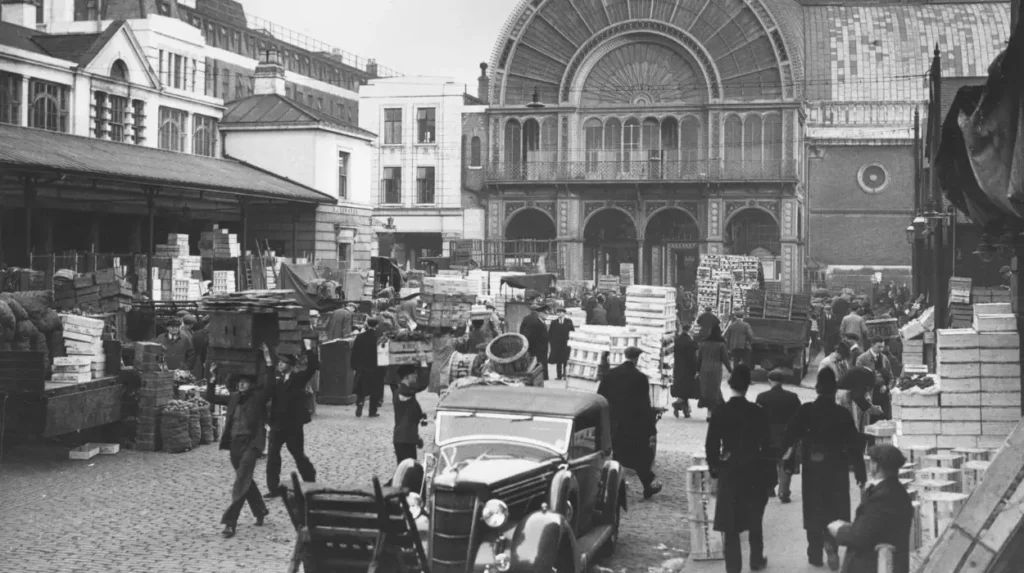
The historic Covent Garden Market was relocated in 1974 because increasing traffic congestion, logistical challenges, and modern distribution requirements made continued wholesale operations impractical in central London.
By the twentieth century, London’s transportation systems had changed dramatically. Motor vehicles replaced many traditional delivery methods.
The narrow streets surrounding Covent Garden struggled to accommodate growing volumes of commercial traffic. Congestion affected both businesses and residents.
Government studies and planning authorities concluded that a modern wholesale market required larger facilities with improved transport connections.
In 1974, wholesale operations moved to Nine Elms in south-west London. The new site became known as the New Covent Garden Market.
The relocation marked the end of more than 300 years of continuous market activity in the historic district.
Many observers initially feared redevelopment would damage the area’s heritage. However, preservation campaigns successfully protected significant architectural features.
The relocation ultimately created opportunities for adaptive reuse, allowing historic buildings to serve new functions while retaining their historical character.
How was Covent Garden preserved and redeveloped in the late twentieth century?
Covent Garden was preserved through conservation initiatives that protected historic buildings while encouraging adaptive redevelopment. This approach transformed the district into a heritage, retail, and entertainment destination without erasing its historical identity.
During the 1960s and 1970s, proposals emerged for large-scale redevelopment involving extensive demolition.
Community groups, conservation organisations, architects, and historians opposed these plans. They argued that Covent Garden contained valuable examples of historic urban architecture.
Public campaigns achieved significant success. Authorities adopted conservation-based planning policies designed to preserve important structures and streetscapes.
The former market buildings underwent restoration and adaptation.
Historic warehouses became retail spaces.
Former commercial buildings accommodated restaurants and cultural venues.
Public squares were improved for pedestrian use.
The redevelopment strategy became an influential example of urban conservation. Rather than replacing historic infrastructure, planners integrated heritage assets into contemporary economic activity.
This model influenced regeneration projects elsewhere in Britain and internationally.
The district’s architectural legacy, therefore, survived while remaining economically viable.
What historical features can still be seen in Covent Garden today?
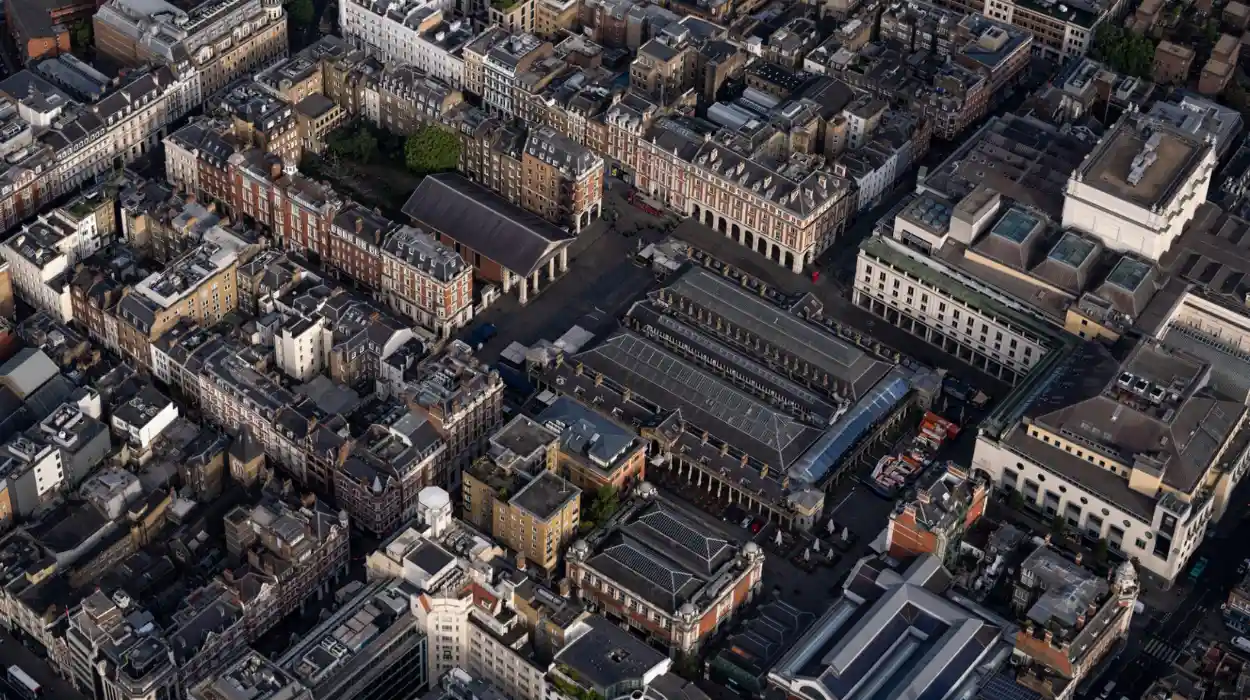
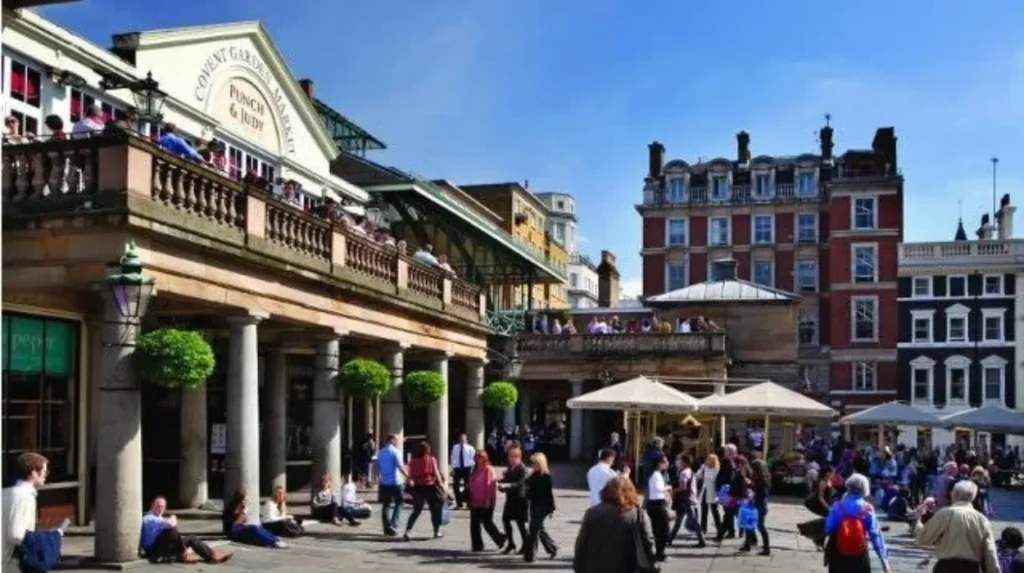
Many historic features remain visible in Covent Garden, including the seventeenth-century piazza, St Paul’s Church, market buildings, theatre landmarks, and street patterns that illustrate centuries of urban evolution and cultural development.
Visitors can observe several layers of London’s history within a relatively compact area.
The central piazza continues to reflect Inigo Jones’s original planning principles. Although modified over time, its basic spatial arrangement remains recognisable.
St Paul’s Church preserves significant architectural elements dating from the seventeenth century. The building remains closely associated with Britain’s performing arts community.
The former market buildings represent Victorian commercial architecture and demonstrate the scale of historic wholesale operations.
The Royal Opera House continues a theatrical tradition that extends back nearly three centuries.
Street layouts reveal patterns established during successive phases of development. Architectural styles from different periods illustrate changing construction methods and urban priorities.
To experience this historic landmark in person today, consult our comprehensive [Things to Do in Covent Garden: Street Performers, Shops, and Dining] for itineraries and visiting parameters.
These surviving features provide tangible evidence of the district’s transformation from an agricultural estate to a global cultural destination.
Why does Covent Garden remain historically important today?
Covent Garden remains historically important because it demonstrates how land ownership, urban planning, commerce, culture, and heritage conservation collectively shaped modern London across multiple centuries of development.
Few locations encapsulate as many dimensions of London’s history within a single district.
The area illustrates the transition from medieval monastic land management to aristocratic urban planning. It demonstrates the rise of organised marketplaces and the growth of metropolitan commerce. It reflects the emergence of theatre and public entertainment as significant cultural institutions.
Covent Garden also provides a valuable case study in heritage preservation. Conservation efforts protected historic architecture while supporting economic sustainability.
Researchers continue to examine archaeological evidence, property records, market documentation, theatre archives, and municipal planning records to better understand the district’s evolution.
Millions of annual visitors engage with these historical layers, making Covent Garden both a living neighbourhood and an educational resource.
Its story extends beyond a single location. It reflects broader developments in British history, including religious reform, urbanisation, commercial expansion, cultural production, and architectural innovation.
From monastery gardens serving medieval monks to a globally recognised entertainment hub, Covent Garden represents more than eight centuries of continuous transformation. Its enduring significance lies in the preservation of that history within a vibrant modern urban environment, ensuring that future generations can study and experience one of London’s most influential historic districts.
What is the history of Covent Garden?
Covent Garden began as agricultural land owned by Westminster Abbey during the medieval period. After the Dissolution of the Monasteries in the sixteenth century, it became royal property and later developed into a planned urban square, market district, and entertainment centre.