Key Points
- Property Seizure: Southwark Council has officially taken possession of a council flat in Walworth, south London, following a comprehensive year-long investigation by its Housing Investigations Team.
- The First Lady Link: The residential property is directly linked to Fatima Bio, the First Lady of Sierra Leone, who previously lived in the United Kingdom.
- The BBC Interview Catalyst: Public and institutional scrutiny intensified after Fatima Bio defended retaining the social housing unit during an expansive interview with BBC Global Women.
- First Lady’s Defence: During the broadcast, Fatima Bio maintained that her children are British citizens, that she was paying for the council house herself, and strongly asserted that she had committed no crime.
- Housing Crisis Context: The repossession occurs against the backdrop of a severe housing shortage in the Borough of Southwark, where more than 18,000 residents are currently on the waiting list for social housing.
- No Criminal Allegations: Southwark Council has explicitly clarified that it is not alleging any criminal wrongdoing, nor has it stated that the First Lady was formally evicted, correcting various speculative media reports.
- Swift Reallocation: Local authority officials have confirmed that the Walworth property will be rapidly refurbished and allocated to a local family facing genuine housing need.
London (Extra London News) June 12, 2026 – Southwark Council has officially taken back possession of a municipal housing property linked to Sierra Leone’s First Lady, Fatima Bio, terminating a high-profile, year-long inquiry into the tenancy status of the south London flat. The local authority confirmed the repossession of the residence, situated in the Walworth neighborhood, following intense public scrutiny in both the United Kingdom and West Africa. The bureaucratic intervention was catalyzed by a widely circulated media interview in which the First Lady publically defended her retention of British social housing despite her current head-of-state diplomatic status in Freetown. Local government officials emphasized that the flat will be immediately reallocated to alleviate the borough’s severe housing backlog, whilst explicitly noting that no criminal charges or formal eviction orders have been leveraged against the First Lady.
- Key Points
- Why Did Southwark Council Seize the Property Linked to Fatima Bio?
- What Did the First Lady of Sierra Leone Reveal to BBC Global Women?
- How Severe is the Social Housing Crisis in Southwark?
- Was Fatima Bio Formally Evicted from the Walworth Flat?
- What Has Been the Political Impact of the Housing Scandal in Freetown?
Why Did Southwark Council Seize the Property Linked to Fatima Bio?
The administrative action taken by the local authority marks the culmination of a protracted, twelve-month investigation executed by Southwark Council’s specialized Housing Investigations Team. The flat, located within the urban district of Walworth, had been under formal review to determine whether its tenancy conformed with strict UK social housing regulations, which mandate that council homes must serve as the primary residence of the authorized tenants.
As reported by the BBC News Africa desk, the property’s usage patterns and its continued retention by a foreign dignitary prompted a comprehensive forensic audit of the tenancy agreement. Under UK housing legislation, local councils maintain rigorous statutory powers to reclaim properties that are left vacant, sublet unlawfully, or held by individuals whose altered socio-economic circumstances mean they no longer meet the baseline criteria for state-subsidized accommodation.
In an official public statement provided directly to British broadcasters, Councillor Reginald Popoola, Southwark Council’s executive member for council homes, articulated the local government’s position on the matter. As reported by the BBC, Councillor Reginald Popoola stated that:
“We can confirm we have taken possession of a property in Walworth following a 12-month investigation by our Housing Investigations Team.”
The councillor further explained that the overarching objective of the enforcement action was entirely corrective rather than punitive. As reported by the BBC, Councillor Reginald Popoola added:
“I look forward to bringing this council property back to its original purpose which is to provide a safe and secure home for people with legitimate housing need on the council’s waiting list. This property will be swiftly allocated to a local family in genuine housing need.”
What Did the First Lady of Sierra Leone Reveal to BBC Global Women?
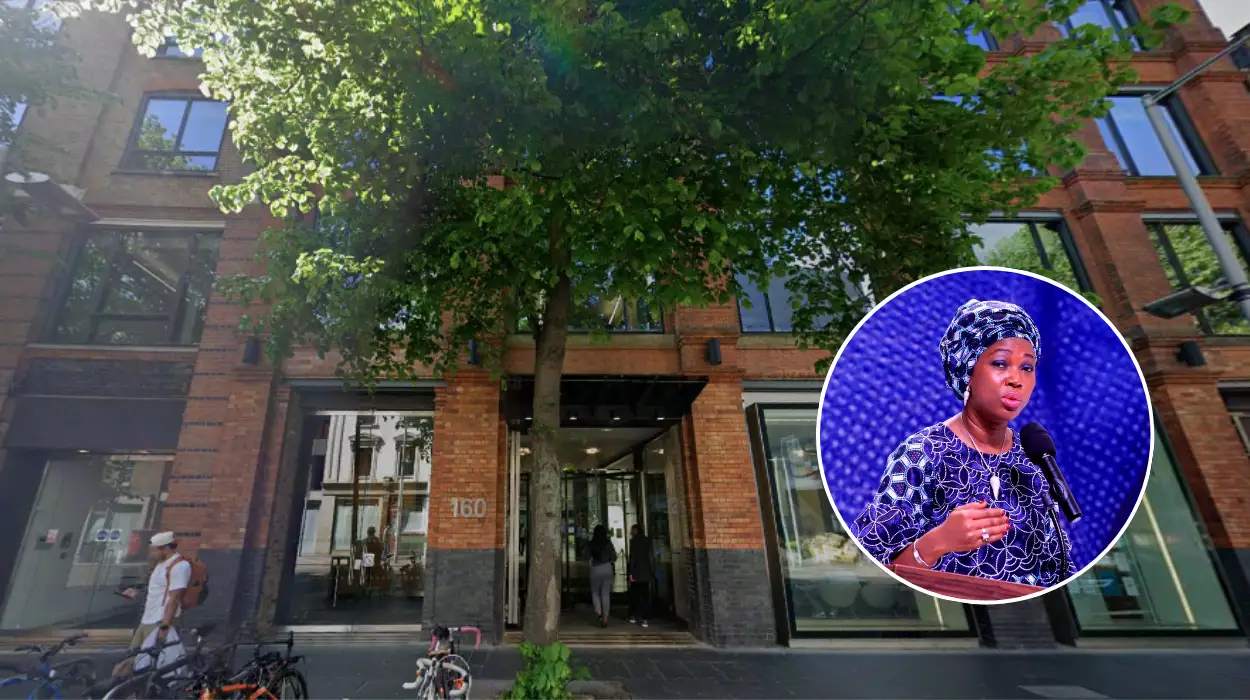
The bureaucratic mechanisms that led to the repossession were significantly accelerated by an intimate and wide-ranging television interview that Fatima Bio granted to the BBC Global Women programme. The broadcast was intended to chart her remarkable trajectory from a vulnerable West African teenager to an influential global advocate and political matriarch.
During the broadcast package, Fatima Bio spoke candidly about her early life traumas, detailing how she fled Sierra Leone as a young girl to escape a strictly enforced, proposed child marriage. Upon her arrival on British soil, she successfully sought asylum, establishing a foundational life within London’s vibrant West African diaspora. Over the subsequent decades, she transitioned into the creative industries as an actress and filmmaker, before marrying Julius Maada Bio, who was elected President of Sierra Leone in 2018.
However, the journalistic focus of the interview pivoted sharply when the discussion turned to her contemporary ties to the United Kingdom, specifically her continued possession of a municipal flat in south London. Confronted with the optics of a sitting First Lady maintaining a council tenancy while residing primarily in a presidential palace, Fatima Bio mounted an impassioned defense of her entitlement to the flat.
As reported by the BBC Global Women production team, Fatima Bio stated during the interview:
“My children are all British citizens.”
She further sought to dispel any insinuation of financial impropriety or systemic exploitation of the British welfare state by clarifying her personal financial contributions to the tenancy. As reported by the BBC, Fatima Bio firmly added:
“I’m paying for my council house myself. I have not committed any crime.”
How Severe is the Social Housing Crisis in Southwark?
The revelation that a foreign head of state’s spouse held the keys to a subsidized municipal flat provoked immediate political fallout in London, primarily due to the acute, ongoing housing emergency gripping the local borough. Southwark Council, which covers a densely populated swathe of south London from the River Thames down to Dulwich, faces some of the most severe inflationary housing pressures in the United Kingdom.
According to statutory data published on Southwark Council’s official municipal website, there are currently more than 18,000 local citizens registered on the borough’s waiting list for social housing. The local government’s public facing literature explicitly warns applicants of the profound systemic shortages, stating unequivocally that “even people in the greatest need can face several years’ wait” before a suitable property becomes available.
The stark disparity between a wealthy international diplomat retaining a London base and thousands of low-income local families living in temporary, overcrowded bed-and-breakfast accommodation transformed the case from a routine tenancy dispute into a symbol of urban housing inequality. Housing activation groups and local opposition politicians used the disclosure to demand immediate transparency regarding how long the flat had sat empty and why the investigation had required a full calendar year to conclude.
Explore more Local News:
Pro-Palestine Big Ben Climber Daniel Day Found Guilty: London 2026
Rapist Flees on Eurostar After Prison Error: London 2026
Was Fatima Bio Formally Evicted from the Walworth Flat?
In the immediate aftermath of the council’s announcement, a wave of sensationalized reporting swept through various digital media outlets and West African news portals, with several titles prematurely claiming that the First Lady had been subjected to a humiliating, forced eviction by bailiffs.
To prevent legal escalations and correct the public record, Southwark Council issued a series of vital legal clarifications regarding the exact terminology and nature of the property transfer. The local authority explicitly noted that the transition of the property back into public hands was handled through administrative repossession protocols rather than an adversarial court-ordered eviction.
Furthermore, the municipality took pains to decouple the repossession from any implications of unlawful conduct or fraudulent intent. As reported by British media correspondents covering the municipal beat, Southwark Council did not state that the First Lady had been evicted, nor did the authority allege any form of criminal wrongdoing on her part. The termination of the tenancy appears to have been resolved on the civil grounds of non-occupation as a primary residence, a standard clause within all UK secure tenancy agreements that does not carry criminal culpability.
What Has Been the Political Impact of the Housing Scandal in Freetown?
While the story occupied a prominent space in London’s local governance reporting, its impact reverberated with even greater force across the political landscape of Sierra Leone. In Freetown, the capital city, opposition parties and civil society organizations seized upon the BBC interview and subsequent council repossession to launch a coordinated critique of the ruling administration’s ethical standards.
The Sierra Leonean diaspora, which maintains deep economic and social ties to the UK, expressed profound shock online, noting the bitter irony of a presidential family holding onto subsidized housing meant for the British working poor while inflation and economic hardship persist at home. Opposition media outlets in West Africa widely re-reported the BBC’s findings, framed around broader questions regarding accountability, presidential assets, and the international image of the country’s leadership.
Supporters of the First Lady, conversely, argued that her comments were taken out of context and reflected a mother’s natural instinct to preserve a secure fallback option for her British-born children, who may one day return to live in the United Kingdom as private citizens. They emphasized her transparency during the interview as evidence that she believed she was operating entirely within the boundaries of her legal rights as a long-term UK resident and taxpayer.
What Happens Next to the Reclaimed Walworth Property?
With the twelve-month Housing Investigations Team inquiry formally closed, Southwark Council has initiated its standard void-property protocol. This process involves a comprehensive physical inspection of the Walworth flat, followed by any necessary structural repairs, safety certifications, and cosmetic refurbishment required to bring the dwelling up to modern decent-homes standards.
Once the property passes its final municipal inspection, it will be entered into the borough’s choice-based letting system. Given the executive mandate delivered by Councillor Popoola, the allocation process will be fast-tracked to ensure that the flat does not sit vacant for a single day longer than necessary. It will be offered to the highest-priority applicant on the 18,000-strong waiting list—most likely a local family currently displaced in temporary accommodation within the Walworth or broader south London area.