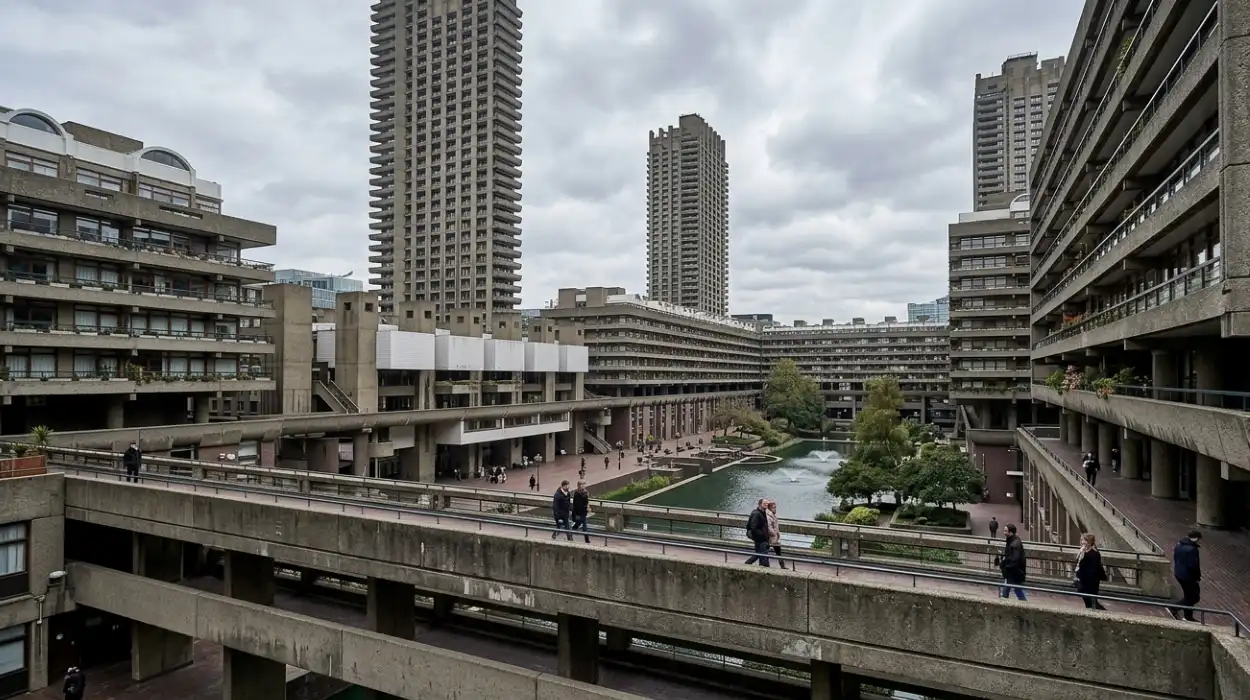
The Barbican is considered a Brutalist masterpiece because it represents a completely realized, utopian post-war vision of high-density urban living. Its cohesive concrete design, innovative elevated pedestrian walkways, and massive scale make it a premier global example of the architectural movement.
- What is the Historical Origin of the Barbican Site?
- Who Were the Key Visionaries Behind the Barbican’s Construction?
- What are the Must-See Architectural and Structural Landmarks Within the Estate?
- How Does the Barbican Arts Centre Function Within the Greater Complex?
- What Were the Socio-Political Intentions and Realities of the Project?
- How Did the Barbican Transition from Public Dislike to Heritage Protection?
- What is the Modern Significance and Future Legacy of the Barbican?
The Barbican Estate stands as one of the world’s most significant examples of Brutalist architecture, a style that emerged in the 1950s out of post-war reconstruction efforts. The term Brutalism derives from the French béton brut, which translates directly to “raw concrete.” This architectural philosophy prioritizes structural transparency, functional expression, and the celebration of raw materials over ornate decoration. The City of London Corporation commissioned the firm Chamberlin, Powell and Bon in 1956 to design the estate, intending to transform a 35-acre site that German aerial bombardment during the Blitz of World War II completely devastated.
Architects Peter Chamberlin, Geoffry Powell, and Christoph Bon approached the project not merely as a collection of residential buildings, but as an integrated, self-contained urban ecosystem. Constructed between 1965 and 1976, the complex features a distinct design language characterized by its massive forms, dramatic geometry, and hand-hammered concrete surfaces. Workers pick-hammered the concrete facades after casting to expose the coarse granite aggregate, a labor-intensive process that gave the massive structures a textured, stone-like quality.
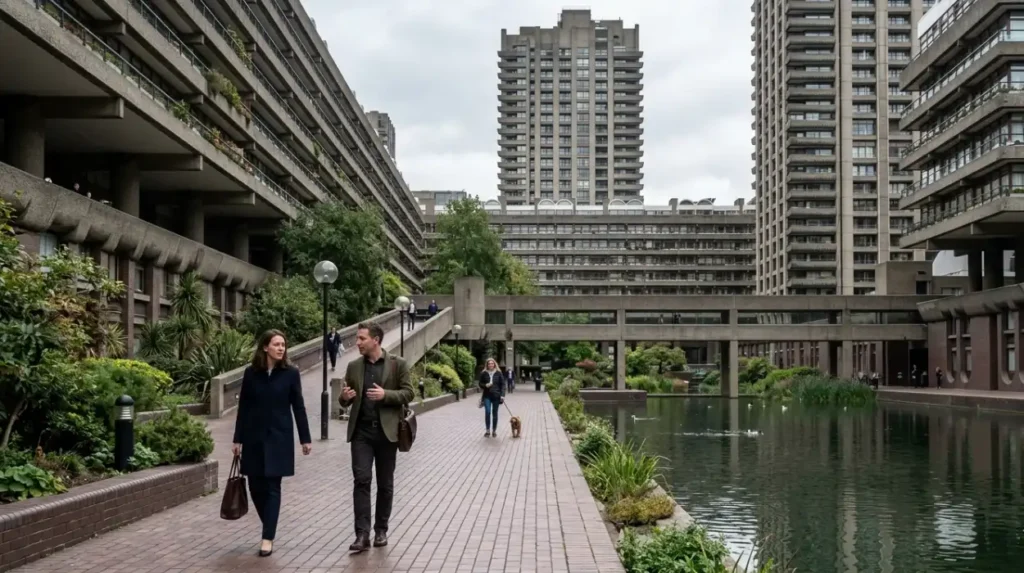
The structural layout relies on a strict separation of vehicular and pedestrian traffic. The architects achieved this by creating the “podium,” an elevated pedestrian network raised above the street-level roads and parking garages. This configuration allows residents and visitors to navigate the entire 35-acre site without encountering a single motor vehicle.
The estate integrates 2,014 residential units across various building types, including three 43-story residential towers—Shakespeare, Lauderdale, and Cromwell Towers—which stood as the tallest residential structures in Europe at the time of their completion. The layout also features long, seven-story terrace blocks that frame central courtyards, a large artificial lake, and public green spaces. By integrating residential housing with educational institutions, commercial spaces, and a massive cultural center, the Barbican realized the Brutalist ideal of a vertical city, proving that high-density urban concrete architecture could provide an elevated, sophisticated standard of living.
What is the Historical Origin of the Barbican Site?
The historical origin of the Barbican site traces back to Roman Londinium, where defensive walls protected the northern border of the city. Centuries later, the area became a dense textile district before World War II bombing cleared the land for redevelopment.
The word “barbican” originates from the Low Latin word barbacana, which defines a fortified outpost, gateway, or watchtower positioned over a gate or bridge used for defensive purposes. The site of the modern Barbican Estate occupies a highly historic footprint along the northern boundary of Roman Londinium, established around AD 43. During the late 2nd or early 3rd century, Roman authorities constructed the London Wall, a defensive stone fortification that enclosed the settlement. A critical fort, measuring 12 acres, stood at the northwest corner of this wall, directly overlapping the modern estate. Parts of these Roman foundations, alongside medieval expansions built by subsequent London authorities, remain visible on the grounds today.
Following the Roman abandonment of Britain, the area transformed over centuries. By the 19th century, the district, known as Cripplegate, developed into a densely populated commercial hub centered on the rag trade, cloth finishing, and textile warehousing. The neighborhood featured narrow medieval streets, tightly packed warehouses, and a small residential population of approximately 14,000 citizens.
This historic urban fabric disappeared entirely on the night of December 29, 1940, during the Second World War. The German Luftwaffe subjected the City of London to an intense incendiary bombing raid, known historically as the Second Great Fire of London. The fires completely incinerated the textile warehouses of Cripplegate, reducing the 35-acre area to smoking rubble and ash.
When the war ended in 1945, the Cripplegate ward recorded a registered residential population of fewer than 50 people. The vast expanse of flattened land presented the City of London Corporation with an unprecedented municipal challenge and a unique geographical blank slate. Rather than selling the land to commercial office developers, the local government resolved to create a high-density residential estate to attract residents back to the financial district, leading directly to the architectural commission that created the modern Barbican.
Who Were the Key Visionaries Behind the Barbican’s Construction?
Architects Peter Chamberlin, Geoffry Powell, and Christoph Bon designed the Barbican Estate after winning a competitive municipal commission. Their vision received critical political backing and funding from the City of London Corporation, which sought to repopulate the financial district.
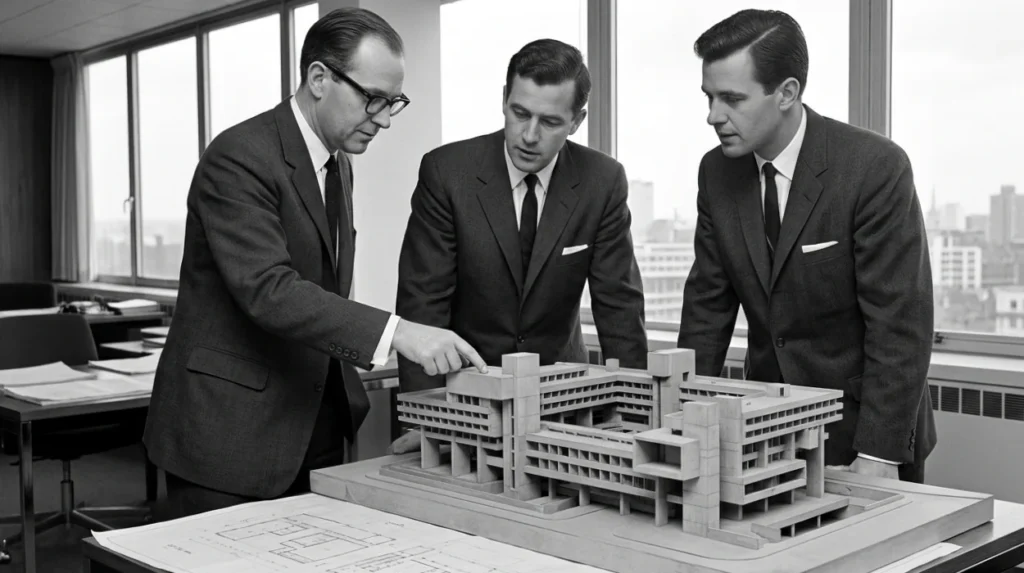
The physical reality of the Barbican is the result of a collaboration between a visionary trio of young British architects and an ambitious municipal government. The architectural partnership of Chamberlin, Powell and Bon formed in 1952 after the three men agreed that if any one of them won the architectural competition to design the nearby Golden Lane Estate, they would execute the project together. Geoffry Powell won that competition, establishing the firm as London’s premier experts in modern, high-density residential planning.
The City of London Corporation, the municipal governing body of the financial district, officially appointed the firm in 1956 to develop a comprehensive plan for the destroyed Cripplegate area. The three partners divided their responsibilities based on architectural focus, yet maintained a unified aesthetic philosophy.
- Peter Chamberlin served as the primary strategist and macro-planner, focusing on how the massive complex integrated into the wider geography of London.
- Geoffry Powell managed the functional execution, ensuring that residential layouts maximized natural light and spatial efficiency.
- Christoph Bon brought a strong continental European influence to the project, drawing heavy inspiration from the Swiss-French modernist architect Le Corbusier, particularly his Unité d’Habitation residential housing concepts in Marseille.
Politically, the project required the sustained support of the City of London Corporation, led by key influential figures including Duncan Sandys, a prominent politician who advocated for high-quality post-war urban planning. The engineers of Ove Arup and Partners managed the complex structural engineering demands of the site, calculating the load-bearing requirements for the three massive residential towers and the intricate underground columns that support the elevated podium above the existing railway lines. Together, these individuals shifted British architecture away from traditional brick terraces toward monumental, avant-garde concrete structural engineering.
What are the Must-See Architectural and Structural Landmarks Within the Estate?
The must-see landmarks within the estate include the three iconic 43-story residential towers, the sweeping crescent of Frobisher Crescent, the tranquil lakeside terrace blocks, and the preserved sections of the ancient Roman and medieval London Wall.
The Barbican Estate comprises several distinct structural components that form its complex architectural landscape. The most prominent visual elements are the three residential towers: Cromwell Tower (completed in 1973), Shakespeare Tower (completed in 1976), and Lauderdale Tower (completed in 1976). These towers stand at 123 meters (404 feet) tall, utilizing a unique structural design where the main lift shafts and service cores form a rigid central spine, while external, bush-hammered concrete columns support the outer residential perimeters. The distinct, deep-set balconies feature integrated concrete crop planters, which the architects added to soften the harshness of the vertical facades.
At the center of the estate lies the lakeside area, which features Gilbert House, an elongated residential block raised on massive concrete columns called pilotis. This block bridges the central artificial lake, which holds millions of gallons of water and utilizes a system of fountains to aerate the water and provide acoustic masking against city noise. The lake is bordered by the Brandon Estate and the sweeping, semi-circular form of Frobisher Crescent, an architectural arc that defines the northern boundary of the formal cultural complex.
Directly adjacent to the water sits the Church of St. Giles-without-Cripplegate. This medieval church, originally constructed in 1394, survived the Blitz despite suffering severe structural damage. The architects deliberately integrated this historic stone church into the modern concrete landscape, positioning it alongside a surviving bastion of the 13th-century medieval London Wall. This juxtaposition creates a direct visual contrast between medieval ragstone masonry and 20th-century raw concrete. To experience this historic landmark in person today, consult our comprehensive [Barbican Visitor Guide and Best Things to Do] for itineraries and visiting parameters.
How Does the Barbican Arts Centre Function Within the Greater Complex?
The Barbican Arts Centre functions as a massive, multi-disciplinary cultural hub built largely underground beneath the residential estate. It houses a major concert hall, theatres, cinemas, an art gallery, and a large indoor tropical conservatory.
The Barbican Arts Centre serves as the cultural heart of the estate, officially opened by Queen Elizabeth II in 1982, who declared it “one of the wonders of the modern world.” The construction of the arts center required an intricate architectural solution; because the City of London Corporation restricted the physical height of the cultural center to preserve views and light for the surrounding residential apartments, the architects excavated 20 meters into the earth. Consequently, the majority of the arts center’s massive infrastructure sits entirely below the pedestrian podium level.
The center acts as a multi-disciplinary institution, containing:
- The Barbican Hall: A 1,943-seat acoustic auditorium that serves as the permanent home of the London Symphony Orchestra and the BBC Symphony Orchestra.
- The Barbican Theatre: A 1,156-seat dramatic theatre featuring a 33-meter-tall fly tower, designed specifically for the Royal Shakespeare Company, which occupied the space as its London home until 2002.
- The Pit: A flexible 200-seat studio theatre designed for experimental and avant-garde performances.
- The Barbican Art Gallery and The Curve: Two dedicated exhibition spaces that host major international contemporary art installations, photography exhibitions, and design retrospectives.
- Cinema Screens: Three separate auditoriums showing independent, foreign, and mainstream cinema.
Located on top of the fly tower of the theatre is the Barbican Conservatory, the second-largest oasis of its kind in London. This structural steel-and-glass greenhouse wraps around the concrete framework of the theatre infrastructure, housing more than 1,500 species of tropical plants, trees, and exotic fish. The conservatory functions as a vivid ecological counterpoint to the gray concrete of the exterior estate, drawing thousands of botanists, horticulturalists, and tourists annually.
Explore More Things To Do
Things to Do in Shoreditch: Street Art, Food & Nightlife
Comprehensive Guide to Ramipril and Cardiovascular Health in London
What Were the Socio-Political Intentions and Realities of the Project?
The socio-political intention of the Barbican was to bring affluent, middle-class professionals back into the City of London through high-quality municipal housing. The reality realized this goal, creating a highly desirable, wealthy enclave rather than working-class social housing.
During the late 1950s, the City of London faced a severe demographic crisis; while hundreds of thousands of commuters entered the financial district daily to work in banking, insurance, and legal firms, the actual resident population plummeted to under 5,000 citizens. The City of London Corporation designed the Barbican Project to reverse this trend. Unlike most post-war British municipal housing projects built during the 1960s—such as the Robin Hood Gardens estate in Tower Hamlets or the Aylesbury Estate in Southwark, which were designed as subsidized social housing for working-class families—the Barbican was explicitly designed from its inception to attract wealthy, upper-middle-class professionals, financial executives, and cultural elites.
The Corporation funded the entire construction out of its own municipal cash reserves rather than relying on national government subsidies. This financial independence allowed the architects to specify premium materials, innovative structural designs, and state-of-the-art residential amenities. The apartments featured advanced Garchey waste disposal systems integrated into the kitchen sinks, underfloor electrical heating elements buried within the concrete floor slabs, and custom-designed timber kitchens manufactured by high-end joiners.
The rental prices, and subsequent purchase prices following the introduction of the Right to Buy legislation in 1980, were set at market rates, ensuring that only affluent individuals could afford to reside within the complex. This policy successfully repopulated the City of London with a stable tax-paying demographic of lawyers, bankers, academics, and artists. Over the subsequent decades, the Barbican evolved into one of the most exclusive, expensive, and sought-after residential enclaves in Central London, completely subverting the common British socio-political stereotype that links concrete brutalist estates with urban poverty and municipal neglect.
How Did the Barbican Transition from Public Dislike to Heritage Protection?
The Barbican transitioned from public dislike to heritage protection as public appreciation for modernist architecture grew, culminating in a Grade II listing in 2001. This statutory protection permanently safeguards its unique architecture from demolition and unsympathetic alterations.*
For the first two decades following its completion, the Barbican Estate faced intense public criticism and aesthetic dislike. Critics routinely disparaged the complex as a grim, monolithic concrete fortress, a confusing labyrinth for pedestrians, and a visual blight on the historic skyline of London. It frequently topped public polls as one of the ugliest architectural developments in the United Kingdom. The complexity of the elevated podium system caused confusion for visitors, who found themselves disoriented within the identical concrete walkways, stairwells, and terrace blocks.
However, during the late 1990s and early 2000s, a significant cultural shift occurred. Architectural historians, heritage preservationists, and a new generation of design enthusiasts began to re-evaluate the historical importance and structural integrity of the Brutalist movement. Advocates highlighted the exceptional craftsmanship of the hand-worked concrete, the spatial generosity of the apartment layouts, and the successful civic integration of the central arts center.
This campaign for recognition succeeded on September 5, 2001, when the UK Department for Culture, Media and Sport, acting on advice from English Heritage, designated the entire Barbican Estate as a Grade II* listed building. In the United Kingdom statutory listing system, a Grade II* designation signifies an “particularly important building of more than special interest,” a category that applies to less than six percent of all listed buildings nationwide.
This legal status places strict statutory protections on both the exterior facades and interior fixtures of the estate. Any proposed modifications to the concrete structures, the window frames, the public podium landscaping, or even the original interior kitchen units require formal Listed Building Consent from municipal planning authorities. This transition permanently secured the Barbican’s status as an irreplaceable monument of British post-war architectural history.
What is the Modern Significance and Future Legacy of the Barbican?
The modern significance of the Barbican lies in its role as a thriving architectural icon and a premier cultural hub that demonstrates the viability of high-density urban design. Its future legacy centers on sustainability, retrofitting, and preserving brutalist heritage.
Today, the Barbican Estate stands as a highly successful example of high-density urbanism, demonstrating that concrete architecture can foster a stable, desirable, and safe community. It attracts an international demographic of architectural students, design tourists, filmmakers, and urban planners who study its layout. The estate maintains a near-zero vacancy rate for its residential units, and properties command premium values in the London real estate market, validating the original spatial layouts and material choices of Chamberlin, Powell and Bon.
The future challenges and legacy of the Barbican center on environmental sustainability and carbon management. Concrete is an carbon-intensive material, and modern engineering standards require older buildings to reduce energy consumption. Because the Grade II* heritage listing prohibits making alterations to the external concrete facades—such as adding exterior insulation or double-glazing that alters the thin profile of the window frames—the City of London Corporation must invest in advanced interior retrofitting technologies.
Current long-term preservation plans involve upgrading the subterranean heating infrastructure, installing internal secondary glazing systems, and introducing smart building management technologies to monitor energy efficiency without disrupting the historical fabric. As cities globally grapple with housing shortages, climate change, and urban sprawl, the Barbican remains a vital case study, proving that bold architectural visions, when executed with high-quality materials and rigorous engineering, can endure across generations as functional, beloved civic institutions.
What is the Barbican in London?
The Barbican is a large residential, cultural, and architectural complex located in the City of London. Built between 1965 and 1976, it is internationally recognised as one of the finest examples of Brutalist architecture.