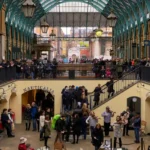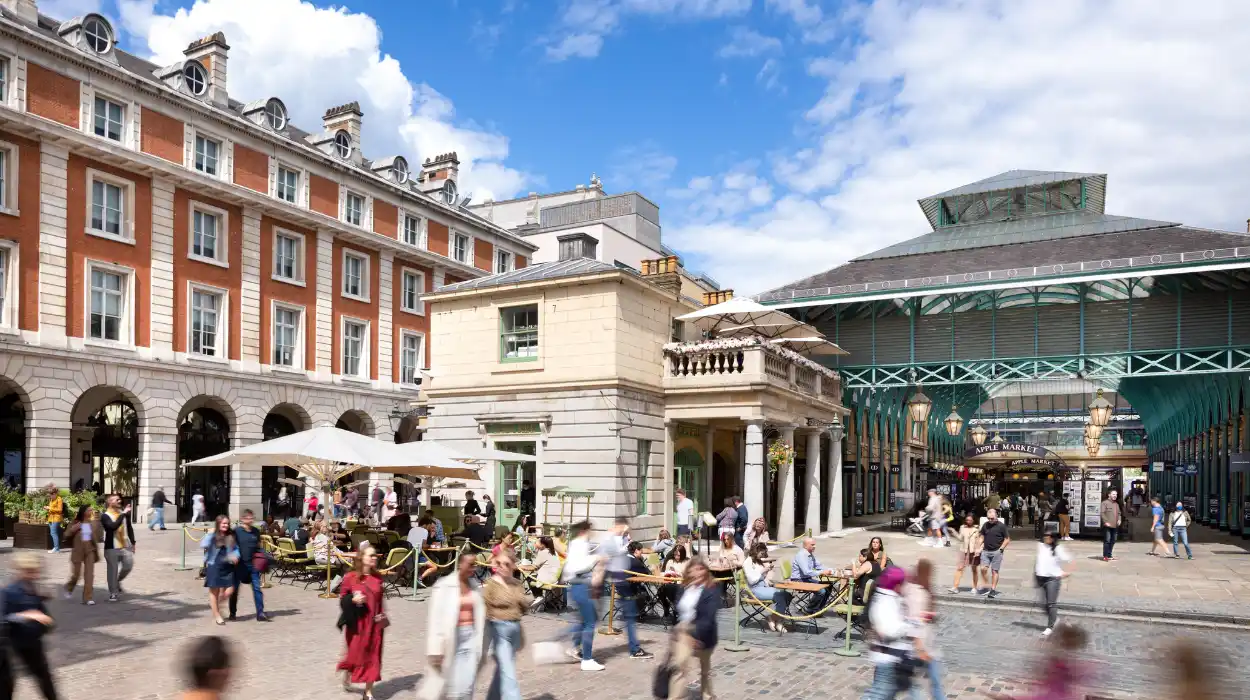
Covent Garden evolved from medieval monastic farmland into London’s most influential market and entertainment district. Its transformation reflects nearly 900 years of urban growth, architectural planning, commercial expansion, theatre culture, transport modernization, and heritage preservation within central London.
- What existed in Covent Garden before London expanded westward?
- How did Inigo Jones reshape Covent Garden into London’s first planned square?
- How did Covent Garden become London’s main fruit and vegetable market?
- Why did Covent Garden become the center of London theatre culture?
- What changes transformed Covent Garden during the Victorian era?
- Why was Covent Garden Market relocated during the 20th century?
- How was historic Covent Garden preserved and transformed into a modern cultural district?
- What historic landmarks can visitors still see in Covent Garden today?
- Why does Covent Garden remain globally significant today?
Covent Garden occupies a central position within London’s West End between St Martin’s Lane, Drury Lane, Strand, and High Holborn. The district developed from land once owned by Westminster Abbey into one of the most commercially and culturally significant areas in Britain.
The name “Covent Garden” derives from “Convent Garden,” the medieval kitchen garden operated by Benedictine monks attached to Westminster Abbey. The district’s historical importance comes from several overlapping developments. These developments included planned urban architecture in the 17th century, wholesale market dominance during the Georgian and Victorian eras, expansion of theatre culture, and large-scale preservation campaigns during the late 20th century.
Covent Garden also became a symbol of London’s changing economy. Agricultural land transformed into commercial real estate. Street markets evolved into organized wholesale systems. Entertainment venues developed into globally recognized institutions. The district’s streets preserve evidence of medieval, Stuart, Georgian, Victorian, and modern London within a compact urban area.
Today, Covent Garden attracts millions of annual visitors through its combination of historical architecture, shopping arcades, theatres, restaurants, and public performances. Modern tourism frequently connects the area with themes associated with the “Covent Garden Guide: Best Shopping, Food & Street Theatre” because the district combines preserved heritage spaces with contemporary cultural activity.
What existed in Covent Garden before London expanded westward?
Before urban development, Covent Garden consisted of agricultural land controlled by Westminster Abbey. Monastic communities cultivated vegetables, fruit, herbs, and grain there during the medieval period, establishing the area’s earliest economic role as a food-producing landscape serving ecclesiastical institutions.
During the 12th and 13th centuries, much of modern central London remained undeveloped farmland beyond the crowded boundaries of the medieval City of London. Westminster Abbey controlled extensive agricultural estates west of the city walls. Among these estates was approximately 40 acres of fertile land that later became Covent Garden.
The abbey’s monks used the land primarily for food cultivation. Medieval monasteries across England depended heavily on agricultural production to sustain religious communities. Similar systems operated at Canterbury Cathedral, St Albans Abbey, and Glastonbury Abbey. The Covent Garden estate contained orchards, vegetable plots, storage buildings, and grazing areas.
The River Thames played a major role in supporting medieval agriculture and transportation. Proximity to the river improved irrigation access and allowed goods to move efficiently between Westminster and nearby settlements.
The district remained largely rural until the Tudor period. A major turning point occurred during the Dissolution of the Monasteries initiated by King Henry VIII between 1536 and 1541. The English Crown confiscated monastic property across England after separating from the Roman Catholic Church.
Westminster Abbey lost ownership of the Covent Garden estate during this process. In 1552, King Edward VI granted the property to John Russell, the 1st Earl of Bedford. The Russell family retained control over the estate for generations and directed its future urban development.
The transfer of church land into aristocratic ownership reflected broader changes in English politics and economics during the Tudor era. Former religious estates increasingly became sites for commercial investment and urban expansion.
How did Inigo Jones reshape Covent Garden into London’s first planned square?
Architect Inigo Jones transformed Covent Garden during the 1630s by introducing Renaissance urban planning principles inspired by Italy. His design established London’s first formal piazza and permanently influenced English architecture, public-space design, and aristocratic residential development.
Francis Russell, the 4th Earl of Bedford, commissioned architect Inigo Jones in 1630 to redesign the former agricultural estate into a fashionable residential district. Jones served as Surveyor of the King’s Works and became one of the most influential architects in early modern England.
Jones studied architecture extensively in Italy, where he encountered Renaissance urban planning and Palladian classical design. Italian cities including Florence, Venice, and Livorno influenced his approach to public squares and civic architecture.
Covent Garden Piazza became London’s first formally planned square. Before this development, most London streets evolved organically through medieval growth patterns characterized by irregular lanes and crowded housing.
Jones designed a symmetrical public square surrounded by elegant terraces and arcades. The piazza created a structured civic environment emphasizing proportion, visibility, and public gathering space.
At the western side of the piazza, Jones designed St Paul’s Church in 1633. The church later became known as the “Actors’ Church” because of its close association with the theatre profession. The building represented one of England’s earliest examples of classical church architecture influenced by Palladian design.
The district initially attracted aristocrats, diplomats, merchants, and lawyers seeking fashionable residences near Westminster and the royal court. However, commercial activity expanded quickly around the piazza, gradually altering the area’s social character.
Covent Garden’s urban layout later influenced planned developments across London. Similar estate-based planning appeared in Bloomsbury, Mayfair, and Belgravia during the 18th and 19th centuries.
How did Covent Garden become London’s main fruit and vegetable market?
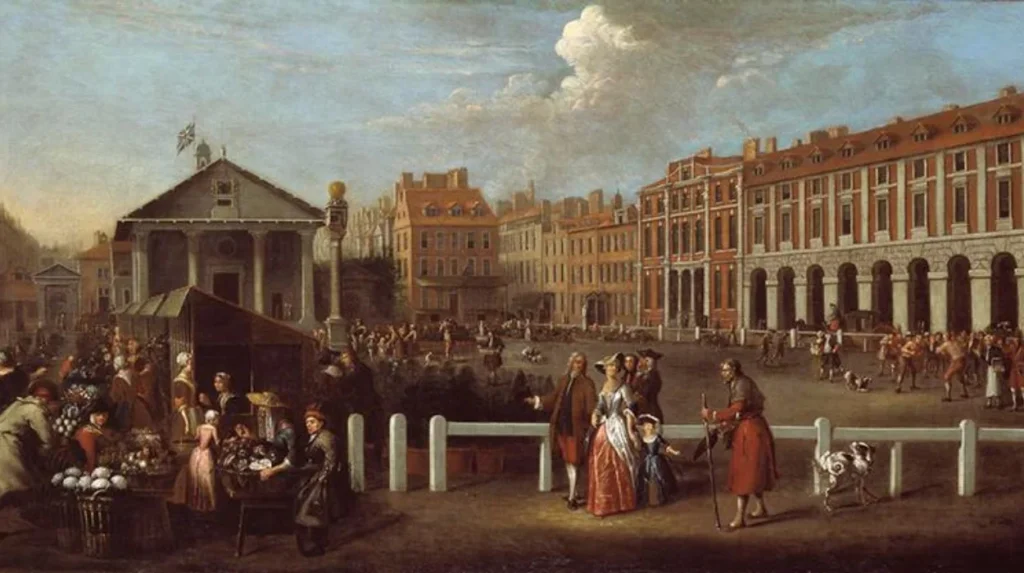
Covent Garden emerged as London’s principal wholesale produce market because of rapid population growth, improved transport systems, and increasing demand for centralized food distribution. By the 18th century, the district became essential to supplying agricultural goods throughout the expanding capital city.
Street trading began informally around the piazza during the 17th century. Vendors sold vegetables, fruit, flowers, herbs, dairy products, and poultry from temporary stalls and carts.
Covent Garden’s location proved highly advantageous. The district sat near major roads connecting Westminster, the City of London, and river transport routes along the Thames. These connections supported the movement of goods from rural counties into central London.
By the late 1600s, Covent Garden Market had become one of the busiest commercial areas in England. Parliament introduced legislation including the Covent Garden Act of 1670 to regulate trading practices and manage market operations.
London’s population expanded rapidly during this period. The city grew from roughly 200,000 residents in 1600 to more than 575,000 by 1700. Urban food supply systems required greater organization and scale to meet increasing demand.
Agricultural goods arrived from counties including Kent, Surrey, Essex, Hertfordshire, and Middlesex. Coastal shipping routes also transported produce from distant agricultural regions.
The Bedford Estate generated substantial revenue through stall rents, market licensing fees, and property leases. Market activity became the economic foundation of the district.
Permanent architecture gradually replaced temporary trading structures. Architect Charles Fowler designed the central market building completed in 1830. The neoclassical structure incorporated covered arcades, organized trading zones, and iron-framed construction suited to industrial commerce.
During the Victorian era, thousands of workers operated daily within Covent Garden Market. Porters, traders, flower sellers, warehouse workers, delivery drivers, and buyers formed one of London’s most important commercial labor networks.
Why did Covent Garden become the center of London theatre culture?
Covent Garden developed into London’s entertainment district because theatres, taverns, coffee houses, opera venues, and publishing businesses concentrated near the market. The district’s accessibility and commercial energy attracted performers, writers, audiences, and cultural institutions from the Restoration period onward.
The restoration of the English monarchy in 1660 transformed London’s theatre industry. King Charles II granted royal patents allowing licensed theatre companies to perform spoken drama in London.
Nearby Theatre Royal Drury Lane opened in 1663 and became one of Britain’s most influential theatrical venues. Actors including David Garrick, Sarah Siddons, and Edmund Kean performed there during the 18th and 19th centuries.
The district also became home to the institution now known as the Royal Opera House. Originally established as the Theatre Royal Covent Garden in 1732, the venue hosted drama, opera, ballet, and orchestral performances.
Fires destroyed earlier theatre structures in 1808 and 1856, but reconstruction projects preserved Covent Garden’s position within British cultural life.
Coffee houses and taverns surrounding the market became gathering spaces for writers, publishers, actors, politicians, and journalists. Similar intellectual communities existed in Fleet Street and Soho during the same period.
The district also developed reputations associated with nightlife and prostitution during the Georgian era. High pedestrian traffic, transient populations, tavern culture, and entertainment businesses contributed to vice industries documented by writers including Henry Fielding and Samuel Pepys.
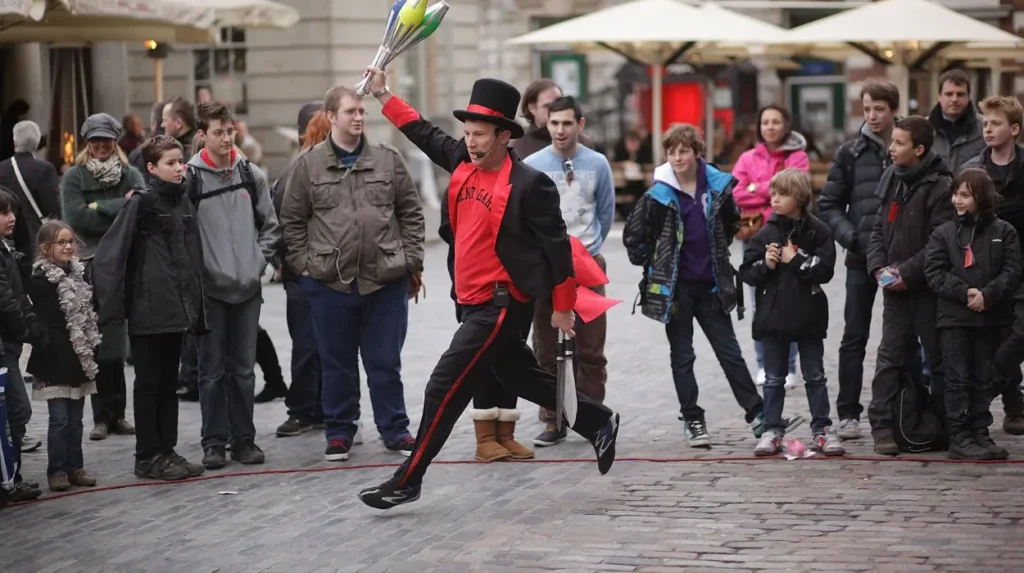
Public entertainment remains central to Covent Garden’s identity today. Street performers, musicians, magicians, and theatre companies continue traditions rooted in the district’s historical culture. To experience this historic landmark in person today, consult our comprehensive [Covent Garden Guide: Best Shopping, Food & Street Theatre] for itineraries and visiting parameters.
What changes transformed Covent Garden during the Victorian era?
Victorian industrialization transformed Covent Garden into a crowded commercial district shaped by railway expansion, wholesale distribution networks, and urban labor systems. Increased market activity strengthened economic importance while worsening overcrowding, sanitation problems, and traffic congestion.
The 19th century brought profound changes to London’s infrastructure and economy. Industrialization expanded railway networks connecting the capital with agricultural regions across Britain.
Rail freight dramatically increased the volume of produce arriving at Covent Garden Market after the 1830s. Goods traveled from Yorkshire, Lancashire, Cornwall, and Scotland in quantities impossible during earlier centuries.
Market operations became increasingly complex. Deliveries often occurred overnight to prepare produce for early morning trade. Thousands of workers participated in loading, transport, sorting, and distribution activities.
Victorian investigators including Henry Mayhew documented working conditions within Covent Garden. His research examined poverty, street labor, market employment, and overcrowded housing conditions affecting working-class Londoners.
Flower trading became another defining feature of the district during the Victorian period. Floral markets supplied decorative arrangements for homes, theatres, ceremonies, and public celebrations throughout London.
Architectural development reflected industrial engineering trends visible across Victorian Britain. Iron structures, warehouses, covered market halls, and transport facilities reshaped the district’s physical appearance.
Despite economic prosperity, congestion created severe challenges by the early 20th century. Narrow streets designed during the 17th century struggled to accommodate horse-drawn wagons, carts, and eventually motor vehicles.
Why was Covent Garden Market relocated during the 20th century?
Covent Garden Market relocated because modern transportation and wholesale logistics exceeded the capacity of the historic district. Traffic congestion, limited loading space, sanitation concerns, and industrial-scale distribution requirements made central London operations increasingly impractical.
By the mid-20th century, Covent Garden Market faced mounting operational difficulties. Wholesale distribution systems required larger refrigerated storage facilities, wider roads, and improved freight access.
Postwar urban planners studied London’s wholesale infrastructure extensively. Reports concluded that central produce markets contributed significantly to traffic congestion and public-health concerns.
The Covent Garden Market Authority Act of 1961 established a governing authority responsible for relocation planning. Officials selected Nine Elms in southwest London as the site for the new market because of improved transport infrastructure and larger industrial space.
The New Covent Garden Market officially opened in 1974, transferring wholesale fruit, vegetable, and flower operations away from the historic piazza.
Many developers proposed demolishing the old market district afterward. Plans included office towers, large-scale road systems, and modernist redevelopment projects common during postwar reconstruction.
However, local residents, conservationists, theatre communities, and historians organized major preservation campaigns opposing demolition.
The Covent Garden Community Association became particularly influential in protecting the district. Preservation advocates argued that the area represented one of London’s most historically important urban environments.
These campaigns reflected broader heritage movements across Britain during the 1970s. Similar conservation efforts protected historic districts including Spitalfields, Soho, and parts of Westminster.
How was historic Covent Garden preserved and transformed into a modern cultural district?
Historic Covent Garden survived through heritage activism, conservation law, and adaptive reuse redevelopment. Preservation campaigns prevented demolition and transformed former market buildings into retail, cultural, and tourism spaces while retaining the district’s historic architecture and street layout.
The preservation of Covent Garden marked a major shift in British urban planning philosophy. Public attitudes increasingly favored conserving historic neighborhoods rather than replacing them with large-scale modernist developments.
The central market building reopened in 1980 following extensive restoration. Developers converted former trading halls into shopping arcades, restaurants, cafés, and performance spaces.
Covent Garden became one of Britain’s best-known examples of adaptive reuse architecture. Adaptive reuse refers to repurposing historical buildings for modern economic functions while preserving original structural and aesthetic features.
The district retained important architectural elements including the piazza, arcades, Georgian terraces, market halls, and theatre buildings. Many structures received Grade II or Grade II* listed status under British heritage protection laws.
Street performance culture expanded significantly after regeneration. Musicians, acrobats, magicians, and theatre performers transformed the piazza into one of London’s most recognizable public entertainment spaces.
Tourism became a major economic driver. Retail businesses, luxury brands, restaurants, cafés, and hospitality venues increasingly occupied restored historic buildings.
Critics also noted rising property prices and increasing commercialization within the district. Independent businesses often struggled against large retail chains and international commercial investment.
Despite these pressures, Covent Garden preserved a substantial portion of its historical character compared with many heavily redeveloped urban districts.
What historic landmarks can visitors still see in Covent Garden today?
Modern Covent Garden preserves major historical landmarks including the market building, St Paul’s Church, Royal Opera House, Georgian streets, and Victorian transport architecture. These surviving structures document centuries of commercial, theatrical, and architectural development within central London.
The Covent Garden Piazza remains the district’s defining urban feature. Although modified over time, the square continues reflecting Inigo Jones’s original 17th-century planning concepts.
London Transport Museum occupies the former Victorian flower market building. The museum documents the evolution of London’s transportation systems from horse buses to underground railways.
St Paul’s Church continues serving as an important religious and theatrical landmark. Memorials within the church commemorate actors, performers, and entertainment professionals connected with London theatre history.
The Royal Opera House remains one of the world’s leading performing-arts venues. Modern renovations integrated contemporary theatre technology while preserving important historical features.
Several surrounding streets retain Georgian and Victorian character. Examples include King Street, Henrietta Street, Maiden Lane, and Floral Street. Historic pubs, warehouses, terraces, and commercial buildings survive throughout these areas.
Archaeological excavations beneath Covent Garden have uncovered medieval drainage systems, ceramics, property foundations, and market-related artifacts revealing earlier phases of urban life.
Modern conservation policies regulate building alterations, signage, and redevelopment to preserve the district’s historic streetscape.
Why does Covent Garden remain globally significant today?
Covent Garden remains globally significant because it preserves nearly 900 years of London’s commercial, architectural, and cultural history within a functioning modern district. The area demonstrates how heritage conservation, tourism, entertainment, and urban commerce can coexist successfully in a global capital city.
Few districts in London preserve such a wide range of historical development within a compact area. Covent Garden contains visible evidence from medieval agriculture, Stuart urban planning, Georgian commerce, Victorian industrialization, and modern heritage conservation.
The district also played a major role in shaping British preservation policy. Campaigns during the 1970s demonstrated growing public opposition to uncontrolled redevelopment and influenced future conservation efforts throughout Britain.
Covent Garden’s market history illustrates broader changes in transportation, food supply systems, labor organization, and metropolitan growth. Its theatres and opera houses document the development of British performing arts across several centuries.
Today, the district functions simultaneously as a heritage site, shopping destination, entertainment quarter, transport hub, and residential neighborhood. Millions of annual visitors interact directly with preserved urban spaces shaped by centuries of historical transformation.
For historians, educators, genealogists, and cultural researchers, Covent Garden provides valuable evidence about London’s social and architectural evolution. Parish records, theatre archives, estate documents, census records, and archaeological discoveries continue contributing to research into the district’s past.
The survival of Covent Garden demonstrates the enduring importance of protecting historic urban environments within rapidly modernizing global cities.
What is Covent Garden?
Covent Garden is a historic district in London’s West End known for its market history, theatres, shopping arcades, restaurants, and street performances.