Hammersmith is a major transport hub and commercial district in West London, situated within the London Borough of Hammersmith and Fulham. The area occupies a prominent position on the north bank of the River Thames, specifically along the Hammersmith Reach. This stretch of the river is globally recognized for its role in the annual Oxford and Cambridge Boat Race and for its high density of Grade II listed public houses. These establishments serve as vital social infrastructure for the local population of approximately 185,000 residents and the significant influx of commuters and tourists. Extra London News provides this comprehensive guide to the historical, architectural, and social significance of Hammersmith’s riverside drinking establishments.
- What are the most historic riverside pubs in Hammersmith?
- Which Hammersmith pubs offer the best views of the River Thames?
- Why is Hammersmith a significant location for London pub culture?
- What are the architectural features of Hammersmith’s riverside pubs?
- How does the River Thames influence the operations of these pubs?
- What is the social and literary history associated with Hammersmith pubs?
- What types of food and drink are characteristic of Hammersmith riverside pubs?
- What is the future outlook for Hammersmith’s riverside hospitality?
What are the most historic riverside pubs in Hammersmith?
The most historic riverside pubs in Hammersmith include The Dove, The Rutland Arms, and The Blue Anchor. These establishments date back to the 17th and 18th centuries, offering preserved architectural features, literary associations, and verified Grade II listed status.
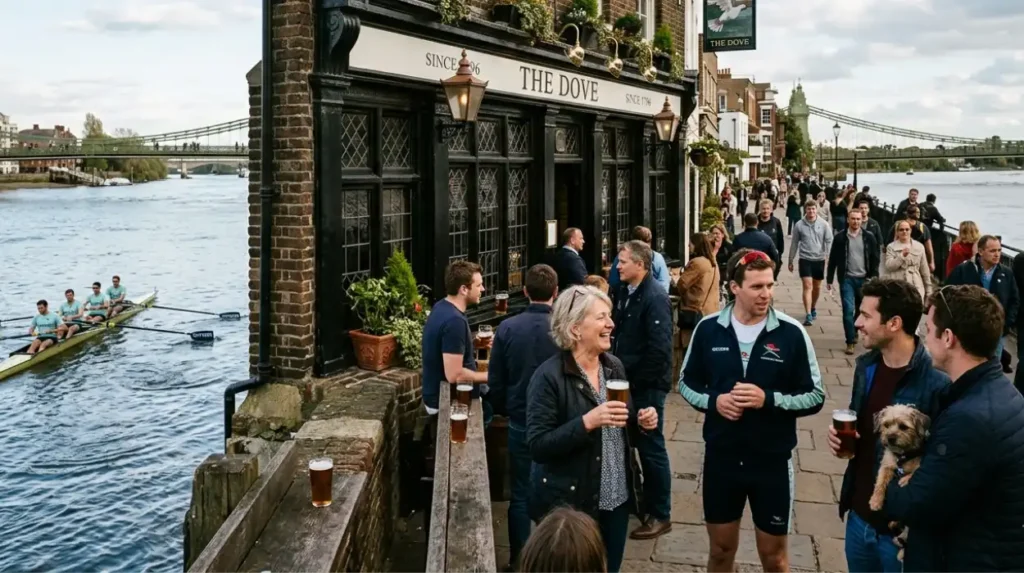
The Dove is an eighteenth-century public house located at 19 Upper Mall. It was established in the 1700s and holds a Grade II listing from Historic England. The building is notable for its association with prominent historical figures, including the poet James Thomson, who reportedly composed the lyrics to “Rule, Britannia!” within its walls. The pub features a small front bar that was once recorded in the Guinness Book of Records as the smallest public bar in the United Kingdom, measuring four feet by seven feet and nine inches. The interior maintains dark wood paneling and open fireplaces, characteristic of Georgian-era architecture.
The Rutland Arms, situated at 15 Lower Mall, represents the mid-Victorian era of Hammersmith’s development. While the current structure dates primarily to the 1840s, the site has hosted a tavern since at least the 18th century. It suffered significant damage during World War II during a German bombing raid in 1941, leading to a post-war reconstruction that preserved its traditional aesthetic. The pub serves as a primary viewing point for the Boat Race due to its position near the Hammersmith Bridge, a suspension bridge completed in 1887 by engineer Joseph Bazalgette.
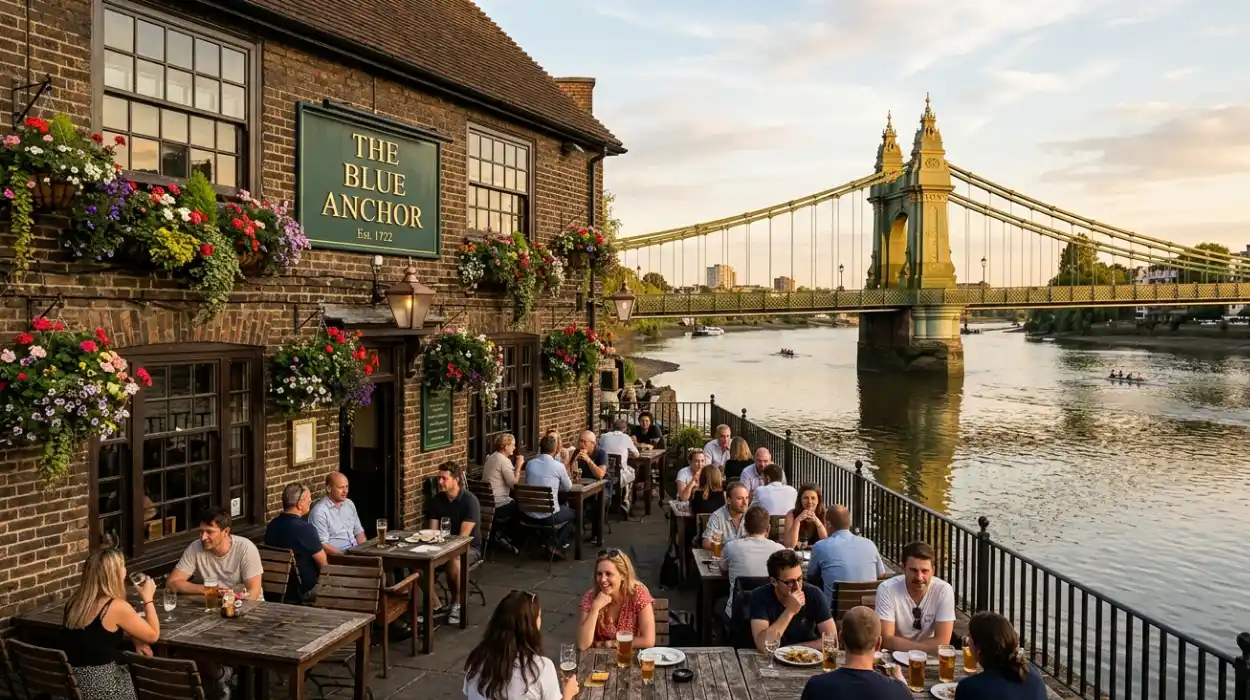
The Blue Anchor, located at 13 Lower Mall, received its first license in 1722. Originally called the Blew Anchor, it has served the local watermen and rowing community for over 300 years. The establishment consists of a traditional wood-paneled “snug” and a more modern zinc-topped bar area. Its historical significance is tied to the industrial heritage of the Thames, serving workers from the local malt houses and lead mills that once lined the riverbank before the area transitioned into a residential and recreational district.
Which Hammersmith pubs offer the best views of the River Thames?
The Old Ship, The Blue Anchor, and The Riverman provide the most expansive views of the Thames. These venues feature elevated terraces, outdoor seating on the Lower Mall, and large windows that overlook the Hammersmith Bridge and Harrods Furniture Depository.
The Old Ship W6 is positioned on Upper Mall and is distinguished by its large, tiered terrace that extends toward the river. This elevation allows patrons to view the sweep of the Thames toward Chiswick Eyot, an unpopulated island that serves as a nature reserve. The pub’s architecture is Victorian, but it underwent extensive renovations to maximize its riverside frontage. The orientation of the terrace provides direct sightlines of the rowing crews that train daily on this stretch of the water, including those from the Auriol Rowing Club and the Furnivall Sculling Club.
The Blue Anchor utilizes the public walkway of Lower Mall to provide outdoor seating. This setup places visitors directly at the water’s edge during high tide. From this vantage point, the Hammersmith Bridge is visible to the east. This bridge is the first suspension bridge over the Thames and is currently subject to structural weight restrictions. The view also encompasses the south bank of the river, specifically the Grade II listed Harrods Furniture Depository, a terracotta-tiled warehouse built between 1894 and 1914, which has since been converted into luxury residential apartments.
The Black Lion, located further west on South Black Lion Lane, offers a different perspective of the river. While its main building is set back slightly from the towpath, it features a large walled beer garden and views over the river toward the Barnes peninsula. This area of the Thames is characterized by a significant bend, which influences the tidal flow and the speed of passing river traffic. The visual appeal of this location is enhanced by the surrounding 18th-century cottages and the lack of high-rise modern developments, preserving a village-like atmosphere within the urban landscape of London.
Explore More London Local News
Party Manifestos and Key Pledges for London Local Elections: Camden 2026
Islington Council downgraded to C3 by RSH, Islington 2026
Why is Hammersmith a significant location for London pub culture?
Hammersmith is significant due to its intersection of maritime history, sporting heritage, and protected architectural conservation areas. It hosts a high concentration of heritage pubs that have functioned as community hubs for watermen, rowers, and writers since the 1700s.
The geographical importance of Hammersmith stems from its position on the Thames path. The river was the primary highway for trade in London for centuries. Public houses in Hammersmith were originally built to serve the crews of sailing barges and lighters transporting coal, timber, and grain. This maritime heritage is reflected in the names of the pubs, such as The Blue Anchor and The Old Ship. These sites provided essential services, including food, lodging, and a venue for commercial transactions among merchants operating in West London.
The sporting significance of Hammersmith is centered on rowing. The stretch between Putney and Mortlake, which passes through Hammersmith, is the official course for the Boat Race, an event contested by the University of Oxford and the University of Cambridge since 1829. During this event, Hammersmith’s riverside pubs become the focal point for thousands of spectators. The pubs provide the infrastructure to support large-scale public gatherings, contributing to the local economy and maintaining the cultural relevance of the river as a site for public spectacle and athletic competition.
Architectural conservation also plays a vital role in Hammersmith’s pub culture. Much of the riverside is designated as a Conservation Area by the local council. This status ensures that the exterior facades and internal layouts of historic pubs remain unchanged. Examples of protected elements include original Victorian tiling, leaded glass windows, and traditional signage. By preserving these physical structures, Hammersmith maintains a tangible link to London’s social history, preventing the homogenization of the urban environment and ensuring that the pubs remain distinct landmarks within the city.
What are the architectural features of Hammersmith’s riverside pubs?
Architectural features include Grade II listed facades, Georgian wood paneling, Victorian brickwork, and traditional “snug” bars. These elements represent various eras of British design, from the early 18th-century vernacular styles to the ornate decorative arts of the late 19th century.
The Dove demonstrates the vernacular architecture of the early 18th century. Its structure is composed of dark brick and features low-beamed ceilings and uneven floors, which indicate the settling of the building over three centuries. The use of timber framing is evident in the interior, a technique common before the widespread adoption of steel frames. The pub also contains a specific architectural anomaly: a very narrow entrance and bar area designed to maximize the use of limited space on the narrow riverbank plot.
The Rutland Arms showcases Victorian commercial architecture. It features large sash windows designed to let in natural light and provide views of the river, a shift from the darker, more enclosed designs of earlier centuries. The exterior often utilizes London stock brick, a type of handmade yellow brick used for the majority of building work in London during the 19th century. The interior layout typically includes a central bar that serves multiple distinct rooms, a design intended to separate different social classes of patrons, such as the public bar and the saloon bar.
The Black Lion is notable for its vaulted ceilings and its proximity to historical industrial sites. The building incorporates a mix of residential and commercial styles, reflecting its history as a place that provided both hospitality and lodging. One of its most distinct features is the inclusion of an old-fashioned skittle alley, one of the few remaining in London. This functional space demonstrates the integration of traditional British games into pub architecture, providing a multi-use environment that goes beyond the consumption of alcohol.
How does the River Thames influence the operations of these pubs?
The Thames influences operations through tidal fluctuations, seasonal tourism, and the regulation of river-based events. Pubs must manage outdoor seating according to the tide levels and adapt their staffing to accommodate major events like the Boat Race.
Tidal fluctuations are a primary operational factor for pubs on the Lower Mall. The Thames at Hammersmith is tidal, with the water level rising and falling twice daily by up to seven meters. During spring tides, the river frequently overspills the embankment, flooding the pedestrian walkway in front of pubs like The Blue Anchor and The Rutland Arms. Establishments must use flood defenses, such as removable barriers and water-resistant materials, to prevent damage. Patrons must also be aware of the tide times to avoid being stranded in outdoor seating areas during high water.
Seasonal tourism significantly impacts revenue and footfall. During the summer months, the Thames Path experiences high volumes of pedestrian traffic, increasing the demand for outdoor service and chilled beverages. Conversely, winter operations rely more on the internal atmosphere, with pubs utilizing open fires and historical interiors to attract local residents. The seasonality of the river necessitates a flexible business model where pubs transition between high-volume outdoor service and lower-volume, higher-margin indoor dining experiences.
The regulation of river events requires coordination with the Port of London Authority (PLA). The PLA is the governing body responsible for the safety and navigation of the 95 miles of the tidal Thames. When events like the Great River Race or the Boat Race occur, the pubs must adhere to specific safety guidelines regarding crowd control and glass usage. These events provide the highest single-day turnover for many Hammersmith pubs, sometimes equaling a month’s worth of standard trade, making the river the central economic driver for the local hospitality sector.
Explore More London Local News
Record‑breaking Leila Newth backed by Everyone Active — Ealing 2026
Green councillor quits after eligibility breach, Hackney Central 2026
What is the social and literary history associated with Hammersmith pubs?
Hammersmith pubs are associated with literary figures like Ernest Hemingway and William Morris, as well as the development of the British socialist movement. These sites served as meeting points for intellectuals, artists, and political reformers during the 19th and 20th centuries.
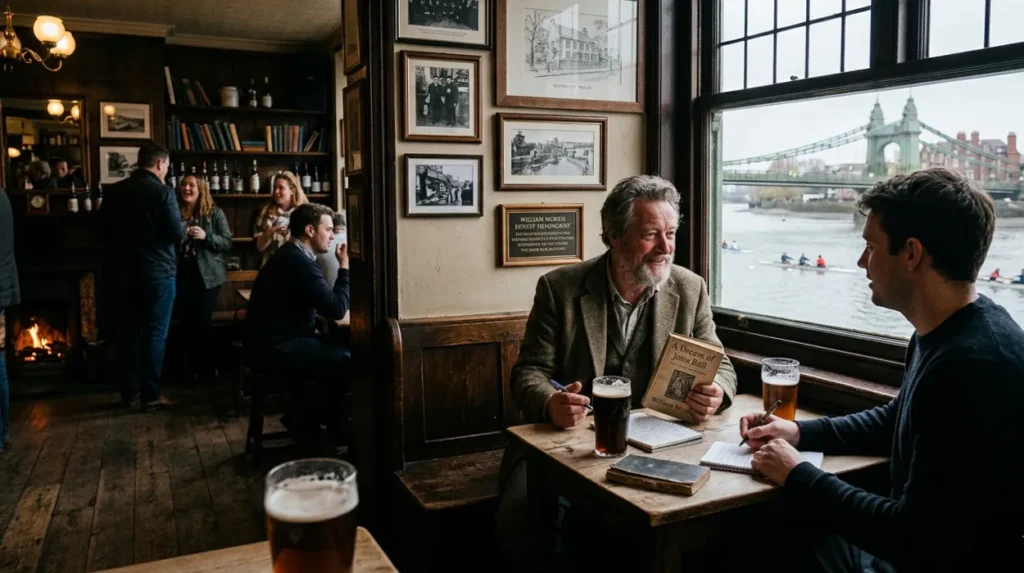
The Dove has a well-documented history as a retreat for writers. In addition to James Thomson, the pub was frequented by Graham Greene and Ernest Hemingway. The peaceful riverside setting provided a contrast to the industrial center of London, making it an ideal location for creative work. The pub’s Guest Book and historical records indicate that it functioned as an informal salon where ideas were exchanged. This literary connection is a key part of the pub’s brand identity and continues to attract tourists interested in British cultural history.
William Morris, the leader of the British Arts and Crafts movement, lived at Kelmscott House on Upper Mall, located between The Dove and The Old Ship. Morris and his associates, including members of the Hammersmith Socialist Society, utilized the local pubs for meetings and debates. The pubs provided a neutral ground for the discussion of political theory and the promotion of artisan craftsmanship. This history links the Hammersmith riverside to the broader social changes of the Victorian era, including the rise of the labor movement and the rejection of industrial mass production.
The Black Lion is central to a famous legal case in English law known as the Hammersmith Ghost case of 1804. A local resident, Francis Smith, shot and killed Thomas Millwood, believing him to be a ghost that was haunting the area. The incident began and ended near the pub, and the subsequent trial at the Old Bailey established important legal precedents regarding self-defense and “mistake of fact.” This macabre piece of local history is frequently cited in legal textbooks and adds a layer of historical intrigue to the pub’s reputation.
What types of food and drink are characteristic of Hammersmith riverside pubs?
Characteristic offerings include British cask ales, craft beers from London-based breweries, and traditional gastropub cuisine. Menus focus on seasonal ingredients, British seafood, and classic Sunday roasts, catering to both traditional tastes and modern culinary trends.
Cask ale is a staple of the Hammersmith pub scene. Many establishments are tied to or frequently stock products from Fullers, Smith & Turner, whose Griffin Brewery is located nearby in Chiswick. Examples of common ales include London Pride and ESB. In recent years, there has been an increase in the availability of craft beers from smaller independent breweries, such as Five Points Brewing and Beavertown. These beers are often served from kegs and emphasize hop-forward profiles, appealing to a younger demographic and diversifying the beverage selection.
Gastropub cuisine represents the evolution of pub food from basic snacks to high-quality dining. Menus typically include dishes like beer-battered Atlantic cod served with triple-cooked chips, or Cumberland sausages with colcannon mash. The emphasis is on sourcing ingredients from within the United Kingdom. For instance, beef is often sourced from British breeds like Hereford or Angus, and vegetables are selected based on seasonal availability in the UK. This focus on provenance aligns with the “farm to fork” movement and improves the perceived value of the dining experience.
The Sunday roast is a significant weekly event for Hammersmith pubs. This traditional meal consists of roasted meat (such as beef, lamb, or chicken), Yorkshire puddings, roasted potatoes, and seasonal vegetables. Statistics from the hospitality industry indicate that the Sunday roast remains the most popular meal for diners in British pubs. Establishing a reputation for a high-quality Sunday roast is essential for the long-term financial viability of these riverside venues, as it ensures consistent weekend footfall throughout the year.
What is the future outlook for Hammersmith’s riverside hospitality?
The future outlook involves a focus on environmental sustainability, digital integration for bookings, and the continued preservation of heritage sites. Pubs are adapting to changing consumer habits while maintaining their historical character to remain competitive in London’s evolving market.
Environmental sustainability is becoming a priority for pub operators in Hammersmith. This includes initiatives to reduce plastic waste, implement energy-efficient lighting, and manage food waste through composting or anaerobic digestion. Because these pubs are located on the Thames, there is also a heightened awareness of river pollution. Many establishments participate in local “beach cleans” to remove litter from the foreshore, demonstrating corporate social responsibility and protecting the aesthetic appeal of their primary asset—the river view.
Digital integration is changing how patrons interact with pubs. While the physical environment remains traditional, the backend operations increasingly rely on online reservation systems and mobile payment apps. Data from market research firms suggests that over 60% of consumers prefer to book tables online. Hammersmith pubs have adopted these technologies to manage peak periods, particularly during the summer and major river events. This allows for better labor management and inventory control, improving the overall efficiency of the business.
The continued preservation of heritage sites remains the cornerstone of Hammersmith’s appeal. As London undergoes rapid modernization, the demand for authentic, historical spaces is expected to grow. Organizations like CAMRA (Campaign for Real Ale) and local heritage groups work to ensure that these pubs are not converted into residential units or subject to insensitive renovations. By balancing modern operational needs with the protection of their 18th and 19th-century features, the riverside pubs of Hammersmith are positioned to remain essential cultural and social landmarks for the foreseeable future. Extra London News will continue to monitor the development of this historic district.
What are the most historic riverside pubs in Hammersmith?
The most historic riverside pubs include The Dove, The Rutland Arms, and The Blue Anchor. These pubs date back to the 17th and 18th centuries and are known for their preserved Georgian and Victorian architecture, literary associations, and Thames-side locations.