Key Points:
- A mysterious statue unveiled in central London’s Waterloo Place this spring has drawn massive crowds of onlookers and tourists, remaining fully intact and in situ.
- As reported by Rachel Kubrick of The Art Newspaper, a spokesperson for Westminster City Council stated that the artwork will remain on view for at least the next few weeks while the local authority deliberates its long-term future.
- The council indicated that a final decision regarding the longevity of the installation is expected by the end of the summer.
- The elusive street artist Banksy confirmed his authorship via an Instagram post on 30 April to his 14 million followers, sharing footage of the statue’s stealthy nighttime installation utilizing a large crane.
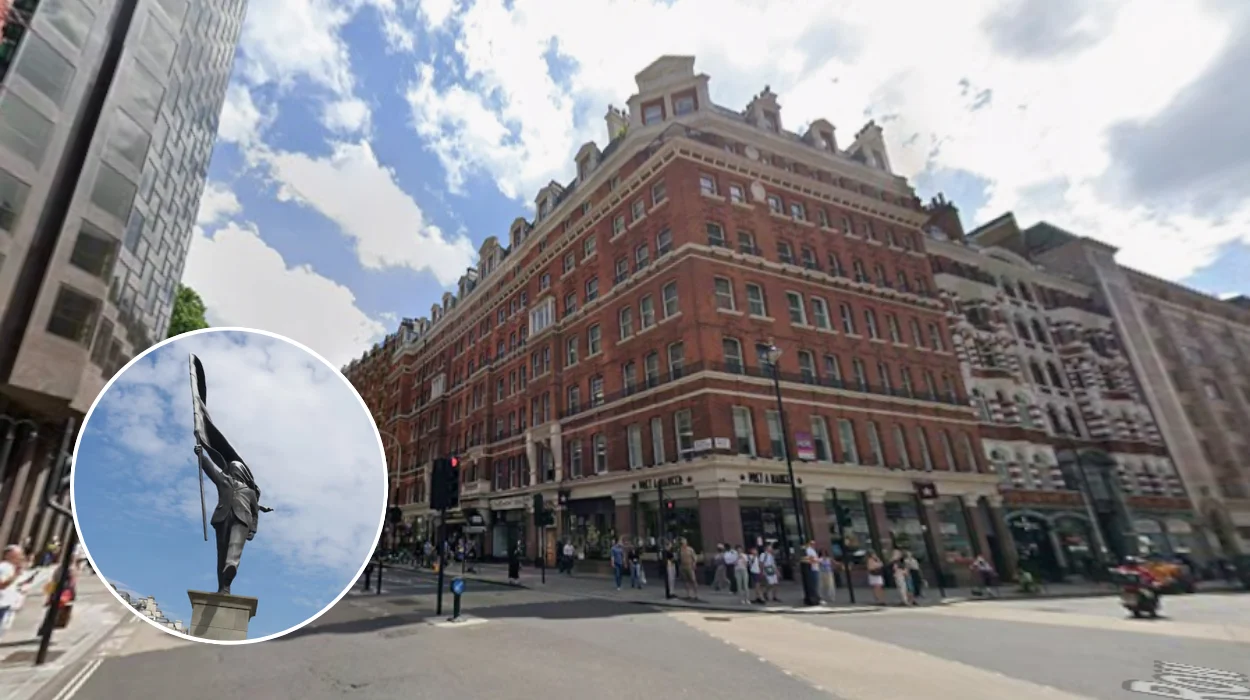
- The sculpture portrays a suited man holding a large flag that completely covers his face, blinding him as he steps forward halfway off the edge of a plinth.
- The artwork is positioned in Waterloo Place within the St James’s neighbourhood, surrounded by various gentlemen’s clubs, art and luxury businesses, government buildings, and foreign embassies, alongside historical monuments dedicated to British imperialism and military history.
- Commentators, art dealers like Philip Mould, and representatives from the Mayor of London’s office and Westminster City Council have widely discussed the cultural significance, proportions, and public safety of the piece.
London (Extra London News) July 28, 2026 – The enigmatic sculpture that quietly materialized in the heart of the British capital earlier this spring may find a permanent home as local authorities continue to weigh its cultural impact. The artwork, which has rapidly transformed into a major tourist attraction and a focal point for intense public debate, continues to stand in Waterloo Place. According to updates provided to Rachel Kubrick of The Art Newspaper, a spokesperson for Westminster City Council confirmed that the piece will remain undisturbed for the next few weeks, with officials aiming to reach a definitive verdict on its permanence by the conclusion of the summer.
Will the Westminster City Council make the Banksy statue permanent?
The fate of the unauthorized yet widely celebrated installation currently rests in the hands of municipal authorities. As reported by Rachel Kubrick of The Art Newspaper, the local authority stated regarding the longevity of the structure:
“There has been no decision made [re: the work] at the moment. We are expecting a conclusion by the end of the summer. It’ll remain on view for the next few weeks.”
Prior to this update, municipal representatives had expressed an initial welcoming stance towards the unexpected arrival.
As noted by Aurelia Foster of the BBC, representatives from Westminster City Council previously described the installation as a “striking addition to the city’s vibrant public art scene.”
Furthermore, to manage the heavy influx of spectators, the council implemented initial safety measures by erecting protective fencing around the base while keeping the monument fully accessible to the public.
How was the statue installed and confirmed by the artist?
The monument appeared seemingly overnight during the early hours of 29 April 2026, catching morning commuters and local workers entirely by surprise. Passers-by quickly noticed Banksy’s signature scrawled across the base of the stone-colored plinth.
Speculation was swiftly put to rest the following day. As documented by Rachel Kubrick of The Art Newspaper and Aurelia Foster of the BBC, Banksy took to Instagram on 30 April to confirm to his 14 million followers that he was indeed the mastermind behind the creation.
Alongside the text confirmation, the elusive Bristol-born artist shared dramatic footage detailing the nighttime operation, which required the precision of a large crane to hoist the heavy sculpture into position.
Explore More Westminister News
Police Boat Strikes Westminster Bridge in London 2026
Central London House Prices Drop 23% in Westminster, 2026
What does the sculpture depict and what are its symbolic meanings?
The artwork diverges from Banksy’s traditional medium of aerosol murals, presenting instead a full-scale figurative sculpture. Fabricated from materials resembling resin or fibreglass, the piece portrays a man dressed in a formal business suit.
Clutched in his hand is a massive flag that blows back violently across his head, entirely obscuring his face and blinding his vision as he walks forward, his shoes stepping halfway off the edge of the tall pedestal into empty space.
Art critics, political commentators, and journalists have heavily scrutinized the geographic context of the installation. Situated in Waterloo Place within the upscale St James’s neighbourhood—an area dense with elite gentlemen’s clubs, high-end art businesses, foreign embassies, and government offices—the statue shares physical space with prominent historical monuments.
These nearby structures include memorials dedicated to British imperial and military history, such as the statue of King Edward VII, Florence Nightingale, and the Crimean War Memorial.
Writing for Hyperallergic, journalist Hakim Bishara interpreted the piece as an explicit anti-imperialist statement, suggesting that the figure represents blind nationalistic fervor leading a society towards its own metaphorical abyss. Similarly, CNN reporter Lex Harvey characterized the piece as a direct satire targeting “blind patriotism”.
How have art experts, politicians, and the public reacted to the installation?
The installation has sparked a diverse array of responses from art world professionals, civic leaders, and everyday spectators.
Philip Mould, a prominent London-based art dealer whose commercial gallery operates in close proximity to Waterloo Place, praised the technical execution of the piece. As quoted by Christian Thorsberg of the Smithsonian Magazine, Philip Mould stated:
“Personally, I think what’s rather clever about it is he’s got the proportions perfectly right for the space. I also rather like it when art, which is often forgotten, can be controversial, can be stimulating in this way.”
Civic leadership has expressed a willingness to embrace the cultural attention brought by the anonymous creator. Michael Levenson of The New York Times reported comments from a representative speaking on behalf of London Mayor Sadiq Khan, who noted:
“Banksy has a great ability to inspire people from a range of backgrounds to enjoy modern art. His work always draws great interest and debate, and the mayor is hopeful that his latest piece can be preserved for Londoners and visitors to enjoy.”
Public sentiment on the ground remains deeply engaged, though mixed. Speaking to Aurelia Foster of BBC News, 23-year-old student and onlooker Ollie Isaac remarked on the ephemeral nature commonly associated with the artist’s public interventions:
“With Banksy, it’s a limited time event because it’s public art—you don’t know how long it’s going to be up.”
Other critics have offered more idiosyncratic reviews; cultural writer Alex Dale wrote in assessments covered by Wikipedia contributors that the sculpture carries
“the aesthetics of mass-produced garden-centre ornaments”
alongside “the moral complexity of a Catchphrase clue”.
Meanwhile, anonymous pedestrians featured in the artist’s official social media release offered polarized views, with some local voices expressing skepticism toward modern interventions near traditional heritage sites.
As Westminster City Council moves forward with its review process over the coming weeks, the future of the Waterloo Place monument remains suspended between municipal regulation and public preservation. Whether the local government chooses to grant the installation permanent status or mandate its removal before the autumn months arrives, the artwork has already cemented its place within contemporary London’s cultural landscape.