
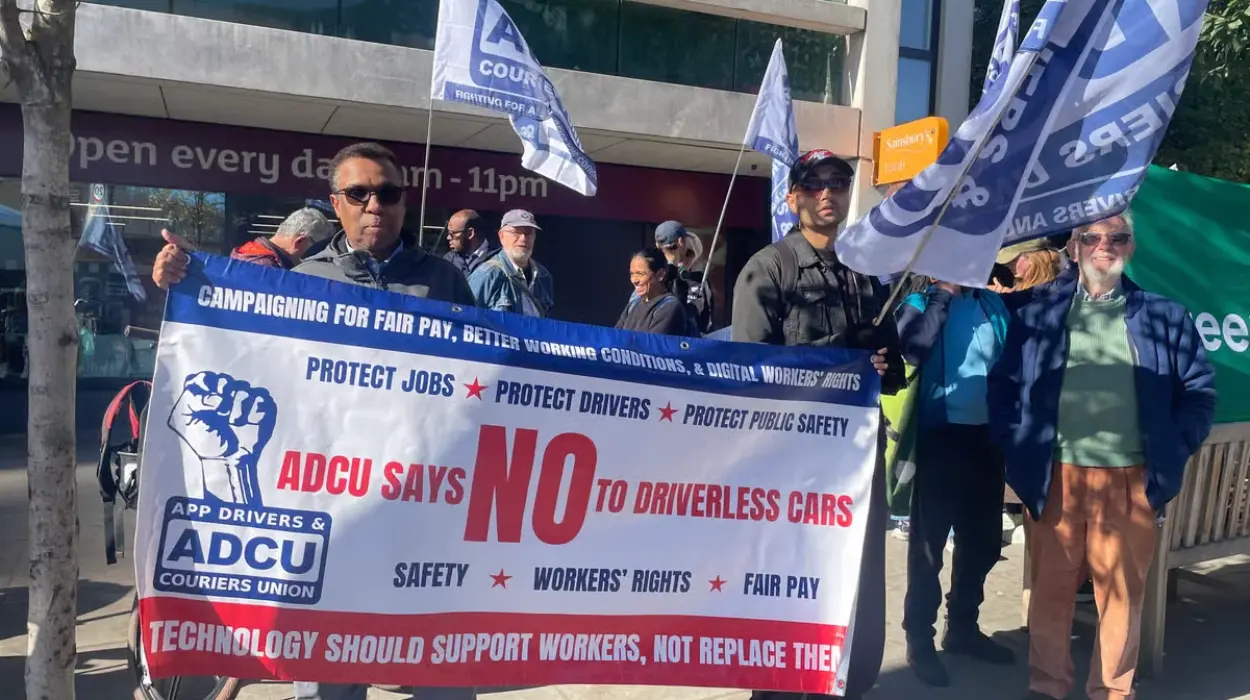
London’s move towards autonomous taxis is facing growing opposition from ride-hailing drivers, trade unions and city transport representatives, raising questions about road safety, employment and who should regulate the technology.
The debate has intensified following the introduction of supervised autonomous rides by Uber and British artificial intelligence company Wayve. While the service represents a significant step towards automated transport, critics argue that the benefits must be weighed against the potential risks to workers and passengers.
Uber and Wayve’s service initially uses a small fleet of electric Ford Mustang Mach-E vehicles equipped with Wayve’s AI driving technology. A trained, licensed private-hire driver remains behind the wheel to supervise the journey and take control if necessary. The service is therefore not yet a fully driverless taxi operation.
More than 100,000 Londoners express interest
Public interest in the technology has been substantial. Uber reported that more than 100,000 Londoners signed up to its interest list for autonomous rides before the service launched. The company subsequently reported more than 140,000 people opting in through its app to increase their chances of being matched with a vehicle.
The figures demonstrate interest in trying the technology, but they do not necessarily indicate that the majority of Londoners support a wider rollout. A YouGov survey commissioned by the London Assembly Transport Committee in June 2026 found that 42% of respondents opposed autonomous passenger vehicles in the capital, compared with 29% who supported them. Only 29% said they were likely to use such vehicles if they became available.
Safety remains a central concern. The survey found that 48% of respondents were concerned about autonomous vehicles responding to unexpected situations, while 41% raised concerns about road danger and 39% identified potential system or technical failures.
These findings highlight a challenge for companies seeking public acceptance: attracting curious customers is not the same as establishing widespread confidence in autonomous transport.
Taxi drivers fear the impact on their livelihoods
The expansion of robotaxis has also prompted concern among London’s licensed private-hire drivers, many of whom depend on app-based work for their income. Drivers and union representatives argue that autonomous vehicles could eventually compete directly with human drivers, potentially reducing the number of available jobs and placing downward pressure on earnings.
The App Drivers and Couriers Union (ADCU) has opposed the rollout and called for protections for workers affected by automation. In recent reporting, drivers have described fears that they could be forced to compete with vehicles capable of operating for longer periods without the fatigue and working-hour limitations experienced by people. The economic impact, however, remains uncertain. The current supervised service is operating on a limited scale, and its long-term effect on driver numbers, passenger fares and employment has yet to be established.
The issue also raises a wider question for policymakers: how can Britain encourage technological innovation without leaving existing workers to bear the costs of the transition?
Transport authorities demand stronger oversight
Concerns extend beyond employment to the regulation of autonomous passenger services. In a report published in October, the London Assembly Transport Committee recommended that the Government give Transport for London (TfL) stronger powers to regulate autonomous passenger vehicles when the full regulatory framework under the Automated Vehicles Act is introduced in 2027.
The committee called for TfL to have the authority to issue and withdraw permits, set conditions for operators and limit the number of autonomous passenger vehicles deployed in London. It also recommended systematic reporting of safety incidents and monitoring of congestion, including the distance vehicles travel without passengers. The recommendations reflect uncertainty about how large-scale adoption might affect London’s already busy roads and existing public transport network.
Transport for London has previously said that autonomous services must be carefully managed and align with the Mayor’s Transport Strategy, including the Vision Zero goal of eliminating deaths and serious injuries from collisions on London’s streets by 2041.
Can autonomous taxis make London safer?
Supporters of autonomous vehicles argue that the technology could improve mobility, expand travel options and reduce collisions caused by human error. The UK Government has also presented autonomous transport as an opportunity to attract investment, develop advanced technology and create skilled jobs.
However, London presents a particularly complex environment for automated driving, with busy junctions, cyclists, pedestrians, roadworks and unpredictable traffic conditions. The technology must demonstrate that it can respond safely to these situations before a fully driverless service can expand.
Accessibility is another important consideration. Autonomous taxis could eventually offer greater independence to some older and disabled passengers, but operators and regulators will need to ensure that services meet different passengers’ needs.
A crucial test for London’s transport future
London’s robotaxi debate is no longer simply about whether artificial intelligence can drive a car. It is about how a major city should manage a technology that could transform transport, employment and public safety.
For now, supervised rides offer an opportunity to gather evidence about the technology in real-world conditions. The next stage will depend on regulatory approval, safety performance and the ability of companies and policymakers to address public concerns.
As London considers a wider rollout, the challenge will be to ensure that innovation serves passengers and the city as a whole without overlooking the people whose livelihoods may be affected.