Key Points
- Summer Open Days Revealed: Shirley Windmill welcomes public visitors on specific summer Sundays—including July 5, August 2, September 6, and October 4—as well as September 20 for London Open House Day.
- Completely Free Admission: Managed by the dedicated volunteer group, the Friends of Shirley Windmill, guided tours are provided to the public completely free of charge.
- A 19th-Century Time Capsule: Built in 1854, the 54-foot-high tower mill stands as a fascinating relic of local history, constructed at a time when traditional wind power was already turning obsolete due to the rise of coal and steam.
- Marvel of Early Automation: The internal engineering reveals centuries-old automated mechanisms where millers relied strictly on wind power rather than physical strength to rotate the 10-ton cap, turn internal shafts, and lift heavy sacks of grain.
- Expertly Guided Multi-Floor Tours: Lasting roughly one hour, the guided tours take visitors through a vertical descent from the top dust floor down to the bin store and millstone floor, showcasing specialized equipment like the governor mechanism and hands-on exhibits for children.
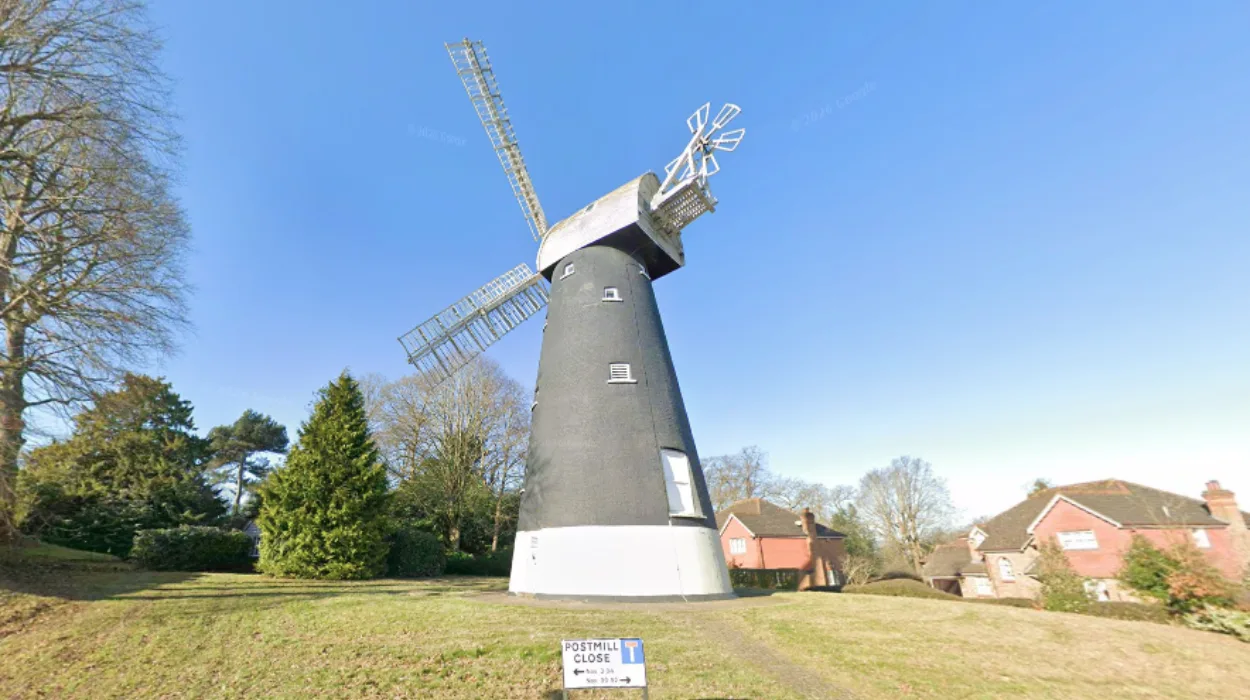
Croydon (Extra London News) June 18, 2026 – A rare window into early Victorian engineering and local heritage has opened in the heart of Surrey, as the historic Shirley Windmill prepares to host a series of public open days throughout the summer months. Standing as a 54-foot-high architectural relic, the landmark offers visitors an immersive look at century-old automation and industrial ingenuity right before wind power was permanently supplanted by coal and steam electricity. Managed and maintained by the Friends of Shirley Windmill, the site is offering fully guided, hour-long heritage tours entirely free of charge on select Sundays, making it a definitive fixture for regional summer itineraries.
- Key Points
- Where Is Shirley Windmill Located and When Can You Visit?
- Why Is the Shirley Windmill Considered an Industrial Relic?
- How Did Century-Old Automation Power the Shirley Windmill?
- Did Historical Millers Need Mass Physical Strength to Operate the Machinery?
- What Structural Elements Allowed the Windmill to Automate Grain Production?
- What Can Visitors Expect to See on a Guided Volunteer Tour?
- What Specific Mechanical Artifacts Are Displayed During the Tour?
Writing for Inside Croydon, resident correspondent Ken Towl detailed a comprehensive firsthand descent through the multi-floored timber and brick structure, charting the complex machinery that once powered local grain production. As reported by Ken Towl of Inside Croydon, the journey through the historic site offers a striking contrast to modern industrial spaces, noting that the tour party “started on the dust floor and descended to the bin store, and thence to the millstone floor,” before continuing downward through the remaining two stories of the historic tower mill. The opening of the site coincided directly with the annual celebration of Shirley Windmill Day on the first Sunday of June, serving as the launchpad for the landmark’s upcoming mid-year public schedule.
Where Is Shirley Windmill Located and When Can You Visit?
For those looking to explore the architectural marvel firsthand, the historic site is tucked away in a residential enclave in South London. As documented by Ken Towl of Inside Croydon, the physical structure is located directly down at Postmill Close, standing as an unexpected historic monument amidst contemporary surroundings. The venue operates on a specific, seasonal calendar dictated by the availability of its volunteer workforce, ensuring that the community has regular, predictable access to the site during the warmest months of the year.
According to the reporting published by Ken Towl in Inside Croydon, the upcoming public visitation dates for this year have been officially locked into the calendar for July 5, August 2, September 6, and October 4. In addition to these standard weekend openings, the windmill will open its doors on September 20 to participate directly in the prestigious “London Open House Day,” an annual city-wide festival celebrating architectural excellence and historical preservation. Reflecting on the surprising nature of the attraction, Ken Towl of Inside Croydon remarked to readers that if they make the journey down to the Postmill Close site, they “are sure of a big surprise, for that’s the day the Friends of Shirley Windmill receive visitors.”
Is There an Admission Fee to Tour the Historic Windmill?
In an era where access to cultural landmarks and historical museums increasingly requires costly tickets, the Shirley Windmill remains a rare and highly accessible exception for families and history enthusiasts alike. The entire operation relies heavily on philanthropic community interest and civic pride to keep its doors open to the general public.
As highlighted within the original coverage by Ken Towl of Inside Croydon, the preservation group behind the building’s upkeep does not financialise the visitor experience, explicitly pointing out that the Friends of Shirley Windmill “don’t even charge for it.” This commitment to free public education ensures that local history remains universally accessible to all segments of the community, regardless of socio-economic background.
Explore more Croydon News:
£1bn Camden Film Quarter Approved: Screen Hub for Kentish Town 2026
Camden Council Levies £100 Fines for Public Drinking: London 2026
Why Is the Shirley Windmill Considered an Industrial Relic?
To fully appreciate the historical significance of the Shirley Windmill, one must understand the precise technological era in which it was constructed. The mid-19th century was a period of volatile and rapid industrial transformation across Great Britain, marking the twilight of agrarian systems and the rapid dawn of the machine age.
When Was the Shirley Windmill Built?
The tower mill was constructed in 1854, a date that places it at a fascinating crossroads of human technological development. Writing on the historical irony of its construction timeline, Ken Towl of Inside Croydon explained that for anyone “remotely interested in local history, then the Shirley Windmill, already practically obsolete when built in 1854, is a fascinating 54-feet-high relic of a time gone by.”
By the time the final bricks were laid and the massive sails were hoisted into place, the global industrial landscape had shifted irrevocably. The traditional reliance on elemental forces—such as wind and water—was rapidly being eradicated by the reliable, unyielding power of coal-fired boilers and high-pressure steam engines. Consequently, the mill stands today not just as a monument to Victorian construction, but as a physical testament to a dying technology, caught in the moments “just before wind power had finally given way to the might of coal and steam.”
How Did Century-Old Automation Power the Shirley Windmill?
Beyond its visual prominence on the skyline, the interior of the Shirley Windmill serves as an exceptional laboratory showcasing historical mechanical engineering. The structure challenges the common modern assumption that pre-digital eras relied solely on grueling, manual human labor to accomplish large-scale industrial tasks. Instead, the design represents a peak era of mechanical self-regulation.
As outlined by Ken Towl of Inside Croydon, the internal architecture of the tower stands today as “a testament to human ingenuity and the mechanics of centuries-old automation.” The entire workflow of the building was carefully engineered to capture, convert, and distribute the kinetic energy of the wind across multiple floor levels simultaneously, minimizing the physical toll on the human operators inside.
Did Historical Millers Need Mass Physical Strength to Operate the Machinery?
A common misconception regarding historical trade professions is that milling required immense, muscular workers to hoist heavy loads and manipulate heavy machinery. However, the advanced engineering preserved within the Shirley site completely upends this narrative, showing that brains frequently triumphed over brawn in the Victorian industrial sector.
Through the insights gathered during the tour, Ken Towl of Inside Croydon explained that modern visitors quickly learn that “millers of old did not need to be big and strong.” This lack of a requirement for sheer physical power was due to a single, fundamental design principle: “The power of the air was harnessed for everything.” Human hands were required merely to steer, monitor, and maintain the systems, while the atmosphere did the heavy lifting.
What Structural Elements Allowed the Windmill to Automate Grain Production?
The internal automation of the Shirley Windmill was driven by a cascading series of mechanical connections that began at the very top of the 54-foot tower and extended down to the ground floors. The system operated on a continuous loop of kinetic energy transfer that handled everything from structural orientation to vertical material transport.
As reported by Ken Towl of Inside Croydon, the mechanical workflow relied on several key components:
- The 10-Ton Rotating Cap: The massive sails of the mill were permanently attached to an incredibly heavy, moveable roof structure. According to Towl’s observations, these sails, “fixed to a 10-ton rotating cap, were moved around the mill by the wind” itself, ensuring the sails automatically maintained the optimal angle to catch the prevailing breezes without requiring manual hand-cranking from the ground.
- The Central Drive Shaft: Once the sails began rotating, they transferred their mechanical energy directly into the core of the building. Towl noted that the sails “in turn, turned a shaft that ran down the centre of the building,” serving as the primary kinetic spine powering all subsequent floors.
- The Automated Sack Hoist: The transport of heavy raw grain to the upper levels of the mill was also fully mechanical. As Ken Towl of Inside Croydon detailed, “the sacks of grain were lifted up to the millstone floor by ropes that were attached to wheels powered by the shaft.”
This integrated network of gears, pulleys, clutches, and rotating shafts meant that from the moment raw grain arrived at the building to the moment it was ground into fine flour, virtually “everything was automated.”
What Can Visitors Expect to See on a Guided Volunteer Tour?
The preservation of both the physical structure and the technical knowledge required to explain it is sustained entirely by local volunteers. These preservationists act as living historians, translating complex 19th-century mechanical concepts into accessible demonstrations for modern tour groups.
As reported by Ken Towl of Inside Croydon, the intricate details of the facility “was expertly explained to us by Richard, one of the Friends of Shirley Windmill and volunteers.” These specialized docents lead highly educational walking tours that typically run for “about an hour’s duration,” offering an optimal balance of historical narrative and mechanical exploration.
What Specific Mechanical Artifacts Are Displayed During the Tour?
During the hour-long descent through the historic tower, the tour guides provide close-up looks at highly specialized components that highlight the sheer precision of Victorian engineering. Visitors are treated to explanations of systems designed to handle variables like fluctuating wind speeds and strict legal trade measurements.
According to the firsthand account published by Ken Towl of Inside Croydon, the volunteer guides explicitly demonstrate several key historical mechanisms, including:
- The Governor Mechanism: A highly sophisticated mechanical feedback system that automatically “adjusts the millstones according to windspeed,” preventing the stones from spinning too fast and scorching the flour, or spinning too slow and stalling the system.
- The Official Bushel: A verified, historical standard container used to guarantee honest trade and precise volume measurements for grain transactions within the local marketplace.
- Interactive Hands-On Exhibits: Dedicated educational displays built directly into the tour path that Ken Towl of Inside Croydon noted “proved vital for keeping children occupied” while the adults focused on the broader engineering masterclass.
With a comprehensive summer schedule now officially established, the Friends of Shirley Windmill continue to offer a unique, cost-free bridge to Britain’s industrial past, providing an educational asset for families, engineers, and local historians alike.