Brixton is one of London’s most historically significant cultural districts. Located in the London Borough of Lambeth, south of the River Thames, the area developed from rural common land into a major Victorian commercial centre before becoming internationally associated with Black British history, Caribbean migration, music, food and political activism.
- What makes Brixton an important cultural and historical destination in London?
- How did Brixton’s food markets develop into major cultural spaces?
- What is the historical importance of Electric Avenue?
- How do Brixton Village and Market Row continue the market tradition?
- Why is Caribbean and Black British history central to Brixton’s cultural identity?
- What can visitors learn at the Black Cultural Archives?
- How did Brixton become one of London’s most important music districts?
- How are Brixton’s food and music histories connected?
- Which historic buildings help explain Brixton’s development?
- How can visitors understand Brixton as a complete cultural landscape?
- Why does Brixton remain historically relevant today?
- Frequently Asked Question
Its modern identity rests on several connected historical foundations. Brixton’s markets emerged during nineteenth-century urban expansion. Its transport links connected the district to central London and surrounding suburbs. Post-war migration transformed its population and commercial culture. Music venues provided important spaces for performance and cultural exchange. Public institutions, archives and historic buildings preserved evidence of these changes.
Today, Brixton’s food markets, music venues and cultural institutions form part of the same historical landscape. Brixton Village, Market Row, Electric Avenue, Windrush Square and the Black Cultural Archives represent different periods in the development of a district shaped by migration, commerce, architecture and community organisation.
This guide examines how Brixton developed and explains why its food, music and cultural experiences should be understood together rather than as separate attractions.
What makes Brixton an important cultural and historical destination in London?
Brixton is historically important because nineteenth-century urban development, major transport connections, Caribbean migration, Black British cultural history, commercial markets and influential music spaces combined to create one of London’s most distinctive cultural districts with visible heritage from several historical periods.
Brixton stands approximately five kilometres south of central London and developed rapidly during the nineteenth century. Before large-scale urbanisation, much of the surrounding landscape consisted of open land, including Rush Common.
The history of this landscape remains important because urban development did not completely erase its earlier geography. Lambeth Council records that Rush Common was once part of a much larger area of open land and that the Rush Common Act 1806 protected remaining sections from development. Land associated with the historic common still includes areas around Brixton Hill, St Matthew’s Church Gardens and Windrush Square.
During the nineteenth century, London expanded rapidly beyond its historic centre. Brixton became part of this expansion. Residential development, commercial buildings and public institutions replaced much of the earlier rural landscape.
The arrival and improvement of transport systems accelerated this transformation. Railway and tram connections made Brixton accessible to workers, shoppers and businesses. The district developed into a major commercial centre serving south London.
How did Victorian development shape modern Brixton?
Victorian urban growth established many of the physical structures that still define central Brixton. Commercial premises, department stores, public buildings and market spaces created a dense town centre with strong connections between shopping, transport and entertainment.
Lambeth Council’s conservation records state that Brixton street market began on Atlantic Road during the 1870s. The market expanded along Brixton Station Road and Popes Road, while railway arches also became part of the district’s commercial landscape. Trains and inexpensive tram services brought customers into the growing shopping district.
This period also established Electric Avenue as an important commercial street. During the 1880s, Electric Avenue became notable for electric lighting and covered pedestrian footways. These developments reflected changing retail technology and the increasing scale of urban consumer culture.
Modern Brixton therefore contains a visible combination of Victorian commercial planning and later twentieth-century cultural development.
The Brixton Conservation Area was first designated on 20 October 1980. Lambeth Council identifies the area as a nineteenth-century town centre containing early and mid-twentieth-century commercial, civic, residential and retail buildings, including Brixton Town Hall, Tate Library, the Ritzy Cinema, St Matthew’s Church and covered markets.
This conservation status demonstrates that Brixton’s cultural significance is connected to its physical environment as well as its social history.
How did Brixton’s food markets develop into major cultural spaces?
Brixton’s markets developed from nineteenth-century street trading into permanent commercial spaces that now combine food retail, international cuisines, independent businesses and community activity, preserving the district’s long relationship between migration, commerce, transport and everyday public life.
Brixton’s market history began with the expansion of the Victorian town centre. Street traders established themselves near Atlantic Road and Brixton Station Road, where large numbers of shoppers passed through the district.
The location of the market was practical. Brixton had growing residential populations, improving transport links and a busy commercial centre. Markets supplied food and household goods to local communities while providing opportunities for small businesses.
Over time, the market landscape became more permanent and architecturally defined.
What is the historical importance of Electric Avenue?
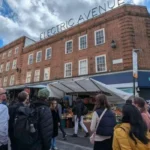
Electric Avenue remains one of Brixton’s best-known historic streets. Its name reflects technological change during the late nineteenth century and its role within the expanding commercial centre.
Lambeth Council records that Electric Avenue developed during the 1880s with electric lighting and protected pedestrian footways. These features made the street an important example of changing urban retail design.
The street later acquired additional cultural importance through Brixton’s Caribbean and African communities. Shops, market stalls and specialist businesses reflected the changing population of the district during the twentieth century.
Food therefore became an important record of migration.
Caribbean ingredients, African produce and other international foods entered Brixton’s retail economy through businesses serving communities with connections across the world. The market became a place where cultural identity could be expressed through everyday commerce.
This historical process explains why Brixton’s food culture cannot be separated from its migration history.
How do Brixton Village and Market Row continue the market tradition?
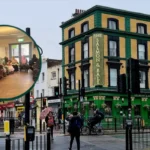
The covered markets of Brixton represent the continuation of the district’s historic commercial role. Their contemporary food businesses operate within an area shaped by generations of trading activity.
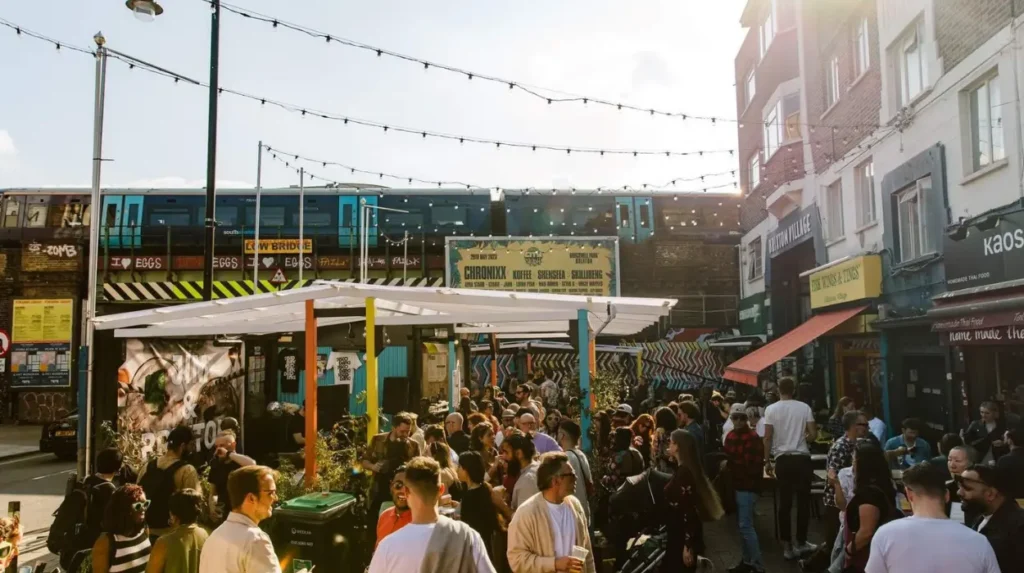
Brixton Village and Market Row bring together restaurants, food businesses, specialist retailers and independent traders. The combination reflects a broader transformation in urban market economies across London, where historic trading environments increasingly support both local shopping and cultural tourism.
The historical value of these spaces lies partly in continuity.
Brixton has remained a commercial destination despite major changes in retail patterns. The goods, cuisines and businesses have changed, but the market function has survived.
The physical relationship between markets, railway infrastructure and central streets also preserves the nineteenth-century geography of Brixton commerce.
For visitors, food markets provide direct access to this history because eating and shopping take place within spaces shaped by earlier patterns of urban development.
To experience Brixton’s historic streets, markets and cultural landmarks in person today, consult our comprehensive [The Inspiring History Behind Brixton’s Diverse Cultural Heritage and Community] for itineraries and visiting parameters.
Why is Caribbean and Black British history central to Brixton’s cultural identity?
Caribbean and Black British history became central to Brixton after post-war migration transformed the district, creating communities, businesses, institutions, political movements and cultural traditions that made Brixton a nationally important centre of Black British life and heritage.
The most important post-war historical development in Brixton was the growth of Caribbean communities.
The arrival of the MV Empire Windrush at Tilbury on 22 June 1948 became a major symbol of post-war migration to Britain. Lambeth Council records that the ship carried 492 migrants and that its arrival is widely associated with the beginning of modern British multicultural society.
The history of the ship and the history of Brixton became closely connected because many Caribbean migrants settled in Lambeth and surrounding south London districts.
Lambeth historical records state that more than 300 passengers from the Empire Windrush eventually found their way to Lambeth. Some initially stayed in temporary accommodation at the Underground deep shelter on Clapham Common before establishing homes in the wider area, including Brixton.
Migration reshaped Brixton’s housing, businesses, employment networks and cultural institutions.
Caribbean communities established churches, shops, restaurants, social organisations and political groups. These institutions provided practical support while also preserving cultural traditions.
Food became one visible result of this transformation. Caribbean ingredients and cooking traditions entered Brixton’s commercial landscape. Music created another major form of cultural expression.
What does Windrush Square represent in Brixton?
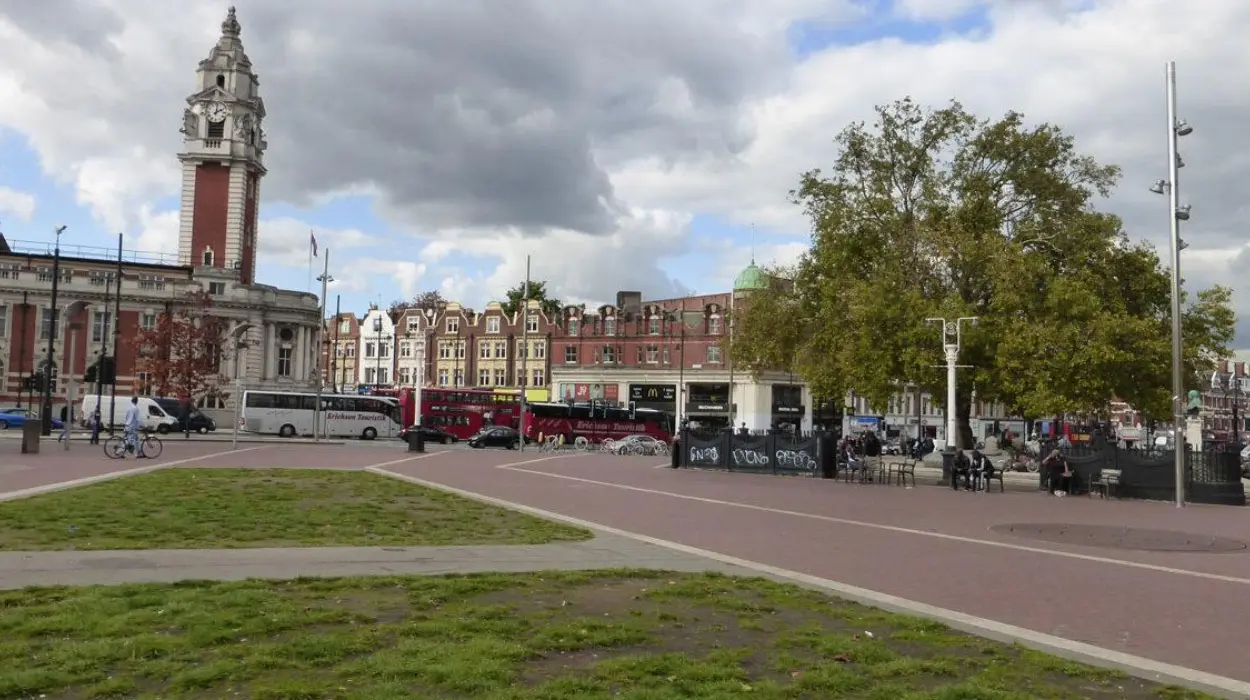
Windrush Square is a central public space that connects Brixton’s local geography with national Black British history.
The square commemorates the Empire Windrush and the broader history of Caribbean migration to Britain. Lambeth Council describes it as an important meeting point and records that the present square was created by bringing together two previously separate spaces: Windrush Square and Tate Library Gardens. The project was completed in 2010.
The site also contains important memorials.
The African and Caribbean War Memorial commemorates African and Caribbean service personnel who fought in the First World War and Second World War. The Cherry Groce Memorial Pavilion, installed in 2021, commemorates Cherry Groce, who was shot by police in her home during a 1985 operation. The pavilion was designed by architect David Adjaye.
These monuments demonstrate how Brixton’s public spaces preserve different historical periods, including imperial military service, post-war migration and campaigns for justice.
What can visitors learn at the Black Cultural Archives?
The Black Cultural Archives preserves and provides access to records, objects and historical materials documenting African and Caribbean people in Britain, making Brixton an important destination for researching Black British history, migration, education, activism and cultural development.
The Black Cultural Archives is one of Brixton’s most important heritage institutions.
Its mission is to collect, preserve and celebrate the histories of people of African and Caribbean descent in Britain. The institution maintains archives, museum objects and reference collections while supporting exhibitions, educational programmes and public engagement.
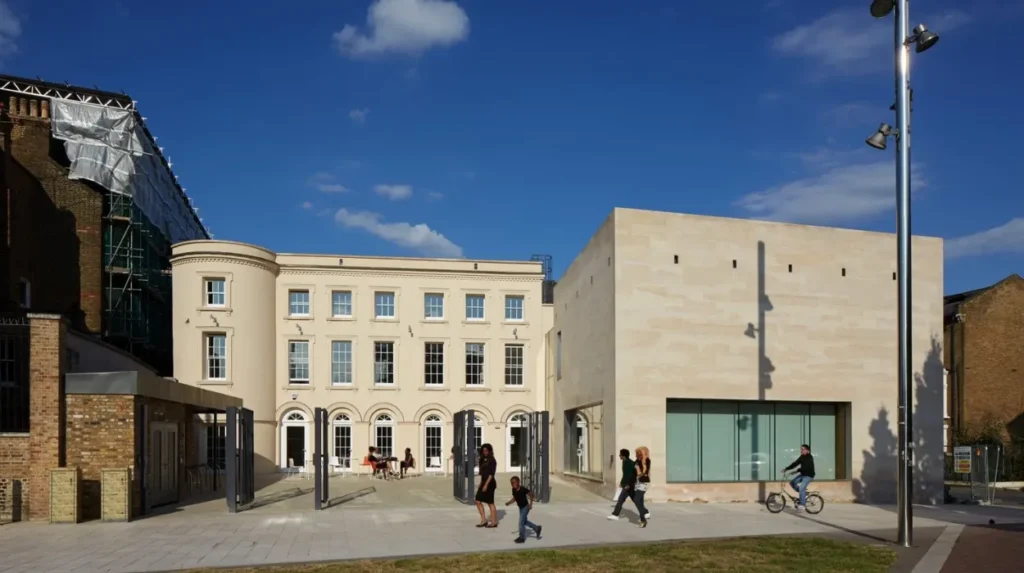
The archives are located at 1 Windrush Square.
The building itself is part of Brixton’s architectural history. According to Historic England, 1 Windrush Square originally consisted of two early nineteenth-century houses. The buildings later became associated with the Brixton Liberal Club and Raleigh Hall before being converted for museum and archive use in 2014. The site is Grade II listed.
This architectural history is significant because the building demonstrates the changing use of urban space.
A nineteenth-century residential structure became associated with political and social activity before eventually becoming a national heritage institution focused on Black British history.
Why are archives important for understanding Brixton?
Archives provide evidence that extends beyond famous landmarks.
They preserve photographs, documents, publications, organisational records and other materials that allow researchers to investigate how communities lived and organised themselves.
For educators, the Black Cultural Archives provides resources for studying migration, identity and British history.
For genealogical researchers, archival collections can provide evidence about families, organisations and communities.
For heritage preservationists, the institution demonstrates how historically significant collections can be connected to the places where the communities represented by those collections developed.
Brixton therefore functions as both a physical heritage landscape and a centre for documentary research.
How did Brixton become one of London’s most important music districts?
Brixton became a major music district through the growth of twentieth-century entertainment venues and the influence of Caribbean, African and Black British communities, creating spaces where reggae, ska, soul, punk, electronic music and contemporary genres developed public audiences.
Music is one of the strongest elements of Brixton’s international reputation.
The district’s musical history developed through several connected processes. Population growth created audiences. Transport brought performers and visitors into the area. Caribbean migration introduced and strengthened musical traditions. Entertainment venues provided permanent spaces for concerts and public performances.
Brixton’s music culture also developed outside formal venues.
Sound systems, community events, record shops and social spaces contributed to the circulation of music. These activities connected Brixton with wider cultural networks across London, the Caribbean, Africa and the United States.
Why are music venues historically important to Brixton?
Music venues preserve evidence of cultural change because they record who performed, who attended and which forms of entertainment attracted public audiences.
The architectural history of Brixton’s entertainment district is also important.
Lambeth Council identifies the Ritzy Cinema as one of the significant historic buildings within the Brixton Conservation Area. Its presence alongside civic buildings, markets and commercial premises demonstrates that entertainment formed part of the historic town centre rather than existing separately from everyday commerce.
Brixton’s major performance spaces later strengthened the area’s position within London’s music economy.
The significance of these venues rests on their connection to wider social history. Performances occurred within a district shaped by migration, youth culture, political activism and changing patterns of urban identity.
The history of Brixton music therefore includes several cultural traditions, including reggae, ska and soul. These examples developed alongside later electronic, hip-hop, punk and contemporary music scenes.
Each genre represents a different historical connection between Brixton and wider musical networks.
How are Brixton’s food and music histories connected?
Brixton’s food and music cultures developed through the same historical processes of migration, community formation, independent enterprise and cultural exchange, making markets and performance spaces connected records of how residents preserved and transformed cultural traditions in London.
Food and music are often presented as separate visitor experiences. Brixton’s history demonstrates that they are closely connected.
Both developed through migration.
Caribbean migrants brought cultural knowledge, family traditions and commercial networks to Britain. Food businesses created access to familiar ingredients and cooking traditions. Music provided cultural expression through performance, recordings and social events.
Both also developed through independent enterprise.
Small shops, market traders, record businesses and event organisers operated within local networks. These enterprises created economic opportunities while supporting cultural continuity.
The physical geography of Brixton strengthened these connections.
Markets, shops, transport routes and entertainment spaces existed close to one another. Residents and visitors could move between commercial and cultural activities within the same town centre.
This urban concentration helped create Brixton’s distinctive identity.
How did migration change Brixton’s commercial landscape?
Migration changed the commercial landscape by creating demand for goods and services that reflected the backgrounds of new residents.
This process is visible in food retail.
Specialist shops supplied ingredients that were not widely available through conventional British retailers. Restaurants introduced cuisines connected to Caribbean and African traditions. Market stalls adapted to changing customer needs.
The same process occurred in music.
Record stores, community events and performance spaces supported music that represented the cultural backgrounds of local communities.
Brixton therefore provides an important example of how migration changes cities through everyday economic activity.
These changes are historically significant because they leave physical and cultural evidence.
Buildings survive. Market streets remain active. Archives preserve records. Public spaces carry commemorative names and monuments.
Which historic buildings help explain Brixton’s development?
Brixton’s historic buildings explain its development by preserving evidence of nineteenth-century suburban expansion, Victorian commerce, public administration, entertainment and later cultural institutions, allowing visitors to trace how a rural-edge settlement became a dense metropolitan centre.
The architecture of Brixton provides a chronological record of urban development.
Early nineteenth-century buildings reflect the district’s transition from open land and suburban development.
Later Victorian buildings demonstrate rapid commercial expansion.
Twentieth-century structures reveal changes in civic administration, retailing and entertainment.
Lambeth Council identifies Brixton Town Hall, Tate Library, St Matthew’s Church, the Ritzy Cinema and the covered markets as important elements of the Brixton Conservation Area.
The former Bon Marché department store also represents Brixton’s nineteenth-century commercial development.
Lambeth’s conservation statement records that the building dates from 1876 and was Britain’s first purpose-built department store. The development included extensive facilities for staff and reflected the increasing scale of Victorian retailing.
These buildings provide evidence of the economic transformation that made Brixton a major commercial destination before the district became internationally recognised for its twentieth-century cultural history.
Why does conservation matter in Brixton?
Conservation protects the physical evidence needed to understand historical change.
Without historic buildings, the development of Brixton would be visible primarily through documents and photographs.
Conservation areas preserve streets, structures and urban relationships that allow researchers and visitors to understand historical geography.
The Brixton Conservation Area has existed since 1980, with later boundary changes including changes recorded in 1982, 1999, 2012 and 2024.
This continuing process demonstrates that heritage protection responds to changing understandings of historical significance.
Preservation is especially important in Brixton because the district contains overlapping histories.
Victorian commercial architecture exists beside institutions associated with Black British heritage.
Public spaces preserve memories of migration and activism.
Markets continue commercial traditions established during earlier periods.
How can visitors understand Brixton as a complete cultural landscape?
Visitors can understand Brixton as a complete cultural landscape by connecting its historic streets, markets, public spaces, heritage institutions and entertainment venues, because each location represents a different stage in the district’s development from rural land to Victorian town centre and multicultural metropolis.
A complete understanding of Brixton begins with geography.
The district developed around routes connecting south London with the capital. Transport encouraged urban growth. Commercial buildings followed population growth. Markets developed beside major transport infrastructure.
The next historical layer is Victorian commerce.
Electric Avenue, Atlantic Road and the wider market district preserve evidence of this period.
The twentieth-century layer is defined by migration and community formation.
The settlement of Caribbean communities transformed Brixton’s social and cultural identity. Businesses, food traditions, music and political organisations developed within the existing urban environment.
The contemporary heritage layer includes institutions and memorials.
Windrush Square commemorates post-war migration. The Black Cultural Archives preserves national histories connected to African and Caribbean communities. Historic buildings protect earlier architectural evidence.
Understanding these layers together prevents Brixton from being reduced to a single cultural theme.
What is the best historical sequence for exploring Brixton?
A historical exploration begins with the physical town centre and its nineteenth-century commercial development.
The next stage examines the markets and Electric Avenue, where the history of retailing connects directly with migration and food culture.
Windrush Square provides the strongest connection to post-war Caribbean migration and Black British public history.
The Black Cultural Archives provides documentary evidence and research resources.
Music and entertainment venues complete the picture by showing how Brixton became an important centre of cultural production.
This sequence connects architecture, commerce, migration and cultural expression.
Why does Brixton remain historically relevant today?
Brixton remains historically relevant because its streets, markets, archives, memorials and cultural venues preserve evidence of urban expansion, migration and Black British history while continuing to show how commerce, food, music and public memory shape London communities.
Brixton’s historical importance continues because its heritage remains visible and active.
The markets are not simply preserved historic sites. They continue to support commercial activity.
Windrush Square is not only a commemorative space. It remains a public meeting place.
The Black Cultural Archives does not simply display the past. It continues to preserve records and support research.
Historic buildings remain part of everyday urban life.
This combination makes Brixton particularly important for cultural tourists and history researchers.
The district demonstrates that history exists in ordinary activities as well as monuments.
Shopping reflects commercial history.
Food reflects migration history.
Music reflects cultural exchange.
Buildings reflect architectural history.
Archives preserve documentary evidence.
Together, these elements explain why Brixton occupies a distinctive position in London’s heritage landscape.
The historical development of Brixton also has long-term importance for understanding modern Britain. The district provides evidence of how post-war migration changed British cities and how communities created institutions that preserved their histories.
Its cultural landscape connects nineteenth-century urban expansion with twentieth-century migration and contemporary heritage preservation.
For educators, Brixton provides a concentrated case study in urban history.
For academic students, it provides evidence of migration, architecture, commerce and cultural studies.
For genealogical researchers, it connects family histories with wider community archives.
For heritage preservationists, it demonstrates the importance of protecting both buildings and documentary collections.
Brixton’s food markets, music venues and cultural experiences therefore belong to one historical system.
The markets record the development of Victorian commerce and later migration.
Food records changing communities and international connections.
Music records cultural production and public expression.
Windrush Square preserves national memory within a local landscape.
The Black Cultural Archives protects evidence of African and Caribbean histories in Britain.
Together, these places make Brixton one of London’s most significant districts for understanding how history, culture and everyday life develop in the same urban space.
Frequently Asked Question
Where are Brixton’s best food markets?
Brixton Village and Market Row are among the best-known food destinations in the area. They contain independent restaurants, cafés, food businesses and specialist shops representing Brixton’s diverse cultural communities.