London’s South Bank is one of Britain’s most important cultural landscapes. The riverside district combines post-war architecture, nationally significant arts institutions, historic transport routes, public spaces and entertainment venues along the southern bank of the River Thames.
- What makes South Bank one of London’s most important cultural destinations?
- How did the Festival of Britain transform South Bank in 1951?
- Why is the Royal Festival Hall historically important?
- How did South Bank become a major centre for theatre and performing arts?
- What is the historical importance of BFI Southbank?
- How did South Bank’s architecture reflect post-war Britain’s changing identity?
- What year-round cultural experiences does South Bank provide?
- How does the wider South Bank and Bankside corridor connect London’s industrial and cultural history?
- How has heritage preservation shaped the modern South Bank?
- Why does South Bank remain important to London’s future cultural history?
- Frequently Asked Question
The modern identity of South Bank developed most visibly after the Second World War. Bomb damage, industrial decline and ambitious reconstruction plans transformed a previously mixed riverside landscape into a major cultural quarter. The 1951 Festival of Britain became the decisive turning point. Its permanent architectural legacy, especially the Royal Festival Hall, established the foundations for the cultural district that expanded through the second half of the twentieth century.
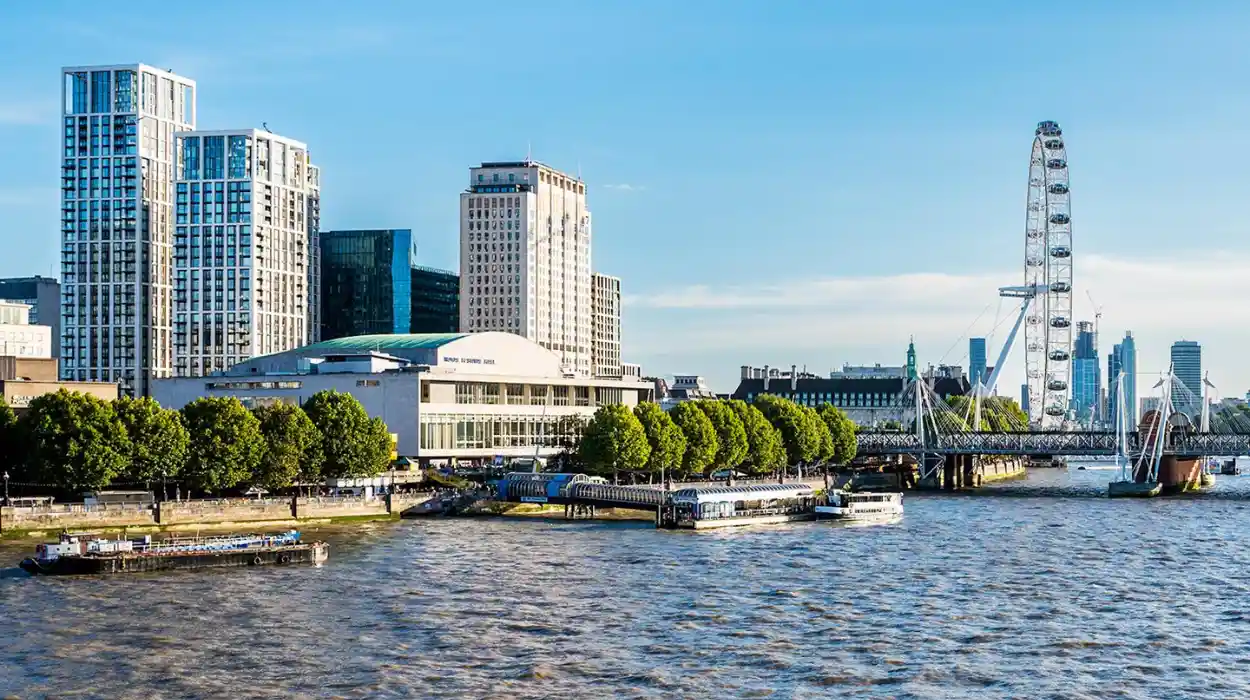
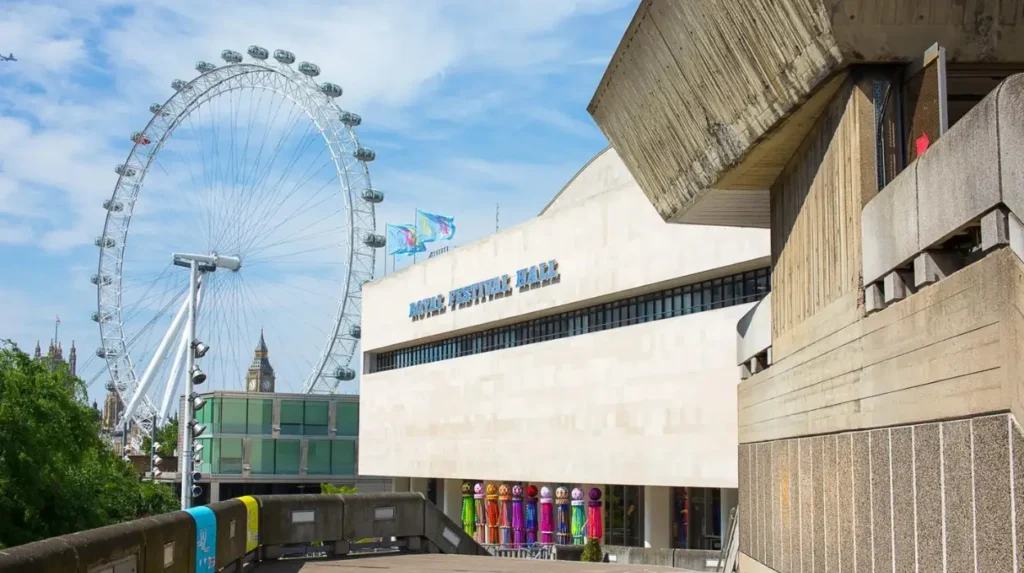
Today, South Bank connects major attractions and institutions including the Royal Festival Hall, National Theatre, BFI Southbank, Hayward Gallery, London Eye and Tate Modern across the wider riverside cultural corridor. Its significance extends beyond tourism. The area provides evidence of post-war planning, architectural change, public cultural policy and the transformation of former industrial land.
The South Bank therefore offers a year-round record of London’s historical development. Its buildings, promenades and public spaces preserve the physical consequences of decisions made by government bodies, architects, artists and cultural institutions over more than seven decades.
What makes South Bank one of London’s most important cultural destinations?
South Bank is one of London’s most important cultural destinations because it concentrates major theatres, concert halls, cinemas, galleries, public spaces and historic landmarks along the River Thames, while preserving the physical legacy of Britain’s post-war reconstruction and cultural development.
South Bank occupies a strategically important section of the Thames waterfront opposite central Westminster. The river historically functioned as London’s principal transport route and commercial artery. Communities and industries developed along both banks, with warehouses, workshops, breweries and manufacturing sites shaping the southern shoreline.
By the nineteenth century, parts of the modern South Bank area contained industrial structures and densely developed urban land. The district did not initially function as a unified cultural destination. Its transformation resulted from twentieth-century planning and redevelopment.
The Second World War accelerated this change. German bombing caused extensive destruction across London. Parts of the South Bank suffered damage, while older industrial structures and deteriorating buildings increasingly became targets for redevelopment.
The London County Council, the elected authority responsible for much of London’s strategic planning before the creation of the Greater London Council, controlled important sections of the South Bank site. Post-war reconstruction created an opportunity to reconsider how the riverside could serve the capital.
The decisive transformation arrived with the Festival of Britain in 1951. The event converted the South Bank into the flagship site for a national exhibition celebrating British science, design, industry and culture after years of war and austerity.
The National Archives records that the main festival site stretched along the Thames between Waterloo Bridge and County Hall. Before redevelopment, the area included damaged and largely derelict industrial buildings, including structures associated with the Lion Brewery and the Shot Tower.
The Festival created a new relationship between the city and its river. Visitors encountered modern architecture, landscaped spaces, exhibitions and cultural programming on a scale that changed public perceptions of the area.
The Royal Festival Hall became the event’s most important permanent architectural achievement. Most temporary Festival structures disappeared after 1951, but the concert hall remained and became the institutional foundation for the future South Bank cultural complex.
This transformation established a pattern that continues today. South Bank combines permanent institutions with changing exhibitions, theatre productions, film programmes, festivals and public events. The physical setting remains historically significant because the modern cultural district occupies land reshaped by post-war reconstruction.
To experience this historic riverside district in person today, consult our comprehensive [How London’s South Bank Became a World-Class Cultural Destination] for itineraries and visiting parameters.
How did the Festival of Britain transform South Bank in 1951?
The Festival of Britain transformed South Bank from a damaged industrial riverside into Britain’s leading post-war exhibition landscape, introducing modern architecture, cultural institutions and public spaces that established the area as a permanent centre for national creativity and cultural life.
The Festival of Britain opened on 3 May 1951 and ran until 30 September 1951. It formed part of a nationwide programme, but London’s South Bank served as its principal exhibition site.
The event took place one century after the Great Exhibition of 1851. Britain in 1951 faced very different circumstances. The country was recovering from the destruction and economic pressures of the Second World War. Rationing and reconstruction remained part of daily life.
The Festival presented a forward-looking image of Britain. It promoted achievements in design, science, technology, architecture and the arts. The South Bank site became a demonstration of how modern public spaces could be designed.
Southbank Centre describes the Festival as a national effort intended to create optimism after war and economic instability. It estimates that approximately half of Britain’s population experienced Festival activities directly across the wider national programme.
The South Bank exhibition included several famous temporary structures. The Skylon, a tall futuristic tower, became one of the Festival’s most recognisable symbols. The Dome of Discovery displayed scientific and technological exhibitions. The Telekinema demonstrated the expanding importance of film and television.
These structures represented a new visual language. Their modern forms differed sharply from many traditional buildings associated with central London. The Festival presented architecture as part of national reconstruction.
The Royal Festival Hall had a different future. It was designed as a permanent building and became the principal surviving structure from the Festival site. King George VI officially opened it on 3 May 1951, and the first concert included performances conducted by Sir Adrian Boult and Sir Malcolm Sargent.
After the Festival ended, most of the temporary structures were dismantled. The National Archives explains that decisions about demolition reflected practical issues, redevelopment plans, material shortages and the difficulty of adapting temporary buildings for permanent use.
The Festival nevertheless permanently changed the area’s direction. Its cultural infrastructure encouraged later investment in theatres, concert halls, galleries and cinemas.
The modern South Bank therefore represents a long-term consequence of a short-term national exhibition. The Festival lasted five months, but its institutional and architectural effects continue more than seven decades later.
Why is the Royal Festival Hall historically important?
The Royal Festival Hall is historically important because it is the principal surviving building from the 1951 Festival of Britain and became the foundation of Southbank Centre, Britain’s largest arts complex devoted to music, performance, exhibitions and public cultural activity.
The Royal Festival Hall stands as one of the most important examples of post-war British architecture. Its construction began before the Festival of Britain and formed part of a larger plan to establish a permanent cultural function on the South Bank.
Prime Minister Clement Attlee laid the foundation stone in 1949. The building opened two years later for the Festival. Its construction demonstrated that the South Bank was intended to retain a cultural role after the temporary exhibition ended.
The building’s architectural significance lies in its modern planning and public purpose. It represented a major departure from older concert hall traditions. The structure was designed for large-scale musical performance while incorporating public circulation areas and riverside connections.
The hall became the foundation for Southbank Centre, which later expanded to include additional performance and exhibition spaces.
The Royal Festival Hall is listed at Grade I on the National Heritage List for England. Grade I designation identifies buildings of exceptional interest. Historic England places the hall within a nationally significant group of post-war cultural structures on the South Bank.
Its historical importance also reflects changes in public access to culture. Concert halls traditionally operated primarily around scheduled performances. South Bank institutions increasingly developed a broader public role.
A major example came in 1983 when the Greater London Council introduced an open-foyer policy. Southbank Centre records that this policy expanded public access to its spaces throughout the day and throughout the week, supporting free exhibitions, performances and public activity alongside ticketed events.
This policy reinforced a defining principle of the South Bank: cultural architecture could also function as public urban space.
The Royal Festival Hall therefore remains important as architecture, heritage and cultural infrastructure. It preserves the only major permanent building from the Festival of Britain while continuing to serve the purpose for which the wider cultural district was developed.
How did South Bank become a major centre for theatre and performing arts?
South Bank became a major centre for performing arts through sustained post-war public investment that added concert halls, galleries and the National Theatre to the Festival of Britain legacy, creating one of Europe’s most concentrated clusters of cultural institutions.
The Royal Festival Hall established the first major permanent institution of the post-war South Bank. Later developments expanded the district’s cultural infrastructure.
The London County Council supported further construction as cultural planning became part of the area’s redevelopment. New buildings provided specialist facilities for different forms of artistic activity.
The Queen Elizabeth Hall opened in 1967. The Purcell Room provided a smaller performance venue. The Hayward Gallery became a major space for temporary and touring exhibitions.
Historic England identifies the Queen Elizabeth Hall, Purcell Room and Hayward Gallery as nationally significant examples of post-war public architecture. The heritage body also emphasises their collective importance alongside the Royal Festival Hall and National Theatre.
The National Theatre extended this cultural concentration. The institution was created to provide Britain with a permanent national theatre company and dedicated performance infrastructure.
The current National Theatre building opened during the 1970s. Designed by architect Sir Denys Lasdun, the structure became a defining example of British Brutalist architecture.
Historic England records that the Royal National Theatre opened on the South Bank in 1976 and holds Grade II* listed status, recognising its exceptional architectural and historical importance.
The development of these institutions reflected broader changes in British cultural policy. Post-war governments and public authorities increasingly supported permanent national and municipal arts infrastructure.
South Bank became a physical expression of this policy. Different buildings supported orchestral music, chamber performances, theatre, visual art and public cultural programmes.
The district also preserved changing attitudes toward architecture. The Royal Festival Hall represented early post-war modernism, while later concrete structures reflected the development of Brutalism and large-scale civic architecture.
Visitors therefore encounter more than entertainment venues. The buildings form a chronological record of post-war architectural ideas and public investment.
What is the historical importance of BFI Southbank?
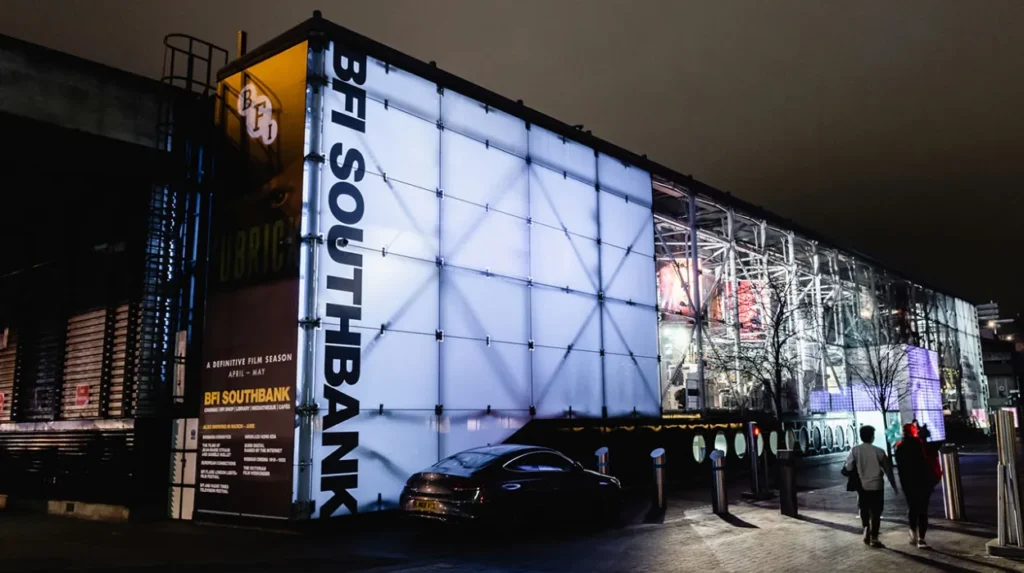
BFI Southbank is historically important because its origins lie in the Festival of Britain’s Telekinema, while the National Film Theatre that followed became a permanent institution for film preservation, international cinema and the development of Britain’s public film culture.
Film played an important role in the Festival of Britain’s modern cultural programme.
The Telekinema was constructed as a temporary Festival attraction in 1951. It presented cinema and television technology and demonstrated the growing significance of screen media in post-war Britain.
The British Film Institute later connected this temporary venue with a permanent national film programme.
According to BFI historical records, the Telekinema seated 410 people and became the National Film Theatre’s initial home after the Festival. The venue operated in this role before a permanent National Film Theatre opened under Waterloo Bridge in 1957.
The new National Film Theatre provided a permanent home for films that were not always widely available through commercial cinemas.
Its importance extended beyond screening programmes. The venue became associated with film criticism, preservation, international cinema and major festivals.
The first London Film Festival opened at the National Film Theatre in October 1957. BFI records identify Akira Kurosawa’s Throne of Blood as the first film shown in the Festival’s inaugural programme.
The institution later expanded physically and organisationally. Additional screens were introduced, and the site was refurbished and developed into BFI Southbank.
BFI records state that the modern BFI Southbank incorporates four cinema spaces and continues the institutional legacy of the National Film Theatre.
This history illustrates how the Festival of Britain generated institutions as well as architecture. The Telekinema was temporary, but its purpose contributed directly to the creation of a permanent national centre for film culture.
BFI Southbank also demonstrates the importance of preservation. Film history depends on archives, specialist exhibition and institutional memory. The South Bank became one of the principal places where Britain’s relationship with cinema has been publicly maintained.
How did South Bank’s architecture reflect post-war Britain’s changing identity?
South Bank’s architecture reflected post-war Britain’s changing identity by replacing damaged industrial landscapes with modern public buildings designed for culture, education and recreation, demonstrating how reconstruction connected national recovery with new ideas about architecture and citizenship.
Architecture on the South Bank records successive stages of twentieth-century British history.
Before the Festival of Britain, the area contained industrial and commercial structures. The Second World War caused further damage and strengthened arguments for comprehensive redevelopment.
The post-war period created severe practical constraints. Britain faced shortages of materials, housing needs and major infrastructure demands. Cultural construction competed with other reconstruction priorities.
The Festival of Britain nevertheless demonstrated that architecture and design could contribute to national recovery.
The Royal Festival Hall established a modern architectural identity for the site. Later structures developed different approaches to concrete, public circulation and large-scale urban design.
The Queen Elizabeth Hall, Purcell Room and Hayward Gallery demonstrated the increasing use of exposed structural materials and interconnected pedestrian spaces.
The National Theatre developed this architectural language further through monumental concrete forms and elevated terraces.
Historic England identifies the wider South Bank complex as a prestigious concentration of post-war arts architecture. The area’s significance comes partly from the relationship between individual buildings rather than from isolated landmarks.
Public walkways also became part of the architectural system. Terraces, stairs and elevated routes connected buildings and created spaces where movement through the district became part of the visitor experience.
The South Bank’s architectural development therefore followed an urban principle: cultural buildings should contribute to a connected public environment.
This principle continues to influence the area. The riverside promenade links attractions while providing views across the Thames toward Westminster, the City of London and other historic districts.
What year-round cultural experiences does South Bank provide?
South Bank provides year-round cultural experiences through permanent museums, theatres, concert halls, cinemas, galleries, riverside public spaces and changing programmes, allowing visitors to engage with London’s history and contemporary culture throughout every season of the year.
The defining advantage of South Bank is its combination of permanent heritage and changing cultural programming.
The buildings remain visible throughout the year. Their architecture provides a continuous historical record. Cultural institutions then add changing exhibitions, concerts, theatrical productions and film programmes.
This structure supports year-round visitation because the district does not depend on a single seasonal attraction.
The Royal Festival Hall and wider Southbank Centre continue the musical and artistic traditions established after the Festival of Britain.
The National Theatre maintains the South Bank’s role in British theatre.
BFI Southbank provides specialist cinema programmes and connects the area with Britain’s national film heritage.
The Hayward Gallery supports changing visual-art exhibitions within one of London’s most important post-war cultural complexes.
The riverside itself provides another permanent experience. Queen’s Walk and connected pedestrian routes allow visitors to examine the relationship between London’s architecture and the Thames.
Public space has remained central to South Bank’s identity. The 1983 open-foyer policy represented an important institutional development by expanding access to cultural buildings beyond ticketed performance times.
The South Bank also contains historically important recreational spaces.
The Southbank Centre Undercroft became associated with British skateboarding from the 1970s. Southbank Centre identifies the space as widely recognised as the birthplace of British skateboarding because its concrete banks, slopes and ledges attracted skateboarders during the sport’s early development in Britain.
This example demonstrates that South Bank’s cultural history extends beyond formal institutions. Informal communities also shaped the meaning of its public architecture.
The result is a district where official culture and everyday urban activity coexist.
How does the wider South Bank and Bankside corridor connect London’s industrial and cultural history?
The wider South Bank and Bankside corridor connects London’s industrial and cultural history by preserving and adapting former infrastructure, particularly Bankside Power Station, demonstrating how twentieth-century industrial buildings became major institutions within the capital’s modern cultural economy.
The Thames historically supported London’s industrial development. Factories, warehouses, power stations and transport infrastructure occupied important sections of the riverbank.
The transition from industry to culture became especially visible at Bankside Power Station.
The power station was designed by Sir Giles Gilbert Scott, an architect also associated with other major British infrastructure projects. Construction occurred across different phases during the twentieth century.
Historic England records that Bankside Power Station was built during the 1940s and 1960s and closed in 1981. The building later faced the possibility of demolition.
The decision to convert the structure into Tate Modern created one of Britain’s most important examples of adaptive reuse.
Architects Herzog & de Meuron designed the conversion, completed in 2000. Historic England records that the project cost £134 million and retained the industrial character of the former power station.
The Turbine Hall preserved the monumental scale of the original industrial building.
This transformation demonstrates a broader historical process. Former industrial land along the Thames acquired new cultural and public functions as London’s economy changed.
The relationship between South Bank and Bankside therefore provides a clear example of urban adaptation.
Industrial infrastructure did not simply disappear. Selected buildings were preserved, converted and integrated into London’s cultural landscape.
The wider riverside corridor now allows visitors to examine several stages of London history within a relatively continuous urban route: the historic Thames, nineteenth- and twentieth-century industry, post-war reconstruction and contemporary cultural development.
How has heritage preservation shaped the modern South Bank?
Heritage preservation has shaped modern South Bank by protecting nationally important post-war architecture and encouraging adaptive reuse, ensuring that buildings created during reconstruction remain active public institutions rather than becoming isolated monuments disconnected from contemporary cultural life.
Preservation on the South Bank involves more than maintaining old buildings.
The district presents a significant challenge because much of its architectural importance comes from the twentieth century. Public attitudes toward modern architecture have changed over time, and several post-war structures initially faced criticism.
Heritage designation has provided formal recognition for major buildings.
The Royal Festival Hall holds Grade I listed status.
The National Theatre holds Grade II* listed status.
Historic England also recognises the importance of the Queen Elizabeth Hall, Purcell Room and Hayward Gallery as part of the nationally significant post-war arts complex.
Listing identifies architectural and historical significance, but preservation also requires continued use.
South Bank institutions remain active. Concert halls continue to host performances. Theatres continue to stage productions. Cinemas continue to exhibit films. Galleries continue to present exhibitions.
This active use protects the original principle behind the district. The South Bank was developed as a functioning cultural environment rather than as a collection of static monuments.
Adaptive reuse provides another preservation model.
The transformation of Bankside Power Station into Tate Modern preserved an important industrial structure while assigning it a new public purpose. Historic England identifies the project as an important example of the shift from an industrial river frontage to a major cultural landscape.
Preservation therefore connects historical evidence with contemporary function.
The South Bank demonstrates that twentieth-century heritage has become an increasingly important part of London’s historical record.
Why does South Bank remain important to London’s future cultural history?
South Bank remains important to London’s future cultural history because its institutions, architecture and public spaces document how cities adapt after crisis, preserve modern heritage and maintain public access to culture while continuously changing to meet new social and artistic needs.
South Bank began its modern development during a period of national reconstruction.
The Festival of Britain responded to the consequences of war by presenting a vision of cultural and technological renewal.
The cultural institutions that followed transformed this temporary vision into permanent infrastructure.
That process remains historically important because cities continue to face questions about redevelopment, public space, heritage and cultural investment.
South Bank provides a documented example of long-term urban transformation.
The area moved from an industrial and damaged riverside landscape toward a planned cultural district.
Its buildings preserve several phases of that transformation.
The Royal Festival Hall preserves the central architectural legacy of the 1951 Festival of Britain.
The National Theatre preserves a major example of 1970s British public architecture.
BFI Southbank preserves the institutional development of Britain’s national film culture from the Festival’s Telekinema.
The Hayward Gallery and neighbouring venues preserve the expansion of publicly supported arts infrastructure.
The Undercroft preserves evidence of informal urban culture and the development of British skateboarding.
Bankside Power Station demonstrates how industrial heritage can acquire a new cultural purpose.
The South Bank’s importance therefore lies in its accumulated history.
It is not defined by one monument or one institution. Its significance comes from the interaction between architecture, public policy, artistic production, transport, recreation and the River Thames.
In 2026, the wider area marks 75 years since the Festival of Britain, reinforcing the continuing importance of the event that established South Bank’s modern cultural identity. Contemporary commemorations have also highlighted the transformation from an industrial and bomb-damaged riverside into one of London’s most significant cultural neighbourhoods.
For history enthusiasts, South Bank provides evidence of post-war Britain in physical form.
For cultural tourists, it provides a concentrated route through major British artistic institutions.
For educators and students, it offers direct examples of reconstruction, architecture, planning and cultural policy.
For heritage preservationists, it demonstrates the growing recognition of twentieth-century architecture as part of the national historic environment.
For researchers tracing London’s changing communities and landscapes, the district provides a record of how industrial land, public institutions and cultural identities evolve across generations.
South Bank remains one of London’s clearest examples of historical continuity through transformation. The river is the oldest constant in the landscape. Around it, the city has repeatedly changed its buildings, institutions and purposes.
The Festival of Britain established the modern foundation in 1951. The decades that followed added theatres, galleries, cinemas and public spaces. Preservation has protected important structures. Cultural institutions have maintained active public use.
This combination gives South Bank its enduring importance.
Its attractions provide entertainment throughout the year, but their deeper value lies in the history embedded within the landscape. Every major structure records a decision about how London should rebuild, what public culture should include and how historic spaces should remain useful for future generations.
South Bank is therefore both a visitor destination and a living historical archive of modern London.
Frequently Asked Question
What is South Bank in London famous for?
South Bank is famous for its riverside location and major cultural attractions, including the London Eye, Southbank Centre, Royal Festival Hall, National Theatre, BFI Southbank and Hayward Gallery.