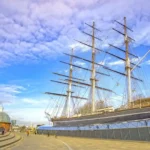
Greenwich became the birthplace of global maritime timekeeping standards because its Royal Observatory connected astronomy, navigation, longitude measurement, accurate clocks, and international cartography. Founded in 1675, the Observatory developed a reference system that eventually made Greenwich Mean Time and the Greenwich meridian global standards.
- Why was the Royal Observatory founded at Greenwich?
- How did longitude create the need for accurate maritime timekeeping?
- How did John Harrison connect Greenwich with marine chronometers?
- How did Greenwich Mean Time develop from astronomical observation?
- How did railways turn Greenwich time into a national standard?
- Why did the Greenwich meridian become the world’s Prime Meridian?
- What role did the Airy Transit Circle play in defining Greenwich longitude?
- How did the 1884 decision connect Greenwich time with global time zones?
- Why was Greenwich especially suitable for maritime standardisation?
- How did Greenwich time become legally established in Britain?
- What remains of Greenwich’s maritime timekeeping history today?
- How did modern timekeeping change the Greenwich system?
- Why does Greenwich still matter to global maritime history?
- What is the lasting historical significance of Greenwich Mean Time and the Prime Meridian?
- Frequently Asked Question
The history began with a practical maritime problem. Ships could determine latitude, or their position north or south, with established astronomical methods. Longitude, their position east or west, was far harder to establish accurately. A reliable longitude system required either precise astronomical observations or a clock that preserved a known reference time during a voyage.
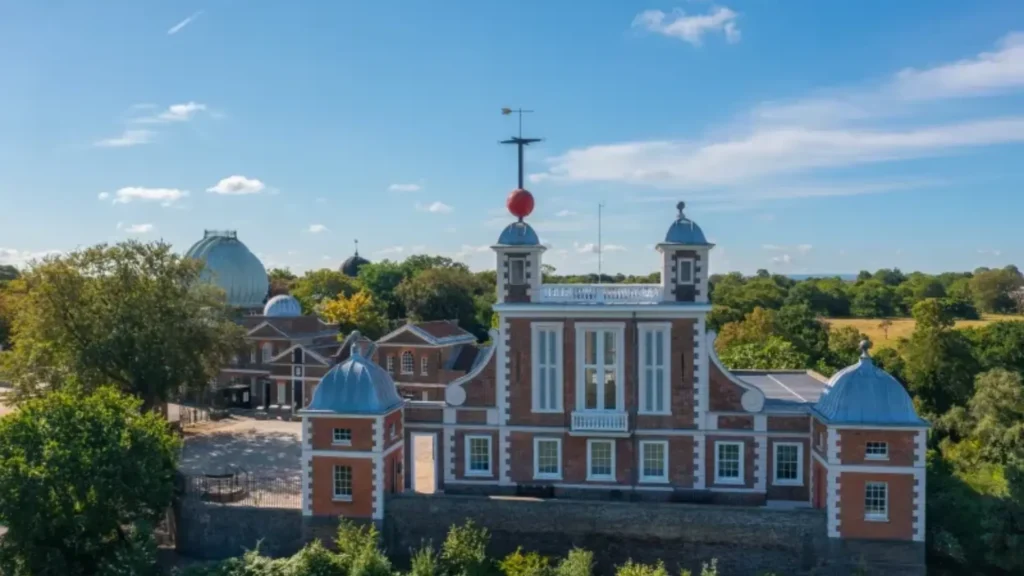
Greenwich provided the institutional setting for solving that problem. Its Royal Observatory produced astronomical observations, tested precision instruments, published navigational information, distributed accurate time, and established a reference meridian. These functions developed over more than two centuries before the International Meridian Conference of 1884 formally selected Greenwich as the world’s Prime Meridian.
The result extended far beyond maritime navigation. Greenwich Mean Time became Britain’s standard time, while the Greenwich meridian became the basis for the international longitude system. The historic reference remains important even though modern civil time is based on Coordinated Universal Time and modern geodesy defines the internationally used reference meridian differently.
Why was the Royal Observatory founded at Greenwich?
The Royal Observatory was founded in 1675 by Charles II to improve astronomical knowledge for navigation, especially the determination of longitude. John Flamsteed became its first Astronomer Royal and began systematic observations from Greenwich.
The foundation of the Royal Observatory reflected Britain’s expanding maritime interests during the seventeenth century. Charles II wanted British scientists to improve astronomical tables and navigation. The official purpose connected astronomy directly with finding longitude.
John Flamsteed, an English astronomer born in 1646, became the first Astronomer Royal. The title identified the scientist responsible for the new institution’s astronomical work. Flamsteed began observations from the newly constructed observatory in Greenwich Park.
The building was designed by Christopher Wren, with assistance from Robert Hooke. Flamsteed House, completed in 1676, became the first purpose-built scientific institution in Britain supported directly by the Crown.
Greenwich was therefore not selected because it already represented international time. Its importance developed from the scientific work conducted there.
The Observatory established a continuous programme of astronomical observation. Astronomers measured the positions of stars and planets, calculated celestial movements, and improved the accuracy of astronomical tables.
This work created an essential foundation for maritime navigation. A ship could compare observed celestial events with accurately calculated reference data. That comparison helped navigators establish their position.
The Royal Observatory’s later role as the home of Greenwich Mean Time emerged from this earlier astronomical purpose. Time measurement and longitude measurement became closely connected because the Earth rotates continuously relative to the celestial sky.
How did longitude create the need for accurate maritime timekeeping?
Longitude measures position east or west of a reference meridian, and accurate longitude at sea requires a reliable comparison between local time and reference time. Greenwich supplied that reference through astronomy, clocks, nautical tables, and marine chronometers.
Latitude was comparatively straightforward for experienced navigators because the height of the Sun or certain stars above the horizon provided information about north-south position.
Longitude presented a different problem. The Earth rotates 360 degrees in approximately 24 hours. One hour of time therefore corresponds to 15 degrees of longitude. Four minutes correspond to approximately one degree.
This relationship created the fundamental timekeeping principle behind maritime longitude.
A navigator who knew the local solar time and carried a clock showing the time at a fixed reference meridian could calculate the difference. If local noon occurred while the reference clock showed 2pm, the ship was 30 degrees west of the reference meridian.
The method depended on the clock maintaining accurate time despite temperature changes, humidity, vibration, ship movement, and long voyages.
Before reliable marine chronometers, navigators relied heavily on astronomical techniques. The lunar-distance method provided one solution. It involved measuring the angular distance between the Moon and selected stars and comparing the observation with published astronomical tables.
Greenwich became important because its astronomers supplied the observations and calculations required for these methods.
The longitude problem also had major economic consequences. Errors in east-west positioning increased the risks of shipwrecks, delayed voyages, endangered crews, and threatened valuable cargoes. International maritime powers therefore invested heavily in improved navigation.
How did John Harrison connect Greenwich with marine chronometers?
John Harrison connected Greenwich with maritime timekeeping through precision marine clocks designed to preserve reference time at sea. His H1, H2, H3, and H4 timekeepers demonstrated that accurate portable timekeeping could solve the longitude problem.
John Harrison was an English carpenter and clockmaker who devoted much of his career to developing accurate marine timekeepers. His work followed the Longitude Act of 1714, which offered financial rewards for a practical method of determining longitude at sea.
Harrison’s first major marine timekeeper, H1, appeared in the 1730s. It represented a major advance in portable precision timekeeping.
He subsequently developed H2 and H3. H3 occupied Harrison for almost two decades and incorporated numerous technical improvements. His fourth major design, H4, used a watch-like form with a high-frequency balance.
H4 underwent a sea trial during a voyage to Jamaica in 1761–1762. The successful performance demonstrated the practical value of a precision timekeeper for determining longitude.
The Royal Observatory later became directly involved in testing Harrison’s H4. Astronomer Royal Nevil Maskelyne received the instrument in May 1766 and conducted further tests at Greenwich.
Harrison did not single-handedly create the international Greenwich system. His work provided one critical solution to the longitude problem. Greenwich supplied the reference time against which such chronometers operated.
The relationship was therefore systematic. The marine chronometer carried Greenwich reference time across oceans, while the Observatory maintained and disseminated the reference.
Royal Museums Greenwich identifies Harrison’s H1, H2, H3, and H4 among the institution’s most important historic timekeeping objects.
How did Greenwich Mean Time develop from astronomical observation?
Greenwich Mean Time developed from the astronomical definition of an average solar day at Greenwich. Astronomers used precision clocks and observations to establish mean time, which later became a practical reference for navigation, railways, communications, and national timekeeping.
Solar time changes slightly during the year because the Earth’s orbit and axial tilt affect the apparent movement of the Sun. A clock cannot conveniently follow these changing intervals if every day is expected to contain exactly 24 equal hours.
Astronomers therefore used mean solar time. Greenwich Mean Time represented the average solar time associated with the Greenwich meridian.
John Flamsteed worked with accurate clocks and astronomical observations at the Observatory. The institution’s precision timekeepers helped establish reliable relationships between astronomical events and measured time.
The concept remained primarily astronomical during the early period of the Observatory. Its wider public significance emerged during the eighteenth and nineteenth centuries.
In 1767, the fifth Astronomer Royal, Nevil Maskelyne, introduced the Nautical Almanac. The publication supplied navigational information based on astronomical observations and calculations associated with Greenwich.
The Nautical Almanac became an important tool for mariners. Greenwich observations therefore moved from the Observatory into the working practices of ships around the world.
By the nineteenth century, Greenwich time had acquired a second major function. It became a practical standard for synchronising clocks.
The spread of railways accelerated this process. Local solar time differed from one town to another because noon occurred at different moments according to longitude. Fast railway travel exposed these differences to ordinary passengers and railway operators.
Royal Museums Greenwich records that London and Liverpool differed by approximately 12 minutes in local solar time. Railway companies increasingly adopted Greenwich Mean Time to coordinate their networks.
How did railways turn Greenwich time into a national standard?
Railways transformed Greenwich Mean Time from an astronomical reference into everyday national time. By the 1840s most British railway companies used Greenwich time, and telegraph networks later distributed accurate Greenwich time to stations and public clocks.
Railway expansion created a practical demand for uniform time.
During the early nineteenth century, towns retained local solar time. A clock in Bristol, for example, showed a different local time from a clock in London because the cities occupied different longitudes.
The difference was manageable when travel was slow. It became operationally significant when trains connected distant cities on fixed timetables.
Railway companies required coordinated schedules. A common time standard reduced confusion and supported the safe operation of increasingly complex railway networks.
By the 1840s, most railway companies had adopted Greenwich Mean Time. The term “Railway Time” became associated with this standard.
Telegraphy strengthened the system. In 1852, the Royal Observatory installed an electrical clock system capable of transmitting Greenwich time through telegraph wires.
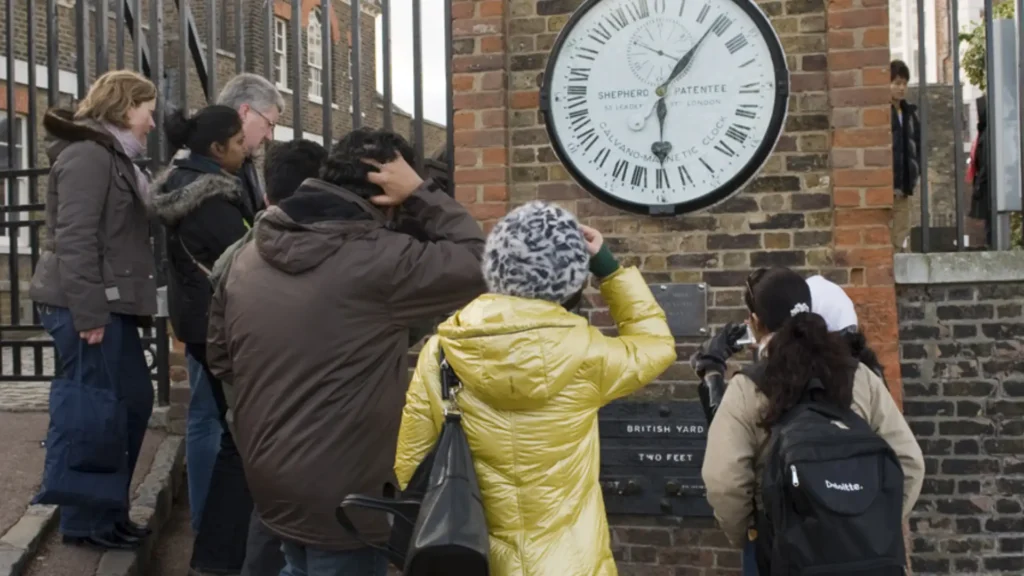
The Shepherd Gate Clock became an important public manifestation of this system. Installed outside the Observatory, it displayed Greenwich Mean Time directly to the public.
The clock used a 24-hour dial. Its mechanism was connected to the Observatory’s master clock, allowing accurate time to be distributed beyond the scientific institution.
The system extended into major British cities. By 1866, Greenwich time signals had also travelled through a transatlantic submarine cable to Harvard University in Massachusetts.
This development demonstrated a fundamental change in the meaning of time. Greenwich was no longer simply a location where astronomers measured celestial movements. It had become a centre for distributing a common temporal reference.
Why did the Greenwich meridian become the world’s Prime Meridian?
Greenwich became the world’s Prime Meridian because its longitude was already widely used by mariners, mapmakers, astronomers, and national time systems. The 1884 International Meridian Conference formalised Greenwich as Longitude 0 degrees for international reference.
A prime meridian is the reference line from which longitude is measured east and west. Unlike the Equator, which has a natural astronomical definition, Earth has no naturally determined zero longitude.
Different countries therefore used different reference meridians before international agreement.
Greenwich had gained an overwhelming practical advantage by the nineteenth century. British nautical charts and astronomical publications were widely used internationally. Greenwich observations had become embedded in navigation and cartography.
The United States also used Greenwich as the basis for its time-zone system. Royal Museums Greenwich states that approximately 72 percent of world commerce depended on sea charts using Greenwich as the Prime Meridian during the period leading to the 1884 conference.
The International Meridian Conference met in Washington, D.C., in October 1884. Delegates considered how to establish a common initial meridian and a universal day.
The conference adopted the Greenwich meridian as the Prime Meridian. Greenwich therefore became the conventional zero point for global longitude.
The decision was practical rather than a claim that Greenwich possessed an inherent geographic right to be zero degrees. Existing usage made the adoption efficient for international navigation and commerce.
The Library of Congress describes the conference’s purpose as establishing a common initial meridian and standardising time worldwide, noting that Greenwich was already widely used by mariners and mapmakers.
What role did the Airy Transit Circle play in defining Greenwich longitude?
The Airy Transit Circle provided the historic observational reference for the Greenwich Prime Meridian. Installed by George Biddell Airy in 1850, its telescope cross-hairs defined the original Greenwich reference for Longitude 0 degrees and the Universal Day.
George Biddell Airy was the seventh Astronomer Royal. He designed the Airy Transit Circle, an astronomical instrument used to measure the precise transit of stars across the meridian.
A transit circle combines a telescope with graduated circles for determining the position of celestial objects as they cross a fixed north-south line.
The instrument became central to Greenwich’s definition of longitude.
At the 1884 International Meridian Conference, the Greenwich meridian associated with the Airy Transit Circle became the international reference for zero longitude.
The historical reference is therefore not simply an outdoor line painted across the ground. Its scientific origin is an astronomical instrument and a long sequence of observations.
The Airy Transit Circle remains preserved at the Royal Observatory. Its historic importance extends beyond its mechanical construction because its observations established the reference adopted by international navigation.
Royal Museums Greenwich states that the instrument’s cross-hairs define Longitude 0 degrees in the historic system and the start of the Universal Day.
The modern Prime Meridian line seen by visitors is therefore a physical representation of a much deeper scientific system.
How did the 1884 decision connect Greenwich time with global time zones?
The 1884 conference connected Greenwich with an international time framework by establishing a Prime Meridian and recommending a Universal Day beginning at Greenwich midnight. This provided a common reference from which global longitude and time-zone systems developed.
The conference did more than choose a meridian.
Its resolutions addressed the relationship between longitude and time. Greenwich was designated as the reference for zero longitude, while the Universal Day was associated with the Greenwich meridian.
This arrangement created a logical foundation for dividing the world into time zones.
Earth rotates 360 degrees in approximately 24 hours. The theoretical time difference therefore changes by one hour for every 15 degrees of longitude.
The modern time-zone system did not appear instantly as a perfectly uniform global grid. Countries adopted and adapted time standards according to national requirements.
The Greenwich reference nevertheless provided a common starting point.
Greenwich Mean Time subsequently became widely recognised as the international reference for civil time. Royal Museums Greenwich states that GMT served as the international standard of civil time from 1884 until 1972.
This history explains why Greenwich appears in navigation charts, historical timekeeping literature, international geography, and modern discussions of world time.
The system also established an important distinction. Longitude is a spatial measurement, while time is a temporal measurement. Greenwich connected them through Earth’s rotation.
Why was Greenwich especially suitable for maritime standardisation?
Greenwich was suitable because its observatory already possessed international scientific authority, extensive astronomical records, navigational publications, precision clocks, maritime connections, and established use in charts. The Prime Meridian therefore formalised an existing working standard rather than creating an entirely new system.
Greenwich’s importance developed through several connected institutions and technologies.
The Royal Observatory supplied astronomical observations. The Nautical Almanac converted observations into practical navigational information. Marine chronometers allowed ships to carry reference time. Telegraphs distributed accurate time across land and eventually across oceans.
The surrounding area also had a strong maritime identity.
Greenwich stood on the River Thames and became associated with royal power, naval administration, maritime education, and scientific navigation. The Royal Naval College later occupied the former royal palace and formed part of the architectural ensemble that defines Maritime Greenwich.
UNESCO recognises Maritime Greenwich for its combination of royal, architectural, maritime, and scientific significance. The World Heritage property includes the Royal Observatory and its association with the development of navigation and astronomy.
The Observatory’s scientific work therefore existed within a wider maritime landscape.
This combination explains the historical strength of Greenwich as a timekeeping centre. It connected scientific measurement with practical navigation, government administration, commerce, education, and international communication.
How did Greenwich time become legally established in Britain?
Greenwich Mean Time became Britain’s official legal standard in 1880 after decades of adoption by railways, public institutions, and telegraph networks. The legal recognition followed widespread practical use rather than preceding it.
The British adoption of Greenwich time occurred gradually.
Railway companies began using Greenwich Mean Time during the nineteenth century. Public clocks increasingly followed the railway standard. Telegraph networks then made it possible to transmit precise time over long distances.
By the middle of the nineteenth century, Greenwich Mean Time had become familiar throughout Britain.
The government formally recognised the system in 1880. Greenwich Mean Time then became Britain’s legal standard.
This sequence is important because it shows how standards often develop through practical infrastructure before receiving formal legal recognition.
The Observatory’s master clock played a central role in the distribution of accurate time. Its signals reached railway stations and other buildings through telegraph technology.
The Shepherd Gate Clock provided a visible public connection between scientific time and ordinary life.
Greenwich time subsequently supported national transport, communications, administration, commerce, and scientific activity.
The historical development also demonstrates why the story is broader than the Prime Meridian alone. Greenwich became a global timekeeping centre through the combination of meridian measurement and time distribution.
What remains of Greenwich’s maritime timekeeping history today?
Greenwich preserves its timekeeping history through the Royal Observatory, Airy Transit Circle, Shepherd Gate Clock, historic meridian, Harrison marine timekeepers, astronomical instruments, and surrounding Maritime Greenwich World Heritage landscape, allowing visitors to examine the physical evidence behind global navigation standards.
The Royal Observatory remains the central historic site.
Flamsteed House preserves the earliest phase of the Observatory’s institutional history. The building was constructed in 1675–76 and housed the Astronomer Royal and astronomical equipment.
The Airy Transit Circle remains in its original mounting in the Transit Circle Room. It represents the scientific basis of the historic Greenwich meridian.
The Shepherd Gate Clock remains visible outside the Observatory. Its 24-hour dial provides a direct reminder of Greenwich’s role in distributing standard time.
John Harrison’s marine timekeepers are also preserved at the Observatory. H1, H2, H3, and H4 demonstrate the technological development of precision maritime timekeeping.
The broader Maritime Greenwich landscape adds architectural and institutional context. The Queen’s House, Old Royal Naval College, Greenwich Park, and Royal Observatory form an internationally significant historic environment.
UNESCO inscribed Maritime Greenwich on the World Heritage List in 1997. The designation recognises the area’s architectural, cultural, scientific, maritime, and royal significance.
To experience this historic landmark in person today, consult our comprehensive [Best Attractions in Greenwich Every History and Maritime Enthusiast Should Experience Together] for itineraries and visiting parameters.
How did modern timekeeping change the Greenwich system?
Modern timekeeping replaced Greenwich Mean Time as the international scientific standard with Coordinated Universal Time, while the Greenwich meridian remains historically important. Greenwich therefore represents the foundation of modern global timekeeping rather than its complete present-day technical definition.
The twentieth century brought major changes to the measurement of time.
Astronomical time had historically depended on Earth’s rotation. Scientists later developed atomic clocks capable of measuring time with vastly greater stability.
Coordinated Universal Time, or UTC, became the international reference used by modern civil and scientific systems. UTC is based on atomic time with adjustments that keep it closely aligned with Earth’s rotation.
GMT therefore no longer functions as the primary international scientific standard.
Royal Museums Greenwich identifies 1972 as the end of GMT’s role as the international standard of civil time. GMT remains relevant in Britain and in historical and geographical usage.
The Royal Observatory itself also changed function. As observing conditions at Greenwich deteriorated because of London’s growth and artificial light, the Royal Observatory moved to Herstmonceux in Sussex in 1958. The Greenwich site subsequently developed as a museum and heritage institution.
The change did not erase Greenwich’s historical significance.
Modern satellite navigation, atomic clocks, digital communications, and geodetic reference systems operate with technologies unavailable to seventeenth-century astronomers. Yet the historical Greenwich system explains how societies moved from local solar time toward coordinated global standards.
Why does Greenwich still matter to global maritime history?
Greenwich matters because it demonstrates how astronomy, precision engineering, maritime navigation, communications, cartography, and international diplomacy combined to create a shared global reference. Its legacy survives in navigation history, longitude measurement, time terminology, heritage conservation, and scientific education.
Greenwich’s importance is fundamentally institutional.
The Royal Observatory transformed astronomical observation into navigational knowledge. Marine chronometers transformed reference time into a portable maritime tool. Telegraphs transformed accurate time into a distributed public service. International diplomacy transformed Greenwich usage into a global reference.
Each development solved a different part of the same coordination problem.
The historical sequence also demonstrates the importance of standardisation. Navigation requires agreed reference points. Railways require agreed schedules. International commerce requires common geographical coordinates. Communications networks require synchronised time.
Greenwich supplied a reference that connected these systems.
The physical location remains valuable because the evidence is unusually concentrated. Visitors can see the Observatory buildings, astronomical instruments, clocks, historic meridian, and maritime collections within the same cultural landscape.
Academic researchers also benefit from the surviving institutional records. Royal Museums Greenwich maintains extensive collections documenting the Royal Observatory, Astronomers Royal, astronomical instruments, navigation, timekeeping, and maritime science.
UNESCO’s assessment reinforces the site’s international significance. Maritime Greenwich represents a rare combination of architectural heritage and scientific history, with the Royal Observatory providing the crucial connection between astronomy, navigation, longitude, and global time.
What is the lasting historical significance of Greenwich Mean Time and the Prime Meridian?
Greenwich’s lasting significance lies in its transformation from a seventeenth-century astronomical observatory into an international reference for longitude and time. The system linked maritime navigation with global coordination and established Greenwich as a defining location in modern scientific history.
Greenwich did not become the centre of world time through a single invention.
Its importance accumulated through successive developments beginning with the Royal Observatory’s foundation in 1675. Astronomical observations created reliable reference data. The Nautical Almanac distributed navigational calculations. Harrison’s chronometers provided portable reference time. Telegraphs distributed Greenwich time rapidly. Railways normalised it across Britain. International diplomacy formalised its global geographical role in 1884.
The Prime Meridian represented the spatial side of this system. Greenwich Mean Time represented its temporal side.
Together they created a practical framework for relating position and time across the Earth.
The system influenced navigation, cartography, transportation, communications, commerce, astronomy, and international standardisation. Its terminology remains embedded in everyday language even though modern scientific timekeeping uses UTC.
The historic Greenwich meridian also illustrates an important principle in the history of science: global standards often emerge from accumulated practical use. By 1884, Greenwich already occupied a dominant position in international navigation. The conference formalised an established convention.
Greenwich therefore became the birthplace of global maritime timekeeping standards because it combined the institutions, measurements, technologies, publications, and international usage required to make one location a credible global reference.
Its significance survives in the Royal Observatory, the Airy Transit Circle, historic clocks, Harrison’s marine timekeepers, the Maritime Greenwich World Heritage Site, and the continuing use of Greenwich as a historical reference for world time and longitude.
The story of Greenwich is ultimately the history of standardisation itself. It shows how precise astronomical observation became practical navigation, how maritime requirements transformed clockmaking, how railways turned scientific time into public time, and how international cooperation converted an established local reference into a global standard.
Royal Museums Greenwich describes the Observatory as the historic home of GMT and the Prime Meridian, while UNESCO recognises Maritime Greenwich for the scientific and maritime achievements associated with the development of navigation and astronomy.
For history enthusiasts, cultural tourists, educators, students, and heritage researchers, Greenwich remains an unusually complete physical record of the transition from local solar time to coordinated global timekeeping.
Frequently Asked Question
Why did Greenwich become important for maritime timekeeping?
Greenwich became important because the Royal Observatory, founded in 1675, produced precise astronomical observations and navigational data that helped sailors determine longitude and improve maritime navigation.