Greenwich is one of London’s most historically concentrated districts. Its significance comes from the relationship between monarchy, naval administration, astronomy, navigation, architecture, maritime trade, and scientific timekeeping. The district contains the Maritime Greenwich World Heritage Site, designated by UNESCO in 1997, together with historic buildings, a royal park, museums, a preserved nineteenth-century ship, and the River Thames.
- Why is Greenwich one of London’s most important historical and maritime districts?
- What is the historical significance of the Old Royal Naval College?
- Why should history enthusiasts visit the Queen’s House?
- How did the Royal Observatory change navigation and global timekeeping?
- What makes the National Maritime Museum essential for understanding British maritime history?
- Why is Cutty Sark one of Greenwich’s most important maritime attractions?
- What can visitors learn from Greenwich Park’s archaeological and royal history?
- How does St Alfege Church fit into Greenwich’s historical landscape?
- How should visitors connect Greenwich’s attractions into one historical experience?
- How has Greenwich preserved its historical identity into the modern era?
- What is Greenwich’s long-term historical importance?
- Frequently Asked Question
For history and maritime enthusiasts, Greenwich is best understood as a connected historical landscape rather than a collection of separate attractions. The Royal Observatory explains the development of navigation and longitude. The National Maritime Museum documents Britain’s relationship with the sea. The Cutty Sark represents nineteenth-century global trade. The Old Royal Naval College preserves the architecture and institutions of naval welfare and education. The Queen’s House represents a major change in British architectural design. Greenwich Park preserves royal, archaeological, scientific, and landscape history.
UNESCO identifies Maritime Greenwich as an exceptional ensemble representing artistic and scientific achievement during the seventeenth and eighteenth centuries. The site incorporates the Queen’s House, Old Royal Naval College, Royal Observatory, Greenwich Park, historic town centre buildings, and associated landscapes.
Why is Greenwich one of London’s most important historical and maritime districts?
Greenwich combines royal history, naval heritage, astronomy, maritime commerce, architecture, and scientific timekeeping within one World Heritage landscape beside the Thames, making it an unusually concentrated centre for studying Britain’s historical relationship with the sea.
Greenwich developed around a royal palace established and expanded by successive monarchs. The Tudor monarchy made Greenwich an important royal residence. Henry VIII was born there in 1491, while Mary I and Elizabeth I were also born at Greenwich. The royal connection shaped the development of Greenwich Park and the surrounding settlement.
The seventeenth century transformed Greenwich into a centre of scientific and architectural ambition. Charles II supported the establishment of the Royal Observatory in 1675. The same period saw the redesign of Greenwich Park and the development of major royal and naval buildings.
The eighteenth century strengthened Greenwich’s naval role. The Royal Hospital for Seamen was established on the site of the unfinished royal palace. Christopher Wren developed the principal architectural plan, while Nicholas Hawksmoor and other architects contributed to its construction. The institution provided accommodation and support for naval veterans.
Greenwich later became an important centre for naval education and administration. From 1873 until 1998, the former Greenwich Hospital buildings housed the Royal Naval College. The site subsequently became a university campus and public heritage attraction.
The district’s maritime importance also extends beyond naval institutions. Greenwich preserves evidence of commercial shipping, global trade, marine painting, shipbuilding, navigation, astronomy, and the development of standardized time.
UNESCO inscribed Maritime Greenwich as a World Heritage Site in 1997 because its architecture, landscape, royal associations, scientific achievements, and naval history form an integrated cultural landscape.
What is the historical significance of the Old Royal Naval College?
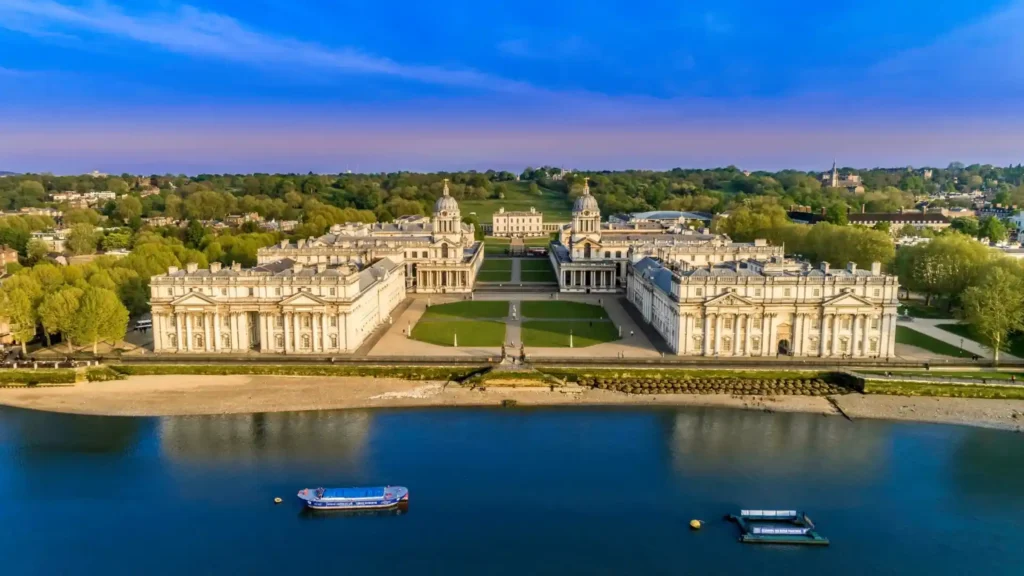
The Old Royal Naval College preserves the former Royal Hospital for Seamen, an institution established in the late seventeenth century to support naval veterans, and its Wren-designed buildings remain among England’s most important Baroque architectural ensembles.
The Old Royal Naval College occupies the riverside site associated with the former Greenwich Palace. The palace declined after the Stuart period, leaving an unfinished royal building complex that was later adapted for the Royal Hospital for Seamen.
Queen Mary II revived the proposal for a naval hospital during the 1690s. The institution was intended to provide accommodation and welfare for retired and disabled sailors. Its development reflected the expanding importance of the Royal Navy to Britain’s military and commercial power.
Sir Christopher Wren prepared the principal architectural plan. Wren was one of England’s leading architects and designed St Paul’s Cathedral after the Great Fire of London. Nicholas Hawksmoor also played an important role in the development of the Greenwich complex.
The buildings were arranged around two principal courts separated by a central axis. Their riverfront position gave the institution an imposing architectural relationship with the Thames.
The Painted Hall is the most celebrated interior. It was decorated by Sir James Thornhill between 1707 and 1726. The extensive painted programme presents allegorical and historical imagery connected with monarchy, naval power, commerce, and national achievement. The Old Royal Naval College describes it as one of England’s greatest decorative painted schemes.
The Chapel of St Peter and St Paul provides another important architectural layer. The chapel was built between 1696 and 1712 as part of Wren’s original plan. A fire in 1779 destroyed much of the interior, after which James “Athenian” Stuart redesigned the space in a Neoclassical style.
The former hospital also demonstrates how naval welfare became institutionalized. Pensioners lived within the complex under regulations governing their daily lives. The institution therefore provides evidence of the social history of Britain’s maritime workforce, not simply its military history.
Today, the Old Royal Naval College preserves the architectural structure, Painted Hall, Chapel, riverfront setting, and archaeological associations of the former institution. UNESCO identifies the complex as one of the central components of Maritime Greenwich’s Outstanding Universal Value.
Why should history enthusiasts visit the Queen’s House?
The Queen’s House is historically important because Inigo Jones designed it from 1616 as a pioneering Palladian building, introducing an influential classical architectural language to England and establishing a major royal setting for art and court culture.
The Queen’s House represents an important change in British architectural history. Inigo Jones designed the building for Anne of Denmark, wife of James I, beginning in 1616. Jones had studied European architecture and introduced ideas associated with Italian Renaissance and Palladian design.
Palladianism refers to an architectural tradition derived from the work of Italian architect Andrea Palladio. It emphasizes classical proportions, symmetry, columns, and restrained ornament. The Queen’s House became an influential example of this approach in England.
The building formed part of the royal landscape at Greenwich. Its position created a visual relationship with the river, park, and royal palace. The architectural composition also reflected the growing importance of classical design within royal and aristocratic culture.
UNESCO identifies the Queen’s House as the first Palladian building in Britain and states that it influenced classical houses and villas constructed across the country during the following two centuries.
The building later acquired an important maritime connection through its use by the Royal Hospital School. Its subsequent association with the National Maritime Museum strengthened Greenwich’s role as a centre for preserving naval and royal collections.
The Queen’s House now forms part of Royal Museums Greenwich. Its collections include royal portraits and works associated with British artistic history. The building itself remains an important heritage object because its architecture demonstrates how European classical ideas entered English royal design.
The Great Hall and Tulip Staircase are among its best-known architectural features. The building therefore offers a different historical perspective from the naval and scientific institutions nearby.
For researchers studying architectural history, royal patronage, visual culture, or the development of British classicism, the Queen’s House provides direct evidence of seventeenth-century design transformation.
How did the Royal Observatory change navigation and global timekeeping?
The Royal Observatory was founded in 1675 to improve astronomical knowledge for navigation, and its observations later established Greenwich as the reference point for longitude and time, connecting astronomy with maritime navigation, railway coordination, international timekeeping, and global geography.
King Charles II founded the Royal Observatory in 1675. John Flamsteed became the first Astronomer Royal after receiving a Royal Warrant on 4 March 1675. The foundation stone was laid on 10 August 1675.
The original purpose was practical. Seafarers could determine latitude relatively effectively by observing celestial bodies, but determining longitude was much harder. Longitude identifies a location east or west of a reference meridian.
The Observatory was established to improve astronomical observations and develop information that could assist navigation. Flamsteed lived and worked at the Observatory and made more than 50,000 observations of the Moon and stars during his career.
The development of accurate clocks became central to solving the longitude problem. A navigator could compare local astronomical time with a reference time and calculate the difference in longitude. This relationship between time and position became fundamental to maritime navigation.
John Harrison later demonstrated that precision marine timekeepers could provide a practical solution to determining longitude at sea. Several of Harrison’s timekeepers are associated with the Royal Observatory’s interpretation of time and navigation.
Greenwich also became central to standardized civil time. In 1833, the Greenwich Time Ball was installed at Flamsteed House. The ball provided a visible time signal for ships on the Thames and remains an important surviving symbol of nineteenth-century public timekeeping.
By the 1840s, most British railway companies had adopted Greenwich Mean Time to coordinate railway schedules. In 1880, Greenwich time became the legal standard in Britain. The International Meridian Conference of 1884 selected Greenwich as the Prime Meridian at longitude 0 degrees.
The modern global reference system later developed beyond GMT. Coordinated Universal Time, or UTC, is now the international standard for precise civil time. Greenwich remains historically significant because the Prime Meridian and Greenwich Mean Time established a powerful geographical and temporal reference framework.
The Royal Observatory therefore connects astronomy directly with maritime history. Its importance is not limited to telescopes. It represents the scientific infrastructure required to coordinate ships, maps, clocks, railways, and international geography.
What makes the National Maritime Museum essential for understanding British maritime history?
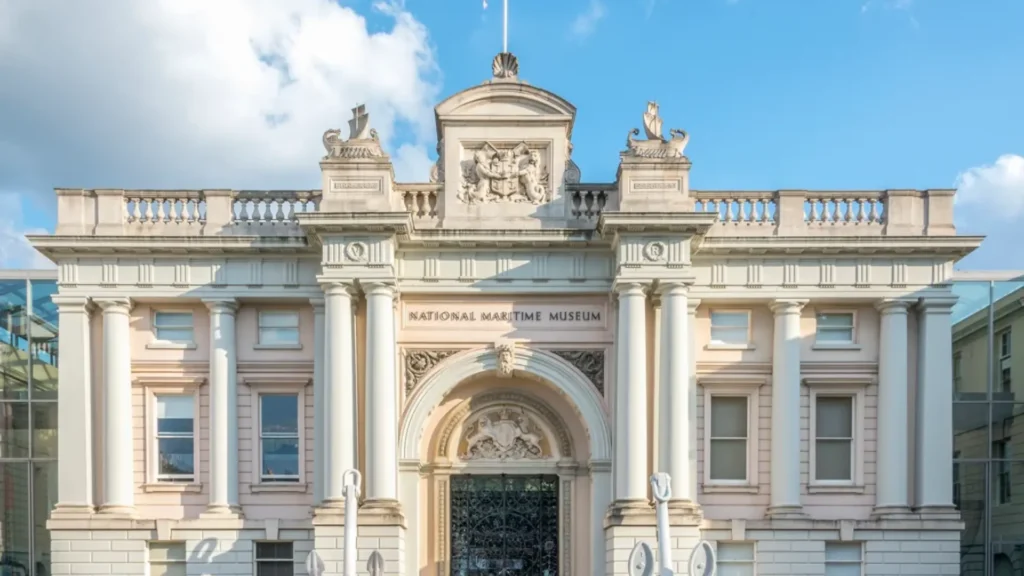
The National Maritime Museum preserves extensive collections covering naval warfare, exploration, trade, navigation, maritime labour, migration, scientific development, and British seafaring, providing the broad historical context needed to understand Greenwich’s wider maritime landscape.
The National Maritime Museum opened in 1937 and became a major institution for preserving Britain’s maritime heritage. Royal Museums Greenwich now comprises the National Maritime Museum, Royal Observatory, Queen’s House, and Cutty Sark, linking maritime history with astronomy, art, and navigation.
The museum covers a chronological and thematic range that extends beyond the Royal Navy. Its collections examine ships, sailors, trade, exploration, navigation, cartography, migration, warfare, and everyday relationships with the sea.
The Caird Library and Archive is particularly important for academic research. Royal Museums Greenwich describes it as home to the world’s largest maritime archive and library collection.
The museum also provides evidence for studying Britain’s imperial and commercial history. Maritime expansion connected Britain with ports, colonies, trading networks, naval conflicts, and global commodities.
This context is essential when studying Greenwich itself. The Royal Observatory explains navigation through astronomy. Cutty Sark represents commercial shipping. The Old Royal Naval College represents naval welfare and education. The National Maritime Museum provides the wider historical framework connecting these subjects.
The museum’s collections also support genealogical research. Records and objects associated with ships, sailors, officers, merchants, naval institutions, and migration provide historical evidence for people whose lives were connected with maritime Britain.
The institution therefore functions as both a visitor attraction and a research resource. Its role extends beyond displaying historic objects because its collections preserve documentary and material evidence for interpreting Britain’s relationship with the sea.
Why is Cutty Sark one of Greenwich’s most important maritime attractions?
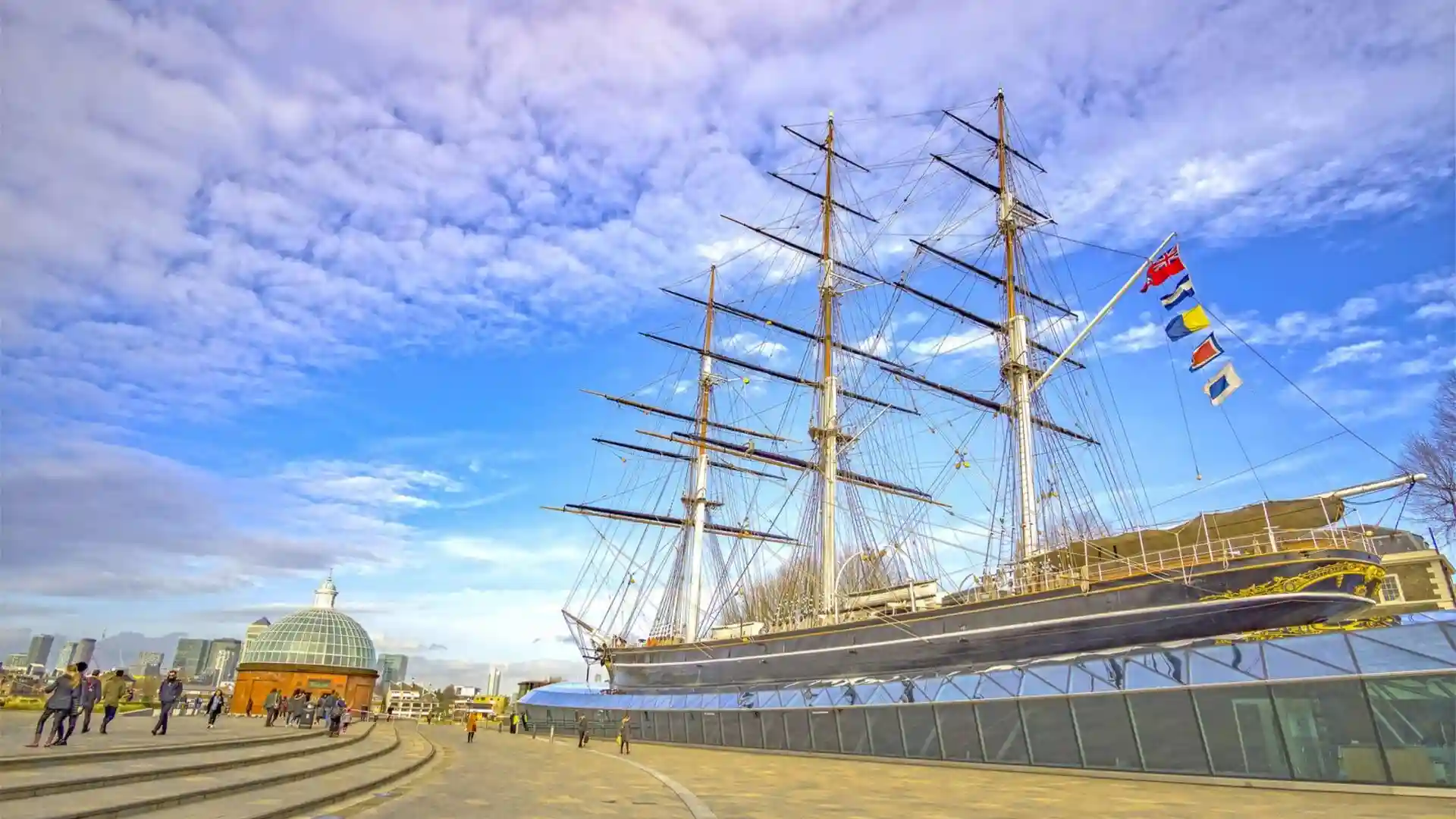
Cutty Sark is the world’s only surviving extreme clipper and a major surviving example of nineteenth-century commercial sailing technology, preserving evidence of the China tea trade, Australian wool trade, global shipping, and the transition from sail to steam.
Cutty Sark was launched in Dumbarton, Scotland, on 22 November 1869. Shipowner John Willis commissioned the vessel for the China tea trade, while Hercules Linton was the designer. The ship was built for speed during a period of intense competition between tea clippers.
The tea trade created strong commercial incentives for speed. Victorian consumers valued early-season tea, and merchants sought to bring new cargoes to London quickly. Clipper ships were designed with long narrow hulls, sharp bows, tall masts, and extensive sail areas.
Cutty Sark had approximately 32,000 square feet of sail area and around 11 miles of rigging. Its main mast was approximately 153 feet high. The hull used a composite construction of timber attached to an iron framework, combining structural strength with a relatively light design.
The ship completed eight voyages to China carrying tea. Its tea-trading career was disrupted by the opening of the Suez Canal in 1869. Steamships could use the canal to shorten the journey between Europe and Asia by more than 3,000 miles, giving them a major commercial advantage.
Cutty Sark subsequently became associated with the Australian wool trade. This transition demonstrates a major process in maritime history: sailing vessels adapted to changing global trade routes while steam technology increasingly transformed long-distance shipping.
The ship later became a training vessel before entering preservation. It was moved to Greenwich and opened to the public in 1957. A major restoration followed a fire in 2007, and Queen Elizabeth II reopened the restored ship in 2012.
Cutty Sark is therefore more than a preserved ship. Its structure provides direct evidence of nineteenth-century ship design, cargo capacity, rigging technology, maritime labour, global trade, and the economic forces that accelerated the transition from sail to steam.
What can visitors learn from Greenwich Park’s archaeological and royal history?
Greenwich Park preserves archaeological evidence from Roman and Anglo-Saxon periods alongside royal landscapes, Tudor associations, seventeenth-century French garden design, the Royal Observatory, wartime remains, and long-standing public use, making it an essential historical landscape within Maritime Greenwich.
Greenwich Park has been settled since Roman times. Archaeological investigation identified the remains of a Roman temple in the southern part of the park, excavated in 1999. More than 30 Anglo-Saxon burial mounds also survive in the western part of the park.
The medieval history of the park became closely connected with the Crown. Humphrey, Duke of Gloucester, inherited the land in 1427 and enclosed the park in 1433. He also constructed a tower on the site later occupied by the Royal Observatory.
The Tudor period strengthened the royal identity of Greenwich. Henry VIII was born at Greenwich in 1491 and introduced deer to the park. His daughters Mary I and Elizabeth I were also born at Greenwich.
During the seventeenth century, James I replaced the park’s earlier enclosure with a substantial brick wall. Charles II later commissioned André Le Nôtre, the French landscape designer associated with Versailles, to develop a formal landscape scheme.
Le Nôtre’s design introduced avenues, formal banks, and geometric relationships between landscape elements. The surviving structure demonstrates the influence of continental landscape design on royal England. UNESCO recognizes Greenwich Park as an important example of symmetrical landscape design applied to irregular terrain.
The park also preserves modern historical evidence. During the First World War, sections were used for allotments. During the Second World War, three air-raid shelters served local residents. Archaeologists and Royal Parks volunteers uncovered a largely intact shelter near the Queen’s House in 2019.
Greenwich Park therefore provides a chronological landscape extending from Roman archaeology to modern wartime history. Its significance rests on surviving physical evidence as well as royal associations.
How does St Alfege Church fit into Greenwich’s historical landscape?
St Alfege Church represents Greenwich’s historic parish community and adds an ecclesiastical dimension to the royal, naval, and scientific heritage of the district, with the present church rebuilt to designs associated with Nicholas Hawksmoor between 1712 and 1714.
St Alfege Church stands within the historic town centre of Greenwich. Its name refers to Alfege, an eleventh-century Archbishop of Canterbury who was killed at Greenwich in 1012 after being captured by Viking forces.
The medieval church became part of the developing settlement around the royal palace. The present building reflects the architectural transformation of Greenwich during the early eighteenth century.
Nicholas Hawksmoor designed the rebuilding undertaken between 1712 and 1714. The church forms part of the historic urban setting surrounding Maritime Greenwich. UNESCO specifically identifies the church and Greenwich town centre as elements contributing to the World Heritage Site.
The church is important because Greenwich was not only a royal and naval centre. It was also a permanent community with parish institutions, residents, businesses, religious practices, and burial traditions.
For genealogical researchers, parish churches provide an important historical context because parish administration traditionally recorded events such as baptisms, marriages, and burials. Such records help reconstruct family connections and population history when surviving archival material is available.
St Alfege therefore completes the historical picture by connecting monumental royal and naval buildings with the everyday institutional history of Greenwich’s residents.
How should visitors connect Greenwich’s attractions into one historical experience?
The most coherent historical route connects the Thames, Cutty Sark, Old Royal Naval College, National Maritime Museum, Queen’s House, Greenwich Park, and Royal Observatory, following the development of trade, naval power, royal patronage, astronomy, navigation, and standardized time.
The physical arrangement of Greenwich makes this sequence especially effective for historical study. The River Thames provides the starting point because it explains Greenwich’s relationship with shipping, trade, naval movement, and London’s wider river economy.
Cutty Sark then introduces nineteenth-century commercial shipping. Its construction, cargoes, crew, voyages, and transition from tea to wool demonstrate how global trade shaped maritime technology.
The Old Royal Naval College shifts the focus from commerce to state power and naval welfare. Its architecture demonstrates how the Crown invested in institutions supporting naval veterans and later naval education.
The National Maritime Museum expands the chronology. Its collections connect individual ships and institutions with wider themes such as exploration, warfare, trade, navigation, migration, and maritime labour.
The Queen’s House provides the architectural and royal context. Its Palladian design demonstrates the transformation of English architecture under royal patronage.
Greenwich Park connects the built environment with archaeology and landscape design. Roman remains, Anglo-Saxon burial mounds, Tudor associations, Le Nôtre’s formal landscape, and the Royal Observatory demonstrate that the area developed through many historical periods.
The Royal Observatory completes the intellectual sequence. Astronomy transformed navigation by improving knowledge of celestial positions and time. The resulting Greenwich reference system later influenced longitude, railway time, civil time, and international geography.
To experience this historic landscape in person today, consult our comprehensive [Why Greenwich Became the Birthplace of Global Maritime Timekeeping Standards] for itineraries and visiting parameters.
This sequence also reflects the UNESCO concept of Maritime Greenwich as an integrated cultural landscape rather than a group of unrelated monuments. The World Heritage boundary includes the major buildings, Royal Park, town centre, and associated setting.
How has Greenwich preserved its historical identity into the modern era?
Greenwich has preserved its historical identity through listed buildings, archaeological protection, museum collections, conservation programmes, the World Heritage framework, adaptive reuse of historic structures, and continued public access to its royal, naval, scientific, and maritime sites.
The preservation of Greenwich depends on multiple institutions. Royal Museums Greenwich manages the National Maritime Museum, Queen’s House, Royal Observatory, and Cutty Sark. The Old Royal Naval College is maintained through a dedicated charitable organisation. Greenwich Park is managed by The Royal Parks.
UNESCO’s World Heritage designation provides an international framework for protecting the cultural significance of Maritime Greenwich. The site contains Grade I listed buildings, scheduled monuments, registered parkland, conservation areas, and other heritage protections.
Adaptive reuse has also preserved historic structures. The former Royal Naval College buildings now accommodate educational institutions while remaining accessible as heritage buildings. The change demonstrates how historic architecture can retain a public function after its original institutional purpose ends.
Cutty Sark provides another preservation example. Its conservation as a museum ship transformed a former working merchant vessel into a permanent educational resource. Restoration work following the 2007 fire enabled the ship to reopen in 2012.
The Royal Observatory also demonstrates adaptive interpretation. Its original scientific operations moved away from Greenwich as observing conditions deteriorated and the Royal Observatory relocated to Herstmonceux in the twentieth century. The Greenwich site subsequently developed as a museum and heritage attraction.
Greenwich Park retains its historic landscape structure while archaeological projects continue to reveal evidence of earlier occupation. The discovery of the Second World War air-raid shelter demonstrates that heritage research continues to add new layers to the district’s historical record.
These preservation strategies ensure that Greenwich remains useful for historians, educators, researchers, and visitors. The district functions simultaneously as an archaeological landscape, architectural conservation area, museum complex, educational centre, and living London neighbourhood.
What is Greenwich’s long-term historical importance?
Greenwich’s long-term importance lies in its unusually direct connection between royal government, naval institutions, global trade, astronomy, navigation, architecture, standardized time, and heritage preservation, creating a historical record that links local London history with Britain’s international maritime development.
Greenwich demonstrates how national and global systems developed through local institutions. The royal palace created the original political importance. The Royal Hospital connected the district with naval welfare. The Royal Naval College later connected it with naval education. The Observatory connected Greenwich with astronomy and navigation.
Commercial shipping added another dimension. Cutty Sark illustrates the global movement of commodities and the technological competition between sailing ships and steamships. The National Maritime Museum places these developments within the broader history of British maritime activity.
The Greenwich Meridian created an even wider legacy. The 1884 International Meridian Conference selected Greenwich as the Prime Meridian, establishing longitude 0 degrees as the international geographical reference. Greenwich Mean Time also became a major standard for coordinating clocks and schedules before modern UTC became the international scientific time standard.
The district’s architectural significance is equally durable. Inigo Jones’s Queen’s House influenced British Palladian architecture. Wren’s Royal Hospital complex represents a major achievement in English Baroque architecture. Le Nôtre’s Greenwich Park landscape demonstrates the influence of formal continental garden design.
Greenwich also demonstrates the historical importance of conservation. The continued survival of buildings, landscapes, archaeological remains, archives, artworks, scientific instruments, and ships allows modern researchers to examine physical evidence rather than relying solely on written accounts.
For educators, Greenwich provides a compact field-study environment covering architecture, monarchy, maritime trade, naval history, archaeology, astronomy, geography, science, and industrial change.
For genealogists, the historic town and institutional records provide context for families connected with sailors, naval personnel, merchants, artisans, educators, and residents.
For heritage preservationists, Greenwich demonstrates how a historic district can accommodate universities, museums, tourism, public parks, conservation projects, and a permanent residential community while retaining its historical character.
The continuing relevance of Greenwich comes from this layered identity. Its importance does not depend on a single monument. The Royal Observatory explains time and longitude. Cutty Sark explains global commerce. The Old Royal Naval College explains naval institutions. The Queen’s House explains architectural change. Greenwich Park preserves royal and archaeological landscapes. The National Maritime Museum connects these subjects through extensive collections.
Together, these attractions make Greenwich one of London’s most concentrated environments for studying the relationship between Britain, the sea, science, monarchy, architecture, and global historical change. The district remains a significant example of how local heritage can preserve evidence of processes that reshaped international navigation, commerce, government, and culture.
Frequently Asked Question
What are the best historical attractions in Greenwich?
The best historical attractions in Greenwich include the Royal Observatory, Old Royal Naval College, Queen’s House, Greenwich Park, National Maritime Museum, Cutty Sark, and St Alfege Church. Together, they cover royal, naval, architectural, scientific, archaeological, and maritime history.