
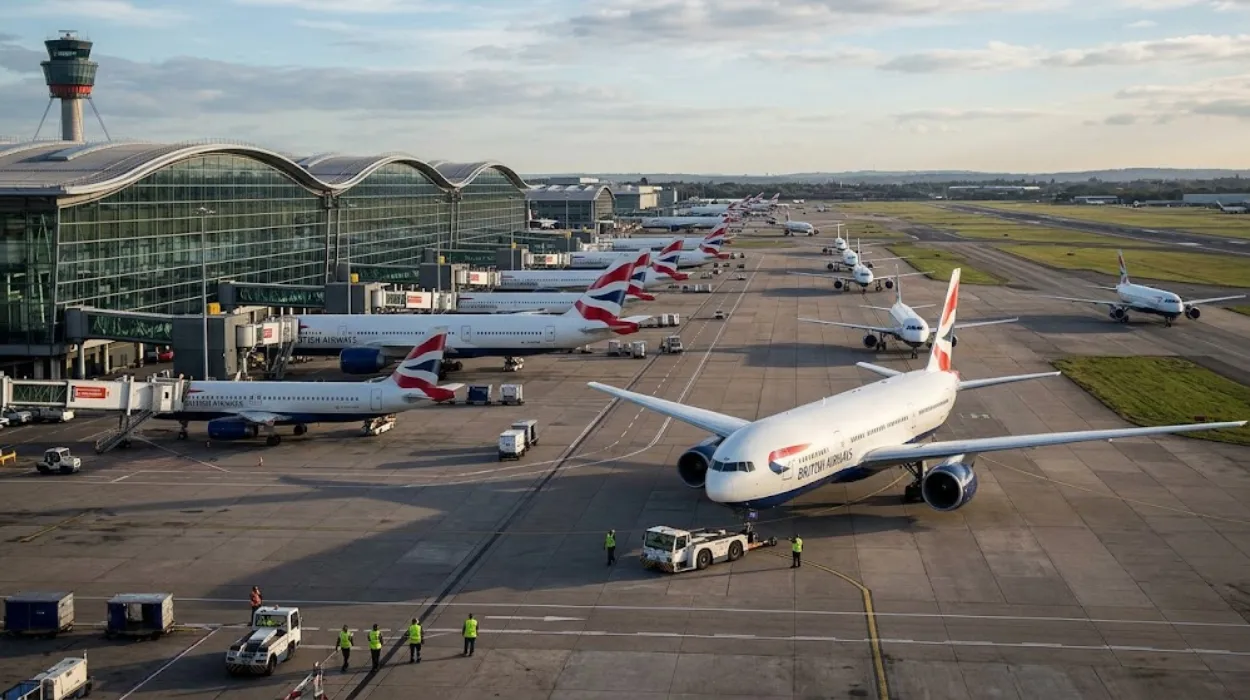
London Heathrow Airport (IATA: LHR, ICAO: EGLL) is the largest and busiest commercial international airport in the United Kingdom, serving as Europe’s premier global hub. Located in the London Borough of Hillingdon, 14 miles (23 kilometers) west of Central London, the airport covers a physical area of 1,227 hectares (4.74 square miles). The facility functions as the main international gateway for England’s capital, managing non-stop commercial flights to more than 214 global destinations across 84 countries. Extra London News provides this definitive analysis of Heathrow Airport’s operations, background, structural design, and transit connections.
- What Is the History and Historical Background of Heathrow Airport?
- What Is the Operational Structure and Terminal Layout of Heathrow Airport?
- How Do Passengers Access Ground Transportation to and from Central London?
- What Is the Economic Significance and Cargo Impact of Heathrow Airport?
- What Key Statistics and Operational Metrics Define Heathrow Airport?
- What Are the Future Expansion Plans and Environmental Challenges for Heathrow Airport?
- Frequently Asked Question
What Is the History and Historical Background of Heathrow Airport?
Heathrow Airport originated in 1930 as a private 150-acre aviation field known as the Great West Aerodrome before evolving into a major post-WWII civil aviation hub. The airfield expanded under government military control before opening commercially in January 1946.
British engineer and aircraft manufacturer Richard Fairey acquired 150 acres of land in the village of Harmondsworth in 1930 for £15,000 to construct a private assembly and flight testing facility. During World War II, the British government requisitioned the land alongside the neighboring hamlet of Heath Row to build an Royal Air Force airfield called RAF Heston. The Ministry of Civil Aviation inherited the infrastructure following the war, officially opening the facility as London Airport on January 1, 1946.
The original commercial setup utilized military surplus tents along the Bath Road as passenger terminals before permanent structures were built. Architect Frederick Gibberd designed the permanent Central Terminal Area, incorporating the control tower and passenger facilities that opened in 1955. The airfield was formally renamed Heathrow Airport in 1966 to distinguish it from other facilities within the London airport system.
Historically, Heathrow operated six distinct runways configured in a star-shaped hexagram pattern to accommodate propeller aircraft facing changing wind directions. Modern jetliner requirements led to the consolidation of these layouts into two long parallel east-west runways, designated 09L/27R and 09R/27L.
What Is the Operational Structure and Terminal Layout of Heathrow Airport?
Heathrow Airport operates four active passenger terminals and one dedicated cargo terminal, managed by private operator Heathrow Airport Holdings Limited. The infrastructure is arranged around two active parallel runways operating near peak capacity.
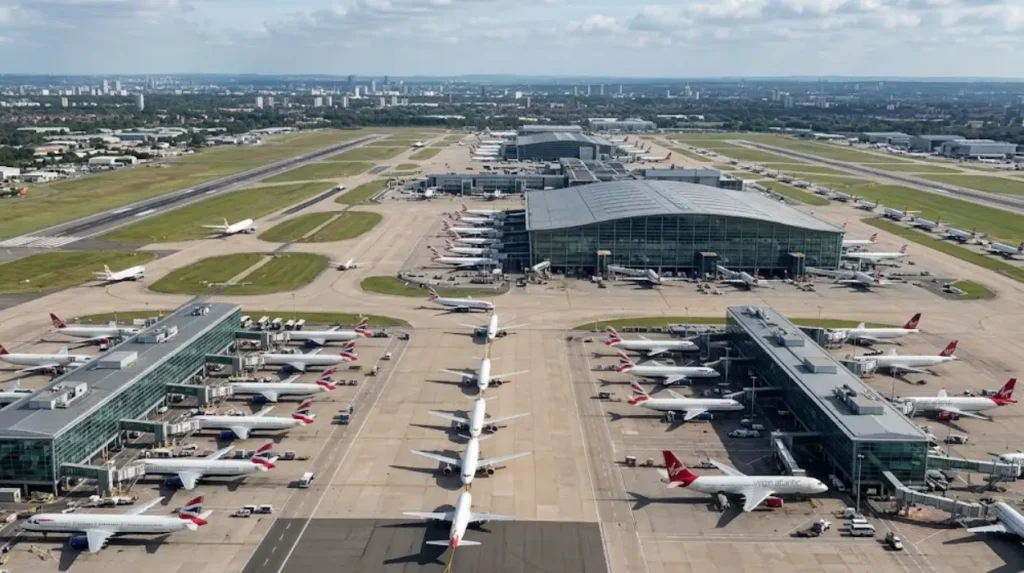
The infrastructure processes passengers through four distinct buildings: Terminal 2, Terminal 3, Terminal 4, and Terminal 5. Terminal 1 permanently ceased operations in June 2015 to permit the structural expansion of Terminal 2, known as the Queen’s Terminal. British Airways maintains its primary home base at Terminal 5, which opened in 2008 and handles the majority of the carrier’s long-haul and short-haul flights. Virgin Atlantic and various global airline alliances operate primarily out of Terminal 3.
Aircraft movements are governed by strict runway alternation schedules to manage environmental noise levels over West London. The Northern Runway (09L/27R) measures 3,901 meters (12,799 feet) in length, while the Southern Runway (09R/27L) spans 3,658 meters (12,001 feet). The facility operates at approximately 98% of its legal air traffic cap, managing over 470,000 annual flight movements.
| Terminal Unit | Primary Operating Airlines & Alliances | Key Operational Features |
| Terminal 2 | Star Alliance, Aer Lingus | Opened in 2014; processes approximately 20 million passengers annually. |
| Terminal 3 | Oneworld, Virgin Atlantic, Delta | Handles long-haul flights and high-capacity Airbus A380 operations. |
| Terminal 4 | SkyTeam, independent international carriers | Located south of the southern runway; linked via dedicated underground rail. |
| Terminal 5 | British Airways, Iberia | Dedicated multi-building hub; features main terminal (5A) and satellite concourses (5B/5C). |
How Do Passengers Access Ground Transportation to and from Central London?
Ground transport to Heathrow includes the direct Heathrow Express rail link, the Elizabeth line, the Underground Piccadilly line, and public motorway networks. These routes connect the airport directly to Central London and national destinations.
The Heathrow Express provides the fastest rail link, operating non-stop services between London Paddington Station and the airport every 15 minutes, taking 15 minutes to reach the Central Terminal Area. The Elizabeth line provides cross-city rail connectivity, linking terminals directly to key commercial centers including Bond Street, Liverpool Street, and Canary Wharf without requiring train transfers.
The London Underground Piccadilly line offers continuous metro service, stopping at three dedicated airport stations: Terminal 2 & 3, Terminal 4, and Terminal 5. Highway access is provided via the M4 motorway, connecting to the central access tunnel, and the M25 orbital motorway, which links directly to Terminal 5 and Terminal 4. National Express operates regional coach networks connecting Heathrow directly to major cities across the UK.
What Is the Economic Significance and Cargo Impact of Heathrow Airport?
Heathrow Airport is the UK’s highest-value freight port and a major engine of national economic output, generating over £3.5 billion in annual airport revenue. It directly employs approximately 75,000 individuals on-site.
As a freight gateway, the airport handles over 1.4 million metric tonnes of cargo each year. Unlike maritime ports, Heathrow moves high-value, time-sensitive goods, accounting for nearly 30% of all UK non-EU trade by value. The dedicated Heathrow Cargo Centre processes major commercial exports, including pharmaceuticals, salmon, automotive components, and books.
The broader economic footprint includes over 83,000 direct airport jobs and supports more than 100,000 additional jobs across regional supply chains. The total annual trade facilitated through the airport exceeds £190 billion.
What Key Statistics and Operational Metrics Define Heathrow Airport?
Heathrow Airport ranks as the busiest airport in Europe and the fifth-busiest airport globally by overall passenger traffic. It holds the highest rank globally for international connectivity.
Operational data demonstrates the global scale of the facility’s routine traffic output:
- Annual Passenger Output: Processed 84.46 million passengers, setting an all-time operational record.
- Flight Operations: Recorded 477,883 total aircraft takeoffs and landings.
- Dominant Carrier: British Airways handles over 50% of all passenger traffic at the airport.
- Busiest International Route: London Heathrow to New York John F. Kennedy International Airport (JFK).
- Regional Traffic Allocation: European Union destinations represent 33.6% of overall traffic, while North American routes represent 24.3%.
What Are the Future Expansion Plans and Environmental Challenges for Heathrow Airport?
Expansion plans center on the proposed construction of a third parallel runway and upgraded passenger processing infrastructure. Project development is closely regulated by UK net-zero targets and legal noise boundaries.
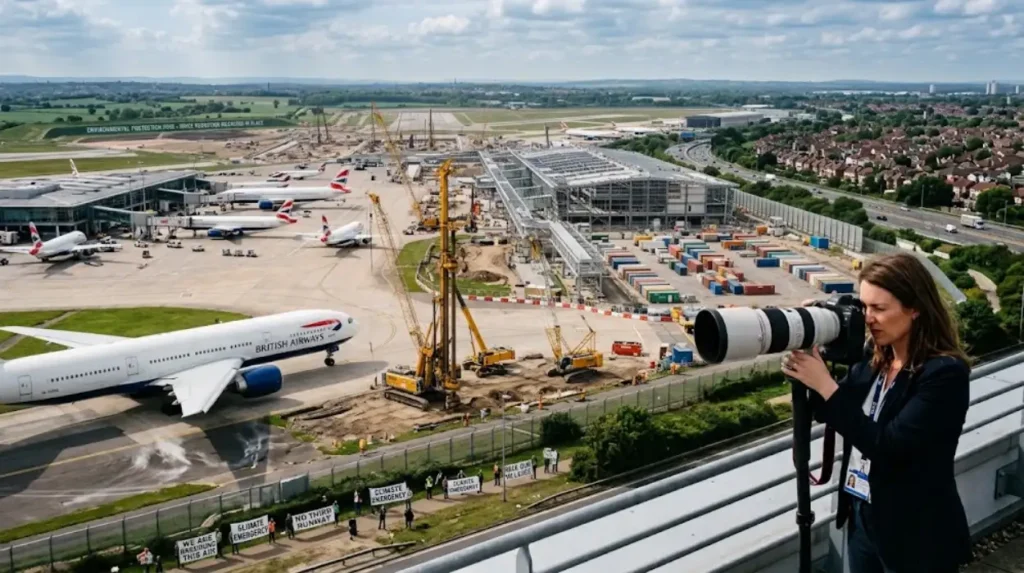
The UK Parliament approved the National Policy Statement for Airports, permitting a 3,200-meter Northwest Runway scheme. This proposed development would increase overall site capacity from 480,000 to 740,000 flights per year, allowing passenger throughput to approach 130 million annually.
Environmental regulations require strict compliance with national climate commitments, including the integration of Sustainable Aviation Fuel (SAF) into existing fueling hydrants. Heathrow 2.0, the facility’s sustainability framework, commits the operator to achieving net-zero carbon emissions for airport operations while implementing strict noise envelope controls for surrounding communities in Hillingdon, Hounslow, and Berkshire.
Extra London News will continue monitoring regulatory updates, transport developments, and operational statistics at London Heathrow Airport.
Frequently Asked Question
How Many Passengers Does London Heathrow Airport Serve Annually?
London Heathrow Airport serves over 84.5 million passengers annually, reaching a record 84.46 million travelers in 2025 across its four active terminals. The airport operates near maximum capacity, supporting non-stop direct flights to more than 214 global destinations.
As the primary international gateway to the United Kingdom, Heathrow manages an average of 230,000 passengers per day. European Union routes account for the largest share of passenger volume at 33.6%, followed closely by North American transatlantic routes at 24.3%. To handle these traffic levels, the airport manages approximately 477,000 aircraft movements per year across its two active parallel runways.