London’s royal history extends far beyond Buckingham Palace. For more than 1,000 years, monarchs shaped the city’s political institutions, religious life, military defences, ceremonial traditions, and architecture. Medieval fortresses, Tudor palaces, royal chapels, ceremonial parks, and former hunting grounds remain preserved across the capital. Together, these sites reveal how the British monarchy evolved from Norman conquest through the Tudor, Stuart, Georgian, Victorian, and modern eras.
- Why should history lovers explore royal attractions beyond Buckingham Palace?
- Which royal attraction best explains the origins of the English monarchy?
- How does Westminster Abbey preserve Britain’s royal history?
- Why is Hampton Court Palace essential for understanding Tudor monarchy?
- What makes Kensington Palace historically significant?
- How do the Palace of St James’s and Clarence House remain connected to the monarchy?
- Why are the Royal Parks part of Britain’s royal heritage?
- What royal collections can visitors explore at the Royal Mews and the King’s Gallery?
- How did Greenwich become one of England’s most important royal centres?
- How have London’s royal landmarks survived into the modern era?
- Why do London’s royal attractions remain historically important today?
- Frequently Asked Question
Many visitors focus exclusively on Buckingham Palace because it serves as the monarch’s official London residence. However, history enthusiasts gain a far deeper understanding of Britain’s royal heritage by exploring London’s wider network of royal attractions. These landmarks preserve original buildings, archaeological remains, ceremonial spaces, royal collections, and historic landscapes that illustrate nearly a millennium of constitutional development.
Why should history lovers explore royal attractions beyond Buckingham Palace?
London’s wider collection of royal landmarks preserves over 1,000 years of monarchy, architecture, politics, religion, warfare, and ceremonial tradition. Together, these attractions provide a complete understanding of how successive monarchs shaped England and later the United Kingdom through governance, diplomacy, patronage, and cultural development.
Buckingham Palace became the monarch’s principal residence only in 1837 when Queen Victoria established it as the official royal home. Before that date, generations of English and British monarchs lived, governed, worshipped, entertained foreign ambassadors, and defended their kingdoms from numerous other royal residences across London.
The capital contains surviving Norman fortresses, Tudor palaces, medieval abbeys, royal ceremonial routes, hunting parks, and former government complexes that explain how royal authority developed over centuries.
These landmarks also reflect major constitutional changes, including the signing of Magna Carta in 1215, the English Reformation during the reign of Henry VIII, the English Civil War between 1642 and 1651, the Glorious Revolution of 1688, and Britain’s transition into a constitutional monarchy during the eighteenth and nineteenth centuries.
Many sites retain original masonry, royal apartments, chapels, defensive walls, ceremonial halls, and archaeological evidence dating back hundreds of years. Together they create one of the world’s richest surviving royal landscapes.
Which royal attraction best explains the origins of the English monarchy?
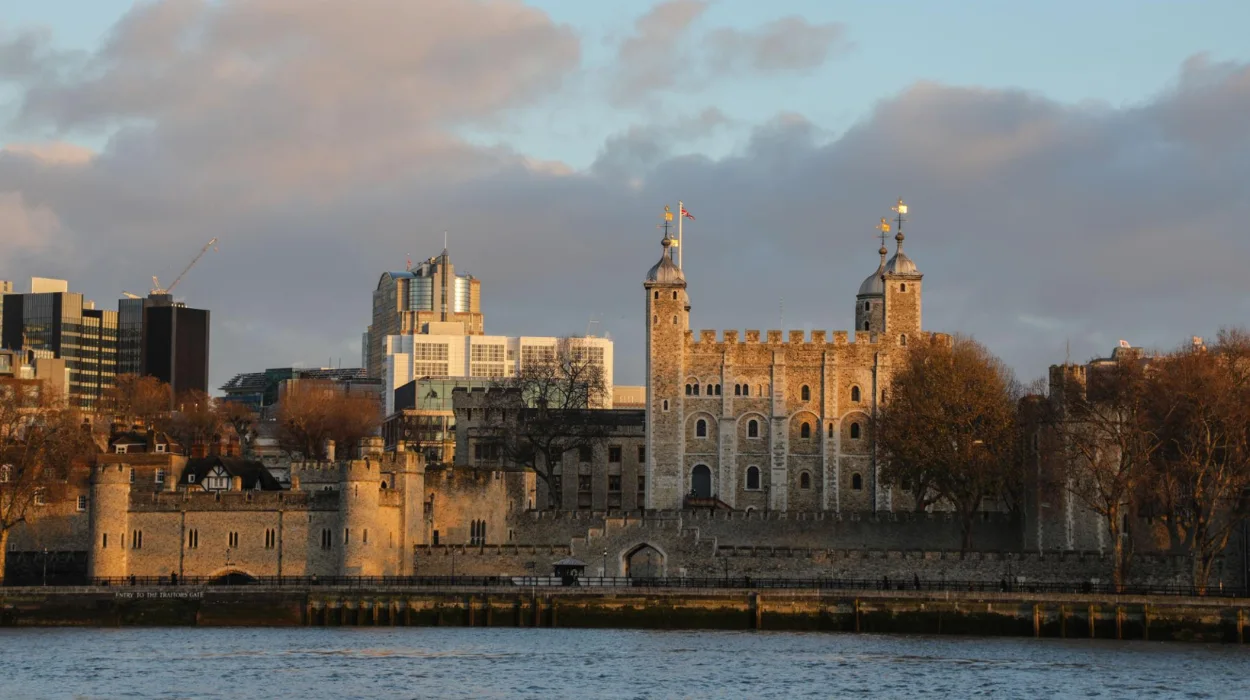
The Tower of London provides the clearest surviving record of royal authority because it functioned as a fortress, palace, treasury, prison, armoury, and administrative centre from the Norman Conquest onward. Its buildings document nearly one thousand years of continuous royal history.
The Tower of London
Founded shortly after the Norman Conquest of 1066, the Tower of London began with the construction of the White Tower under William I around 1078.
Its original purpose was military dominance. The massive Norman keep projected royal authority over the newly conquered capital while protecting strategic access to the River Thames.
Over successive centuries, monarchs expanded the complex into multiple defensive rings containing royal residences, administrative offices, minting facilities, royal archives, and military barracks.
The Tower also housed famous historical prisoners, including Anne Boleyn, Lady Jane Grey, Sir Walter Raleigh, and Rudolf Hess.
The Crown Jewels remain housed within the fortress today. The collection includes St Edward’s Crown, the Imperial State Crown, the Sovereign’s Orb, and ceremonial regalia used during British coronations.
UNESCO designated the Tower of London as a World Heritage Site in 1988 because of its exceptional historical significance.
To experience this historic landmark in person today, consult our comprehensive [The History of Britain’s Royal Residences and Their Importance to the Monarchy] for itineraries and visiting parameters.
How does Westminster Abbey preserve Britain’s royal history?
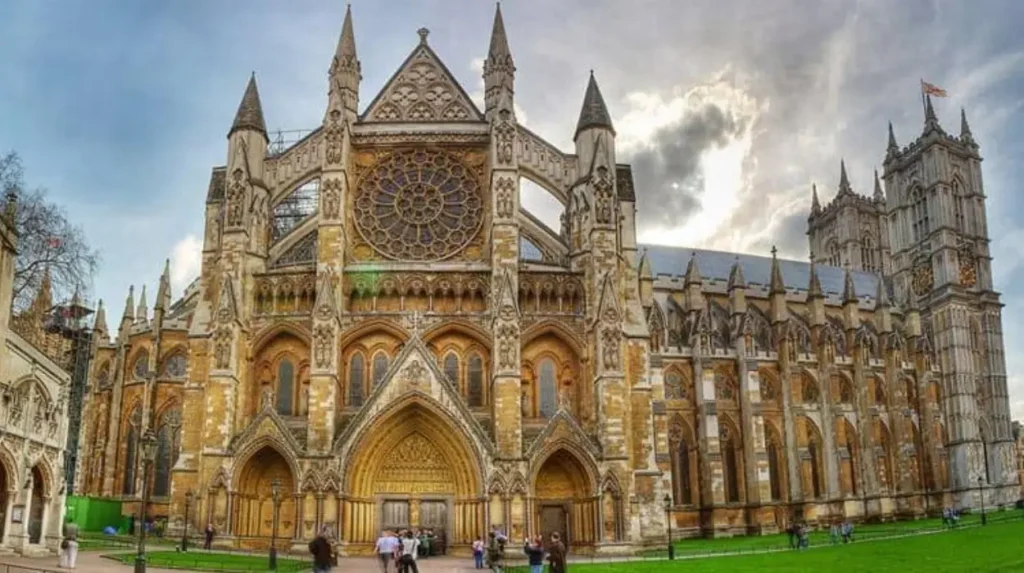
Westminster Abbey preserves Britain’s monarchy through coronations, royal weddings, state funerals, and burials spanning almost one thousand years. Every English and British coronation since 1066, except two examples including Edward V and Edward VIII, connects directly to this historic church.
The Coronation Church
King Edward the Confessor founded Westminster Abbey during the eleventh century. The current Gothic church largely dates from the rebuilding programme initiated by Henry III in 1245.
The Coronation Chair, commissioned in 1296 by Edward I, remains one of Britain’s oldest surviving items of royal furniture.
Since the coronation of William the Conqueror on Christmas Day 1066, Westminster Abbey has hosted almost every English and British coronation.
The abbey also contains the tombs of numerous monarchs, including Henry III, Edward I, Edward III, Richard II, Henry V, Elizabeth I, Mary I, James I, Charles II, and Mary Queen of Scots.
Royal weddings have added another chapter to the abbey’s history. Queen Elizabeth II married Prince Philip there in 1947, while Prince William married Catherine Middleton in 2011.
Beyond royalty, Westminster Abbey also honours scientists, writers, politicians, military leaders, and national figures whose contributions shaped Britain.
Why is Hampton Court Palace essential for understanding Tudor monarchy?
Hampton Court Palace demonstrates how Tudor monarchy combined political authority, religious transformation, diplomacy, domestic life, and artistic patronage. The palace preserves original Tudor architecture alongside later Baroque additions commissioned by William III during the seventeenth century.
Cardinal Wolsey’s Palace
Construction began in 1514 for Cardinal Thomas Wolsey, chief minister to King Henry VIII.
When Wolsey lost royal favour in 1529, Henry VIII acquired the palace and transformed it into one of Europe’s grandest royal residences.
The palace became closely associated with Henry’s six marriages.
Anne Boleyn, Jane Seymour, Catherine Howard, Anne of Cleves, Katherine Parr, and Catherine of Aragon all spent significant periods connected to Hampton Court.
Henry also used the palace during the English Reformation, when England separated from papal authority under the Church of Rome.
The Great Hall remains one of Britain’s finest surviving medieval-inspired royal interiors. Its hammerbeam roof reflects exceptional Tudor craftsmanship.
William III later commissioned Sir Christopher Wren to redesign parts of the palace in the Baroque style, creating an architectural contrast between Tudor and seventeenth-century royal tastes.
The surviving kitchens demonstrate the enormous logistical operation required to feed hundreds of courtiers daily.
What makes Kensington Palace historically significant?
Kensington Palace illustrates the evolution of constitutional monarchy from the late Stuart period through the Georgian, Victorian, and modern royal family. The palace served as the birthplace, residence, and workplace of several monarchs across more than three centuries.
From William III to Queen Victoria
William III and Mary II purchased Nottingham House in 1689 before expanding it into Kensington Palace.
Architect Sir Christopher Wren redesigned the residence to accommodate the royal court while providing healthier surroundings away from central London’s pollution.
Queen Anne continued to use the palace extensively before the Hanoverian monarchs established it as their principal London residence.
King George I and King George II governed from Kensington Palace during the eighteenth century.
Queen Victoria was born there in 1819 and spent her childhood within its walls before ascending the throne in 1837.
The palace also became associated with Diana, Princess of Wales, whose residence there during the late twentieth century reinforced its modern royal importance.
Today, restored State Apartments, royal collections, paintings, and exhibitions interpret more than 300 years of royal domestic history.
How do the Palace of St James’s and Clarence House remain connected to the monarchy?
St James’s Palace remains the senior ceremonial royal palace despite Buckingham Palace serving as the monarch’s principal residence. Together with neighbouring Clarence House, these buildings continue supporting constitutional, diplomatic, and ceremonial functions within Britain’s monarchy.
The Tudor Palace That Still Matters
Henry VIII commissioned St James’s Palace between 1531 and 1536 on the site of a former leper hospital.
Its red-brick Tudor gatehouse survives largely intact despite numerous fires affecting surrounding buildings.
Although monarchs stopped living there permanently after the reign of William IV, St James’s Palace remains the official senior royal palace.
The Accession Council formally proclaims every new sovereign there.
Foreign ambassadors continue presenting diplomatic credentials through court procedures associated with St James’s Palace.
Adjacent Clarence House, completed during the 1820s, became the London residence of Queen Elizabeth The Queen Mother and later King Charles III before his accession.
Together these buildings demonstrate the continuity of ceremonial monarchy even as royal residential patterns evolved.
Why are the Royal Parks part of Britain’s royal heritage?
London’s Royal Parks originated as royal hunting grounds, private estates, and ceremonial landscapes before gradually opening to the public. Their historical development reflects changing relationships between monarchy, urban planning, conservation, recreation, and constitutional government across several centuries.
Royal Landscapes
Eight Royal Parks cover approximately 5,000 acres across Greater London.
Hyde Park originated as part of Westminster Abbey before Henry VIII acquired it during the Dissolution of the Monasteries in 1536.
St James’s Park developed from marshland transformed into a royal deer park under Henry VIII before Charles II redesigned it with French landscape influences.
Green Park once formed part of royal hunting grounds.
Richmond Park, enclosed by Charles I during the seventeenth century, still supports one of Britain’s largest free-ranging deer populations.
Bushy Park, Greenwich Park, Kensington Gardens, and Regent’s Park also originated through royal patronage.
These landscapes preserve original avenues, lakes, monuments, ceremonial routes, and ecological habitats alongside their historical importance.
What royal collections can visitors explore at the Royal Mews and the King’s Gallery?
The Royal Mews and the King’s Gallery preserve ceremonial transport, decorative arts, paintings, sculpture, manuscripts, and royal collections accumulated over centuries. These institutions explain how monarchy supported artistic patronage, diplomacy, craftsmanship, and state ceremony throughout British history.
Ceremonial Collections
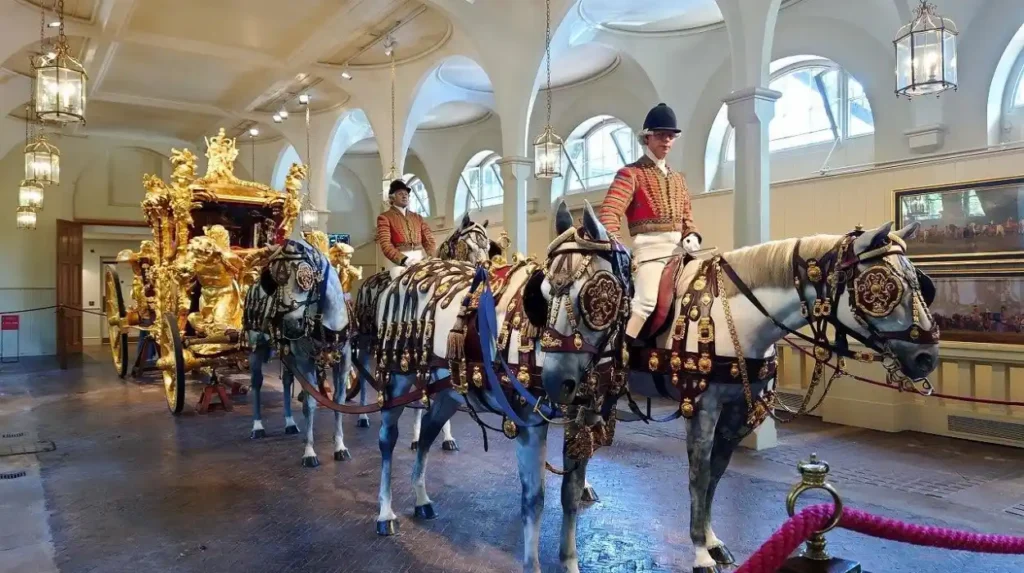
The Royal Mews houses one of the world’s finest working collections of historic state coaches.
Its most famous vehicle is the Gold State Coach, completed in 1762 for George III.
The coach weighs approximately four tonnes and appears during coronations, jubilees, and state occasions.
Visitors also encounter ceremonial horses, carriages, and transport equipment that continue serving official royal functions.
Nearby, the King’s Gallery displays rotating exhibitions drawn from the Royal Collection.
The Royal Collection contains more than one million objects accumulated by successive monarchs.
Paintings by Leonardo da Vinci, Rembrandt, Canaletto, Vermeer, Rubens, and Holbein form part of this internationally significant collection.
Unlike privately owned collections, these artworks remain held in trust by the Sovereign for the nation.
How did Greenwich become one of England’s most important royal centres?
Greenwich developed into a major royal residence during the fifteenth and sixteenth centuries, becoming the birthplace of Henry VIII, Mary I, and Elizabeth I. Its surviving buildings and landscapes connect Tudor monarchy with maritime expansion and scientific innovation.
Tudor Greenwich
The Palace of Placentia stood on the Greenwich waterfront from the fifteenth century until the seventeenth century.
Henry VIII was born there in 1491.
Mary I followed in 1516.
Elizabeth I was born there in 1533.
Although the palace disappeared after the Civil War, its legacy shaped subsequent development.
Sir Christopher Wren later designed the Old Royal Naval College on the site.
Nearby Greenwich Park remains London’s oldest enclosed royal park, established during the fifteenth century.
The Royal Observatory, founded in 1675 by Charles II, later established Greenwich Mean Time and contributed significantly to global navigation.
Greenwich therefore connects royal patronage with Britain’s emergence as a maritime power.
How have London’s royal landmarks survived into the modern era?
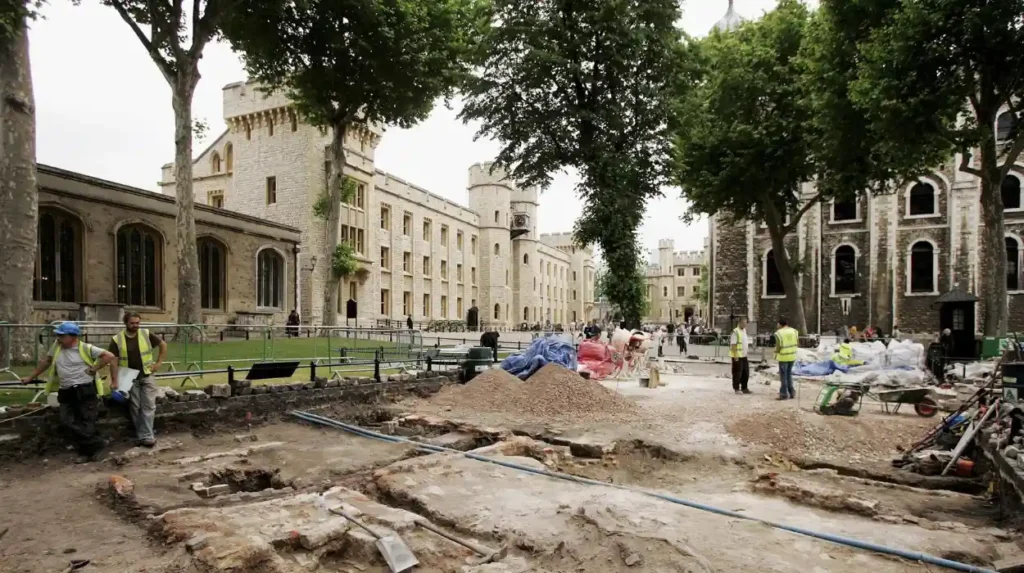
Royal landmarks survive through conservation legislation, charitable management, public funding, archaeological research, and heritage protection. Restoration programmes preserve historic fabric while allowing millions of visitors to understand Britain’s constitutional, architectural, and cultural development through authentic historical environments.
Conservation and Preservation
Many royal sites receive legal protection through Listed Building status or Scheduled Monument designation.
Several also enjoy UNESCO World Heritage recognition.
Conservation specialists use archaeological evidence, archival records, architectural surveys, and scientific analysis to preserve historic structures while maintaining authenticity.
Organisations including Historic Royal Palaces, English Heritage, the Royal Collection Trust, the Royal Parks charity, and Westminster Abbey oversee preservation programmes.
Historic Royal Palaces alone manages several major royal landmarks, including the Tower of London, Hampton Court Palace, Kensington Palace, Banqueting House, Hillsborough Castle, and Kew Palace.
Annual maintenance involves specialist stonemasons, conservators, historians, archaeologists, architects, gardeners, and collections experts.
Digital documentation, laser scanning, climate monitoring, and structural analysis increasingly support long-term conservation planning.
Public access also contributes to preservation by generating revenue for restoration while promoting education and historical understanding.
Why do London’s royal attractions remain historically important today?
London’s royal attractions remain historically significant because they preserve authentic evidence of monarchy, constitutional development, architecture, religion, diplomacy, warfare, ceremonial tradition, and national identity across nearly one thousand years of continuous British history.
Together, these landmarks illustrate how royal authority evolved rather than remaining static.
The Tower of London represents medieval military power.
Westminster Abbey demonstrates the enduring relationship between monarchy and religion.
Hampton Court Palace explains Tudor government and the English Reformation.
Kensington Palace reflects the emergence of constitutional monarchy and domestic royal life.
St James’s Palace preserves ceremonial continuity.
The Royal Parks illustrate changing relationships between monarchy and public space.
Greenwich connects royal patronage with scientific progress and maritime expansion.
Meanwhile, the Royal Mews and the King’s Gallery preserve ceremonial traditions and artistic patronage that continue shaping Britain’s cultural identity.
For history lovers, visiting these attractions creates a chronological journey through the development of England and the United Kingdom. Collectively, they preserve architecture, collections, landscapes, documents, and ceremonial traditions that continue informing historical scholarship, heritage conservation, education, and public understanding. Their survival ensures that future generations can study Britain’s royal past through authentic places rather than reconstructed interpretations.
Frequently Asked Question
What are the best royal attractions to visit in London beyond Buckingham Palace?
The best royal attractions beyond Buckingham Palace include the Tower of London, Westminster Abbey, Hampton Court Palace, Kensington Palace, St James’s Palace, the Royal Mews, the King’s Gallery, Greenwich, and London’s Royal Parks.