Key Points
- London Trams carried out rare test runs driving trams in reverse (anti-clockwise) through the Croydon town centre loop.
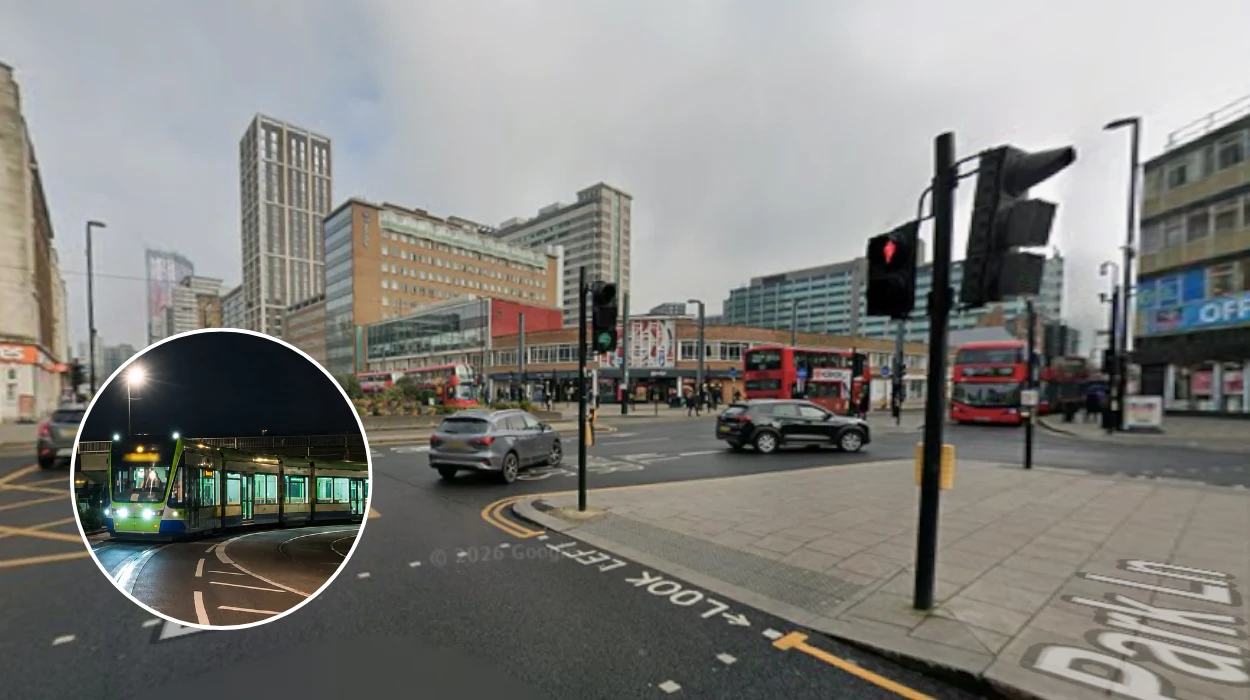
- The test involved two trams—one from each fleet type—travelled from Reeves Corner along Church Street and into George Street late at night.
- Temporary road closures and traffic marshals were deployed to ensure safety during the unusual trial manoeuvre.
- The exercise was conducted ahead of a scheduled three-week partial closure of the London Trams network in August for major infrastructure and track replacement works.
- The successful test allows operators greater operational flexibility, enabling trams to be repositioned through the town centre to continue services toward New Addington, Elmers End, and Beckenham Junction while bypassing closed sections.
- Transport for London (TfL) officials highlighted that trams have not regularly run backwards through this specific loop since 1999.
London (Extra London News) July 24, 2026 — Seeing a tram heading the wrong way through Croydon town centre might normally be a sign that something has gone very wrong. However, as reported by journalist Ian Mansfield of ianvisits, a few weeks ago, it was exactly what was supposed to happen as part of a meticulously planned technical trial. The unusual sight was part of a preparatory test ahead of a scheduled partial closure of the London Trams network for essential engineering works. The upcoming engineering works will shutter the entire central section of the tram network, but to maintain a reliable service profile, operators will occasionally need to move vehicles from one side of the network to the other.
Because trams haven’t been driven the wrong way through the network since 1999, transport authorities deemed it vital to check whether such a manoeuvre remained feasible. Late at night, two trams—representing each fleet type—travelled from Reeves Corner along Church Street and into George Street, navigating a route normally reserved exclusively for the opposite direction. Temporary road closures and traffic marshals were heavily relied upon to ensure the test was executed safely.
Why Was This Reverse-Direction Trial Necessary?
To understand the operational logic behind the decision, one must look at the upcoming infrastructure constraints.
As detailed by journalist Ian Mansfield of ianvisits, the successful trial grants London Trams much greater flexibility during the intensive engineering period. Instead of forcing passengers onto inevitable and often congested replacement buses, trams can be cleverly repositioned through the heart of the town centre.
This capability ensures that lines running toward New Addington, Elmers End, and Beckenham Junction can sustain localized operations.
Adding further context regarding the scheduling and infrastructure needs, transport authorities explained the broader scope of the project.
As revealed by Transport for London’s general manager of the tram network, Mark Davis, in an interview covered by Inside Croydon, the network’s operators conducted test runs with trams running anti-clockwise between Reeves Corner, Church Street, and George Street to East Croydon. Mark Davis stated that the reverse-direction trial was an absolute operational necessity:
“to confirm that it will be possible for trams to be brought in from one part of the network to the depot at Therapia Lane for servicing and safety checks during the engineering works.”
Explore More Croydon News
Phoenix City Chinese Takeaway Zero Hygiene Rating Croydon 2026
Croydon Council Opposes Draft London Plan Over Green Belt In Croydon 2026
How Will the Upcoming August Engineering Works Disrupt Services?
The vital maintenance project involves a half-mile stretch of the network that requires comprehensive intervention. As reported by Mark Davis of Transport for London via Inside Croydon, the scheduled disruption will take place from Thursday, August 6, to Sunday, August 30. During this period, the track segment between Tamworth Road (Centrale) and along Wellesley Road will experience a complete closure while the infrastructure is replaced.
While acknowledging the inevitable service interruptions, Mark Davis offered an official apology and a look toward long-term benefits, stating:
“The good news, of course, is that as we renew the infrastructure in those particular areas, which will hopefully lead to fewer emergency positions where we have to carry out repairs to broken rails and things like that.”
Davis further added:
“Yes, there is going to be some disruption during the summer, for which I wholeheartedly apologise, but what it will mean is that once completed the tramway will become more reliable because the assets are a lot newer.”
What Safety Concerns Do Transport Managers Have Regarding Croydon’s Trams?
The operational trial also brought underlying safety challenges into sharp focus, particularly concerning public interaction with the tramway infrastructure. During discussions surrounding the network’s day-to-day management, senior leadership raised alarms regarding pedestrian attentiveness.
As noted by Mark Davis of Transport for London in insights published by Inside Croydon, transport managers harbor deep concerns over the increasing number of pedestrians who walk through Croydon town centre while absorbed by mobile phones or tablets. These distracted pedestrians frequently fail to check for oncoming trams in busy zones such as George Street, Church Street, or outside East Croydon.
Highlighting the frequency of close calls on the ground, Mark Davis of Transport for London stated that the tram system is consistently affected by
“around one road traffic incident per month, mostly due to cars which jump red lights and cross the tracks as a tram is on-coming.”
Furthermore, Davis emphasized the daily hazards, noting that
“there’s reported one near-miss a day with pedestrians crossing the tracks.”
These stark statistics underline why transport authorities implemented strict measures—such as traffic marshals and temporary road closures—during the recent reverse-loop testing phase, ensuring that an already complex technical manoeuvre did not compound local safety risks.
Ultimately, while commuters may briefly see Croydon’s trams appearing to ignore standard road direction arrows during the upcoming summer engineering period, the advanced testing ensures a more resilient and flexible transit network for South London.