The Great Fire of London remains one of the most significant events in British urban history. Between 2 and 6 September 1666, a devastating fire swept through the medieval City of London, destroying thousands of buildings, reshaping the urban landscape, and influencing city planning for centuries. Today, visitors can follow a historical trail through surviving landmarks, memorials, churches, and reconstructed streets that preserve the memory of this transformative event.
- What was the Great Fire of London and why does its trail matter today?
- Where did the Great Fire of London begin?
- How does The Monument commemorate the Great Fire?
- Why is St Paul’s Cathedral central to the Great Fire story?
- Which churches rebuilt after the fire form part of the trail?
- What can visitors learn from the streets and layout of the City of London?
- How did Sir Christopher Wren shape the post-fire landscape?
- What evidence of the Great Fire survives in museums and archaeological sites?
- How did the Great Fire change London’s future?
- Why does following the Great Fire of London Trail remain important today?
For history enthusiasts, cultural tourists, educators, and researchers, the Great Fire of London Trail offers direct access to places connected with the disaster and its aftermath. Walking this route provides insight into seventeenth-century London, the mechanisms of urban recovery, and the architectural legacy that emerged from one of Europe’s most destructive urban fires.
What was the Great Fire of London and why does its trail matter today?
The Great Fire of London was a catastrophic urban fire that burned from 2 to 6 September 1666, destroying approximately 13,200 houses, 87 parish churches, and major civic buildings. Its surviving landmarks provide tangible evidence of London’s transformation from a medieval city into a modern capital.
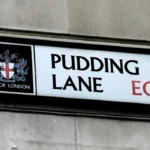
The fire began shortly after midnight on 2 September 1666 in a bakery owned by Thomas Farriner on Pudding Lane. Strong easterly winds, densely packed timber buildings, and dry summer conditions accelerated the spread of flames through the City of London.
By the time the fire was extinguished, approximately 436 acres of the city had been destroyed. Contemporary records estimate that around 70,000 of London’s 80,000 residents lost their homes. Remarkably, recorded deaths remained low, although modern historians believe casualties were underreported.
The historical trail matters because it connects visitors to authentic locations where key events unfolded. Unlike many historical disasters that leave few visible traces, the Great Fire’s footprint remains embedded in London’s streets, monuments, churches, and urban design.
The route also demonstrates how catastrophe accelerated change. New building regulations required brick and stone construction, wider streets, and improved fire prevention measures. These reforms influenced urban planning throughout Britain and beyond.
Where did the Great Fire of London begin?
The Great Fire began in Thomas Farriner’s bakery on Pudding Lane near the River Thames. This location marks the starting point of the historical trail and represents the point from which flames spread across medieval London.
Pudding Lane was a narrow street in the eastern section of the City of London. In 1666, the area consisted of closely packed wooden buildings with overhanging upper floors that created ideal conditions for fire transmission.
Although the original bakery no longer survives, the location remains one of the most important sites on the trail. Modern visitors can stand near the traditional origin point and observe the urban environment that once formed part of London’s commercial waterfront district.
The proximity of the bakery to the Thames highlights an important historical paradox. Despite being near a major water source, firefighting capabilities in seventeenth-century London remained limited. Firefighting relied largely on hand-operated equipment, leather buckets, and the demolition of nearby structures to create firebreaks.
Archaeological investigations and historical maps have helped scholars identify the fire’s point of origin with considerable confidence. Today, interpretive markers provide historical context for visitors seeking to understand how a local incident escalated into a citywide catastrophe.
How does The Monument commemorate the Great Fire?
The Monument was constructed between 1671 and 1677 to commemorate the Great Fire and celebrate London’s recovery. Standing 61.57 metres tall, it remains one of the most important physical memorials associated with the disaster.
Designed by Sir Christopher Wren and Robert Hooke, The Monument stands near the location where the fire began. Its height corresponds closely to its distance from the bakery on Pudding Lane.
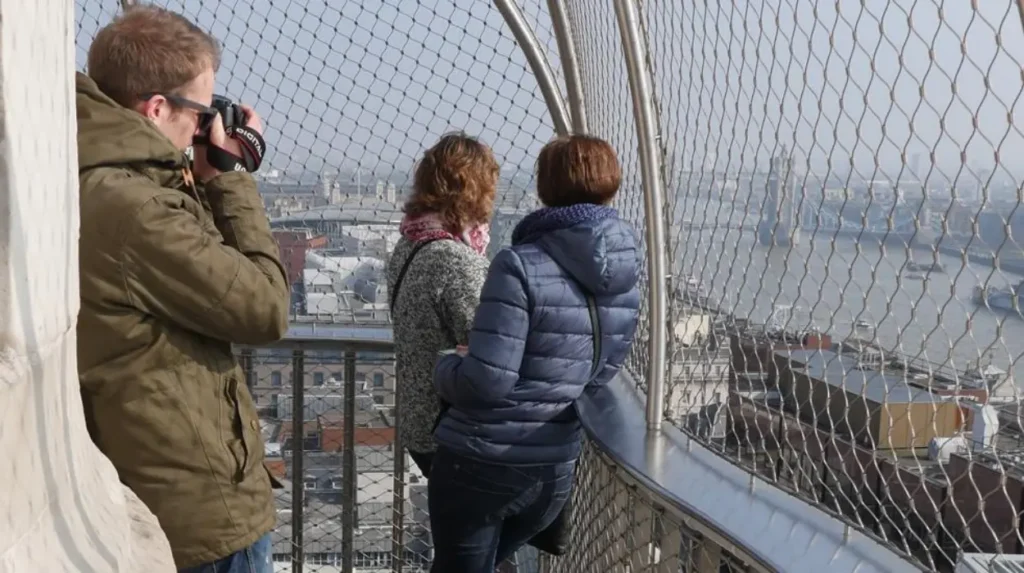
The structure serves several purposes. It functions as a memorial, an observation point, and a symbol of urban renewal. Visitors can climb 311 steps to reach the viewing platform, which provides panoramic views of the City of London.
The Monument incorporates extensive inscriptions describing the fire and the city’s reconstruction. These inscriptions offer valuable insight into how contemporaries interpreted the disaster and presented the recovery effort.
Architecturally, the column reflects classical influences popular during the Restoration period. Its design demonstrated London’s renewed confidence following years of political upheaval, plague, and fire.
For anyone following the Great Fire Trail, The Monument acts as the central interpretive landmark linking the beginning of the fire to the city’s subsequent reconstruction.
Why is St Paul’s Cathedral central to the Great Fire story?
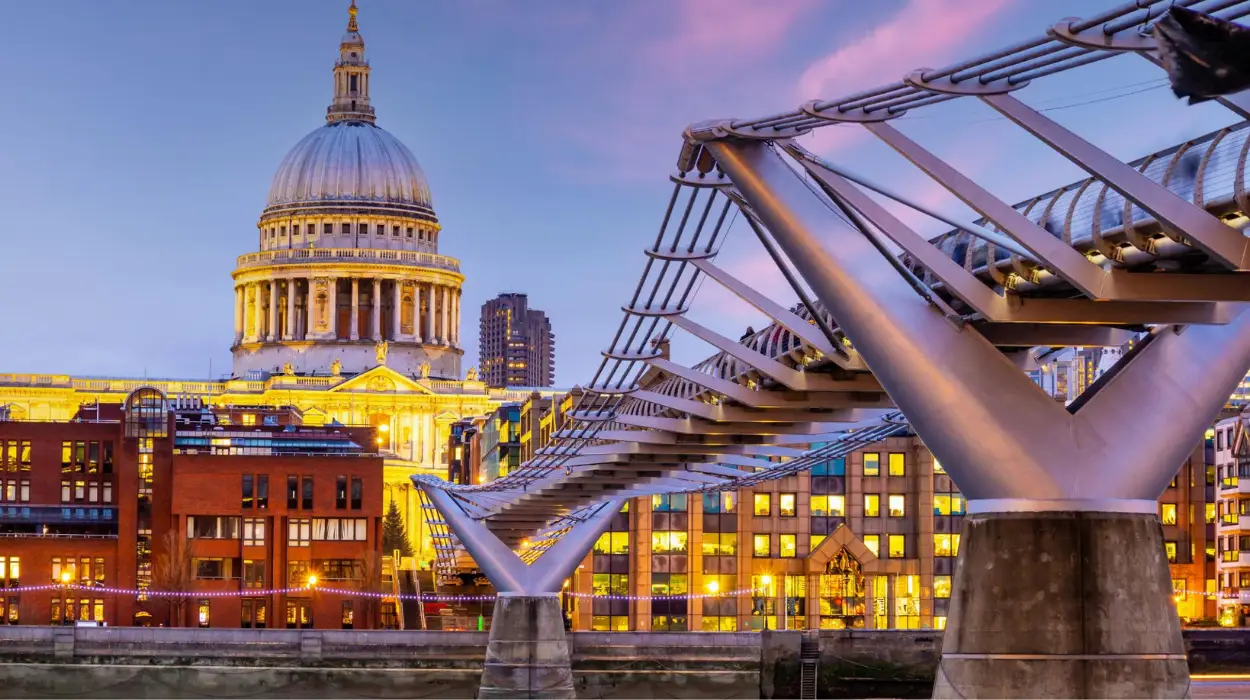
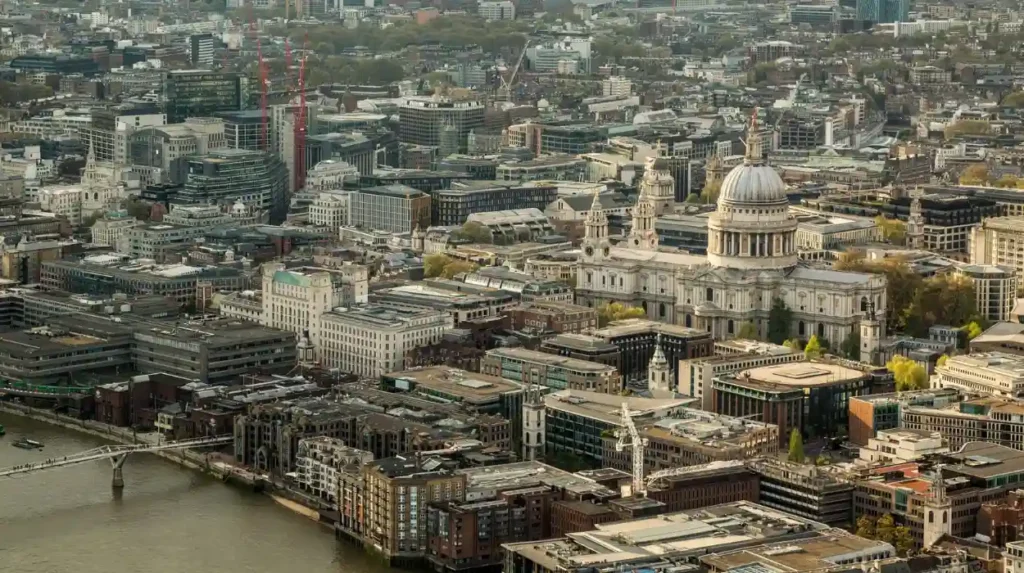
St Paul’s Cathedral symbolises both destruction and recovery because the medieval cathedral was destroyed during the fire and replaced by Sir Christopher Wren’s masterpiece, one of London’s most recognisable landmarks today.
The medieval St Paul’s Cathedral initially appeared likely to survive. Stone walls led many residents to believe the structure offered protection from the flames. As a result, merchants stored valuable goods within the cathedral.
These assumptions proved incorrect. Scaffolding surrounding restoration work caught fire, and intense heat caused extensive damage. Molten lead flowed through surrounding streets, while the roof collapsed under extreme temperatures.
The destruction of the cathedral represented a profound cultural and religious loss. St Paul’s had served as one of England’s most important ecclesiastical centres for centuries.
Reconstruction began under the leadership of Sir Christopher Wren. The new cathedral, completed largely by 1710, became one of the defining achievements of English architecture.
The building stands as a visible reminder of how London emerged from disaster with a new architectural identity. To experience this historic landmark in person today, consult our comprehensive The Great Fire of London: How the 1666 Disaster Reshaped the City for itineraries and visiting parameters.
Which churches rebuilt after the fire form part of the trail?
Dozens of churches rebuilt after the Great Fire survive today, providing direct evidence of London’s reconstruction programme. Many were redesigned by Sir Christopher Wren and remain active places of worship and heritage sites.
The fire destroyed 87 parish churches. Rebuilding these religious institutions became a major civic priority because churches served both spiritual and community functions.
Several surviving churches illustrate different aspects of post-fire reconstruction.
St Magnus the Martyr, located near London Bridge, stands close to the fire’s origin point and contains exhibits relating to the disaster. The church offers visitors a valuable introduction to the historical context of the event.
St Bride’s Church on Fleet Street represents another important stop. Its distinctive tiered spire became one of Wren’s most celebrated designs and influenced later architectural forms.
St Lawrence Jewry, rebuilt by Wren after destruction in the fire, continues to serve the City of London. The church demonstrates how reconstruction balanced continuity with innovation.
These churches collectively reveal the scale of rebuilding undertaken after 1666. They also demonstrate how architecture helped restore civic identity following widespread devastation.
What can visitors learn from the streets and layout of the City of London?
The modern street pattern of the City of London preserves evidence of both medieval origins and post-fire reconstruction. Walking the trail reveals how urban planning evolved in response to disaster and rebuilding priorities.
Before 1666, much of London consisted of narrow lanes, timber buildings, and dense development patterns inherited from the medieval period.
The fire created opportunities for reform. Although ambitious proposals to redesign the city on a grid system were never fully implemented, authorities introduced significant improvements.
New regulations required wider streets in selected areas. Brick and stone replaced timber as primary construction materials. Building heights and projections became more tightly regulated.
Visitors walking through areas such as Cheapside, Cornhill, and Fleet Street can observe how reconstruction influenced the city’s physical character.
Historical maps reveal the continuity of many medieval routes despite post-fire rebuilding. This combination of preservation and adaptation makes the City of London a valuable case study in urban resilience.
For educators and students, the street network provides a practical demonstration of how cities evolve after major disasters.
How did Sir Christopher Wren shape the post-fire landscape?
Sir Christopher Wren became the leading architect of London’s recovery, overseeing the design of St Paul’s Cathedral and more than fifty parish churches that defined the rebuilt city.
Wren emerged as the most influential figure in the reconstruction effort following the fire. Although several architects proposed redevelopment plans, Wren’s practical solutions aligned most closely with political and economic realities.
His work introduced elements of classical architecture into the urban landscape. Domes, columns, symmetry, and carefully proportioned facades became prominent features of the rebuilt city.
Wren’s influence extended beyond individual buildings. His projects established a coherent architectural identity that distinguished post-fire London from its medieval predecessor.
More than fifty churches attributed to Wren survived into modern times, although some were later damaged during wartime bombing. Together, these structures form a network of historical landmarks connected directly to the Great Fire narrative.
The rebuilding programme transformed London into a capital that reflected Restoration-era ambitions and emerging national confidence.
What evidence of the Great Fire survives in museums and archaeological sites?
Museums and archaeological discoveries preserve physical evidence of the Great Fire, including burned foundations, household artefacts, historical documents, and reconstruction records that help historians understand the disaster in detail.
Archaeological excavations across the City of London have uncovered numerous remains associated with the fire.
Researchers have identified burned building materials, charred timber, domestic objects, and structural foundations dating to the destruction layer of 1666. These discoveries provide scientific evidence that complements written records.
Museum collections preserve maps, eyewitness accounts, government documents, and reconstruction plans. Together, these materials allow historians to reconstruct the chronology and impact of the fire with considerable precision.
Excavations conducted during modern development projects continue to produce new information about pre-fire and post-fire London. Such findings contribute to ongoing research into urban life, commerce, housing, and recovery.
For genealogical researchers tracing family histories, these records provide valuable context regarding population displacement, property ownership, and community rebuilding after the disaster.
How did the Great Fire change London’s future?
The Great Fire permanently transformed London’s architecture, governance, public safety systems, and urban planning principles, creating foundations that influenced city development for centuries after 1666.
The immediate response included legislation governing rebuilding standards. The Rebuilding Act introduced stricter construction requirements intended to reduce future fire risks.
Brick and stone construction became widespread. Building regulations established clearer standards for walls, roofs, and street alignments.
The disaster also influenced insurance development. Fire insurance companies emerged during subsequent decades, introducing organised approaches to risk management and property protection.
Urban governance evolved as authorities recognised the importance of coordinated responses to emergencies. Over time, this contributed to improvements in firefighting infrastructure and public administration.
The fire’s legacy extends beyond London. Urban planners throughout Europe examined London’s experience when considering fire prevention measures and reconstruction strategies.
Modern disaster management principles continue to draw lessons from historical events such as the Great Fire, demonstrating the enduring relevance of the 1666 catastrophe.
Why does following the Great Fire of London Trail remain important today?
Following the Great Fire of London Trail connects visitors directly with locations that illustrate destruction, resilience, reconstruction, and urban transformation. The route provides one of the most complete historical experiences available within the modern City of London.
The trail combines multiple dimensions of historical interpretation. Visitors encounter the site of origin, memorials, rebuilt churches, reconstructed streets, and architectural landmarks linked to recovery.
Each location contributes evidence to a broader narrative about how societies respond to crisis. The trail demonstrates that cities are dynamic environments shaped by both human decisions and unexpected events.
For educators, the route provides a practical framework for teaching urban history, architecture, governance, and social change. For tourists, it offers a structured exploration of London’s historic core. For researchers, it preserves connections between physical spaces and documentary evidence.
More than three and a half centuries after the disaster, the Great Fire remains visible in London’s built environment. The surviving landmarks ensure that the event continues to inform public understanding of the city’s past.
Following the Great Fire of London Trail therefore represents more than a historical walk. It is an examination of how catastrophe reshaped one of the world’s most influential cities and how the legacy of 1666 continues to shape London’s identity today.
When did the Great Fire of London happen?
The Great Fire of London burned from 2 September to 6 September 1666, destroying much of the medieval City of London over four days.