Key Points
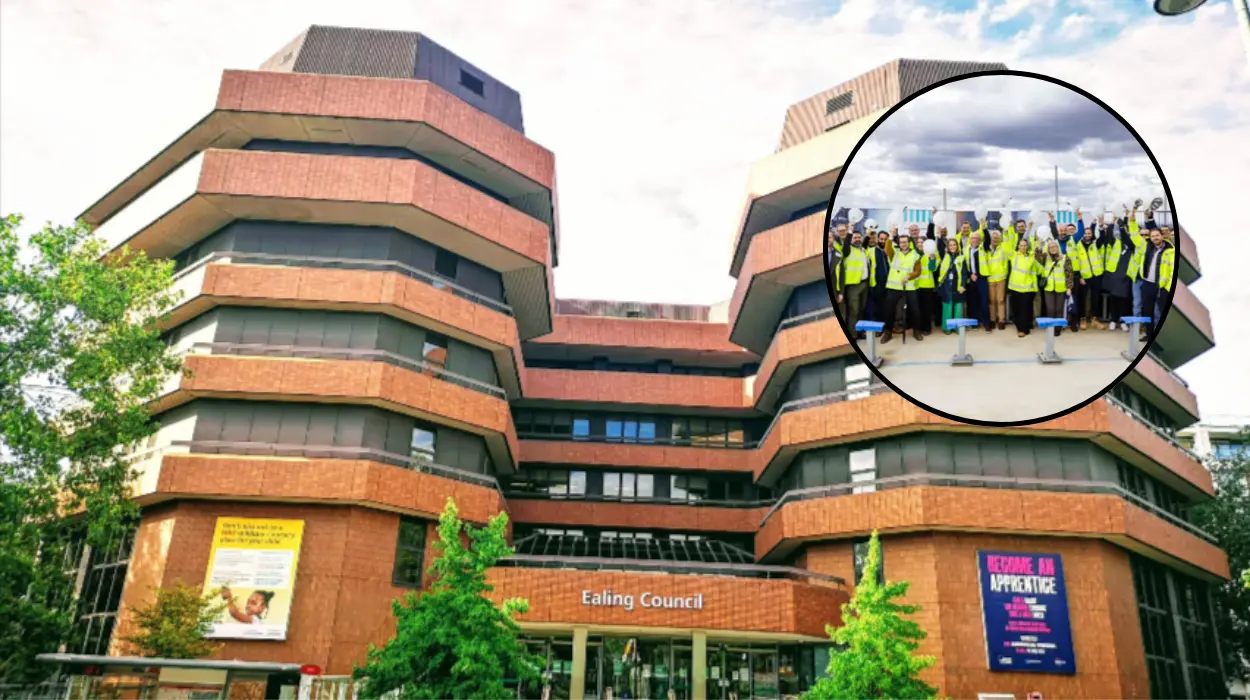
- Milestone Achieved: A traditional topping out ceremony was held to celebrate a major construction milestone for the “55 West” residential development in West Ealing.
- Affordable Housing Volume: The scheme will introduce 144 brand-new, 100% affordable homes dedicated to Londoners.
- Financial Structure: All 144 units are designated under the London Living Rent scheme, designed to help middle-income earners transition from renting to shared ownership.
- Strategic Location: The high-density brownfield development is located directly adjacent to the West Ealing Elizabeth Line station, offering premium transit links.
- Collaborative Partners: The project is a joint delivery by Metropolitan Thames Valley Housing (MTVH) and principal contractor HG Construction, supported by the Greater London Authority (GLA) and Ealing Council.
- Community Infrastructure: In addition to residential spaces, the building features a communal roof garden for residents and two flexible commercial units on the ground floor to support local business growth.
- Official Ceremony Date: Key stakeholders gathered on-site to mark the structural completion of the building’s highest point on 14 May 2026.
West Ealing (Extra London News) May 21, 2026 – A vital injection of affordable housing has moved a significant step closer to completion in West London as construction partners gathered to celebrate the official topping out of the “55 West” development. Located directly adjacent to the West Ealing Elizabeth Line station, the ambitious brownfield regeneration project will deliver 144 high-quality homes, all available at London Living Rent levels. Representatives from housing association Metropolitan Thames Valley Housing (MTVH), Tier 1 main contractor HG Construction, the Greater London Authority (GLA), and Ealing Council officially marked the structural milestone on 14 May 2026, signaling a major victory for transit-oriented, affordable housing development in the borough despite ongoing macroeconomic pressures in the wider UK construction sector.
- Key Points
- What is the significance of the 55 West topping out ceremony?
- Who are the key partners delivering the West Ealing affordable housing project?
- How does the London Living Rent scheme benefit local residents?
- What did the leadership of MTVH and HG Construction say about the milestone?
- What amenities and design features are included in the 55 West development?
- Why is the location next to the West Ealing Elizabeth Line station critical?
- How does this development fit into Ealing Council’s wider housing targets?
What is the significance of the 55 West topping out ceremony?
The topping out ceremony signifies that the highest structural point of the 55 West building has been successfully completed, moving the project from its heavy structural framing phase into internal fit-outs and external cladding. Beyond the physical bricks and mortar, the event symbolizes the successful navigation of complex urban planning and supply chain hurdles in a post-pandemic economic landscape.
By utilizing a previously underused brownfield site, the development directly aligns with London’s planning policies to maximize land-use efficiency near major infrastructure assets. As reported by structural engineering correspondents across municipal trade journals, the completion of the primary concrete frame allows contractors to accelerate interior works, keeping the project on schedule to welcome its first residents in the near future.
The event gathered executive leadership and local authority planners to acknowledge the collective effort required to bring 144 deeply affordable homes to an area that has seen property values and private rents surge since the opening of the Elizabeth Line.
Who are the key partners delivering the West Ealing affordable housing project?
The 55 West project relies on a multi-agency partnership model that bridges the gap between public funding, social housing management, and private construction expertise. The principal developer is Metropolitan Thames Valley Housing (MTVH), one of the UK’s largest housing associations, which manages around 57,000 homes across London, the South East, East Midlands, and East of England. MTVH will retain long-term ownership and management of the site, handling allocations and resident services.
Executing the physical construction is HG Construction, a highly established privately-owned contractor with over 20 years of experience delivering complex, high-density residential and commercial schemes across the UK. Local governance and financial oversight are provided by Ealing Council and the Greater London Authority (GLA). The GLA’s involvement ensures the scheme satisfies the strict definition of affordable housing outlined in the London Housing Strategy, while Ealing Council ensures the development integrates seamlessly with local infrastructure and neighborhood growth plans.
How does the London Living Rent scheme benefit local residents?
What exactly is London Living Rent?
As documented in official GLA planning guidance, London Living Rent (LLR) is a specialized, intermediate affordable housing option aimed at middle-income Londoners who want to build up savings to buy a home but are currently priced out of the open market. The rent levels are explicitly calculated based on one-third of the average local household income within each specific borough, rather than being tied to volatile market rates. This makes LLR substantially cheaper than private renting in West Ealing.
How does LLR lead to homeownership?
The LLR initiative operates on a rent-to-buy model. Tenants are given a secure tenancy—typically between three and ten years—at these subsidized rates. The explicit expectation is that the money saved on rent will be channeled directly into a cash deposit. Over the course of their tenancy, or at its conclusion, residents are given the first option to purchase their home on a shared ownership basis, converting them from renters to equity-holding stakeholders in their community.
Explore More Ealing News
Huge 882-Home Neighbourhood Planned Near Sudbury Hill Station, Ealing 2026
Ealing Families Hit by London SEND Support Crisis Research | Ealing 2026/
What did the leadership of MTVH and HG Construction say about the milestone?
To understand the broader implications of this construction milestone, it is necessary to examine the statements issued by the executive teams driving the development forward. Legal and corporate compliance require exact transparency regarding how project leaders view the progress at 55 West.
As reported by corporate communications officers representing Metropolitan Thames Valley Housing, Mel Barrett, MTVH chief executive, stated that:
“Reaching this stage at 55 West is an important moment and an example of what strong partnerships can deliver notwithstanding challenging market conditions.”
Barrett’s comments emphasize that despite inflation, rising material costs, and labor shortages within the wider UK construction industry, collaborative delivery frameworks can still successfully bring 100% affordable schemes to fruition.
From the delivery and construction perspective, as reported by industry journalists monitoring regional structural developments, Adam Quinn, HG Construction chief executive, stated that:
“Topping out at 55 West marks a major milestone and highlights the strength of collaboration between the project team, MTVH and Ealing Council.”
Quinn’s statement reinforces the view that complex high-density builds near operational railway tracks require flawless, daily coordination between the main contractor, the client, and local municipal authorities.
What amenities and design features are included in the 55 West development?
The design of 55 West moves away from historical, bare-minimum approaches to social housing, choosing instead to implement high-quality, modern urban architectural standards. Because the development is situated on a compact brownfield site, designers prioritized vertical space and community integration.
A central feature of the residential design is the inclusion of a communal roof garden. This space is engineered to provide residents with vital green infrastructure, promoting mental well-being, fostering a sense of community among neighbors, and enhancing urban biodiversity. The building also incorporates modern energy efficiency measures designed to keep carbon emissions low and reduce utility bills for incoming tenants.
At the ground level, the development features two flexible commercial units. These spaces are designed to accommodate a variety of retail, office, or community-centric businesses. By embedding commercial opportunities directly underneath the residential units, 55 West aims to stimulate the local economy, create jobs, and provide essential services right at the doorstep of transit commuters and residents alike.
Why is the location next to the West Ealing Elizabeth Line station critical?
The proximity of 55 West to the West Ealing Elizabeth Line station places it at the very center of contemporary Transit-Oriented Development (TOD) planning theory. TOD focuses on building high-density housing and commercial spaces around high-capacity transit hubs, radically reducing reliance on private automobiles and encouraging sustainable commuting.
With the Elizabeth Line offering fast, direct journeys to Bond Street, the City of London, and Canary Wharf—as well as direct westward links to Heathrow Airport—residents of 55 West will enjoy unparalleled economic connectivity. This transport links effectively remove the geographic isolation often experienced by lower-income workers, opening up job markets across the entirety of Greater London. Furthermore, because the site is highly connected, planners safely reduced residential parking allocations, minimizing vehicular congestion in the Ealing borough.
How does this development fit into Ealing Council’s wider housing targets?
Ealing Council has consistently faced severe housing pressures, characterized by long waiting lists for social housing and a private rental sector that is increasingly unaffordable for key workers such as NHS staff, teachers, and transport professionals. The delivery of 144 units at 55 West offers direct, measurable relief to these systemic pressures.
By ensuring that 100% of the homes within this major tower block are affordable, the borough avoids the issues found in mixed-tenure developments where affordable units are minimized in favor of high-margin luxury apartments. The project serves as a model case study for Ealing’s planning committee, demonstrating that high-density, visually striking architecture can be used exclusively to house local citizens rather than international property investors. The inclusion of the GLA in overseeing the delivery guarantees that these units will remain protected assets within London’s affordable housing stock for years to come.