Hyde Park is one of London’s eight Royal Parks and covers 350 acres in central London. Established as a royal hunting ground in 1536 by King Henry VIII, it evolved into a public landscape associated with monarchy, protest movements, military ceremonies, recreation, and urban planning.
- How did Hyde Park evolve from royal hunting grounds into a public park?
- How should visitors plan a complete walking route through Hyde Park?
- What can visitors see at Marble Arch and the northeastern entrance?
- Why is Speaker’s Corner internationally significant?
- What makes the Serpentine one of Hyde Park’s defining landmarks?
- What historical memorials and monuments should visitors stop to examine?
- How did Hyde Park influence Victorian London and the Great Exhibition?
- What can visitors discover inside Kensington Gardens during the walk?
- How does Hyde Park reflect London’s environmental and urban planning history?
- Why does Hyde Park remain culturally relevant in modern London?
Hyde Park occupies a central position between Westminster, Kensington, and Mayfair. The park forms part of a wider ceremonial and environmental corridor that includes Kensington Gardens, Green Park, and St James’s Park.
The site originally belonged to Westminster Abbey before King Henry VIII seized church lands during the Dissolution of the Monasteries in the sixteenth century. Hyde Park remained a royal hunting estate for deer and wild game until the seventeenth century.
Public access expanded gradually during the reign of James I. Major landscape alterations followed during the eighteenth century under Queen Caroline of Ansbach, who commissioned the creation of the Serpentine in 1730. The artificial lake became one of the earliest naturalistic water features in Britain.
The park later developed into a national gathering site connected to major historical events. Examples include the Great Exhibition of 1851, anti-war demonstrations, suffrage campaigns, and royal celebrations. Hyde Park also contains memorials connected to the Napoleonic Wars, the Second World War, and the Holocaust.
Today, Hyde Park receives millions of visitors annually and functions as both a recreational landscape and a preserved historical environment managed by The Royal Parks.
How did Hyde Park evolve from royal hunting grounds into a public park?
From Royal Hunting Grounds to Public Park: Hyde Park History reflects nearly five centuries of transformation shaped by monarchy, landscape architecture, political reform, and urban planning. The park evolved from a private Tudor deer-hunting estate into one of the world’s most recognised public green spaces.
The phrase “From Royal Hunting Grounds to Public Park: Hyde Park History” accurately summarises the site’s historical development. In 1536, King Henry VIII acquired the land from Westminster Abbey during the Dissolution of the Monasteries. The enclosed estate became a controlled hunting reserve populated with deer and game animals reserved for the royal court.
During the seventeenth century, access gradually expanded under James I, who permitted limited public entry along selected pathways. The park later changed dramatically during the Georgian era when Queen Caroline of Ansbach ordered the construction of the Serpentine in 1730. The artificial lake introduced naturalistic landscaping principles that influenced park design throughout Britain.
The Victorian period accelerated Hyde Park’s public identity. The Great Exhibition of 1851 transformed the park into an international showcase for industrial innovation, imperial trade, and architectural engineering. Millions of visitors entered Hyde Park during this period, reinforcing its status as a civic gathering space rather than an exclusive royal preserve.
The evolution from hunting grounds to public parks also reflected wider political changes in Britain. Public demonstrations at Speaker’s Corner established Hyde Park as a centre for democratic expression and assembly rights. Twentieth-century memorials later connected the landscape with national remembrance and collective memory.
Today, Hyde Park combines preserved royal heritage with environmental conservation, recreation, and cultural tourism. The transformation documented in “From Royal Hunting Grounds to Public Park: Hyde Park History” remains visible through its ceremonial gates, historic pathways, memorials, and landscaped gardens.
How should visitors plan a complete walking route through Hyde Park?
A complete Hyde Park walking route begins at Marble Arch, moves through Speaker’s Corner and the Serpentine, continues to memorials and gardens, and finishes near Kensington Palace. The route covers approximately four miles and combines political history, landscape architecture, and royal heritage.
The most practical starting point is Marble Arch at the northeastern edge of the park. The monument was designed by architect John Nash in 1827 as a ceremonial entrance to Buckingham Palace before its relocation in 1851.
From Marble Arch, the route proceeds southward toward Speaker’s Corner. Visitors then follow pathways beside the Serpentine Lake before crossing the Serpentine Bridge into Kensington Gardens.
The central section includes the Diana Memorial Fountain, the Rose Garden, and the Holocaust Memorial. The western segment concludes near Kensington Palace, historically associated with Queen Victoria and Diana, Princess of Wales.
The route allows visitors to observe how Hyde Park developed across several eras. Examples include Tudor royal ownership, Georgian landscaping, Victorian exhibition culture, and twentieth-century commemorative architecture.
To experience this historic landmark in person today, consult our comprehensive [Insert Anchor Text for Things to Do Article Here] for itineraries and visiting parameters.
What can visitors see at Marble Arch and the northeastern entrance?
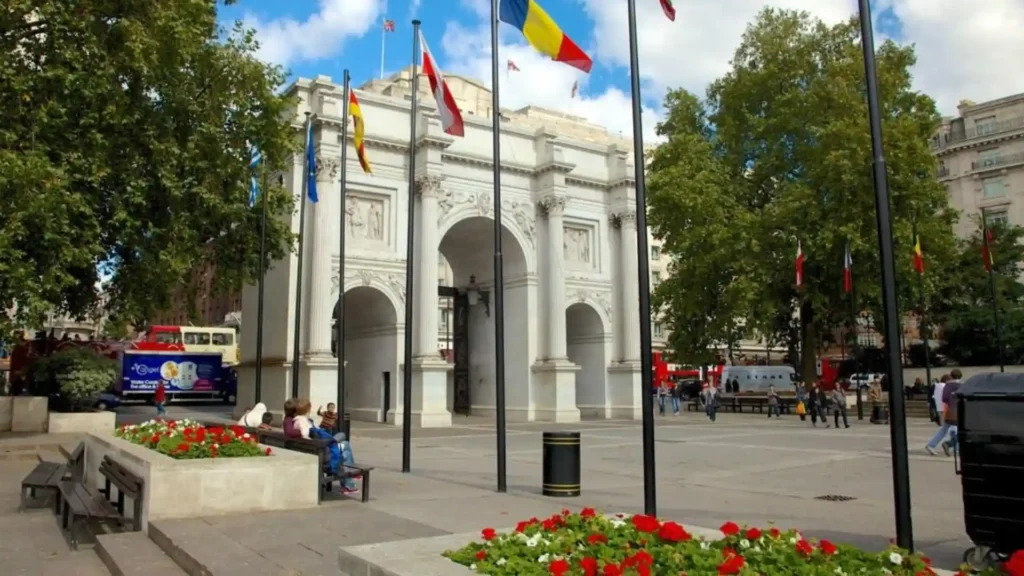
Marble Arch and the northeastern entrance introduce Hyde Park’s relationship with monarchy, imperial ceremonies, and nineteenth-century urban planning. The area historically connected elite districts of London with royal processional routes leading toward Buckingham Palace and Westminster.
Marble Arch was constructed using Carrara marble imported from Italy. The structure was inspired by Roman triumphal arches, particularly the Arch of Constantine in Rome.
The surrounding district also contains darker historical associations. Near Marble Arch stood the Tyburn gallows, one of England’s most notorious execution sites between the twelfth and eighteenth centuries. Public executions drew crowds exceeding 50,000 spectators during major political trials.
The northeastern entrance demonstrates how Hyde Park connected with London’s expanding road system during the Industrial Revolution. Nearby routes such as Oxford Street and Park Lane became major commercial and transportation corridors during the nineteenth century.
Victorian planners preserved the park despite rapid urbanisation. This decision contributed to London’s modern green-belt philosophy and influenced later public park systems across Europe and North America.
Why is Speaker’s Corner internationally significant?
Speaker’s Corner became an internationally recognised symbol of free speech, political activism, and democratic assembly during the nineteenth century. The site hosted debates involving socialists, suffragists, religious reformers, anti-war campaigners, and civil rights advocates.
Speaker’s Corner emerged after the Reform League demonstrations of 1866 and 1867. Public pressure encouraged the British government to tolerate open-air political meetings inside Hyde Park.
The location developed into a rare space where ordinary citizens could publicly challenge government authority. Speakers traditionally stand on ladders, stools, or small platforms to address audiences.
Several influential figures appeared at Speaker’s Corner during the twentieth century. Examples include George Orwell, Karl Marx, and Marcus Garvey.
The site also reflects Britain’s legal history regarding assembly rights and public order legislation. Debates around censorship, policing, and protest restrictions frequently centred on Hyde Park gatherings.
Modern demonstrations continue at the site today, preserving Hyde Park’s role as a living civic landscape rather than a purely recreational park.
What makes the Serpentine one of Hyde Park’s defining landmarks?
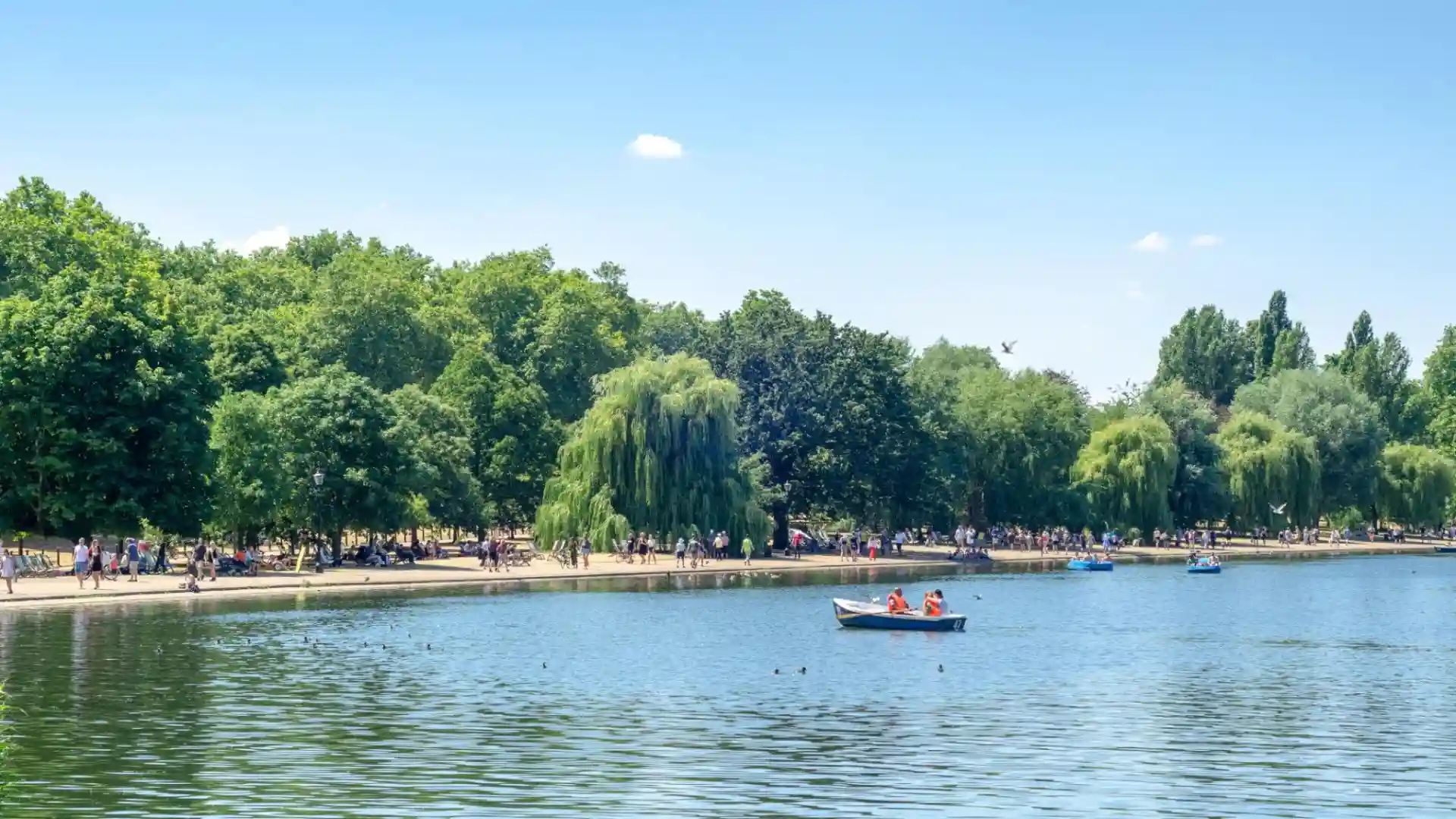
The Serpentine transformed Hyde Park from a formal royal estate into a naturalistic public landscape. Created in 1730, the lake introduced new principles of English garden design that rejected rigid geometric layouts in favour of irregular natural forms.
Serpentine was engineered by damming the River Westbourne. Queen Caroline of Ansbach supervised the project as part of broader improvements to Kensington Gardens and Hyde Park.
The lake stretches across both Hyde Park and Kensington Gardens. Its curved shape inspired the name “Serpentine,” distinguishing it from earlier straight canals common in Baroque landscape design.
The Serpentine later became associated with Victorian leisure culture. Rowing boats, swimming clubs, and winter bathing traditions developed around the lake during the nineteenth century.
The Serpentine Swimming Club, founded in 1864, remains one of Britain’s oldest open-water swimming organisations. Annual Christmas Day races continue despite near-freezing water temperatures.
The lake also supports biodiversity within central London. Bird populations include swans, herons, ducks, grebes, and geese. Environmental management programmes maintain water quality and aquatic habitats despite heavy urban pressures.
What historical memorials and monuments should visitors stop to examine?
Hyde Park contains memorials commemorating military victories, humanitarian tragedies, and members of the royal family. These monuments illustrate how public parks became spaces for national remembrance and collective historical identity between the nineteenth and twenty-first centuries.
One major landmark near Hyde Park Corner is Wellington Arch. Constructed between 1826 and 1830, the monument commemorated British victories during the Napoleonic Wars led by Arthur Wellesley.
The arch originally supported an enormous equestrian statue before replacement with the present bronze quadriga sculpture in 1912.
Further inside the park stands the Diana Memorial Fountain, opened in 2004 in memory of Diana, Princess of Wales. Designed using Cornish granite, the circular watercourse symbolises movement and accessibility.
The Holocaust Memorial commemorates Jewish victims of Nazi persecution during the Second World War. Installed in 1983, the memorial was Britain’s first public civic monument dedicated to Holocaust remembrance.
Nearby, the 7 July Memorial honours the fifty-two victims killed during the London bombings of 2005. Fifty-two stainless steel columns represent each individual life lost during the attacks on London’s transport system.
These memorials demonstrate how Hyde Park evolved beyond royal recreation into a national commemorative landscape reflecting Britain’s modern historical consciousness.
How did Hyde Park influence Victorian London and the Great Exhibition?
Hyde Park became a global symbol of Victorian industrial progress during the Great Exhibition of 1851. The event introduced millions of visitors to technological innovation, imperial trade networks, and modern exhibition culture within a monumental glass structure called the Crystal Palace.
The Great Exhibition was organised under the patronage of Prince Albert and supported by the Royal Society of Arts. The event opened on 1 May 1851.
Architect Joseph Paxton designed the Crystal Palace using prefabricated iron and glass components. The structure measured approximately 1,848 feet in length and covered nineteen acres.
More than six million visitors attended the exhibition during its five-month operation. Displays included industrial machinery, textiles, scientific instruments, colonial goods, and decorative arts from across the British Empire and international states.
Profits from the exhibition funded major educational and cultural institutions in South Kensington. Examples include the Victoria and Albert Museum, the Science Museum, and the Natural History Museum.
The exhibition permanently altered Hyde Park’s global reputation. The site became associated with innovation, public spectacle, and international exchange during the height of the British Empire.
What can visitors discover inside Kensington Gardens during the walk?
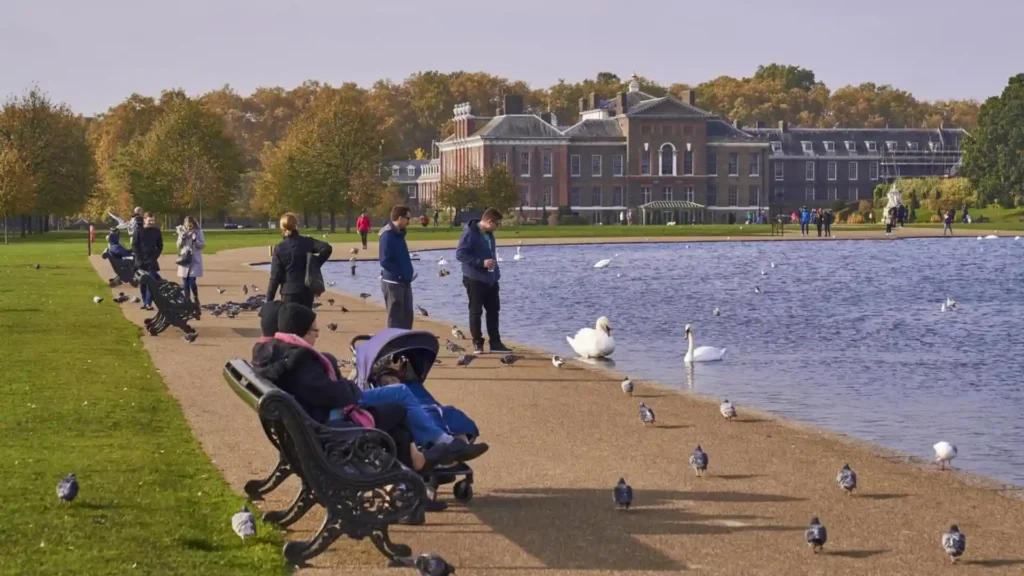
Kensington Gardens contains royal residences, formal gardens, and memorial landscapes connected to Britain’s monarchy from the seventeenth century onward. The western section of the walk presents a quieter environment shaped by aristocratic design and ceremonial architecture.
Kensington Gardens was separated formally from Hyde Park in 1728. The landscape was redesigned to complement Kensington Palace, originally a Jacobean mansion acquired by William III and Mary II.
Queen Victoria spent her childhood at Kensington Palace before ascending the throne in 1837 at age eighteen.
The gardens include the Italian Gardens, created during the 1860s under Prince Albert. Ornamental fountains, stone basins, and symmetrical pathways reflect Victorian interpretations of Renaissance landscaping.
Another prominent landmark is the Albert Memorial, completed in 1872. Designed by George Gilbert Scott, the Gothic Revival monument commemorates Prince Albert following his death in 1861.
The memorial incorporates statues representing Europe, Asia, Africa, and America, illustrating Victorian imperial ideology and Britain’s global political influence during the nineteenth century.
How does Hyde Park reflect London’s environmental and urban planning history?
Hyde Park reflects nearly five centuries of environmental management, public planning, and urban preservation. The park protected open land within a rapidly industrialising metropolis and influenced later approaches to public health, recreation, and ecological conservation.
During the nineteenth century, London experienced severe overcrowding, industrial pollution, and public health crises. Urban reformers argued that large parks improved sanitation and reduced respiratory illness by increasing air circulation and public access to open landscapes.
Hyde Park became part of a wider movement promoting civic recreation. Activities expanded to include horseback riding, boating, cycling, concerts, and organised sports.
The park also preserves mature tree populations within central London. Species include London plane trees, horse chestnuts, cedars, and limes. Several trees date to the eighteenth century.
Modern conservation programmes monitor biodiversity, soil erosion, water quality, and visitor impact. Environmental planning balances heritage preservation with contemporary public usage.
The Royal Parks charity now manages more than 5,000 acres of historic parkland across London. Hyde Park remains one of the most visited components of this network and functions as both a heritage landscape and an active ecological resource.
Why does Hyde Park remain culturally relevant in modern London?
Hyde Park remains culturally relevant because it combines royal heritage, democratic traditions, memorial culture, environmental preservation, and public recreation within one accessible urban landscape. The park continues to host national events, concerts, demonstrations, and international tourism throughout the year.
The park hosts large-scale events attended by international audiences. Examples include British Summer Time concerts, ceremonial commemorations, charity runs, and Winter Wonderland seasonal attractions.
Hyde Park also remains politically important. Demonstrations concerning climate change, international conflicts, labour rights, and civil liberties continue to occur near Speaker’s Corner and Park Lane.
Cultural representation in literature, film, and journalism further reinforces the park’s symbolic importance. Hyde Park appears in works by authors including Virginia Woolf and Charles Dickens.
The park’s continued relevance reflects its adaptability across historical eras. Examples include Tudor hunting grounds, Georgian pleasure gardens, Victorian exhibition space, wartime gathering site, and contemporary cultural venue.
Hyde Park therefore operates simultaneously as an environmental refuge, historical archive, ceremonial landscape, and democratic public forum in the centre of modern London.
What is Hyde Park famous for?
Hyde Park is famous for its royal history, public protests, large open green spaces, and historic landmarks including the The Serpentine and Speaker’s Corner. The park is also known for hosting major national events, concerts, demonstrations, and recreational activities.