Extra London News brings you this comprehensive guide to South Bank, London’s vibrant riverside district spanning from County Hall to Tower Bridge. This area attracts 20 million visitors annually for its cultural landmarks, diverse street food, and panoramic Thames views. Explore timeless attractions that define the South Bank experience.
- What Is South Bank and Its History?
- Where Are the Best Cultural Attractions in South Bank?
- What Street Food Options Stand Out in South Bank?
- Which Spots Offer the Best Views in South Bank?
- How Do You Plan a Full Day in South Bank?
- What Family-Friendly Activities Exist in South Bank?
- Are There Unique Experiences Beyond Main Attractions?
- What Events and Performances Happen Regularly?
- How Does South Bank Impact London’s Tourism?
What Is South Bank and Its History?
South Bank is a 1.5-mile stretch along the south bank of the River Thames in central London, from Westminster Bridge to Tower Bridge. It transformed from industrial warehouses into a cultural hub post-World War II through the 1951 Festival of Britain, which introduced the Royal Festival Hall and established its arts focus. Today, it hosts over 50 attractions drawing diverse crowds year-round.
South Bank originated as a medieval trade zone with wharves for timber and coal. The 19th century brought theaters like the Old Vic in 1818, which still operates. Post-war reconstruction under the London County Council created the South Bank Centre in the 1960s, including Queen Elizabeth Hall (1967) and Hayward Gallery (1968).
Key components include the Southbank Centre complex, public walkways, and green spaces like Queen’s Walk. Processes involve ongoing regeneration, such as the 2020s Jubilee Gardens refurbishment, adding 2.5 acres of landscaping. Examples feature the 1986 opening of the National Theatre, designed by Denys Lasdun with three auditoriums seating 2,500 total.
Statistics show 7 million annual visitors to Southbank Centre venues alone. Implications include the economic impact of £1.5 billion yearly from tourism. Future relevance lies in planned 2030 expansions for sustainable public spaces.
Where Are the Best Cultural Attractions in South Bank?
Top cultural sites include the Tate Modern with 5.8 million visitors yearly, the Southbank Centre for classical music, Shakespeare’s Globe theater replica, and the National Theatre staging 20+ world premieres annually. These venues offer free exhibitions, live performances, and historical reenactments daily.
Macro context positions South Bank as London’s arts epicenter, home to five major institutions. Subtopics cover visual arts, performing arts, and film.
Tate Modern, housed in a 4.7-million-square-foot former power station redesigned by Herzog & de Meuron in 2000, features Turbine Hall installations by artists like Olafur Eliasson. It displays 70,000 works across 10 floors, with free permanent collection entry.
Southbank Centre, opened 1951, encompasses Royal Festival Hall (2,500 seats), Queen Elizabeth Hall (900 seats), and Purcell Room (350 seats). It hosts 5,000 events yearly, including the London Philharmonic Orchestra’s 120 performances.
Shakespeare’s Globe, a 1997 thatched reconstruction of the 1599 original seating 1,400 standing groundlings, performs original-practice plays like Hamlet from April to October. National Theatre, founded 1963 by Laurence Olivier, presents modern works in Olivier (1,160 seats), Lyttelton (890 seats), and Dorfman (400 seats) theaters.
Implications feature accessibility via £5 under-25 tickets at National Theatre. Data indicates 90% occupancy rates across venues.
Tate Modern’s riverside facade exemplifies industrial reuse in culture.
What Street Food Options Stand Out in South Bank?
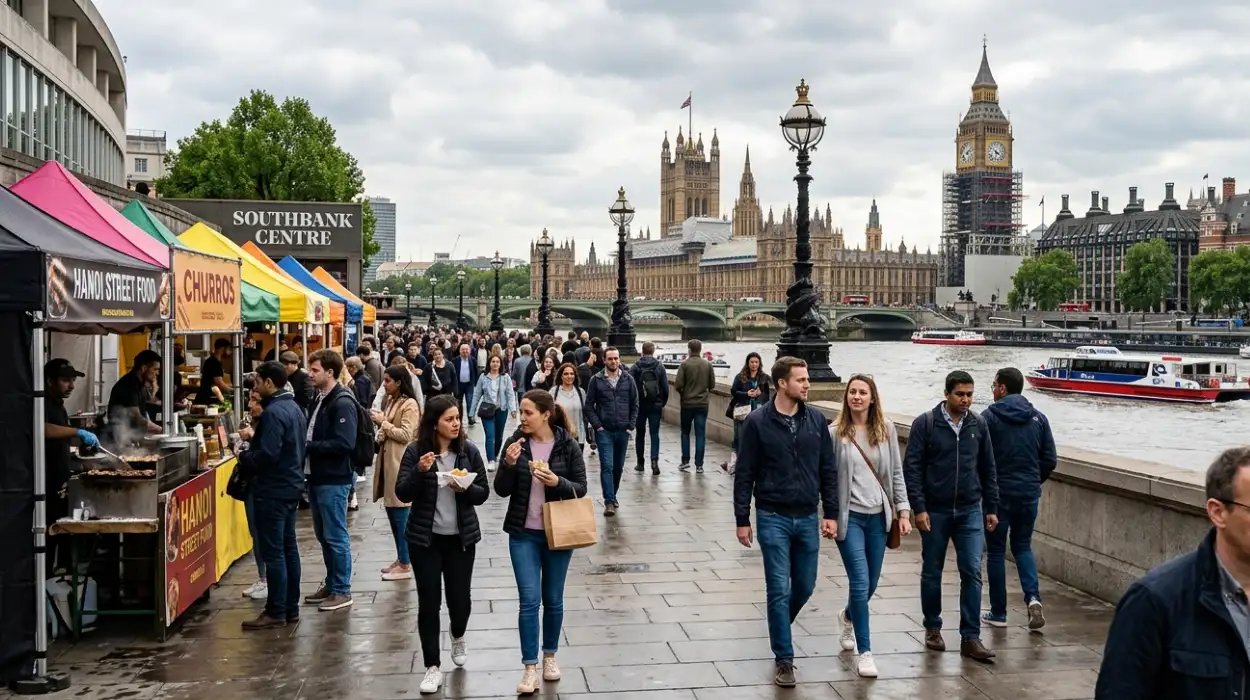
Gabriel’s Wharf and Southbank Centre Food Market offer 20+ vendors with Mexican tacos from Taco Bros, Mauritian curry at Curry Shack, Punjab biryanis from Indians Next Door, and New Orleans po’boys at Voodoo. Leake Street Arches add Polish pierogi at Mamuśka and Vietnamese pho at Banh Bao Brothers, open daily until 10 PM.
Street food defines South Bank’s casual dining scene, serving 100,000 visitors weekly. Markets operate under covered spaces for year-round access.
Gabriel’s Wharf, a 1980s riverside development with 30 independent units, features vegan Caribbean jerk from Itzik’s, Italian arancini, and Mexican quesadillas. Vendors rotate seasonally, emphasizing local sourcing.
Southbank Centre Food Market, held Fridays to Sundays behind Royal Festival Hall, includes Street Pig BBQ ribs, Athenian Greek gyros, and Two Als New York chopped cheeseburgers. It accommodates 5,000 diners per weekend.
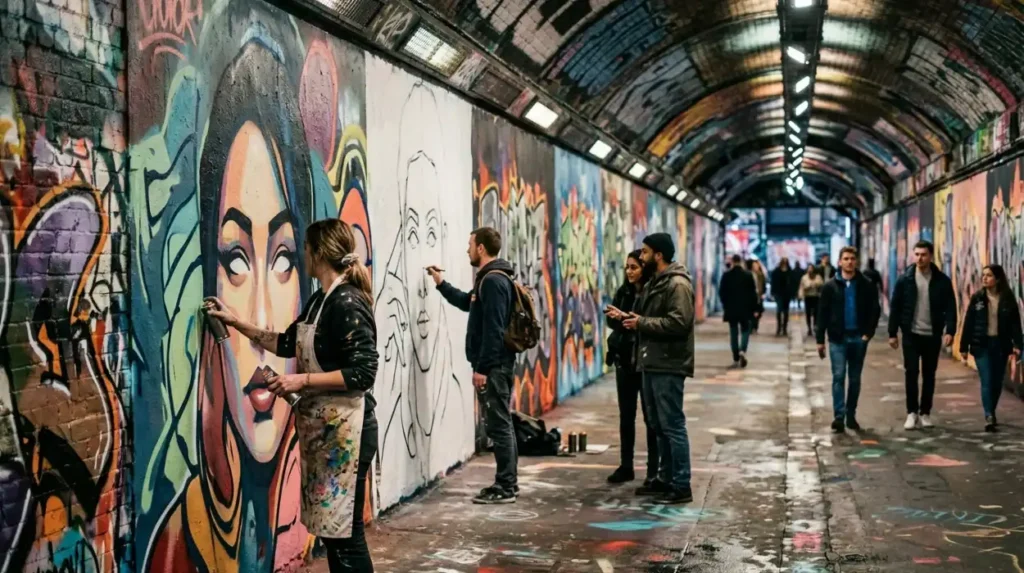
Leake Street Arches, a graffiti tunnel under Waterloo Station legalized for street art in 2008, hosts pop-ups like Mamuśka’s potato pancakes and Passyunk Avenue Philly cheesesteaks. Examples include board game cafe pairings with meals.
Statistics reveal 80% visitor satisfaction in Visit London surveys. Implications involve supporting 200 independent traders annually.
Which Spots Offer the Best Views in South Bank?
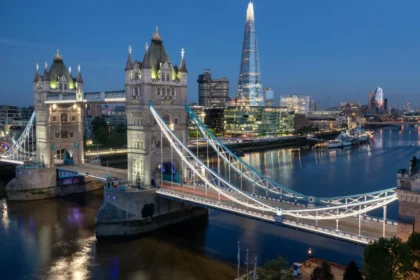
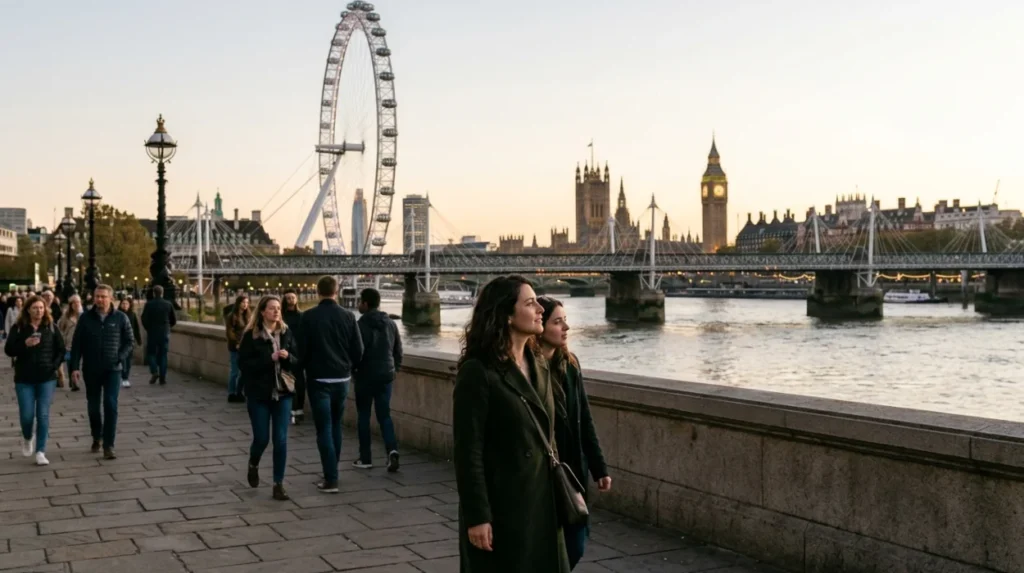
London Eye provides 360-degree panoramas from 443 feet, SEA LIFE London Aquarium offers underwater Thames vistas, and Queen’s Walk delivers free riverside sights of Big Ben and Shard. Golden Jubilee Bridges frame St. Paul’s Cathedral at sunset.
Views leverage South Bank’s Thames position opposite Westminster. Structures include observation wheels, bridges, and elevated walkways.
London Eye, installed 2000 for the millennium, rotates 26 pods carrying 800 passengers per revolution in 30 minutes. It reveals 25-mile vistas on clear days, with fast-track tickets at £35.
SEA LIFE, Europe’s largest aquarium since 2008 in County Hall, houses 500 species in 2 million liters across 50 displays, including shark tunnel views. Golden Jubilee Bridges, pedestrian spans opened 2003, connect Westminster to South Bank with 1,700-foot lengths.
Queen’s Walk, a 1-mile paved path landscaped post-1951 Festival, passes Jubilee Gardens with 50 benches. Processes include timed photography spots for landmarks.
Data shows 3.5 million annual London Eye riders. Implications include year-round accessibility with winter illuminations.
London Eye capsules glide above the Thames at dusk.
How Do You Plan a Full Day in South Bank?
Start at 9 AM with Tate Modern free entry, lunch at Gabriel’s Wharf by noon, afternoon at London Eye and SEA LIFE, evening show at National Theatre, and dinner at Southbank Food Market. Total cost £50-80 per person, covering transport via Waterloo Station.
Planning maximizes 12-hour daylight in summer. Sequence follows west-to-east flow along the river.
Morning: Arrive via Jubilee line to Waterloo. Tate Modern opens 10 AM; explore Blavatnik Building levels one hour. Historical context: Bankside Power Station decommissioned 1981.
Midday: Walk 10 minutes to Gabriel’s Wharf for street food; sample three vendors in 45 minutes. Subtopics include timing around peak crowds post-1 PM.
Afternoon: London Eye ride queues under 30 minutes pre-2 PM; follow with SEA LIFE’s 2-hour self-guided tour viewing 14 zones. Examples: Penguin encounter at scheduled feeds.
Evening: National Theatre tour at 5:15 PM or 7:30 PM performance; dine at Leake Street post-show. Statistics: 90% of days feature free riverside busking.
Implications: Use the Citymapper app for real-time Thames Clipper boats every 20 minutes.
What Family-Friendly Activities Exist in South Bank?
London Dungeon immerses in 1,000 years of history with 11 live shows, Shrek’s Adventure! features interactive ogre quests for ages 5+, SEA LIFE hosts shark dives, and IWM London displays 47 aircraft free entry. All operate 10 AM-6 PM daily.
Families target interactive sites accommodating 500,000 children yearly. Venues integrate education with entertainment.
London Dungeon, relocated to the South Bank in 2017, stages actors in plagues and Jack the Ripper scenes across 90 minutes. Capacity reaches 2,000 daily.
Shrek’s Adventure!, opened in 2016 near the London Eye, offers boat rides and DreamWorks character meetups in 14 sets for groups up to 30. SEA LIFE includes touch pools with starfish.
Imperial War Museum (IWM) London, founded in 1978 in the former Bethlem Hospital, exhibits World War tanks and holograms across six floors. Florence Nightingale Museum details Crimean War nursing reforms.
Data: 75% repeat visits per family surveys. Implications enhance school trips with group rates.
Are There Unique Experiences Beyond Main Attractions?
Leake Street Arches showcase rotating graffiti under a legal street art policy since 2008, Southbank Centre Book Market sells 10,000 secondhand volumes daily under Waterloo Bridge, and Vaulty Towers bar occupies Victorian loos. These draw 1 million niche visitors yearly.
Unique draws complement mainstream sites. Graffiti tunnels span 200 meters.
Leake Street, tunneled in 1848 for Waterloo tracks, permits artist-led murals refreshed monthly; 50 creators contribute yearly. Book Market, operational since 2016, stocks rare maps from £2.
Vaulty Towers, a 1892 public toilet converted in 2019, serves craft beers in porcelain surrounds. Beach Captain statues and Thierry Noir murals add scavenger hunts.
Examples: Fox sculptures by Emily Young near Oxo Tower. Statistics: 95% Instagram tags for Leake Street.
Implications foster creative communities.
Leake Street’s vibrant murals change weekly.
What Events and Performances Happen Regularly?
Southbank Centre hosts 400 free outdoor concerts yearly, National Theatre streams NT Live to 50 countries, BFI Southbank screens 2,000 films annually in IMAX, and street performers entertain 24/7 on Queen’s Walk. Check schedules via official apps.
Events sustain vibrancy across seasons. The venue’s schedule 20 daily happenings.
Southbank Centre’s Meltdown Festival features annual curators like Grace Jones. National Theatre’s War Horse ran 1,200 performances.
BFI Southbank, home to the British Film Institute since 1952, projects 70mm classics. Buskers follow auditioned slots via the Westminster Council.
Data: 4 million event attendees yearly. Implications include hybrid online access post-2020.
How Does South Bank Impact London’s Tourism?
South Bank generates £2.8 billion in visitor spending annually, employs 15,000 in hospitality, and ranks as Europe’s top cultural district per TripAdvisor 2025. Infrastructure supports 40 million footfall with 99% accessibility compliance.
Impact stems from the 1951 Festival blueprint. Components include 10 miles of paths.
Economic mechanisms channel tube revenues to maintenance. Examples: The London Eye contributes £100 million in taxes yearly.
Research from Visit Britain notes 60% international tourists prioritize it. Future relevance involves net-zero goals by 2030.
What is South Bank?
South Bank is a 1.5-mile riverside district along the River Thames, stretching from Westminster Bridge to Tower Bridge. It’s one of London’s top cultural areas, attracting around 20 million visitors each year.