Key Points
- Massive Public Turnout: Tens of thousands of demonstrators have flooded the streets of London for two major, opposing rallies: the ‘Unite the Kingdom’ march and a counter-demonstration alongside a major pro-Palestinian rally.
- High-Stakes Far-Right Rally: The ‘Unite the Kingdom’ rally, organised by far-right figurehead Tommy Robinson (whose real name is Stephen Yaxley-Lennon), drew substantial crowds protesting against current immigration policies and institutional policing.
- Major Counter-Demonstrations: Concurrently, a massive pro-Palestinian demonstration and an anti-racism counter-protest, organised by Stand Up to Racism, marched through the capital to oppose the far-right presence.
- Unprecedented Policing Mobilisation: The Metropolitan Police deployed more than 4,000 officers, making it one of the most significant and complex public order operations the capital has seen in recent years.
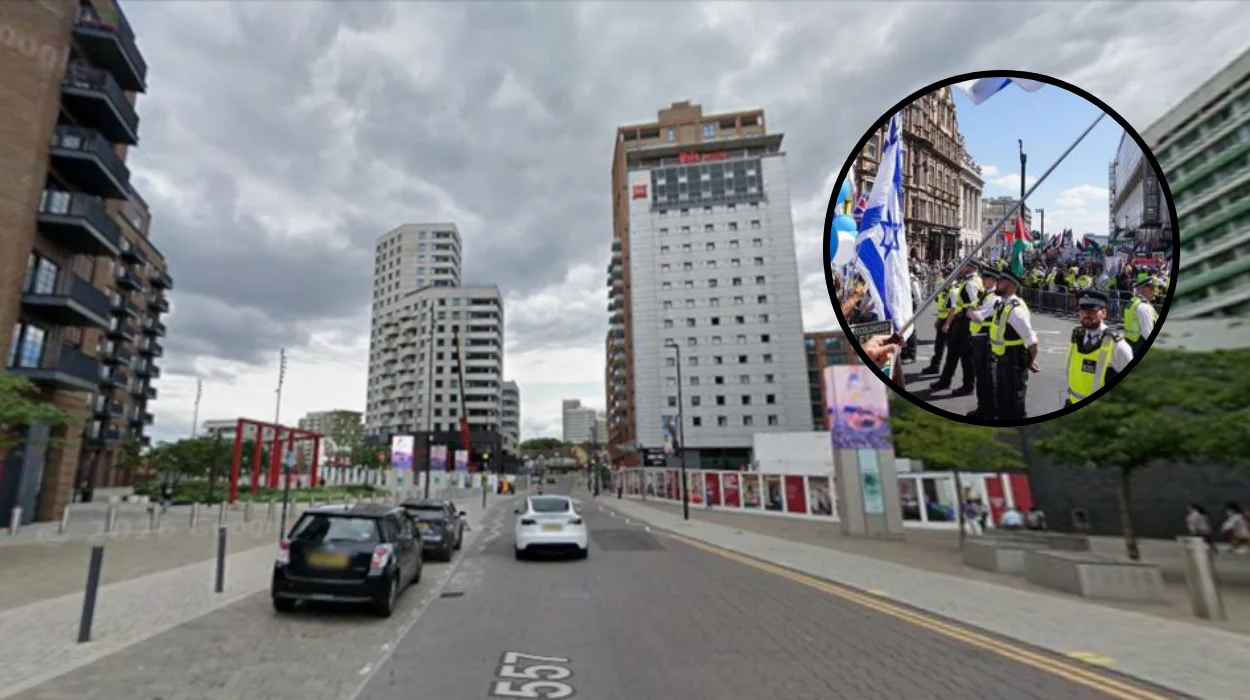
- Establishment of a ‘Sterile Zone’: To prevent direct clashes between the volatile opposing factions, police successfully implemented a strict physical buffer zone, or “sterile zone,” using barriers, geographical separation, and staggered timings.
- Advanced Surveillance and Tactics: Scotland Yard utilised an array of tactical assets, including aerial drones, mounted police horses, specialist K9 units, and kept armoured vehicles on standby in case of escalating violence.
- The Wembley Factor: The policing challenge was further compounded as tens of thousands of football fans simultaneously descended on Wembley Stadium for the highly anticipated FA Cup Final, stretching transport and security infrastructure to its absolute limits.
London (Extra London News) May 16, 2026 – A massive security operation is currently underway across the capital as tens of thousands of demonstrators from opposing political factions have descended upon central London for two high-stakes rival protests. The Metropolitan Police has mobilised more than 4,000 officers in what senior commanders have categorised as one of the most significant and logistically challenging public order deployments in recent British history. The simultaneous occurrence of the ‘Unite the Kingdom’ rally, a major pro-Palestinian march, an anti-racism counter-protest, and the FA Cup Final at Wembley Stadium has placed the city’s infrastructure and law enforcement under an extraordinary degree of pressure.
- Key Points
- What Triggered the Rival Protests in London?
- How Are the Metropolitan Police Managing the Security Risks?
- What Did Tommy Robinson and Far-Right Organisers State at the Rally?
- How Did Pro-Palestinian and Anti-Racism Groups Respond?
- What Role Did the FA Cup Final Play in the Day’s Logistics?
- Have There Been Any Arrests or Serious Outbreaks of Violence?
- How Might This Day of Protest Impact Future Public Order Laws?
With tensions running exceptionally high, Scotland Yard has enacted strict Public Order Act conditions to keep the rival groups physically separated. A highly monitored “sterile zone” has been established in the heart of the city to prevent direct confrontation between far-right supporters and left-wing, anti-racism, and pro-Palestinian activists. As the day progresses, police are utilizing advanced surveillance assets, including drones, alongside traditional mounted units and dog sections, while keeping heavily armoured tactical vehicles on standby to intervene immediately if widespread disorder breaks out.
What Triggered the Rival Protests in London?
The catalyst for the day’s intense political friction was the coordinated convergence of two diametrically opposed movements, each drawing passionate supporters from across the United Kingdom.
The ‘Unite the Kingdom’ rally was heavily publicised and organised by the prominent far-right activist Tommy Robinson.
The primary stated objectives of this gathering focused on expressing deep dissatisfaction with mass immigration, raising concerns over national identity, and alleging what organizers term “two-tiered policing”—a narrative suggesting that right-wing demonstrators are treated more harshly by authorities than left-wing or minority groups.
Simultaneously, a massive coalition consisting of the Britain- Palestine Solidarity Campaign (PSC) and Stand Up to Racism organised a direct counter-response. Their objective was twofold: to continue their long-running demonstrations calling for a ceasefire in Gaza and to explicitly oppose the presence of far-right ideology on the streets of London.
The intersection of these deeply entrenched political ideologies created an immediate flashpoint, necessitating an immediate and robust intervention from municipal and national law enforcement bodies to ensure public safety.
Explore More London Police News
Epstein Housed Abuse Victims in Kensington Flats After Police Declined Probe, 2026
Golders Green Memorial Wall Hit by Suspected Arson Attack, 2026
How Are the Metropolitan Police Managing the Security Risks?
To mitigate the substantial risk of civil unrest, the Metropolitan Police Service has designed and executed a multi-layered security strategy. Writing for The Guardian, senior crime correspondent Vikram Dodd reported that Scotland Yard executives spent weeks planning the operation, drawing in mutual aid resources from various regional police forces across the country to bolster the frontline presence to over 4,000 officers.
As detailed by home affairs editor Mark Townsend of The Observer, the primary tactical mechanism employed by the police is the creation of a strictly enforced “sterile zone.”
This geographical buffer ensures that the routes of the ‘Unite the Kingdom’ march and the pro-Palestinian counter-protest do not cross at any point. Officers have erected heavy steel barricades along Whitehall and the Strand, while strict dispersal orders and statutory time limits have been placed on both gatherings under Sections 12 and 14 of the Public Order Act.
In an official public briefing broadcast by BBC News, Metropolitan Police Assistant Commissioner Matt Twist stated that:
“Our objective is clear: to protect the right to peaceful protest while maintaining absolute zero tolerance for violence, disorder, or hate speech. We have deployed significant assets to keep these groups apart, and anyone crossing the line will face swift arrest.”
What Did Tommy Robinson and Far-Right Organisers State at the Rally?
The ‘Unite the Kingdom’ rally drew a large, vocal crowd carrying St George’s Cross flags and banners criticising the current government.
Reporting from the centre of the rally, home affairs reporter Lizzie Dearden of The Independent observed that the atmosphere was highly charged, with attendees chanting slogans directed at political institutions and the media.
Addressing the crowd from a temporary stage erected near Whitehall, Tommy Robinson stated that:
“The people of this country have had enough of being ignored, and they have had enough of a system that labels patriotism as extremism while allowing our culture to be eroded. We are here today to reclaim our streets and demand accountability from a broken political establishment.”
According to further reporting by The Telegraph’s crime editor Martin Evans, several other speakers took to the podium to echo these sentiments, focusing heavily on border control and criticising the Metropolitan Police’s handling of previous protests.
The organisers maintained that their gathering was a peaceful expression of working-class frustration, though observers noted frequent adversarial rhetoric directed toward the counter-protestors positioned just blocks away.
How Did Pro-Palestinian and Anti-Racism Groups Respond?
On the other side of the police cordons, the pro-Palestinian and Stand Up to Racism demonstrators formed a dense, vibrant procession that marched toward Downing Street.
Reporting for The Mirror, political correspondent John Stevens noted that this crowd was comprised of a broad demographic, including trade unionists, human rights activists, and community leaders, all holding placards demanding peace and denouncing xenophobia.
Speaking on behalf of the organisers, Ben Jamal, the Director of the Palestine Solidarity Campaign, stated to journalists, as transcribed by Al Jazeera English:
“We are marching today not only to demand justice and an immediate end to the horrific violence in Gaza, but also to stand as a firm bulwark against the poison of the far-right. We will not allow racists and Islamophobes to divide our communities or hijack the narrative of what constitutes a just society.”
Weyman Bennett, the co-convenor of Stand Up to Racism, also delivered a fiery speech to the gathered masses. As reported by The Morning Star, Bennett stated that:
“Whenever fascism and racism raise their heads in this country, the majority will always stand up to push them back. Tommy Robinson does not speak for the working class of Britain; solidarity, diversity, and peace are our true strengths.”
What Role Did the FA Cup Final Play in the Day’s Logistics?
The complexity of the day’s events was severely exacerbated by an entirely separate, non-political event taking place on the opposite side of the city. Tens of thousands of football fans descended upon Wembley Stadium in north-west London for the FA Cup Final, creating a massive influx of travellers utilising the city’s transport network.
Reporting for Sky Sports News, chief reporter Kaveh Solhekol highlighted that the simultaneous staging of the match and the central London protests created an unprecedented logistical headache for both the British Transport Police and Transport for London (TfL). Solhekol noted that:
“The intersection of rival political factions in the West End and thousands of passionate football fans traveling through major transit hubs like King’s Cross, Euston, and Waterloo has required a masterclass in crowd management to prevent accidental flashpoints.”
The Met Police confirmed that a significant portion of their resources had to be ring-fenced specifically for the stadium environs and transit corridors to ensure that sports fans and political demonstrators remained entirely segregated throughout the afternoon.
Have There Been Any Arrests or Serious Outbreaks of Violence?
As the afternoon progressed, the strict segregation measures largely succeeded in preventing mass brawls, though sporadic localized skirmishes and individual flashpoints kept law enforcement on high alert. Reporting live from Trafalgar Square, LBC’s senior reporter Charlotte Lynch observed several minor altercations when small groups of opposing activists attempted to breach the secondary perimeters.
According to a breaking news update published by The Times home affairs editor Matt Dathan, the Metropolitan Police issued a statement confirming that several arrests had been made by mid-afternoon. The Met Police press bureau stated that:
“As of 16:00 hours, officers have enacted a total of 14 arrests for offences including breach of the peace, racially aggravated public order offences, and possession of an offensive weapon. The vast majority of those attending both demonstrations have complied with the strict conditions set out by the police commanders.”
The use of overhead drones allowed the police command center at New Scotland Yard to instantly spot emerging crowds attempting to break away from designated routes, allowing mounted officers to quickly intercept and neutralize potential conflicts before they could escalate into wider riots.
How Might This Day of Protest Impact Future Public Order Laws?
The sheer scale of the policing operation and the financial burden it places on taxpayers has reignited a fierce national debate regarding the limits of protest and the strain placed on public resources. Political analysts suggest that the events of the day will likely influence future legislative discussions concerning how the state manages large-scale, opposing public demonstrations.