Key Points
- Supreme Court Appeal Granted: The UK Supreme Court has officially confirmed that Palestine Action co-founder Huda Ammori has been granted permission to appeal against a lower court ruling that declared the government’s terrorist ban on the group lawful.
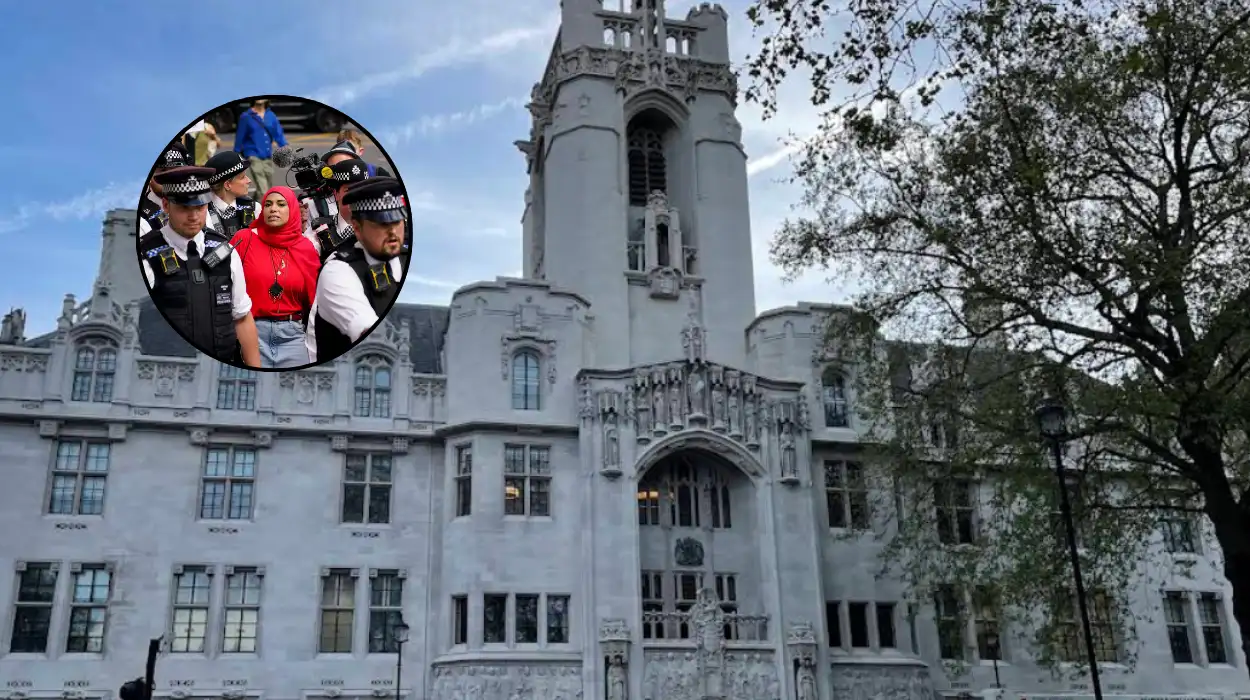
- Mass Arrests Outside Court: More than 100 demonstrators were arrested by the Metropolitan Police outside Westminster Magistrates’ Court during a demonstration organised by the Defend Our Juries activist group.
- Context of Court Hearings: The protest coincided with court proceedings scheduled for the first wave of thousands of citizens previously arrested and charged under the Terrorism Act for voicing support for the proscribed network.
- Met Police Warnings: Officers deployed to central London explicitly warned that displaying placards or showing support for Palestine Action constituted an offense under counter-terrorism legislation, leading to immediate detentions.
- Legal Background: The legal battle follows a June 2026 Court of Appeal judgment that overturned an earlier High Court ruling, concluding that the Home Office proscription of Palestine Action under counter-terrorism laws was “justified and proportionate”.
London (Extra London News) July 30, 2026 — More than 100 demonstrators were arrested outside Westminster Magistrates’ Court on Thursday as crowds gathered to protest the ongoing criminalisation of Palestine Action, coinciding with the announcement that the group’s co-founder has secured permission to challenge the government’s controversial terrorist ban at the UK Supreme Court.
Why Was the Demonstration Held Outside Westminster Magistrates’ Court?
As reported by Daniel Khalili-Tari and news agencies for Al Jazeera, the high-visibility protest was organised by the grassroots activist group Defend Our Juries. The demonstration was assembled to picket the commencement of formal court hearings for the first batch of individuals facing charges under section 12 and section 13 of the Terrorism Act 2000.
These defendants are among roughly 3,000 people arrested across Britain since July 2025 for expressing solidarity with or displaying support for Palestine Action after it became the first direct-action network to be proscribed as a terrorist organisation.
The atmosphere outside the central London courthouse grew tense as hundreds of demonstrators converged carrying banners and signs bearing slogans such as
“I oppose genocide, I support Palestine Action”.
According to updates provided by police and news wires, officers from the Metropolitan Police moved swiftly through the crowds, detaining individuals who refused to disperse or continued displaying prohibited symbols. Reuters correspondent Sam Tobin noted that roughly a hundred people were taken into custody on suspicion of showing support for a proscribed organisation.
What Did the Supreme Court Decide Regarding the Terror Ban?
In a crucial legal breakthrough for the campaign group, the UK Supreme Court’s official website confirmed on Wednesday that Huda Ammori, the co-founder of Palestine Action, has been granted permission to bring an appeal against the Court of Appeal’s recent judgment.
As detailed by legal affairs reporters, the legal saga has seen a turbulent path through the British judiciary. In February 2026, the High Court had initially ruled that the Home Secretary’s decision to proscribe Palestine Action was unlawful, finding that the ban constituted a disproportionate interference with freedom of expression and assembly under Articles 10 and 11 of the European Convention on Human Rights.
However, that victory was short-lived; in June 2026, a five-judge panel at the Court of Appeal—including Lady Chief Justice Baroness Carr and the Master of the Rolls, Sir Geoffrey Vos—overturned the High Court’s ruling. The appellate panel concluded that the Home Secretary was entitled to wide latitude in evaluating future threats to public safety and third-party property, declaring the proscription “justified and proportionate”.
Responding to the Supreme Court’s decision to hear the challenge, Ms Ammori issued a fierce public statement. As quoted by The Straits Times and Al Jazeera, Huda Ammori stated that:
“We will continue to fight this proscription all the way to the Supreme Court and, if necessary, to the European Court of Human Rights to overturn what has become one of the most extreme attacks on free speech and the right to protest in modern British history.”
Explore More Westminister News
Banksy Statue May Become Permanent in Westminster, London 2026
Police Boat Strikes Westminster Bridge in London 2026
How Are the Police Enforcing the Proscription Order?
The Metropolitan Police defended their heavy deployment and the subsequent arrests outside Westminster Magistrates’ Court, reiterating that the Court of Appeal’s June judgment remains the active legal standard.
Law enforcement representatives stressed that because Palestine Action remains a proscribed entity under British counter-terrorism law, publicly displaying support, wearing branded articles, or holding representative placards constitutes an arrestable criminal offense punishable by up to 14 years in prison.
Critics, civil liberties organisations, and human rights watchdogs—including Liberty and Amnesty International UK—have consistently argued that utilizing counter-terrorism legislation against a direct-action campaign group sets a dangerous precedent.
These groups contend that criminalising property damage, civil disobedience, and peaceful solidarity under the banner of terrorism effectively criminalises dissent over foreign policy and severely curtails traditional forms of political protest.
What Lies Ahead for the Legal and Political Landscape?
The unfolding confrontation at Westminster Magistrates’ Court highlights deep societal and legal divisions over the boundaries of state power, national security, and civil liberties in the United Kingdom.
With the Supreme Court scheduled to evaluate the lawfulness of the proscription, legal scholars anticipate a landmark constitutional ruling that will define the limits of executive authority when balancing public safety against fundamental human rights.
Meanwhile, grassroots campaigns have vowed to continue their demonstrations outside courtrooms as more activists face prosecution.
As the legal battle shifts to the nation’s highest court, both supporters and opponents of the ban prepare for a historic courtroom showdown that will shape the future of political activism and protest law in modern Britain.