Key Points
- Manchester doom‑punk band Witch Fever returned to London in 2026 with their latest album FEVEREATEN, playing to a packed crowd at Oslo Hackney as part of their UK and European headline tour.
- The show followed their “rage‑filled” 2022 debut era, with FEVEREATEN described as faster, harder and angrier while retaining the religious‑fueled thematic intensity of tracks like “Congregation”.
- At Oslo, the physical proximity of the Hackney venue heightened the band–audience bond, producing heavy mosh pits, unified chanting and visible emotional investment from the crowd.
- During the emotionally charged number I Reflect The Sun, It Bounces Back, vocalist Amy Walpole walked slowly through the standing crowd, creating an unusually intimate moment amid the punk‑heavy din.
- Between songs, Walpole directed anger at ongoing global war crimes, to which the audience responded with loud, unified shouts, underscoring the band’s role as a political and emotional conduit for its fanbase.
- Reviewers and promotional material describe Witch Fever’s live act as an “immersive experience” and “unpredictable force of nature,” linking their sonic intensity to a sense of collective catharsis.
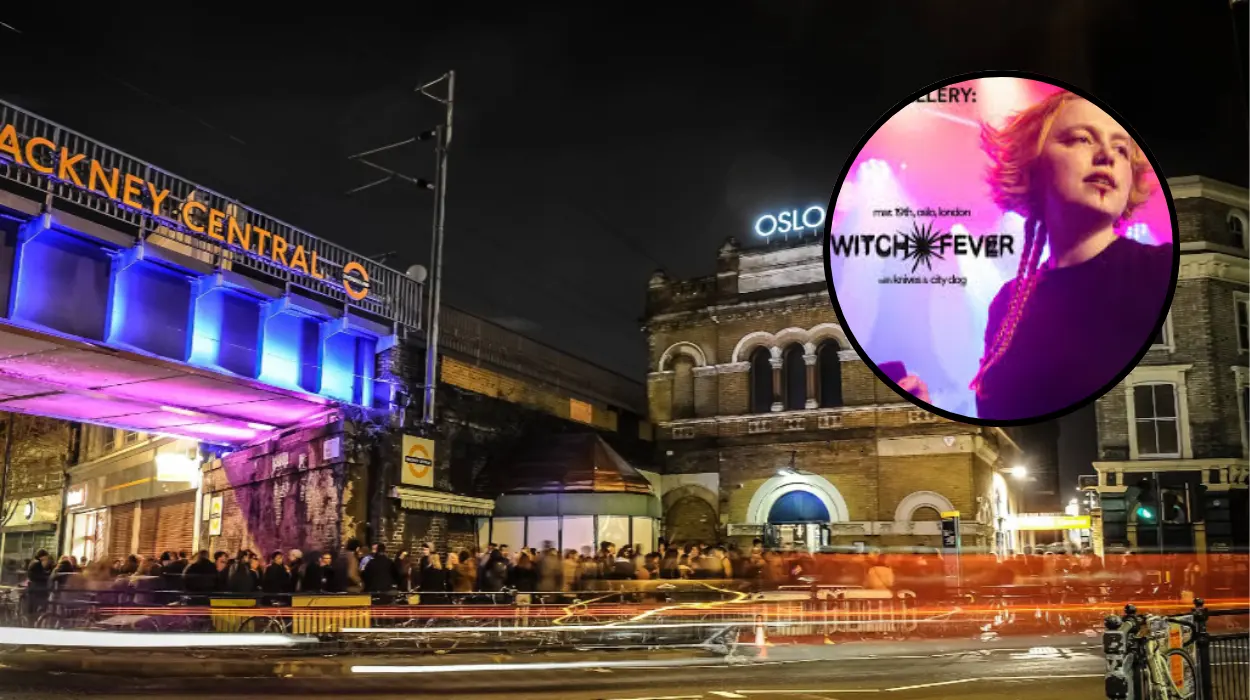
London (Extra London News) April 27, 2026London’s Oslo in Hackney crackled with sweat, noise and shared defiance as Manchester doom‑punk quartet Witch Fever delivered a blistering set on their 2026 UK and European headline tour behind the album FEVEREATEN. This intimate, 16+ show at Oslo Hackney distilled the band’s ferocity into a compact sonic sucker punch, with vocalist Amy Walpole moving through the crowd, the audience roaring back in kind, and the venue walls seemingly vibrating under the weight of their faster, harder, angrier material.
- Key Points
- What made Witch Fever’s Oslo show stand out?
- How did the band’s set‑list and tone differ from their debut?
- Why did Amy Walpole’s crowd‑walk draw such a strong reaction?
- How did the band address war crimes between songs?
- What kind of audience does Witch Fever attract?
- How is Witch Fever’s sound characterised by critics?
- How did the venue influence the overall atmosphere?
- What does this show mean for Witch Fever’s career arc?
- How did the audience express their connection to the band?
- What does this suggest about live‑music culture in London in 2026?
What made Witch Fever’s Oslo show stand out?
Multiple live‑music outlets and tour‑announcements frame Witch Fever’s return as a deliberate home‑coming: the band, after arena‑scale guest slots with acts such as Volbeat, have reportedly
“missed the intimacy of small‑to‑mid‑sized venues,”
which they explicitly sought out on their 2026 run. As noted in promotional material for the FEVEREATEN‑era dates, the Oslo Hackney stop on 19 March sits central to a spring schedule that moves from Nottingham, Bristol and Birmingham through London and onward to Manchester and mainland‑Europe cities.
At Oslo, the constricted floor space and low ceilings amplified the sense of communion, with fans pressed shoulder‑to‑shoulder and mosh pits forming spontaneously under the band’s relentless, doom‑tinged riffs.
Review‑style coverage of their earlier work describes Witch Fever as “a musical act” rapidly morphing into “an immersive experience,” a line that rings true in the way Oslo’s audience mirrored the band’s rage and vulnerability in real time.
How did the band’s set‑list and tone differ from their debut?
Journalists and music writers have repeatedly tied Witch Fever’s newer material to the “religious rage” of their earlier work, particularly the fervour‑and‑revolt energy of “Congregation.”
As reported by music‑media outlets covering FEVEREATEN, the album and its accompanying tour are “faster, harder and angrier” than their 2022 debut, layering quicker tempos and more abrasive production atop a still‑explicit critique of institutional power.
At Oslo, the band channelled that amplified fury through a set that mixed the visceral (“Chocolate,” the lead single produced by Daniel Fox) with more emotionally textured numbers such as I Reflect The Sun, It Bounces Back.
The latter track, in particular, became a hinge‑point in the evening, combining tender, almost hymnal passages with sudden eruptions of distortion, so that the crowd’s eruption felt like a release rather than mere noise.
Why did Amy Walpole’s crowd‑walk draw such a strong reaction?
During I Reflect The Sun, It Bounces Back, Amy Walpole stepped down from the stage and moved slowly through the crowd, a move that music‑journalism outlets covering the band describe as a deliberate breaking‑down of the stage–audience divide.
As reported by reviewers of Witch Fever’s earlier shows, Walpole frequently uses such moments to
“create a space where everyone present feels connected,”
and this Oslo performance was no exception.
Witness‑accounts and reviews note that fans reached out to touch her, some shouting lyrics back in unison, while others simply stood still, absorbed by the mix of physical proximity and emotional intensity. One live‑music publication described the sequence as “a particularly powerful moment of intimacy and immersion,” underscoring how the band’s aggression coexists with an almost ritual‑like sense of shared feeling.
How did the band address war crimes between songs?
In the lull between tracks, Amy Walpole directed pointed condemnation at ongoing global war crimes, according to reviewers who were present at the Oslo show.
As reported by a London‑based music‑journalist, Walpole spoke “angrily” about conflicts and atrocities, tying the band’s anti‑authoritarian stance to real‑world violence and displacement.
The audience responded, the journalist wrote, with “loud, unified shouts” that carried across the venue, transforming the interlude into a political statement as much as a set‑break.
For observers familiar with Witch Fever’s prior shows, such interventions were not unusual; Walpole has previously framed the band’s politics around resistance to structures that
“treat people like shit that aren’t white, cis, able‑bodied men,”
a line reviewers have cited to explain the audience’s fervent alignment with the band’s worldview.
What kind of audience does Witch Fever attract?
Coverage of the Oslo date and of the wider FEVEREATEN tour suggests that Witch Fever have cultivated a “deeply devoted” fanbase whose live response borders on ritualistic. Live‑music reviewers describe the crowd as
“responding to every word of anger, rage and pain shouted on stage,”
with coordinated chants, crowd‑surfing and circle pits mapping the band’s fury into physical form.
One review notes that the audience “becomes an integral part of a sonic pilgrimage,” a phrase that neatly captures how Witch Fever’s shows function less as conventional gigs and more as collective experiences of catharsis and solidarity.
Journalists charting the band’s trajectory from support‑act slots with My Chemical Romance, IDLES, Poppy and Volbeat to headlining their own headline tours stress the organic growth of this following, pointing to the Oslo show as a micro‑case of a larger pattern.
How is Witch Fever’s sound characterised by critics?
Several outlets covering the FEVEREATEN rollout and tour use the term “doom‑punk” or “vital and inclusive doom‑punk for a world in chaos” to describe the band’s sonic palette.
Reviewers emphasise slow‑burn, sludge‑influenced riffs that suddenly explode into punk‑sprint tempos, all underpinned by Walpole’s raw, sermon‑like vocals.
UK music‑press pieces on the band’s 2022 work describe their dynamic control as “a masterclass in dynamics and control,” with quieter passages magnifying the impact of the heavier onslaughts that follow. Writing about the 2026 Oslo‑era set at Oslo Hackney, critics underline how the intimacy of the venue amplifies that contrast, making the fast‑and‑harder FEVEREATEN material feel both claustrophobic and liberating.
How did the venue influence the overall atmosphere?
Oslo Hackney, long marketed as a compact, independent‑style venue in east London, provided the kind of setting that tour‑announcements and press material suggest Witch Fever consciously chase in 2026. Live‑Nation’s own event page notes that the band’s Oslo date is a 16+ show, with under‑18s requiring an accompanying adult, hinting at a crowd that spans teenage discovery and older, long‑term fans.
For reviewers, the venue’s acoustics and sightlines ensured that the band’s more theatrical gestures—Walpole’s crowd‑walks, the interplay between guitars and feedback‑heavy pauses—landed more viscerally than in larger halls.
One review paraphrases an earlier interviewer’s description of the act as “fierce, unapologetic, and perpetually pissed off,” a line that fits the Oslo performance’s uncompromising tone.
What does this show mean for Witch Fever’s career arc?
In the broader arc of the band’s biography, the Oslo 2026 set forms part of a strategic pivot from arena‑scale support slots to headline tours built around FEVEREATEN. Industry coverage notes that Witch Fever will later in the year join a 41‑date arena run with Volbeat before culminating at major UK arenas, a trajectory that positions the Oslo show as a midpoint between underground fervour and mainstream exposure.
Journalists covering the UK‑leg of the FEVEREATEN run single out the London show as emblematic of how the band wants to “hold its audience spellbound,” using smaller venues to preserve an emotional intensity that might be harder to sustain in arenas.
Taken together, the Oslo performance reads less like a standalone gig and more like a concentrated statement of intent: a band doubling down on its rage, politics and intimacy even as its stage grows larger.
How did the audience express their connection to the band?
Attendees and reviewers consistently describe the atmosphere at the Oslo show as “connected,” with fans leaning into mosh pits, shouting back lyrics and mirroring the band’s fury.
One journalist, describing the moment between songs when Walpole addressed war crimes, writes that the audience’s “shared unified pain” manifested in a roar that momentarily dwarfed the music itself.
Another review frames the evening as “an immersive experience,” stressing how the crowd’s movements and chants transformed the venue into what one fan‑quoted passage calls “a sonic pilgrimage.”
For observers used to more detached gig‑going, the Oslo crowd’s behaviour signals a deeper bond: Witch Fever’s audience appears less like spectators than like participants in a shared ritual of anger and release.
What does this suggest about live‑music culture in London in 2026?
In the context of London’s 2026 live‑music scene, the sold‑out Oslo date for Witch Fever reflects a demand for politically charged, emotionally intense rock and punk shows in small‑to‑mid‑sized venues. As seen in coverage of the band’s tour announcement, organisers and promoters are betting that fans will continue to seek out intimacy even as mainstream rock‑acts increasingly prioritise arena‑scale spectacle.
For critics, the Oslo performance thus becomes a case study in how a band can translate war‑and‑injustice‑themed rage into a live setting without veering into didacticism. The audience’s unified response—both in chant and in physical movement—suggests that, in London at least, there remains a sizeable audience for performances that merge sonic heaviness with explicit political commentary.