Traders at Kingston’s historic Ancient Market face further disruption after a fire destroyed several stalls and damaged nearby businesses, forcing the market to close for nine days while safety work, demolition preparations and clean-up operations take place.The Royal Borough of Kingston upon Thames confirmed on 9 October that the market would remain closed from Saturday, 10 October, until Sunday, 18 October, after inspections identified additional safety concerns. The closure affects all market stalls, although businesses around the perimeter that were not affected by the fire are permitted to open as normal.
The decision comes just days after the blaze broke out in the early hours of Tuesday, 6 October, disrupting a market that has served the town for centuries. The immediate priority is to make the site safe, but the prolonged closure has also raised questions about lost income, the future of damaged stalls and how quickly independent traders can resume business.
Fire destroys stalls as eight people are evacuated
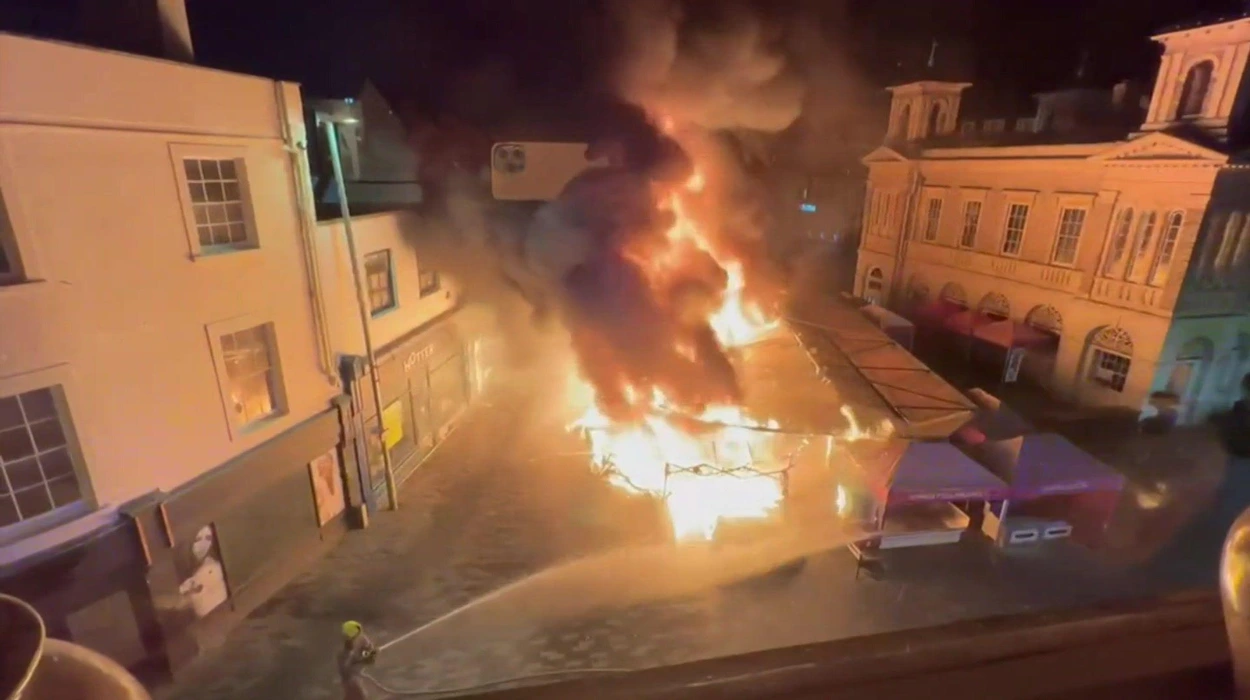
The London Fire Brigade was called to Kingston Market Place at 4.33am on 6 October after receiving reports of a fire. Four fire engines and around 25 firefighters from Kingston, Surbiton, New Malden and surrounding stations attended the incident. According to the fire brigade, the blaze was extinguished by 6.08am. Eight people were evacuated from the area, and no injuries were reported. The fire damaged several market stalls and affected the fronts of nearby properties, as well as a small section of a neighbouring roof, according to incident reports. The affected area was cordoned off while the London Fire Brigade and Metropolitan Police carried out investigations.
The fire brigade’s incident report and subsequent coverage described the fire as accidental, while police found no suspicious circumstances, according to The Standard. However, a definitive technical explanation of the ignition source should not be assumed without confirmation from the investigating authorities.The incident has left parts of the market requiring remedial work before traders can safely return.
Council extends closure over safety concerns
In its statement published on 9 October, Kingston Council said further safety concerns had been identified during on-site inspections. The closure would allow remedial work to take place, damaged stalls to be prepared for demolition and the affected area to be cleaned up. Council leader Andreas Kirsch acknowledged the hardship facing traders but said public safety had to come first.
“We understand how hard this is for traders but the safety of everyone who uses the market is our priority and we will take every precaution necessary,” Kirsch said in the council’s statement. He added that the council was working with market operator Between the Bridges to support traders and find temporary locations for those whose stalls had been destroyed.
The council also confirmed that traders would not have to pay pitch fees while they were unable to trade during the closure. It said discussions were continuing over ways to mitigate their loss of earnings. However, the waiver does not automatically compensate traders for lost sales, damaged stock, equipment or other business expenses. The extent of any financial losses and the availability of additional assistance have not been publicly quantified in the council’s statement.
Livelihoods at stake as traders await a return
For small traders, a market closure can mean more than a temporary interruption to business. Fresh-food sellers may have to deal with perishable stock, while independent retailers can lose daily sales and customers who rely on their regular presence.Kingston’s Ancient Market has more than 20 permanent stalls and normally trades seven days a week, from 10am to 5pm, according to Kingston Council. Its businesses include fishmongers, butchers, greengrocers, florists, an artisan bakery and international street-food vendors.
That variety makes the market an important part of the local retail economy. Its appeal lies not only in the goods sold but also in the relationships between traders and regular customers. Reporting by BBC News described the impact on fishmonger Tim Meads, who had worked at the market for 42 years. Meads said his stall had been damaged and feared that approximately £2,000 worth of fish stored in outdoor refrigerators could have been lost. The figure was reported as his estimate of potential losses, rather than a confirmed total for the market. Meads’ experience illustrates the uncertainty facing traders who must wait for access to their stalls and a clearer assessment of the damage before determining the full financial consequences.
Nearby businesses have also felt the effects. Some shopfronts were damaged, while businesses inside the cordoned-off area faced restrictions on trading. The council subsequently reduced the cordon to allow unaffected businesses to reopen.The distinction matters: not every business in the surrounding area has been forced to close for the full nine-day period, but those directly affected continue to face disruption.
A historic market with deep community roots
Kingston’s Ancient Market is more than a collection of stalls. Historical records of a market in Kingston date back to the early 1200s, making it a longstanding feature of the town’s commercial and civic life. Its central location has helped connect residents, visitors and independent businesses for generations. The loss of stalls therefore raises concerns about the recovery of both individual traders and a familiar public space.
In its initial response to the fire, Kirsch said the Ancient Market sat “at the heart of the community” and expressed sympathy for traders, business owners and residents affected by the incident. The market operator, Between the Bridges, also issued a statement expressing devastation over the fire. It said it was working with the fire brigade, police and local authority to make the site safe and support the clean-up and recovery.
The disruption comes as the market has also been the subject of redevelopment proposals. According to The Standard, Between the Bridges submitted plans to Kingston Council in January for a revamp that would include replacement stalls, a central piazza, a restaurant, a bar and a roof terrace. A decision on those proposals had not been made at the time of the report. The fire and subsequent closure may add urgency to discussions about the market’s future, although no confirmed timetable for a wider redevelopment has been announced.
What happens next?
The immediate task is to complete the necessary safety work and prepare damaged structures for removal. The council and Between the Bridges are also exploring temporary locations for traders whose stalls were destroyed. The market is scheduled to remain closed until Sunday, 18 October, under the council’s announcement. That date is the planned end of the announced closure, rather than a guarantee that every damaged stall or business will be ready to reopen immediately.
Several questions remain unanswered: how many stalls will require replacement, what the total financial damage will be, whether further support will be made available and how long individual traders will need to resume normal operations. For businesses dependent on daily sales, even a short interruption can create pressure. For those who have lost stalls or stock, recovery may take considerably longer than the initial closure period.
The council has said it is working to reopen the market safely as soon as possible. Its next steps, together with the progress of clean-up operations and arrangements for temporary trading spaces, will be central to determining how quickly affected traders can rebuild their businesses. For now, Kingston’s Ancient Market faces a difficult period: protecting public safety while preserving the livelihoods and local traditions that have sustained the market for centuries.
The fire was extinguished in less than two hours. Restoring the market’s trading life, however, will require more than putting out the flames.