Camden Market is one of London’s best-known market destinations, but its global reputation is relatively recent. The market’s identity developed from a much older industrial landscape shaped by the Regent’s Canal, railway freight, working horses, warehouses, music venues, independent traders and alternative fashion.
- How did Camden Market begin?
- Why was Camden important before the market existed?
- How did the Regent’s Canal shape Camden Market’s location?
- What role did Camden’s railway and horse infrastructure play in the market’s history?
- Why did Camden’s industrial economy decline?
- How did music and alternative culture make Camden Market famous?
- How did Camden Market expand from a small market into a major destination?
- How did Camden Market become an international tourist attraction?
- Which historic features still survive at Camden Market today?
- Why is Camden Market’s history important for London today?
- What does Camden Market’s history reveal about its global popularity?
- Frequently Asked Question
The modern market occupies parts of Camden Town that once handled goods moving through London. Its surviving buildings preserve evidence of nineteenth-century transport and industry, while its later market culture reflects major social and economic changes in London during the twentieth century.
Camden Council identifies the conversion of Camden Lock’s former wharves and warehouses into craft markets during the 1970s as a decisive development in Camden Town’s transformation into a major tourist destination.
The history of Camden Market therefore begins long before the first market stall appeared in 1974. Its development follows a sequence of industrial expansion, transport decline, urban regeneration, cultural experimentation and international tourism.
How did Camden Market begin?
Camden Market began on 30 March 1974 with 16 traders selling antiques, jewellery, arts and crafts beside the Regent’s Canal. Its original setting was a former timber yard behind Dingwalls, transforming an industrial site into a small independent market.
The first Camden Market was established in an area that had recently experienced industrial decline. The site behind the T. E. Dingwall building contained a timber yard beside the Regent’s Canal. Bill Fulford and Peter Wheeler, childhood friends and business partners associated with Northside Developments, became involved with the site in the early 1970s.
Their approach focused on adapting existing industrial property rather than replacing it with conventional commercial development. The market opened as a temporary venture. Its early traders sold non-essential products that fitted the planning context of the period.
Camden Council’s economic study records the opening date as Saturday 30 March 1974. The first market contained 16 traders and concentrated on antiques, jewellery, arts and crafts. The intention was to avoid direct competition with established retail businesses on Camden High Street.
The small scale of the original operation is important to understanding Camden Market’s later expansion. The site did not begin as a large tourist attraction. It began as an experimental use for underused industrial property.
Camden Market’s own historical record similarly identifies 16 original stalls and describes the market as beginning as a small arts and crafts fair.
The first market also benefited from its relationship with Dingwalls Dance Hall. The venue had opened in 1973 inside a former canal-side packaging warehouse. This created an early connection between market trading, music and youth culture.
That relationship became significant because Camden’s cultural reputation grew alongside its commercial identity. Independent retail, live music and alternative fashion eventually became interconnected parts of the Camden experience.
Why was Camden important before the market existed?
Before Camden Market opened, Camden developed as an industrial transport centre because the Regent’s Canal and railway network moved coal, timber, food, building materials and manufactured goods through the area, creating warehouses, depots, workshops, stables and employment.
The Regent’s Canal provided the first major foundation for Camden’s industrial development. The Regent’s Canal Company was formed in 1812 to construct a waterway connecting the Grand Junction Canal at Paddington with Limehouse and the River Thames.
Construction was completed in 1820. The canal subsequently became an important route for transporting goods through London. Timber, coal, building materials and foodstuffs moved along the canal and associated waterways. Commercial traffic continued into the twentieth century.
Camden’s location also became strategically important because railways were added to the transport system. Camden Council records the arrival of Euston station in 1837, King’s Cross in 1852 and St Pancras in 1868. Their associated goods yards and sidings encouraged industrialisation and created employment.
The combination of canal and railway transport produced a dense industrial landscape. Warehouses stood close to waterways and railway infrastructure. Goods depots required stables because horses transported freight between warehouses, railway sidings, canals and local streets.
The Camden Goods Depot became an important part of this system. Historic England identifies the surviving goods-yard structures, canal infrastructure and stabling as an important concentration of nineteenth-century transport architecture.
Camden also became associated with industries including piano making, furniture production, light engineering, scientific instruments and alcohol distribution. The canal enabled businesses to receive raw materials and distribute finished products efficiently.
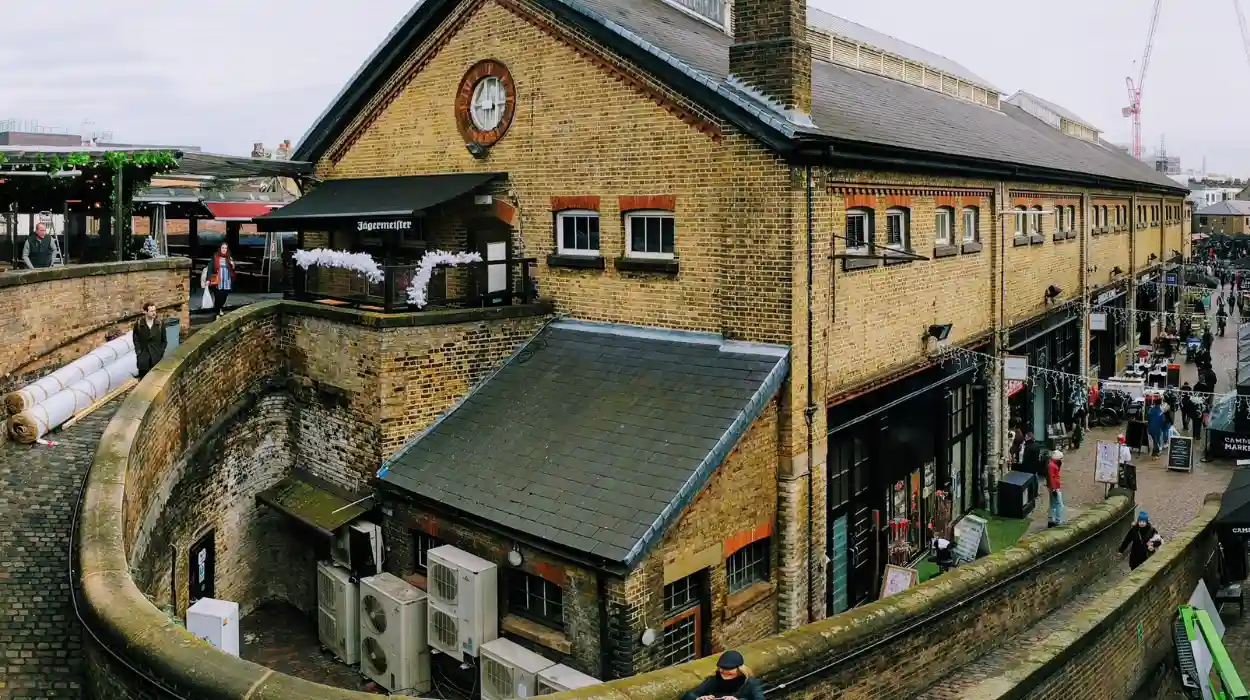
The industrial environment explains why Camden Market later inherited such distinctive architecture. Its market spaces were not purpose-built in the twentieth century. Many were created through the adaptation of warehouses, yards, railway structures, stables and former industrial buildings.
How did the Regent’s Canal shape Camden Market’s location?
The Regent’s Canal made Camden a major freight centre during the nineteenth century and left behind warehouses, wharves and transport infrastructure that later provided the physical setting for Camden Lock Market, connecting modern retail culture with the area’s industrial heritage.
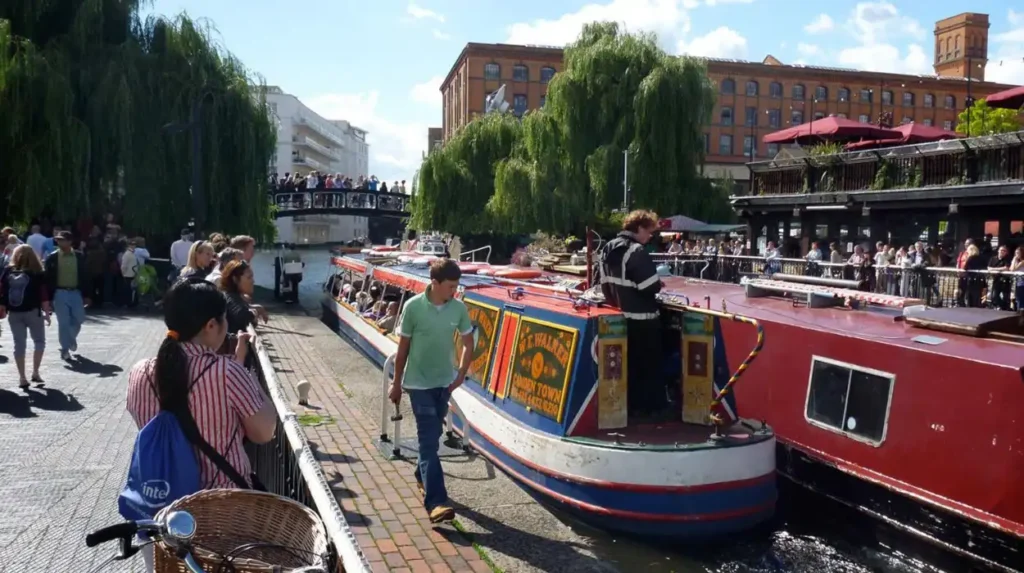
Camden Lock occupies a strategic position on the Regent’s Canal. The lock controlled water levels and formed part of the canal’s working infrastructure. Nearby warehouses and wharves supported the movement and storage of goods.
The canal was particularly important before road haulage became dominant. Barges provided an efficient method of moving heavy materials through London. Camden therefore developed as a working landscape rather than a leisure destination.
During the nineteenth century, the canal environment contained industrial buildings associated with storage and manufacturing. Camden Market’s present-day pedestrian spaces occupy land that once supported commercial logistics.
The decline of canal freight changed the economic role of these buildings. The Canal & River Trust records that commercial traffic on the Regent’s Canal declined as railways and later lorries became more important. By the 1960s, road transport had taken much of the remaining commercial traffic.
The canal itself survived, but many industrial uses around it disappeared. This created a problem common to former industrial districts across London: large buildings remained after their original economic purpose had ended.
Camden’s later regeneration turned this industrial legacy into an asset. Instead of treating the canal as obsolete infrastructure, developers and traders used the warehouses, yards and waterside setting for new commercial and cultural activities.
The connection between canal infrastructure and market culture became particularly strong at Camden Lock. The waterway supplied the historic setting, while the former industrial buildings provided adaptable retail space.
This physical continuity is one reason Camden Market has a stronger historical character than a purpose-built modern shopping centre. The market remains embedded in a landscape originally designed for freight transport.
To experience this historic landmark in person today, consult our comprehensive [Explore Camden Market’s Best Shopping, Food, and Live Music Experiences Today] for itineraries and visiting parameters.
What role did Camden’s railway and horse infrastructure play in the market’s history?
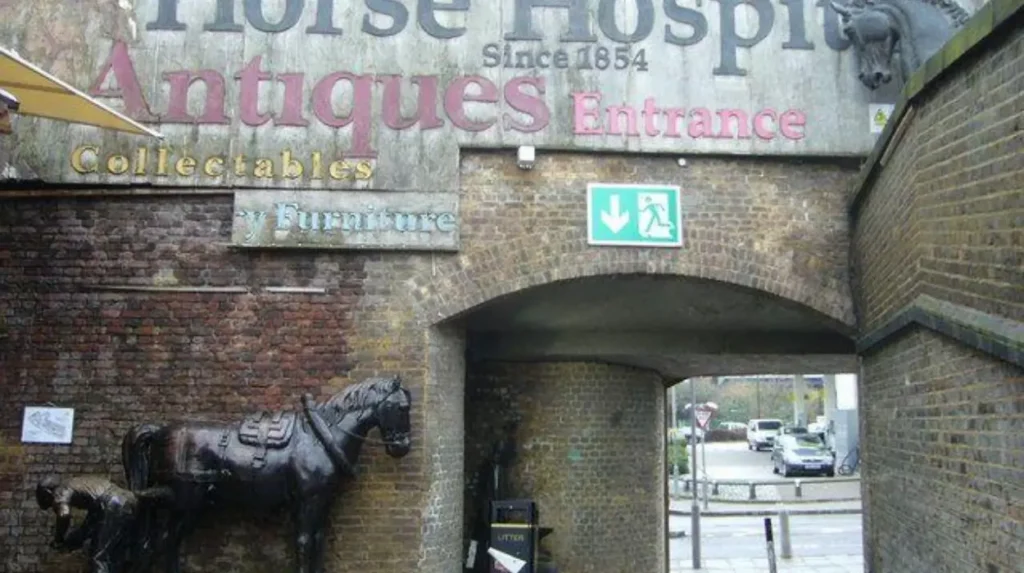
Railways transformed Camden into a major freight centre, while hundreds of working horses moved goods between railway depots, warehouses and canals. The surviving stables, horse tunnels and Horse Hospital later became distinctive architectural components of Camden Market.
The railway revolution intensified Camden’s industrial importance. The North London Railway reached Camden Town in the nineteenth century, creating new connections between railway traffic, canal freight and local distribution.
The Camden Goods Depot required extensive stabling. Historic England records that the original 1839 goods depot provided stabling for 50 horses in vaults below the railway sidings. By 1849, increased goods traffic had raised the number of horses employed at the site to 427.
The redevelopment of the goods depot in 1854–1856 created new stable ranges. These structures occupied the area now associated with the Stables Market. The Camden Railway Heritage Trust identifies the four principal 1856 stable ranges as part of a significant surviving Victorian industrial-stabling complex.
Horse tunnels formed another part of this system. They allowed horses to move between stables and the goods yard without crossing busy railway infrastructure at street level.
The Horse Hospital was constructed in 1882–1883 for the London and North Western Railway. Historic England records that the building was extended in 1897 and later converted to market use. It is listed at Grade II* because of its architectural and historic significance.
The building contains surviving features associated with industrial stabling, including horse ramps, stalls, mangers and hay racks. These features demonstrate how closely the modern market remains connected to nineteenth-century transport systems.
The railway and canal infrastructure therefore created more than an economic district. They created the architectural framework that later allowed Camden Market to develop distinctive spaces.
Why did Camden’s industrial economy decline?
Camden’s industrial economy declined after the Second World War as road haulage replaced much canal freight, manufacturing contracted, and railway goods operations lost importance. By the 1960s and 1970s, vacant industrial buildings created opportunities for alternative commercial and cultural uses.
The decline of Camden’s industrial economy was part of a wider transformation in British transport and manufacturing.
The Regent’s Canal had once carried large quantities of commercial freight. Its role weakened as railways expanded and road transport became increasingly efficient. The Canal & River Trust records that commercial canal traffic had substantially declined by the time the waterway was nationalised in 1948, with lorries taking much of the remaining traffic by the 1960s.
Camden’s railway goods infrastructure also declined. Historic England records that the Camden Goods Depot eventually closed around 1980. The final shunting horse was withdrawn from duty in 1967, marking the end of an important part of the site’s traditional logistics system.
The loss of industrial employment affected the surrounding buildings. Timber yards, warehouses, depots and other commercial premises became underused.
Camden Council’s economic study describes the late 1960s as a period when many buildings were derelict or run down. Dingwall’s Timber Merchants had closed, leaving a vacant building yard beside Camden Lock.
This decline created the physical conditions for regeneration. Large industrial spaces could accommodate workshops, studios, performance venues and market stalls without the costs associated with constructing new commercial premises.
The transformation also reflected changing attitudes toward urban heritage. Former industrial structures increasingly gained value because of their distinctive architecture and central locations.
Camden Market emerged from this transition. Its growth did not erase the industrial landscape. It gave former industrial spaces new economic functions.
How did music and alternative culture make Camden Market famous?
Music transformed Camden’s cultural identity during the 1970s and 1980s, while independent fashion and market trading connected with emerging youth subcultures. Dingwalls and the Roundhouse helped establish Camden as a recognised centre for alternative music and creative expression.
Camden’s cultural transformation developed alongside its market economy. Dingwalls Dance Hall opened in June 1973 in a former packaging warehouse near Camden Lock. The venue became closely associated with live music and Camden’s emerging cultural scene.
The Roundhouse also played a major role in Camden’s cultural history. The building had originally served the railway industry before becoming a major performance venue.
Camden Market benefited from this concentration of cultural activity. People attending music venues encountered independent stalls, unusual clothing, handmade goods and alternative retail.
Fashion became particularly important. Camden Market’s own historical account identifies connections between music and fashion during the 1970s. Market traders sold items associated with mods, rockers, punks, bohemians and other youth cultures.
This process changed the meaning of the market. It was no longer simply a place to purchase goods. It became a recognised location for particular forms of dress, music and cultural identity.
The market’s reputation therefore spread through cultural networks rather than conventional retail advertising alone.
Dingwalls provided a venue for musicians. Market stalls provided clothing and accessories. The surrounding streets supplied restaurants, pubs, clubs and independent businesses. Together, these activities strengthened Camden’s cultural economy.
The process also established an important pattern that continued into later decades. Camden Market remained associated with independent traders and changing cultural trends rather than a single fixed retail category.
How did Camden Market expand from a small market into a major destination?
Camden Market expanded because independent trading, alternative fashion, music culture and adaptive reuse attracted increasing numbers of visitors. New market areas, including the Stables, extended the destination beyond the original Camden Lock site and increased its commercial scale.
The original 16-stall market was only the beginning of Camden’s market development.
Camden Lock Market expanded through permanent shops, temporary stalls, courtyards and former timber-yard buildings. A Camden Council retail study described Camden Lock Market as a market environment incorporating arts and crafts, fashion, food and drink beside the Regent’s Canal.
The Stables became another major component. Its buildings had originally served the transport economy, particularly through stabling and associated railway functions.
By the 1980s, the Stables had developed into a market environment with antique dealers and independent traders. Camden Market’s official history records that the Stables joined the market later than the Lock and developed as a distinct part of the wider destination.
The architectural setting contributed to the market’s expansion. Historic stables, railway arches, cobbled yards and industrial structures created spaces that could accommodate different types of businesses.
This pattern of adaptive reuse continued as the market grew. Retailers, food traders, restaurants and entertainment businesses occupied spaces originally designed for transport, storage or industrial production.
Camden Council’s more recent evidence base describes Camden’s combined markets, including Lock, Stables and Hawley Wharf, as having grown from a small arts and crafts fair in the 1970s into a major London destination. The council identifies more than 1,000 stalls across the wider market environment and more than 1,750 supported jobs.
The market’s scale therefore developed through successive layers rather than one single expansion project.
How did Camden Market become an international tourist attraction?
Camden Market became internationally popular through the combined effect of its distinctive historic setting, independent retail, music heritage, alternative fashion, street food and cultural diversity. Tourism gradually became central to its economic identity and visitor experience.
Camden Market’s international popularity reflects the combination of several historical developments.
First, its physical environment differs from conventional shopping districts. The market occupies former industrial sites beside the Regent’s Canal and within historic railway and stabling structures.
Second, its cultural reputation developed before mass tourism became its dominant economic force. Music venues and alternative fashion established Camden as a recognised destination for cultural visitors.
Third, the market continuously diversified its retail offer. Arts and crafts formed the original commercial foundation. Fashion, antiques, food, souvenirs, jewellery and independent businesses subsequently expanded the range of products available.
Fourth, Camden became increasingly connected to London’s broader tourism economy. Visitors seeking distinctive neighbourhood experiences added Camden Market to itineraries alongside major historic attractions.
Camden Council now describes Camden’s markets as important to the borough’s culture, history and economy. The council states that its markets employ more than 4,000 people across the borough and identifies Camden Lock as an international tourist destination.
The wider market complex has also continued to evolve. Hawley Wharf opened in 2021 as a redeveloped part of the market area, incorporating food, retail and leisure uses. Camden Council identifies it as part of the modern market environment.
This evolution demonstrates that Camden Market’s global popularity did not result from one historical event. It developed through a long sequence of changes involving transport, urban regeneration, cultural industries and tourism.
Which historic features still survive at Camden Market today?
Historic elements surviving within Camden Market include Victorian stables, the Grade II Horse Hospital, cobbled yards, railway-related structures, canal infrastructure and preserved horse tunnels. These remnants provide physical evidence of Camden’s nineteenth-century industrial and transport history.*
The Stables complex provides some of the clearest evidence of Camden’s industrial past.
The Camden Railway Heritage Trust describes the surviving complex as the most complete example of Victorian industrial stabling in London and identifies ranges dating from 1856, together with horse roads, ramps, galleries and tunnels.
The Horse Hospital is particularly significant. Historic England lists it at Grade II*. The building dates from 1882–1883, was designed by the London and North Western Railway Engineer’s Department and was extended in 1897.
Its survival provides evidence of the scale of nineteenth-century goods transport. The building retained elements associated with horses and stable management, including mangers and hay racks.
The horse tunnels are another important remnant. They were designed to move horses safely between different sections of the goods depot without requiring them to cross railway infrastructure at street level.
The underground structures also connect Camden’s railway and canal history. The wider underground network included vaults and engine infrastructure associated with the movement of goods.
The so-called Camden Catacombs are not burial chambers. They refer to underground passages and vaults associated with the former transport and industrial complex. Camden Market’s historical documentation identifies surviving underground structures connected with railway winding engines, horse movement and later storage.
Some underground areas remain inaccessible because of their condition, water levels and modern site constraints. Their survival nevertheless adds archaeological and architectural value to the market environment.
These remnants demonstrate why Camden Market is significant as an example of adaptive reuse. Modern businesses occupy structures whose original functions included freight handling, horse transport, railway logistics and industrial storage.
Why is Camden Market’s history important for London today?
Camden Market demonstrates how historic industrial infrastructure can acquire new economic and cultural functions. Its evolution from canal and railway industry to independent retail and tourism illustrates London’s wider transition from manufacturing toward services, culture, leisure and heritage-led regeneration.
Camden Market’s history provides a clear example of urban economic transformation.
The area first developed because transport infrastructure made industrial activity efficient. The Regent’s Canal connected Camden with wider waterways, while railways created new freight connections. Warehouses, depots and stables followed.
The same infrastructure later became less economically useful. Canal freight declined. Railway goods operations contracted. Working horses disappeared from the transport system. Industrial buildings became underused.
The market emerged from this decline by giving former industrial property new functions.
This process has significance beyond Camden. London contains numerous former industrial districts where warehouses, railway buildings, factories and wharves have been converted into cultural, residential, retail and leisure spaces.
Camden Market also demonstrates the importance of heritage preservation. Historic England’s designation of the Horse Hospital recognises architectural integrity and the building’s relationship with the wider Camden Goods Depot.
Preservation does not mean maintaining a building without economic activity. Camden shows how historic structures can remain economically active while retaining evidence of their original functions.
The market also provides researchers with evidence of changing patterns of employment and consumption. The original traders sold antiques and crafts. Later businesses reflected alternative fashion, music culture, international food and tourism.
For genealogical researchers, Camden’s industrial history also provides useful context. Families connected with railway work, canal transport, manufacturing, warehouse employment, market trading and hospitality were part of the area’s changing economic structure.
For educators, Camden offers a concentrated case study of industrialisation, transport history, urban regeneration, cultural geography and heritage conservation.
For visitors, the market provides direct access to a landscape in which nineteenth-century transport infrastructure and modern commerce occupy the same physical environment.
Camden Market’s global reputation therefore represents the latest stage of a much longer history. The market did not replace Camden’s past. It developed through the reuse of structures and spaces created by that past.
What does Camden Market’s history reveal about its global popularity?
Camden Market became globally recognised because its commercial growth preserved connections between industrial heritage, independent trading, music, fashion, food and tourism. Its history explains why the market functions as both a modern destination and a surviving record of London’s transformation.
Camden Market’s rise followed a distinctive historical sequence.
The first stage was industrialisation. The Regent’s Canal and railway network transformed Camden into a major freight and manufacturing area.
The second stage was industrial decline. Road transport, changing logistics and the contraction of railway goods operations reduced the importance of the canal-side industrial economy.
The third stage was cultural reuse. Former warehouses and yards became spaces for music, creative activity, independent retail and markets.
The fourth stage was commercial expansion. Camden Lock and the Stables developed into larger market environments with increasingly varied businesses.
The fifth stage was international tourism. Camden became recognised as a destination combining shopping, food, music heritage, architecture and alternative culture.
This chronology explains why Camden Market has such a diverse historical identity. It is simultaneously a former industrial district, a surviving transport landscape, a cultural centre, a retail destination and a major tourist attraction.
Camden Council describes the markets as an important part of the borough’s culture, history and economy. Its current evidence base identifies the combined markets as a key element of Camden Town’s identity and records more than 1,000 stalls across the wider market environment.
The market’s historical significance also rests on the survival of physical evidence. The Horse Hospital, Victorian stables, railway structures, canal-side warehouses and horse tunnels preserve connections with the nineteenth-century economy.
Its modern popularity therefore has a historical foundation. Visitors encounter contemporary fashion, food, entertainment and independent businesses within a landscape shaped by canals, railways, horses and warehouses.
Camden Market’s story demonstrates the long-term value of adaptive reuse in a historic city. A place designed for moving goods became a place for exchanging ideas, products, culture and experiences.
From 16 traders in 1974 to a market environment containing more than 1,000 stalls today, Camden’s transformation represents one of London’s most visible examples of industrial heritage becoming part of a modern global visitor economy.
Its history remains relevant because the physical landscape continues to connect London’s industrial past with its cultural present. The canal still runs through Camden. Historic stables still define parts of the market. Listed structures preserve nineteenth-century architecture. Modern traders continue to occupy spaces created for entirely different purposes.
Camden Market’s global popularity is therefore not separate from its history. The history is the foundation on which its modern identity was built.
For history enthusiasts, the market provides evidence of London’s industrial and cultural transformation. For cultural tourists, it offers a historic environment integrated into contemporary city life. For educators and researchers, it provides a compact case study of transport, commerce, architecture, regeneration and heritage preservation.
The result is a market whose significance extends beyond shopping. Camden Market records how London repeatedly adapts old spaces to new economic and cultural purposes while retaining visible traces of earlier generations.
Frequently Asked Question
When did Camden Market first open?
Camden Market first opened on 30 March 1974 with 16 traders selling antiques, jewellery, arts and crafts. The original market operated beside the Regent’s Canal near Dingwalls.