Key Points
- Critical Incident: A 50-year-old man is fighting for his life in a major trauma centre following a severe early-morning assault in Islington, north London.
- Emergency Response: Emergency services, including the Metropolitan Police and a specialised trauma team from London’s Air Ambulance, rushed to Hungerford Road after receiving reports of the incident at approximately 4:00 am.
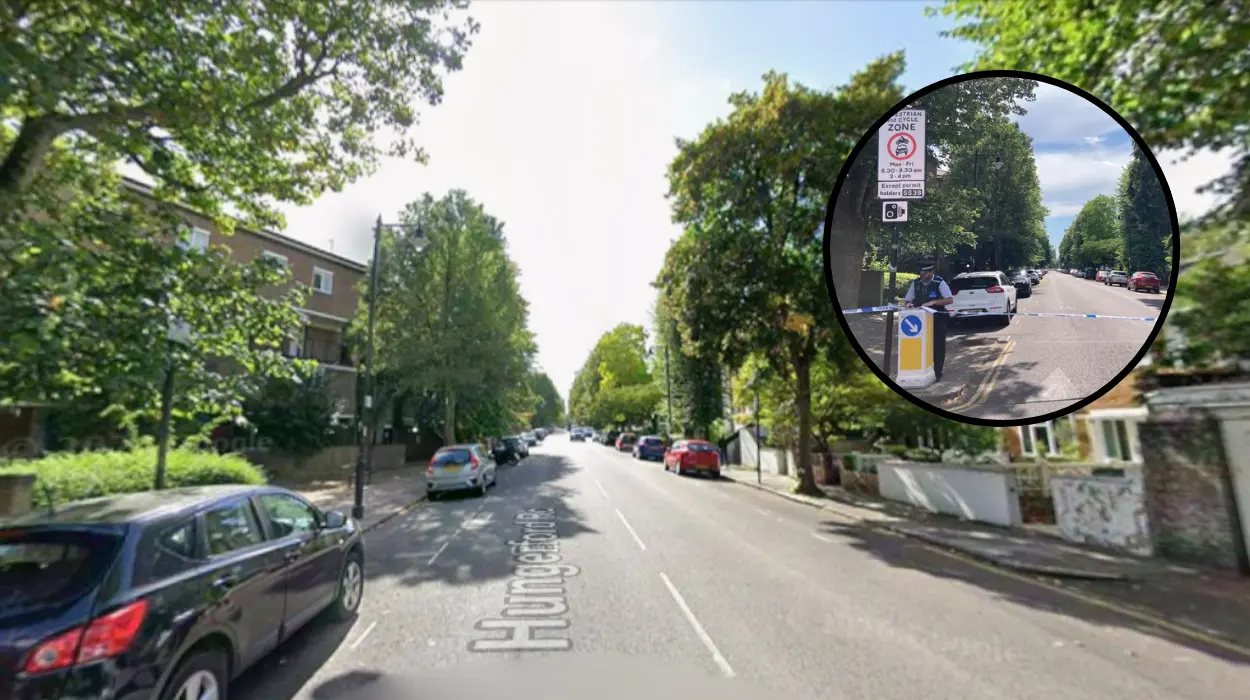
- Active Crime Scene: A extensive police cordon was established along Hungerford Road, spanning from the junction with Corporation Street to York Way, completely shutting down local access.
- Community Disruption: The timing of the road closure caused significant operational chaos and “carnage” for local parents dropping off children at the adjacent special educational needs provider, The Bridge School.
- Investigation Status: No suspects have been arrested at this stage, and Scotland Yard detectives are conducting ongoing enquiries, including reviewing local CCTV and door-to-door footage.
- Public Appeal: Authorities are urgently seeking witnesses or anyone with relevant information, requesting them to contact the police using the reference code 1063/10Jul.
Islington (Extra London News) July 11, 2026 – A 50-year-old man has been left in a critical, potentially life-threatening condition in hospital following a violent early-morning assault in a residential street in Islington, north London. The Metropolitan Police immediately sealed off a large portion of Hungerford Road after being called to the scene in the early hours of Friday, July 10. The emergency response drew significant resources from both law enforcement and specialized medical trauma teams, resulting in an all-day closure of vital neighborhood corridors. As of today, detectives have made no arrests, and an urgent public appeal has been launched to trace anyone who may have witnessed the incident or captured relevant footage on domestic security cameras.
- What happened on Hungerford Road in Islington?
- How did emergency services respond to the scene?
- What is the current medical condition of the victim?
- Where exactly was the police cordon established in north London?
- What operational disruption did the crime scene cause?
- How has the local community reacted to the incident?
- Have any suspects been arrested for the Islington assault?
- How can witnesses contact the Metropolitan Police with information?
The targeted nature of the investigation has transformed a quiet north London residential zone into an active forensic scene. Officers arriving at 4:00 am discovered the middle-aged victim suffering from severe injuries directly on the thoroughfare. Forensic teams spent hours analyzing physical evidence left within the cordon, while local commuters and school transport vehicles faced severe disruptions. With the perpetrator or perpetrators still at large, Scotland Yard is directing substantial operational capacity toward establishing the sequence of events that transpired during the early hours of Friday morning.
What happened on Hungerford Road in Islington?
The peacefulness of a residential Holloway neighborhood was broken in the early hours of Friday when a serious altercation took place. Emergency dispatch systems lit up around 4:00 am as multiple reports were logged regarding an active disturbance on Hungerford Road, an area situated within the N7 postal district of the London Borough of Islington. Police units arrived within minutes to find a scene marked by physical violence, discovering a 50-year-old male victim lying on the pavement with traumatic injuries requiring instantaneous medical stabilization.
As reported by Gianni Cirillo of London Now, a spokesperson for the Metropolitan Police stated that “officers were called following reports of an assault in Hungerford Road, Islington at 4am yesterday (July 10).” The sudden influx of blue lights and emergency vehicles alarmed residents who were waking up to begin their early morning routines. Police rapidly cordoned off the street, treating the immediate vicinity as a high-priority active crime scene to preserve any fragile physical trace evidence before it could be compromised by morning foot traffic or shifting weather conditions.
Initial unconfirmed accounts circulating within the neighborhood initially pointed to a weapon-based attack. As noted by Olivia Carter of the Islington Gazette, early dispatches from the scene highlighted “unconfirmed reports suggesting a stabbing” had occurred during the darkest hours of the morning. While law enforcement personnel have categorized the incident broadly as an assault, the severity of the victim’s physical trauma necessitated the deployment of advanced medical protocols typically reserved for critical penetrative or blunt-force injuries.
How did emergency services respond to the scene?
The medical response to the incident was rapid and heavily resourced, involving multiple tiers of the capital’s emergency network. Paramedics and clinical managers were synchronized to ensure the victim received specialized care directly at the point of injury before attempts were made to move him.
As reported by Annabel Stock of the Islington Gazette, a London Ambulance Service spokesperson said:
“We were called at 4:15am to reports on an incident on Hungerford Road, N7. We sent resources to the scene including an ambulance crew, a paramedic in a fast response car and an incident response officer. We also dispatched a trauma team in a car from London’s Air Ambulance.”
The addition of London’s Air Ambulance trauma team—arriving via an emergency response vehicle by road due to the constraints of night operations—signaled the extreme gravity of the victim’s medical status. These specialized teams carry advanced surgical equipment and blood supplies, allowing them to perform complex, hospital-level interventions directly on the street. For nearly an hour, clinicians worked under the glow of street lamps to stabilize the 50-year-old man’s vital signs sufficiently so that he could withstand the high-velocity transit to a specialized regional medical facility.
Explore More Islington News
Waitrose Reopens Luxury Supermarket Following Transformation: Islington 2026
Prawn On The Lawn Seafood Restaurant Closes Permanently: Islington 2026
What is the current medical condition of the victim?
Following extensive stabilization efforts on Hungerford Road, the victim was carefully loaded into a land ambulance and moved across the capital under emergency escort. The decision regarding his destination was dictated by strict clinical pathways designed to bypass standard accident and emergency departments in favor of comprehensive tertiary care.
As reported by Annabel Stock of the Islington Gazette, the London Ambulance Service spokesperson confirmed that
“We treated a patient at the scene and took him to a major trauma centre as a priority by road.”
Major trauma centres are highly specialized hospitals optimized to treat patients who have sustained severe, multi-system injuries that present an immediate threat to survival or long-term neurological integrity.
Upon his arrival at the major trauma centre, specialized surgical and intensive care teams took over his management. As reported by Gianni Cirillo of the Times Series, a representative for the Metropolitan Police stated that the victim “was taken to hospital where his condition was assessed as ‘potentially life-threatening’.” Medical staff remain engaged in a critical battle to preserve the man’s life, with his status being monitored around the clock while detectives await clinical updates that could fundamentally alter the legal categorization of the ongoing criminal inquiry.
Where exactly was the police cordon established in north London?
The physical layout of the crime scene extended across a large portion of Hungerford Road, reflecting the potential movement of the parties involved during the altercation. Officers immediately erected high-visibility police tape at key junctions to prevent public access and protect the spatial integrity of the site.
As reported by Olivia Carter of the Islington Gazette, the primary “active crime scene in Hungerford Road, Islington” saw “pictures taken by the junction with Corporation Street and York Way.” This specific geographic footprint meant that a significant portion of the residential artery was completely closed off to everyday vehicular and pedestrian navigation, affecting multiple blocks of terraced housing and municipal entryways.
As noted by Annabel Stock of the Islington Gazette, the logistical reality of the lockdown meant that “a crime scene remains in place near the junction with Corporation Street, and a cordon has been set up close to York Way. Only residents are being allowed access, and the road closure is expected to last for several hours.” Forensic investigators in specialized white suits were observed methodically documenting the asphalt, looking for weapons, biological matter, footwear impressions, or dropped items that could link a suspect to the exact coordinate of the assault.
What operational disruption did the crime scene cause?
Because the assault took place just hours before the morning rush hour, the establishment of the extensive police cordon created significant logistical hurdles for the surrounding community. The timing meant that local transport networks, delivery services, and educational routines were instantly disrupted as the neighborhood woke up to a fully locked-down street.
As noted by Olivia Carter of the Islington Gazette during live updates from the scene, the presence of the cordon caused significant complications for families trying to access local services. The reporter described the environment on Hungerford Road as “carnage” as parents of pupils attending The Bridge School began arriving for morning drop-offs. The Bridge School is a prominent educational facility located on Hungerford Road that specializes in supporting students with severe learning difficulties and complex special educational needs.
The strict enforcement of the police perimeter meant that standard school buses and specialized transport vehicles tasked with carrying vulnerable children could not reach their usual drop-off points. As reported by Annabel Stock of the Islington Gazette,
“Access is only in place for residents of Hungerford Road and the road closure is expected to continue for hours.”
School staff, police officers, and parents had to coordinate dynamically to establish alternative meeting points outside the perimeter, turning an ordinary school morning into a complex logistical challenge for families and motorists caught in the surrounding gridlock.
How has the local community reacted to the incident?
The violent event has left residents of Hungerford Road deeply unsettled, as the neighborhood is typically viewed as a cohesive, low-incident urban enclave. The sudden transformation of their doorsteps into a focal point for a major attempted murder or grievous bodily harm investigation has prompted introspection regarding local safety and security infrastructure.
As reported by Olivia Carter of the Islington Gazette, an anonymous resident living within the cordoned area expressed surprise at the morning’s developments, stating:
“It’s been closed off since early this morning. We have cameras and we checked them and couldn’t see anything. You don’t get much trouble around here, not for a long time.”
This sentiment reflects a community that generally views itself as insulated from the more frequent cycles of violent crime observed in other sectors of the capital.
The neighborhood, which regularly features community-led events like street parties supported by local entities like the Arsenal Foundation, is unaccustomed to such prolonged police interventions. The presence of forensic tents and the ongoing restriction of movement served as a stark reminder of the gravity of the situation, prompting many residents to review their own domestic closed-circuit television (CCTV) systems and video doorbells in hopes of identifying anomalous activity from the 4:00 am window.
Have any suspects been arrested for the Islington assault?
Despite the immediate response and hours of investigative work following the assault, the individual or individuals responsible for the life-threatening injuries inflicted upon the 50-year-old victim remain unidentified and at large.
As reported by Gianni Cirillo of London Now, the Metropolitan Police confirmed that “no arrests have been made and enquiries are ongoing.” The current phase of the investigation is heavily reliant on technical data collection, with detective constables mapping out all available digital footprints in the N7 area. This includes pulling footage from public transport buses, commercial properties near York Way, and private residential properties.
The lack of immediate detentions has amplified the urgency of the investigation. Detectives from the local Basic Command Unit (BCU), potentially supported by specialist crime officers, are working to construct a timeline of the victim’s movements leading up to 4:00 am. Investigators are attempting to determine whether the assault was a random street encounter, an escalated dispute, or a targeted ambush, keeping all analytical options open while physical evidence undergoes forensic screening.
How can witnesses contact the Metropolitan Police with information?
With the investigation in its initial stages and the victim unable to provide a statement due to his critical medical status, Scotland Yard is relying heavily on public cooperation to secure a breakthrough. Investigators believe that someone in the immediate vicinity may have seen or heard something crucial in the moments before or after the 4:00 am benchmark.
As reported by Gianni Cirillo of the Times Series, the Metropolitan Police are making a direct appeal to the community, stating that “witnesses or anyone with information that could help the police, is asked to contact the force on 1010 with reference 1063/10Jul.” This unique reference index allows any incoming tips, dashcam files, or phone descriptions to be routed directly to the active case file.
Members of the public who may feel hesitant to contact law enforcement directly are being reminded that they can utilize independent channels to submit information anonymously. Crimestoppers, a fully independent charity, provides a secure mechanism to relay critical details without revealing personal identities or risking legal exposure. As the 50-year-old victim continues to fight for his life in a major trauma centre, any detail—no matter how small or seemingly inconsequential—could prove vital to identifying those responsible and bringing them to justice.