Key Points
- Kent Fire and Rescue Service (KFRS) admitted that a vehicle and crew from the London Fire Brigade (LFB) had to be deployed to combat a recent flat fire in Folkestone.
- The emergency cross-border deployment was required because all three of Kent’s specialised height vehicles were simultaneously out of action due to technical issues.
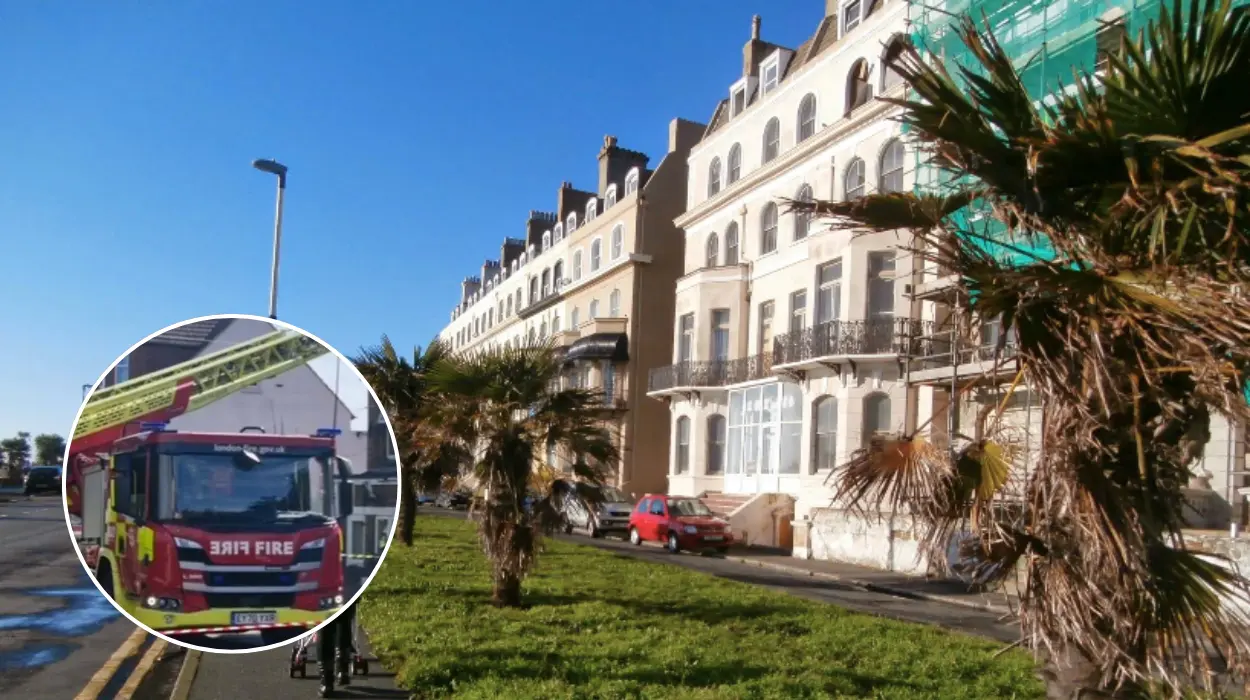
- The fire broke out on Tuesday near Grove Road, adjacent to Dover Road in Folkestone, resulting in one individual being treated at the scene for smoke inhalation.
- The borrowed London Fire Brigade height vehicle is temporarily stationed in Maidstone but remains operated entirely by London-based personnel who commute from their regular London stations.
- Matthew Deadman, the Director of Response and Resilience at KFRS, confirmed that the service is working urgently to return its mechanical fleet back into active operational service.
- Kent Fire and Rescue Service is currently relying on a pre-planned mutual aid agreement with the London Fire Brigade to maintain aerial response coverage across the county.
- Despite the operational setback, management stressed that ongoing investments are being made into the fleet, with a contract recently finalised for 11 new fire engines due within the next 12 months.
Folkestone (Extra London News) July 8, 2026 – Kent Fire and Rescue Service (KFRS) has officially admitted to an operational crisis that left the county entirely without functioning height vehicles during a recent residential blaze, forcing the organisation to rely on resources and emergency personnel brought in from the neighbouring London Fire Brigade (LFB). The multi-agency response became necessary after a flat fire broke out near Grove Road, close to Dover Road, in the coastal town of Folkestone on Tuesday, requiring urgent high-level intervention that Kent’s own fleet was completely unable to provide. As detailed by Hsin-Yi Lo of BBC News, the emergency services had to rapidly implement contingency protocols to ensure public safety as a direct consequence of the mechanical breakdown of Kent’s primary high-reach assets.
- Key Points
- Why Did Kent Rely on the London Fire Brigade During the Folkestone Fire?
- What Happened During the Flat Fire on Grove Road?
- How Is the Borrowed London Fire Brigade Vehicle Being Crewed and Maintained?
- Where is the replacement vehicle currently stationed?
- What are the operational challenges of this crewing arrangement?
- What Is Kent Fire and Rescue Service Doing to Resolve the Fleet Crisis?
- How Does the Mutual Aid Agreement Between Kent and London Function?
- What Future Investments Are Being Made Into Kent’s Emergency Fleet?
- What Operational Risks Face Kent Due to Delayed Aerial Responses?
The unexpected resource deficit meant that an aerial vehicle normally designated for the streets of the capital had to be redirected down into Kent to cover the critical geographical shortfall. While frontline crews managed to contain the Folkestone blaze, the incident has thrown a spotlight on the logistical vulnerabilities within regional emergency asset management. One person required medical treatment for smoke inhalation at the scene, though authorities confirmed that further casualties were avoided. The situation has prompted intense internal review within the regional fire authority as technicians work around the clock to address what has been described as a sudden, cross-fleet systemic failure.
Why Did Kent Rely on the London Fire Brigade During the Folkestone Fire?
The operational reliance on external assistance became unavoidable when a flat fire erupted in a residential sector of Folkestone. According to reports compiled by Hsin-Yi Lo of BBC News, the incident occurred near Grove Road, close to Dover Road, establishing an immediate need for specialized high-reach capability to manage potential vertical fire spread and structural risks associated with multi-storey residential properties.
During the unfolding crisis, local teams realized that they could not deploy their own aerial ladders or high-reach platforms. As reported by Hsin-Yi Lo of BBC News, Matthew Deadman, the Director of Response and Resilience at Kent Fire and Rescue Service, explicitly stated that its three height vehicles are “temporarily unavailable due to technical issues.” This simultaneous mechanical failure across the entire specialized tier of the fleet left the regional service with no choice but to activate emergency contingency plans, drawing assets from outside its traditional administrative boundaries.
What Happened During the Flat Fire on Grove Road?
The emergency call was initiated on Tuesday when smoke and flames were spotted coming from a residential flat property located near the intersection of Grove Road and Dover Road in Folkestone. Due to the high-density nature of the built environment in this specific corridor of Kent, responses to flat fires are prioritized with significant structural and personnel weight.
As reported by Hsin-Yi Lo of BBC News, the fire resulted in one person being treated for smoke inhalation by medical teams. The presence of smoke inhalation victims underscores the volatile environment faced by the attending crews. The deployment of the London Fire Brigade asset provided the required high-level structural overwatch necessary to ensure that the blaze did not spread to adjacent properties or compromise the integrity of the roof structure.
How Is the Borrowed London Fire Brigade Vehicle Being Crewed and Maintained?
The logistical arrangement behind utilizing a capital-city asset within a provincial county involves complex cross-border planning and strict shift management rules. The vehicle provided by the London Fire Brigade is not simply a piece of hardware lent to local crews; it comes as a complete package including specialized personnel who are intimately familiar with that specific machinery’s operational boundaries.
Where is the replacement vehicle currently stationed?
To ensure the most balanced coverage across the county while Kent’s own assets are offline, the borrowed vehicle has been positioned centrally rather than at the coast. As reported by Hsin-Yi Lo of BBC News, a KFRS spokesperson told the BBC the LFB height vehicle which is temporarily based in Maidstone was crewed by LFB personnel, who start and finish their shifts at their usual station in London.
What are the operational challenges of this crewing arrangement?
- Commuting and Shift Boundaries: The LFB firefighters tasked with protecting Kent must report to their home stations in London before travelling down to the Maidstone base, creating a distinct geographical loop for shift handovers.
- Familiarity with Geography: London crews must operate within the regional layout of Kent, relying heavily on localized dispatch communication and regional navigation systems to maintain rapid response times.
- Resource Drainage: While providing crucial protection to Kent, the physical removal of an LFB height vehicle and its dedicated team places a minor, calculated strain on the capital’s secondary response matrices.
What Is Kent Fire and Rescue Service Doing to Resolve the Fleet Crisis?
The administrative leadership of Kent Fire and Rescue Service has sought to reassure the public that the current lack of internal height vehicles is a temporary situation that is being managed with maximum urgency. The priority is to return at least one internal mechanical asset back to an operational status to reduce the reliance on London’s overstretched resources.
As reported by Hsin-Yi Lo of BBC News, Matthew Deadman said KFRS was “working at pace” to bring one back into service as soon as possible. This phrasing indicates that engineering teams are actively diagnosing and repairing the technical faults that caused the simultaneous grounding of the three vehicles. However, until those specific mechanical sign-offs are achieved, the service remains dependent on external support.
How Does the Mutual Aid Agreement Between Kent and London Function?
The capability of Kent to quickly absorb a London asset during a mechanical emergency is the product of long-standing arrangements designed to handle large-scale disasters or unexpected fleet shortages across the United Kingdom’s fire services. These are known formally as mutual aid or cross-border assistance protocols.
As reported by Hsin-Yi Lo of BBC News, Matthew Deadman explained the current stop-gap measure by saying, “In the meantime, we are utilising a pre-planned agreement with our colleagues at London Fire Brigade to have one of their height vehicles based in the county.” These agreements are designed so that fire services can seamlessly share resources without administrative delays when life safety is at risk, ensuring that a shortfall in one area does not leave a population entirely unprotected.
Explore more Fire News:
70 Firefighters Battle Major Converted Flat Fire: Thornton Heath 2026
Serious Fire Shuts Galpins Road and Diverts Buses: Croydon 2026
What Future Investments Are Being Made Into Kent’s Emergency Fleet?
While the current operational landscape is challenged by technical failures, the long-term outlook presented by KFRS leadership focuses heavily on modernisation and fleet renewal. The service is currently executing a capital investment plan intended to replace ageing infrastructure and prevent future multi-vehicle failures.
As reported by Hsin-Yi Lo of BBC News, Matthew Deadman added KFRS continued to invest in its fleet and equipment to maintain its response capability across Kent. This involves not only upgrading specialized height apparatus but also completely refreshing the frontline pumping engines that form the backbone of the service’s daily response model.
When will the new fire engines arrive?
According to the data provided to the public, substantial procurement contracts have already been executed. As reported by Hsin-Yi Lo of BBC News, Matthew Deadman said new specialist vehicles had already been delivered this year and a contract had been signed for new fire engines, with the first 11 expected within the next 12 months.
How will these new vehicles alter response capabilities?
- Adaptation to Modern Infrastructure: The new vehicles are designed to navigate modern urban developments, which frequently feature narrow access roads and complex high-density residential layouts.
- Enhanced Technical Reliability: Modern diagnostic systems built into newer fire apparatus help maintenance teams identify mechanical issues before they cause full operational failures.
- Improved Crew Protection: Updated designs offer better cabin safety and tool storage configurations, keeping firefighters safer while in transit and during active incidents.
As reported by Hsin-Yi Lo of BBC News, Matthew Deadman explained the investment would help crews respond to changing risks and ensure they have the equipment they need. The statement emphasizes that as building styles and materials evolve, the technological profile of the fire service must change alongside them to remain effective.
What Operational Risks Face Kent Due to Delayed Aerial Responses?
The temporary stationing of a London Fire Brigade vehicle in Maidstone introduces distinct geographical factors when responding to incidents on the far corners of the Kent coast, such as Folkestone, Dover, or Thanet. Maidstone is situated centrally within the county, but the physical distance to coastal towns can impact transit times for heavy specialized machinery.
While a standard fire engine from a local station can arrive at a Folkestone address within minutes, a high-reach height vehicle coming down from Maidstone must navigate the regional motorway network, including the M20. In high-traffic scenarios or adverse weather conditions, this reliance on a centrally located asset could lengthen the time it takes for high-level rescue and aerial damping equipment to reach a scene, highlighting the vital importance of resolving Kent’s localized fleet failures as rapidly as possible.